You probably landed here for one of two reasons: a friend won't stop talking about it, or the artwork caught your eye and you wanted to know what game it belonged to. Either way, here's the honest version of what Sorcery: Contested Realm is, before you spend a cent.
The short version: it's a two-player fantasy card game where each of you plays an Avatar — a wizard — building a battlefield and casting spells to banish the other. But the cards undersell it. The publisher's own description is the honest one — "as much a narrative experience you can share with friends, as it is a battle for tactical supremacy" — and that's the part most write-ups skip. Sorcery is slower and more involved than most card games: the kind you sit across a table for and stay present in, not the kind you grind through on autopilot. What people stick around for isn't the artwork — it's the hour you spend inside a game, and who's sitting across from you. The longer version — how it plays, and whether that's for you — is below.
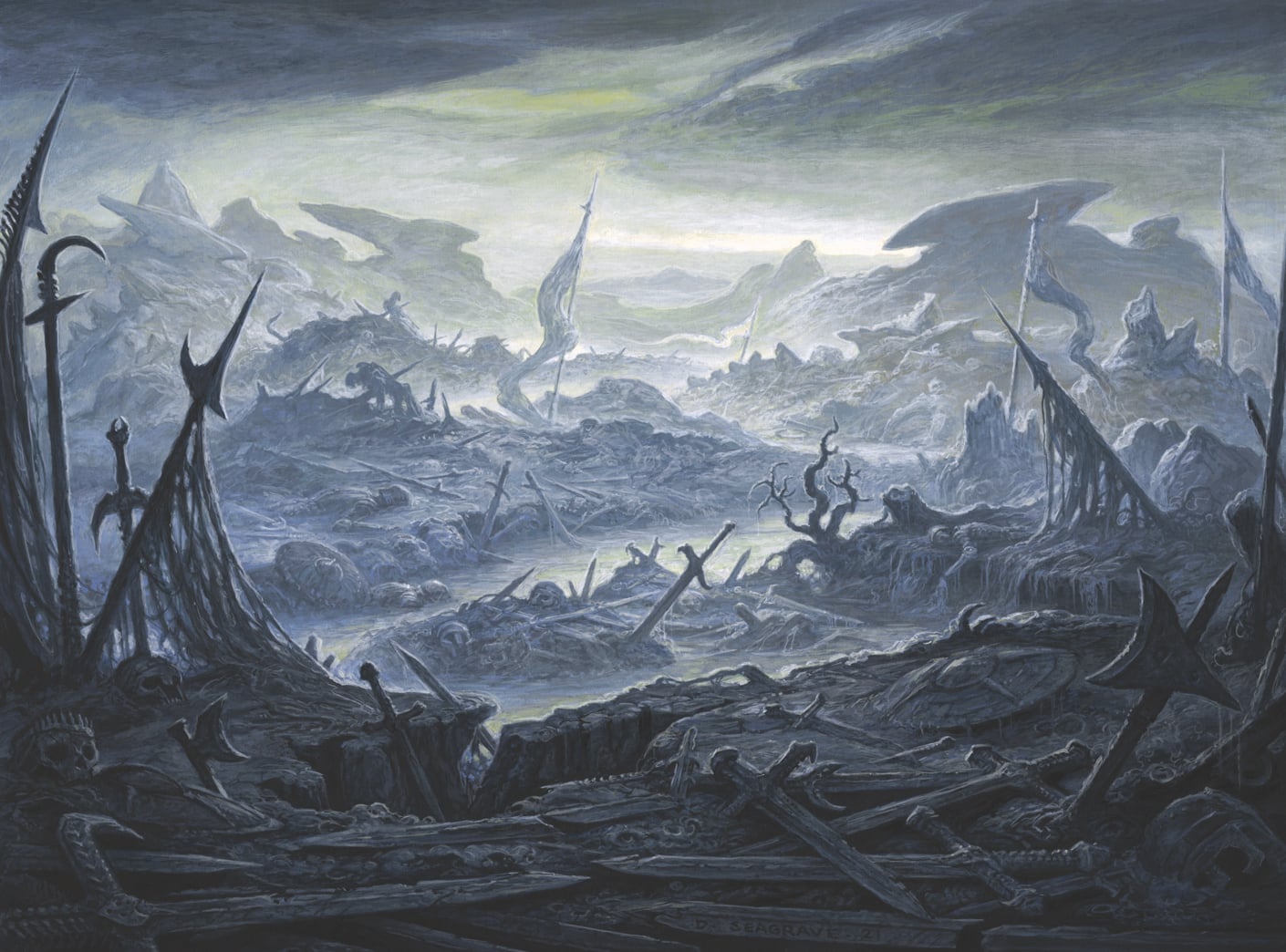
A Sorcery battlefield mid-game — via sorcerytcg.com
Who makes it — and why that matters
Sorcery is published by Erik's Curiosa, an independent studio founded by Erik Olofsson — previously of Grinding Gear Games, the team behind Path of Exile. That lineage shows: it's a deep, systems-heavy game from a small team, not a mass-market product from a corporate card-game machine. If you want the full origin story — why a Path of Exile veteran built a paper card game around hand-painted art — the Erik Olofsson backstory covers it. The studio's own framing leans on three words: "Mastery. Wonder. Creativity."
That independence is also why this guide exists. Sorcery's official pages are authoritative but dense, and there's no single "here's the whole game in five minutes" page. This is that page.
How a game of Sorcery actually plays
Strip away the art and the flavour and the core loop is straightforward:
- You're an Avatar. Each player is a wizard with a life total to protect. Reduce your opponent's Avatar far enough and you win — the game calls it banishing your foe.
- You build the board you fight on. Sorcery uses two decks, not one. Your Atlas holds the Sites — the lands you place to literally shape the battlefield and power your spells — while your Spellbook holds everything you cast: minions, magics, auras, and artifacts. Managing two decks is the single biggest mental shift for players coming from other card games.
- The board is a grid with regions. Minions and sites occupy squares across the surface, underground, underwater, and the void. Where a creature sits determines what it can reach and what can reach it. The four regions of Sorcery and the way combat resolves on the grid are worth a read once the basics click.
- Elements gate your power. Spells cost mana and require elemental threshold — Air, Earth, Fire, Water — which you earn by controlling the right Sites. It's why deck-building is about more than just good cards; the threshold and Sites system is the engine underneath every decision.
If you already play Magic, the Sorcery vs Magic: The Gathering comparison maps the differences directly. If you'd rather just try it, the community deckbuilders and the free Tabletop Simulator mod over in Deckbuilders & Tools let you play a full game without buying a single card.
The art pulls you in — the experience keeps you
The look does a lot of the recruiting. Every illustration is hand-painted in traditional media — the publisher lists "oil, acrylic, water color paintings, pen and pencil, or a mix" — for a cohesive "golden age of fantasy" feel rather than the glossy digital house style most rivals share.
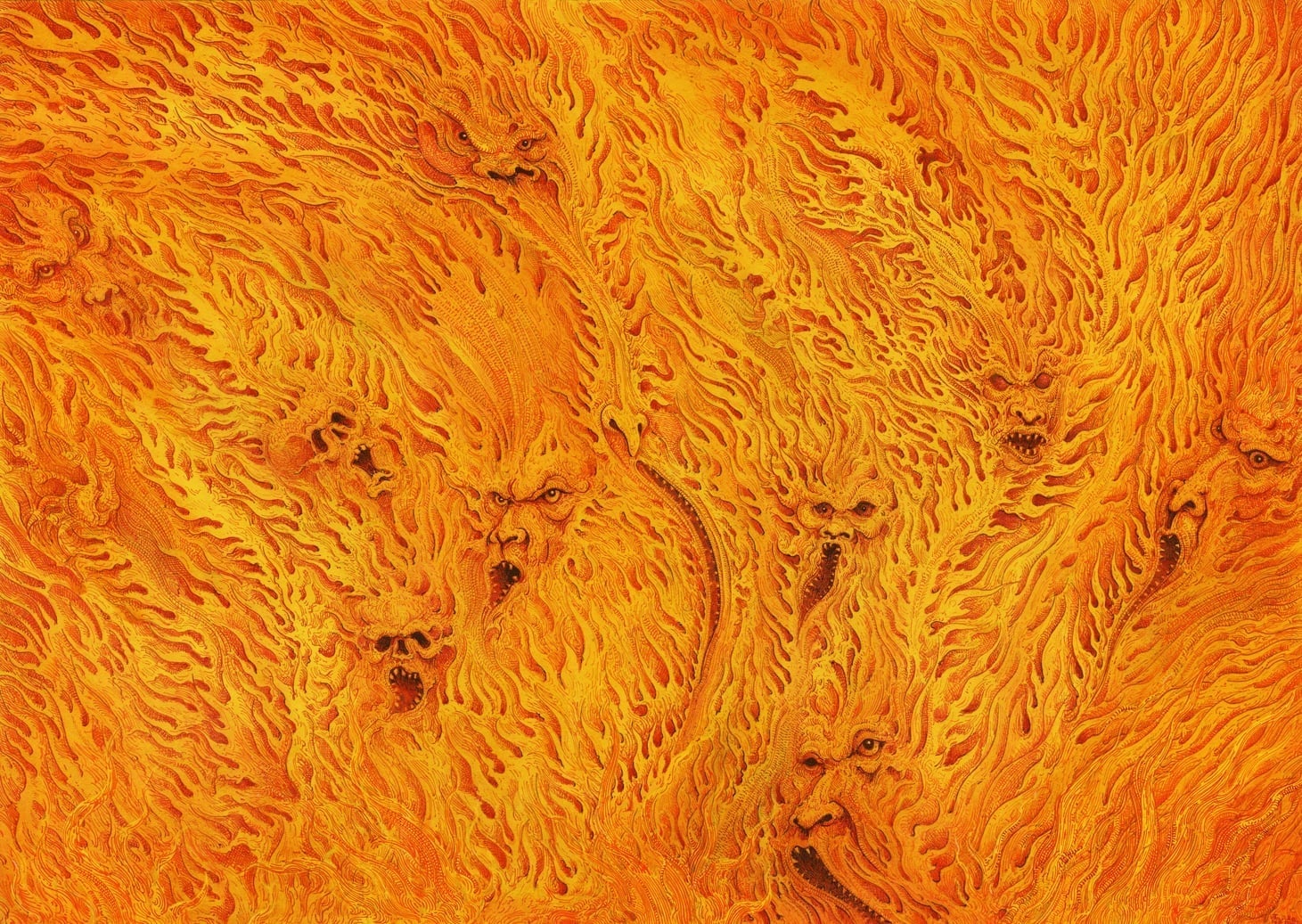
River of Flame — via sorcerytcg.com
But plenty of card games have beautiful art; on its own it's not a reason to play one. What the painted look really does is set a tone — a game of Sorcery feels less like racing a clock and more like sitting inside a story for an hour. That tone is the point, and it's what most reviews skip: the slower, tactical, across-the-table experience, not the cards in a binder. The art is also why those cards behave like collectibles — Erik's Curiosa has licensed heavyweight fantasy illustrators like Frank Frazetta, Brom, and Jeff Easley for its premium "Curio" cards, catalogued through the resources in Art House & Collectors.
The sets, briefly
There are five releases so far, plus a sixth on the way:
- Alpha — the original Kickstarter run. Scarce, expensive, and functionally near-identical to Beta. Collectors only.
- Beta — the practical on-ramp. The set most new players actually buy into.
- Arthurian Legends, Dragonlord, and Gothic — the expansions that followed, each adding new mechanics and Avatars.
- Frost Mage vs. Lavamancer — an upcoming release announced by the publisher.
For what's in each box and which to pick up first, the every Sorcery set explained breakdown goes set by set, and the Where to Buy section lists the stores that actually carry them.
Is Sorcery for you?
Honestly? It depends on what you want from a card game.
It's a strong fit if you like deep, board-state-heavy tactical games, you appreciate physical art objects, and you're not in a hurry — Sorcery rewards patience and punishes autopilot. The two-deck, grid-based design gives it a tactical ceiling that few card games reach.
It's a weaker fit if you want something cheap, fast, and casual, or a game with a giant local scene in every town. Sorcery's community is passionate but smaller than Magic's or Pokémon's, and the entry cost is real.
The lowest-risk way to find out is to play before you pay. Try a full game free through the online play guide, then — if it grabs you — the deeper is Sorcery worth it in 2026 breakdown weighs the cost against the payoff before you commit to a Beta precon or booster box. Newcomers can also start from the curated onboarding links in Start Here.
Sources
- Sorcery: Contested Realm — How to Play — official overview; "narrative experience … battle for tactical supremacy" framing and the banish-your-foe win condition — accessed 2026-06-05
- Sorcery: Contested Realm — official site — publisher (Erik's Curiosa), the "Mastery. Wonder. Creativity." framing, the hand-painted-art statement (oil/acrylic/watercolor/pen/pencil), and the set list including the upcoming Frost Mage vs. Lavamancer — accessed 2026-06-05
- Sorcery: Contested Realm — Beta set — set imagery (battlefield, River of Flame) — accessed 2026-06-05