Sorcery: Contested Realm has four regions, not five. They are Surface, Underground, Underwater, and Void. The fifth thing people sometimes call a region — Air — is an element (alongside Fire, Water, and Earth), and Airborne is a keyword that lets a unit fly while on the Surface. The confusion is common enough that the search query "five regions of Sorcery" outranks the correct framing — but the publisher's Curiosa Codex is unambiguous: "There are exactly four regions in Sorcery: Surface, Underwater, Underground, Void."
This article walks through what each region actually is, which keywords interact with which region, how the regions stack vertically on the 5×4 grid, and why that stacking changes how you build decks. If you've already read the threshold and sites primer, this is the next layer up.
A correction up front
The "five regions" framing exists because two of Sorcery's design layers share a vocabulary. Air is one of the four elements that Sites have affinity for — alongside Fire, Earth, and Water — and so it shows up on cards constantly. Airborne is a separate concept: it's a keyword ability on minions that lets them fly. The keyword's name shares the Air root, which is the trap.
Per the Curiosa Codex entry on Airborne: "Airborne only works on the surface. If the unit starts its step on the surface of a site, it can step diagonally. If the unit starts its step in a different region (void, underwater, underground), then it can't step diagonally." That's the rulebook's framing — Airborne is a modifier on Surface movement, not a separate region you can occupy.
If someone tells you "your dragon is in the Air region," they're describing a Surface unit with the Airborne keyword. There's no Air region in the rulebook. There's no "fly to the sky" zone. The board has four regions and the dragon is in one of them.
That confusion handled, here's how the actual region system works.
The board: a 5×4 grid called the Realm
Every Sorcery game is played on a board the codex calls "the Realm": "all the squares in the game and everything in those squares. Typically the realm is a 5×4 grid of squares." Twenty squares. Five columns wide, four rows deep. Both Avatars start in the middle of their bottom row.
Each square is one of two types at any given moment:
- A Site — a card from your Atlas you've played onto that square. Sites are landscape-oriented cards providing mana and elemental affinity. (How Sites and threshold work covers them in detail.)
- A Void — an empty square with no Site card on it. Per the Curiosa Codex Void entry: "A square without a site is a void. Minions in the void are immediately banished unless they have Voidwalk."
The Site/Void distinction matters because regions stack vertically. A Site provides a Surface region (where most minions live) and a subsurface region (Underground for land sites, Underwater for water sites). A Void only has one location — the Void itself. Voids don't have a subsurface.
When someone says a minion is "in" a region, they mean the minion occupies that region on a specific square. A unit on the surface of column 3 row 2 is in the Surface region of that square; an Airborne unit nearby is also in Surface region (the keyword modifies movement, not region); a Burrowing unit beneath that same Site is in Underground; a Voidwalking unit on column 3 row 1 (a Void square) is in Void.
Region 1 — Surface
The default region. Per the Curiosa Codex, Surface is both a noun (the location on top of a Site) and a verb (to move from subsurface to surface). When you summon a minion to a Site without specifying otherwise, it enters on the Surface.
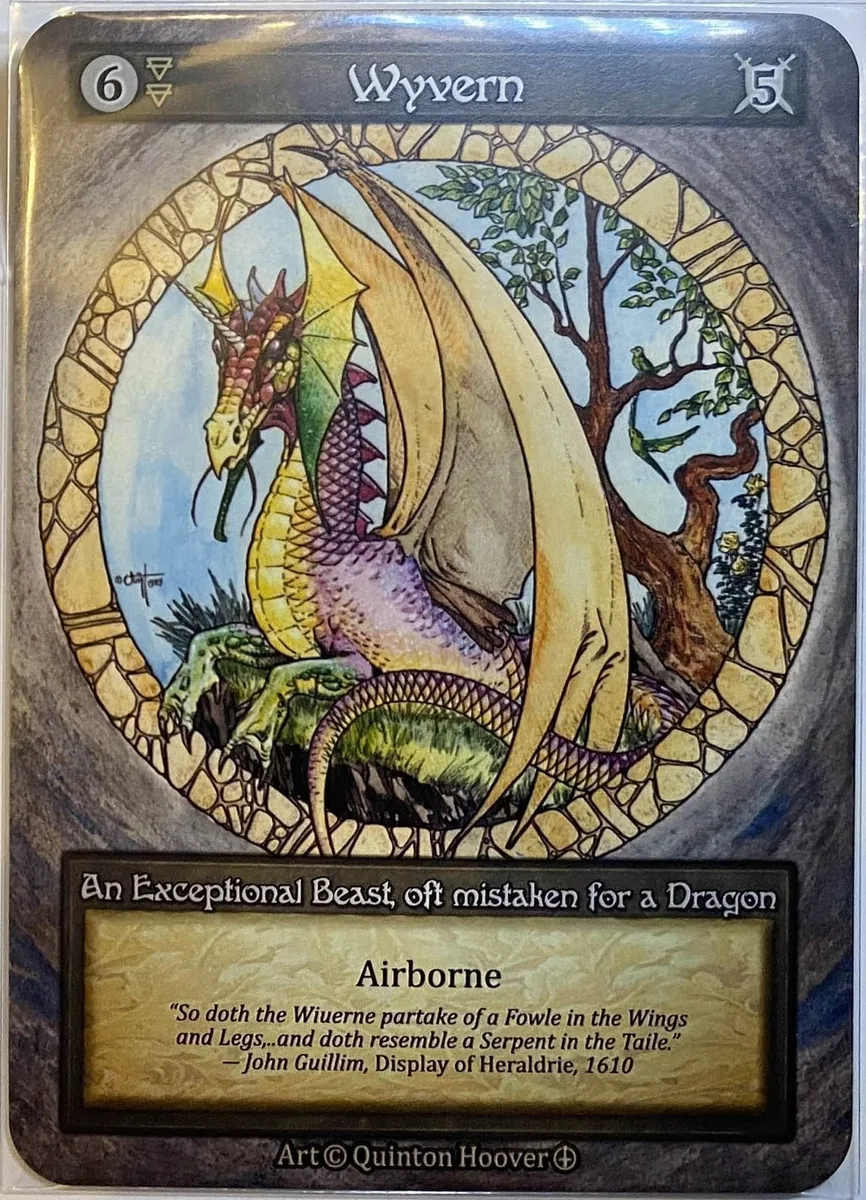
Wyvern by Quinton Hoover — via Collector Arthouse
The Surface is where most of the game happens. Most minions have no positional keywords; they live on Surface, attack other Surface units, and step from Site to Site across the top of the board. The Surface is also the region most cards reference by default — when an effect says "target minion," it usually means a Surface minion unless the card specifies a different region.
Two keywords interact specifically with Surface:
Airborne — flying. The Wyvern above has it. An Airborne unit on the Surface can step diagonally (regular Surface movement is orthogonal only), can attack across longer distances, and can fly over an opposing minion to reach what's behind it. Crucially, Airborne does not give the unit a new region — the unit is still in Surface. It just moves through Surface differently. The Codex is explicit: "Airborne only works on the surface." If a Phantom Steed picks up an Airborne unit and carries it into the Void, the Airborne effect goes dormant — the unit is in Void, not Surface, so the Airborne movement rules no longer apply.
Ranged — attacking at distance. A Ranged unit can attack a target some number of squares away without leaving its current square, but only within its own region. A Ranged Surface unit hits other Surface units across the board; it cannot fire a ranged attack into Underground, Underwater, or Void without crossing the regional boundary first. The Game Nerdz Sorcery FAQ cites a specific publisher ruling: "This ruling prevents projectiles from entering the Void and hitting anything there, or beyond it."
The Surface region is the part of the game beginners spend the longest in. The other three regions are mostly opt-in — your minions don't go there unless they have the keyword that takes them there.
Region 2 — Underground
The subsurface of land Sites. Land Sites are Sites with Earth, Fire, or some non-water elemental affinity (Mountains, Forests, Plains, and similar). Per the Codex, "Underground is the subsurface of land sites. Whenever a minion without Burrowing occupies an underground location, it immediately dies. An avatar may never enter an underground location. Underground is one of the four regions in the realm."
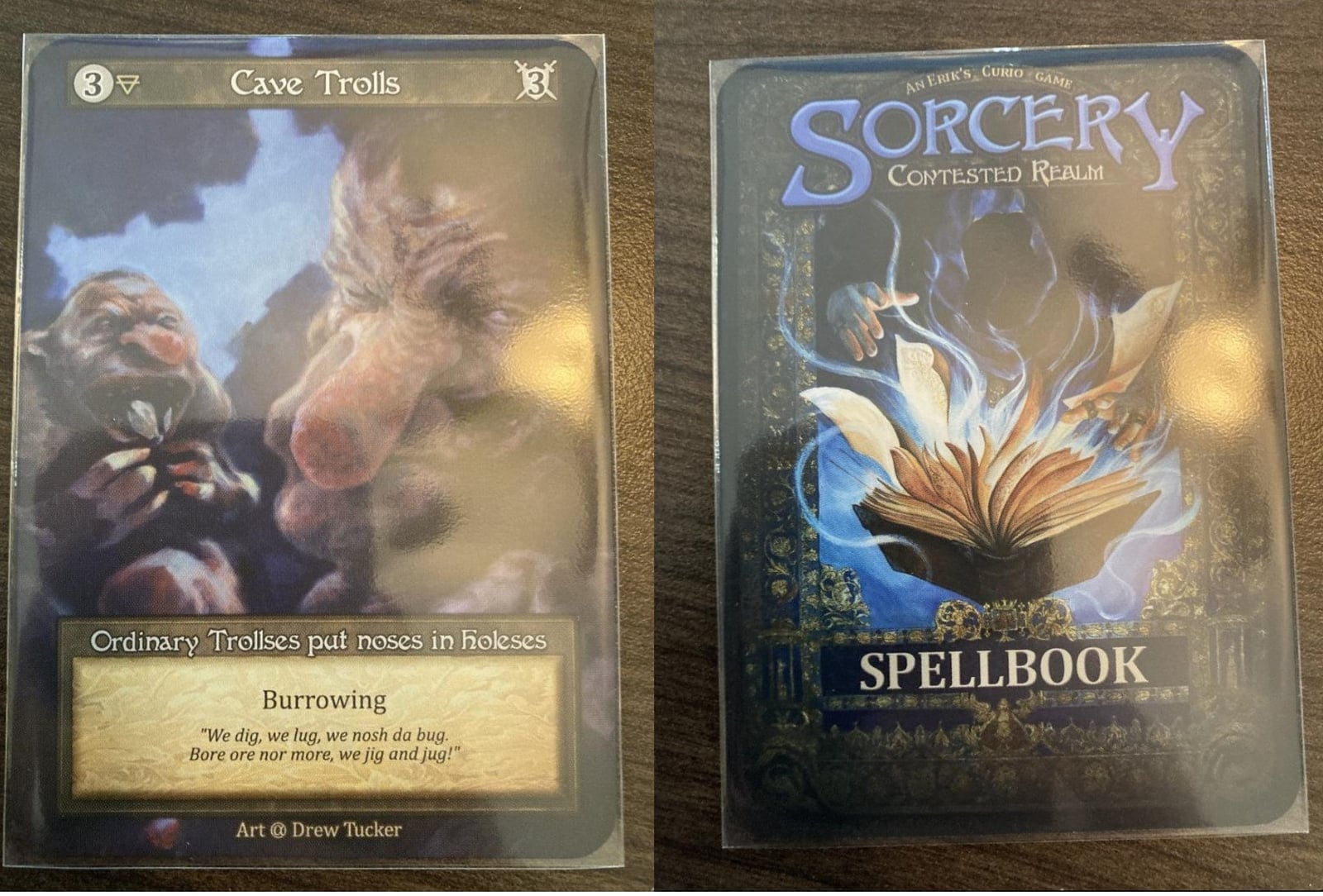
Cave Trolls by Drew Tucker — via Collector Arthouse
The keyword that takes a minion into Underground is Burrowing. Per the Curiosa Codex: "A minion with Burrowing can be summoned to underground locations and survive underground. By using one step, a minion with Burrowing can move between the surface and subsurface of a land site, or between adjacent underground locations."
Cave Trolls is the codex's example. The card's flavor text — "Ordinary Trollses put noses in holeses" — names the keyword inline (it has Burrowing), and the codex describes the canonical play: "Cave Trolls can be summoned underground to one of your land sites. Then, after their summoning sickness wore off, they could use their Move and Attack ability to take a step from underground to the surface of that site."
The strategic point of Underground is hiding from Surface interaction. A Burrowing unit underneath a Site is invisible to most Surface-targeting effects, can't be combat-blocked by Surface-only minions, and emerges on a turn of your choosing for ambush. The trade is that Underground units cannot interact with Surface units (or other regions) unless they Surface first. They're a turn behind on offense, in exchange for a turn ahead on defense.
The "only on land sites" restriction matters: if your Atlas runs heavy Water, you have fewer Underground squares to dig into. Burrowing decks tend to lean Earth-heavy in their Atlas mix.
Region 3 — Underwater
The subsurface of water Sites. Per the Codex, "Underwater is the subsurface of water sites. Whenever a minion without Submerge occupies an underwater location, it immediately dies. An avatar may never enter an underwater location. Underwater is one of the four regions in the realm."
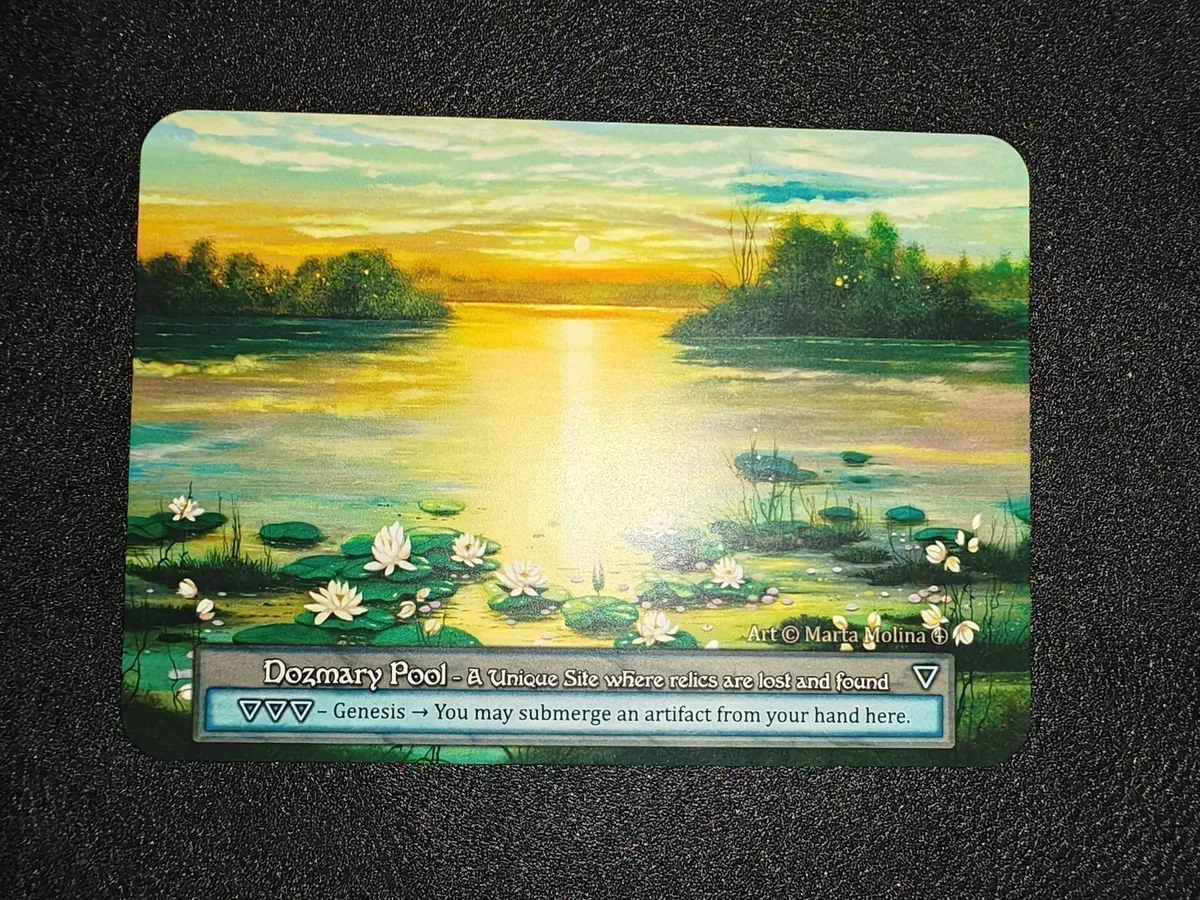
Dozmary Pool by Marta Molina — via Collector Arthouse
The keyword is Submerge, and it works structurally the same way Burrowing does — different region, same pattern: "A minion with Submerge can be summoned to underwater locations and survive underwater. By using one step, a minion with Submerge can move between the surface and subsurface of a water site, or between adjacent underwater locations." The codex's example minion for Submerge is Coral-reef Kelpie.
Dozmary Pool is a water Site whose Genesis ability reads "You may submerge an artifact from your hand here" — the Site itself moves cards into the Underwater region. It's a worked example of how cards interact with regions other than Surface — not just by moving units into them, but by placing other cards into them. The Site is using its rules text to put an artifact in Underwater where most opposing minions cannot reach it.
The December 2025 Rulebook Update cleaned up several Submerge and water-Site interaction edge cases (alongside the broader Collection mechanic and 60-card Spellbook changes). If your edition of the rules predates December 2025, double-check Submerge-related rulings against the current rulebook.
A minion that has both Burrowing and Submerge gets a small bonus: per the Codex, "A minion with both the Burrowing and Submerge abilities can move directly from an underground location to an underwater location in an adjacent square, and vice versa, in one step." Two-keyword units are uncommon, but they're the only minions that can move between subsurface regions without surfacing first.
Region 4 — Void
The fourth region — and the strategic one. Per the Codex, "A square without a site is a void. Minions in the void are immediately banished unless they have Voidwalk. Unlike sites that have two locations (surface and subsurface), a void square only has a single location, the void."
The Void is the negative space of the board. Every square not covered by a Site is a Void. As the board fills with Sites, the Void shrinks; if Sites get destroyed (and replaced by Rubble, which is technically not a Void but functions similarly to one for the purposes of being un-occupiable by most units), Voids re-open.
The keyword is Voidwalk: "A minion with Voidwalk can be summoned to void locations and survive in the void." The Codex's example is Hounds of Ondaros: "Hounds of Ondaros can be summoned to any void location. Then, after their summoning sickness wore off, they could use their Move and Attack ability to take a step from the void directly to the subsurface of an adjacent site, or directly to the surface of an adjacent site."
The strategic implication of Voidwalk is route control. A Voidwalking minion can occupy squares that don't have Sites — which means it can position itself on routes the opponent's Sites haven't reached yet, threaten flanking attacks, and bypass defensive Site clusters. The Void is the only region where the opponent's Sites don't directly contribute to defense (because the Void has no surface to put defenders on), which makes it a corridor for fast-moving threats.
Two final notes on Void:
Avatars cannot enter Void. The codex is explicit: per the Void entry, "Avatars in the void have a mandatory action." In practice, an Avatar can't survive in Void normally — Voidwalk isn't an Avatar keyword. Some effects can force-banish an Avatar, but Avatars never voluntarily move there.
Rubble is functionally adjacent to Void. When a Site is destroyed, it becomes Rubble — a neutral land providing no mana, no threshold, no rules text. Rubble doesn't behave as Void per the rulebook, but for positioning purposes it occupies the same kind of dead-square role: nothing happens there until someone plays a new Site over it.
How the regions stack vertically
This is the rule that takes the longest to internalize.
The four regions are not isolated zones. They exist as a vertical stack on each square. A Land Site square has Surface (top) and Underground (below); a Water Site square has Surface (top) and Underwater (below); a Void square has only Void.
The Codex makes a subtle but important clarification: "Even if a group of surface locations is separated by the void from another group of surface locations, there is still only a single surface region. Every surface location is part of the surface region. Every underground location is part of the underground region."
What that means in practice: there is one Surface region in the game, not many. A unit on the Surface in column 1 row 1 and a unit on the Surface in column 5 row 4 are both in the Surface region — they happen to be in different locations within that region, but the region is contiguous as a concept. Same for Underground, Underwater, and Void.
This matters for cards that say things like "All minions in Underground take 1 damage" or "Search the Surface region for a unit named X." Those effects hit every unit in that region, not just adjacent ones, unless the card narrows the scope further. The region is global; the location is local.
The "vertical stack" framing is useful because regions cross through each other on a column. A Burrowing unit in Underground at column 3 is in the same column as a Surface unit at column 3 — but they're in different regions and cannot interact directly (the Surface unit cannot attack the Burrower without crossing the regional boundary, and most Surface-targeting effects skip the Burrower entirely).
That's the source of a lot of the early-game confusion for MTG transplants. MTG creatures coexist in one "battlefield" zone. Sorcery minions live in four regions stacked on a 20-square board, and which region they're in is as important as which square. (Sorcery vs Magic: The Gathering, Explained walks the broader MTG-to-Sorcery transition.)
The keyword-region map
| Keyword | Region it interacts with | Effect |
|---|---|---|
| Airborne | Surface (only) | Move diagonally; fly over Surface blockers; cannot use the keyword in other regions |
| Burrowing | Underground | Summon to and survive in Underground (subsurface of land Sites) |
| Submerge | Underwater | Summon to and survive in Underwater (subsurface of water Sites) |
| Voidwalk | Void | Summon to and survive in Void squares |
| Ranged | Any (same-region only) | Attack at distance, but cannot cross regional boundaries with the attack |
| Stealth | Any | Cannot be intercepted while moving; functions in all regions |
| Movement +X | Any | Take additional steps per turn |
Only the first four keywords change what region a unit can occupy. The remaining keywords modify how a unit behaves inside its current region. The Codex documents the full keyword glossary in its alphabetical entries — for any keyword whose region-interaction you're unsure of, the Codex entry is the canonical source, and the directory's deckbuilders and tools section lists it alongside the other keyword lookup utilities.
A common mistake: treating Stealth as if it were a regional keyword. It isn't. A Stealth unit on the Surface is still on the Surface; the Stealth just means it cannot be intercepted while moving. The unit gains no region-shifting ability from the keyword alone.
Why this matters for building decks
Two structural implications for deckbuilding.
Threshold needs to match the regions you intend to occupy. A deck built around Burrowing units needs land Sites in its Atlas — water-only Sites don't have an Underground for Burrowers to use. A Submerge-heavy deck needs water Sites for the same reason. A Voidwalk-heavy deck is the most flexible because Voidwalking units don't need any specific Site type to function — they live in the empty squares.
Region-shifting is positioning leverage. Keywords that move units between regions are some of the strongest in the game because they break the assumption that the opponent's defensive cluster is intact. A flying Wyvern can ignore an opponent's choke-point of Ground minions. A Voidwalking attacker can flank a defended Site by going around it. A Burrowing unit can disappear from interaction for a turn and resurface inside the opponent's territory. The Sorcery rulebook discussions on Eternal Durdles and similar community pieces talk about region-shifting as one of the highest-impact deckbuilding levers — the directory's podcasts and newsletters section collects the regular voices on this — and it's a lever MTG converts often miss because nothing in MTG's design rewards positional flexibility the way Sorcery's regional structure does.
For new players: the fastest way to develop region intuition is to play Limited (Sealed or Draft), where you get a small pool of cards with assorted keywords and have to figure out how to use them all. The How to Play Sorcery Online primer walks through TTS-based practice, and the directory's deckbuilders and tools section lists the TTS mod plus the simulators worth pairing with it. Region awareness is one of the things that comes faster on TTS than reading about it — you'll mis-position a Burrower into a Surface-only situation a few times, and then you'll never do it again.
Bottom line
Four regions: Surface, Underground, Underwater, Void. Four keywords that change which region a unit can occupy: Airborne (no — it modifies Surface), Burrowing (Underground), Submerge (Underwater), Voidwalk (Void). The Realm is the 5×4 grid. The "five regions" framing is a common confusion that the official rulebook resolves cleanly.
If you internalize one thing from this article, internalize the stack: every square on the board has a region-stack (Surface plus a subsurface, or just Void), and a unit's region is as important as its square. Build decks where the region your units want to occupy lines up with the Sites in your Atlas. The rest follows.
Where to go from here
- Sorcery Threshold and Sites, Explained — how Sites work, what Atlas-building looks like, and why Site placement is positional
- Sorcery vs Magic: The Gathering, Explained — the broader MTG-comparison piece, including why "board state" is structurally different in Sorcery
- How to Play Sorcery Online, Explained — the TTS path for practicing region awareness without spending on cards
- Every Sorcery Format, Explained — Constructed, Sealed, and Draft, and how region-leaning decks play in each
- Curiosa.io, the Official Deckbuilder, Explained — where to filter cards by keyword (and find the Codex itself)
Sources
- Curiosa Codex — primary source for region definitions and keyword rules
- Sorcery TCG, How to Play — the publisher's canonical rules home
- Sorcery TCG, December 2025 Rulebook Update — Submerge and water-Site ruling refinements, Collection mechanic, 60-card Spellbook
- Game Nerdz, Sorcery: Contested Realm FAQ — publisher ruling on Ranged attacks crossing regional boundaries
- Eternal Durdles, New Player's Guide — community beginner content covering region-shifting strategy
- Sorcery Companion, Rules — community-formatted rulebook