Combat in Sorcery looks more complex than it is because the rulebook buries the answer. Once you see the skeleton, every fight on every board is the same five steps: declare the attacker, resolve any defender or interceptor, first-strikes resolve, regular strikes resolve, damage applies simultaneously. Everything else — Stealth, Airborne, Lance, Ranged — is a modifier on that skeleton.
This article walks you through it once, in the order it actually happens at the table, using the rules as of the July 2025 rulebook update. If you read a different combat walkthrough on a forum from 2024, parts of it are now wrong — intercept and undefended sites both changed materially in July 2025. This version is the one Sorcery is being played under in 2026.
TL;DR — the five steps in order
Every combat exchange in Sorcery is one of these:
- Declare the attacker. A tapped (or moving) unit announces it is attacking a specific target — an enemy unit at an adjacent location, or, since July 2025, an undefended enemy site.
- Resolve the defender or interceptor. If the target site has an enemy unit, that unit is the defender. If the attacker chose Move-and-Attack-without-attacking and an adjacent unit qualifies, that unit can intercept.
- First-strike step. Any unit with "strikes first" deals its damage now. Surviving units continue to step 4.
- Regular strike step. All remaining non-first-strike units strike simultaneously.
- Damage step. Damage applies all at once. Dead minions go to the cemetery. Sites that took fatal damage become Rubble.
The framework is from the official rulebook. The post-July-2025 simplifications are what most newer guides still miss. If combat resolution still feels unintuitive after this walkthrough, the Start Here resources collect the fundamentals worth reading first.
The setup: who can fight whom
Combat only happens between units that can reach each other. Reach is governed by two things: location and movement keywords.
Every unit lives somewhere on the 5×4 board — on a Site, on Rubble, or, for flyers and aquatic units, in the airspace or undercurrent of a square. To attack a unit you don't share a square with, you have to either move into range or possess a keyword that lets you strike at distance.
The default is adjacency. Your minion attacks an enemy minion at an adjacent location — one cardinal step. Diagonal steps don't count by default. Ranged units can strike one step in cardinal directions without entering the square (and post-July 2025, cannot target sites — only the units on them). Airborne units fly over enemies, move diagonally, and only fight other Airborne units or units with specific ability to reach them. Submerge, Voidwalk, and Burrowing put units into terrain bands (water, void, earth) where they're only reachable by units that share the band.
The Curiosa Codex's keyword glossary is the canonical list — you can find it alongside the other deckbuilders and tools in the directory. The Sorcery TCG team's July 2025 update clarified that Avatars who gain Airborne can use it — meaning a Dragonlord can actually fly.
One distinction worth fixing in your head: regions are not the same as keywords. The board's spatial regions are the surface, the underground, the underwater, and the void. Airborne isn't a region — it's a keyword that says "operates above the surface and fights only Airborne." A Submerge unit and an Airborne unit can occupy the same site without ever fighting, because they can't reach each other.
Step 1 — declaring the attacker
Combat starts when you commit a unit to attacking. Two ways to do this:
Tap to attack. You tap an untapped unit that's already adjacent to the target. The unit is now attacking; it cannot also move this turn.
Move and Attack. A single action that lets the unit step into adjacency and attack as part of the same activation. The cost is one action and the unit's normal movement. After July 2025, Move-and-Attack also covers a unit moving with intent to attack but declining to actually attack at the destination — that's the only path that lets an interceptor get involved (more on this below).
What you declare in this step:
- The attacker (a single unit, untapped).
- The target (an enemy unit at an adjacent location, or, since July 2025, an undefended enemy site).
You do not declare a defender or specify damage yet. Those come in step 2 and step 5.
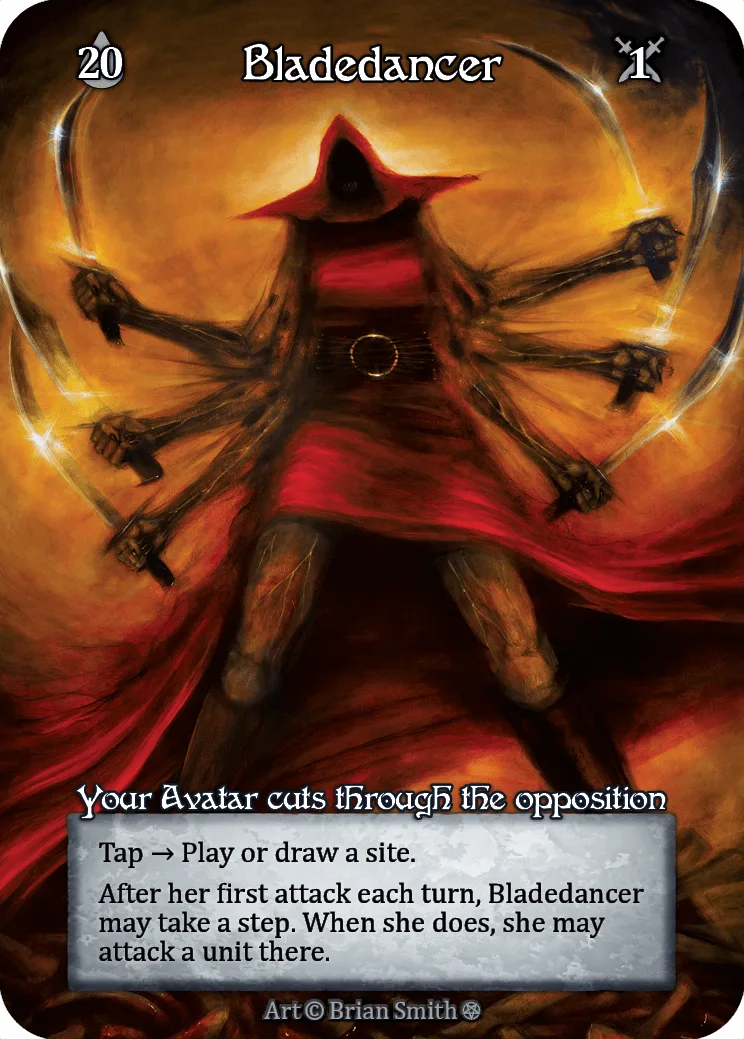
Bladedancer by Brian Smith — via Curiosa
A worked example. You control Bladedancer, your Avatar, on a site adjacent to an enemy Sorcerer. You tap Bladedancer (no movement needed — already in range) and declare the attack. Target: enemy Sorcerer. Now we move to step 2.
A second worked example, with movement. You control a Footman two steps away from an enemy Templar. You use Move-and-Attack: the Footman steps once (into adjacency), then attacks the Templar as part of the same action. Same declaration, just with a movement leg in front of it.
Step 2 — defender, or intercept
This is where the post-July-2025 simplification matters most. Two paths.
Path A: there's a defender at the target site. If the target square has an enemy unit, that unit is the defender by default. It does not need to "declare" anything — being there is the declaration. The fight resolves between attacker and defender.
Path B: the attacker used Move-and-Attack-without-attacking, and an adjacent unit qualifies as an interceptor. This is the rule that changed. Per the July 2025 update:
If an enemy used Move and Attack without attacking, you can intercept!
The timing is now identical to the timing for an attack: after all movement has been completed. If the moving unit attacks, the target unit defends. If the moving unit moves into your zone but chooses not to attack, an adjacent unit of yours can step in and intercept. That intercept resolves as a fight — not a full attack sequence.
The corollary: Movement +1 (and faster) units can now speed past potential interceptors. Because intercept only triggers after all movement is complete, a unit that finishes its move adjacent to nothing-defendable can no longer be intercepted. Pre-July-2025, intercept could fire mid-move; now it cannot. MTG players: this is closer to declaring blockers than to a permanent reactive ability — only one window, only after the attacker stops moving.
For broader rules context across formats, the same combat rules apply whether you're playing Constructed, Draft, or Sealed. Combat doesn't change between formats. Deckbuilding does.
Step 3 — first-strike step
This is the asymmetric step that ends fights early. Any unit involved in the fight with "strikes first" — printed on the card, granted by a weapon, or conferred by a spell — deals its damage before the regular strike step.
The phrasing on cards is literally "Strikes first" (e.g. Albespine Pikemen's rules text reads: Strikes first while attacking.) Weapons confer it conditionally — Lance and Rhongomyniad both grant strikes-first to their bearer's next attack.
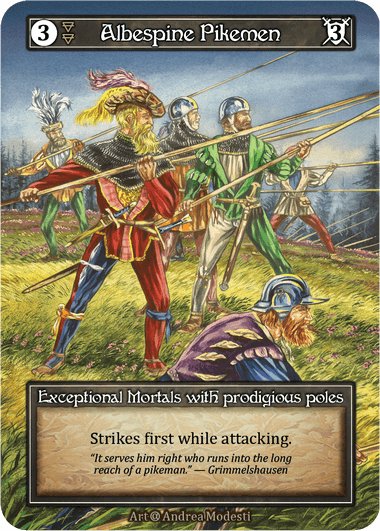
Albespine Pikemen by Andrea Modesti — via Curiosa
The mechanics:
- If only one side of the fight has strikes-first, that side deals its damage first. If the damage kills the opposing unit, the fight ends — the killed unit never gets to strike back.
- If both sides have strikes-first, they strike simultaneously in this step. Standard simultaneous damage rules apply.
- There is only one first-strike window per fight. The Curiosa Codex is explicit on this: stacking two Lances on a single unit doesn't grant "double first strike" — it confers strikes-first once.
A worked example. A 3/3 Albespine Pikemen (strikes-first) attacks a 2/2 Footman (regular strike). In the first-strike step, the Pikemen deals 3 damage to the Footman. The Footman dies before it can strike back. The fight ends. The Pikemen takes no damage.
A second example, with both sides striking first. A 3/3 Albespine Pikemen attacks a 3/3 unit holding a Lance. Both have strikes-first this fight. In the first-strike step, both deal 3 damage simultaneously. Both die. No regular strike step is needed.
Step 4 — regular strike step
Anyone left standing who isn't a first-striker strikes now. All damage is simultaneous within this step.
This is the default damage exchange most newcomers picture when they think "combat." In a vanilla 2v2 with no first-strikers, all four units deal their damage at the same time, and the damage step resolves whatever lethal is lethal.
A worked example. Your Bladedancer (1/1 base, +3 from a buff, so 4/4) attacks an enemy Templar (3/3). Neither has strikes-first. Both deal damage at the same time. Bladedancer deals 4 to the Templar (dies). Templar deals 3 to Bladedancer (survives at 1). One body trades down for free; the Templar trades up because the buff died with the attack.
A more interesting example: a 2v2 where one side has a first-striker. You attack with a 3/3 Albespine Pikemen and a 2/2 Footman against an enemy 3/3 and 2/2 (vanilla). Step 3: Pikemen strikes first, deals 3 to the enemy 3/3, killing it. Step 4: the surviving enemy 2/2 and your 2/2 trade strikes. Your 2/2 dies; the enemy 2/2 takes 2 damage and survives at 1. Net: you lost a 2/2, killed a 3/3 cleanly thanks to first-strike, and the enemy 2/2 is now low.
Step 5 — damage allocation
Damage from steps 3 and 4 applies simultaneously in this step. In a 1v1 fight, allocation is trivial — the attacker's damage hits the defender, the defender's damage hits the attacker. In multi-unit fights, the controller of each side allocates damage from their units across the opposing side's units, in any order they like, as long as no point of damage is double-counted.
Three details that matter:
1. Site damage. Since July 2025, undefended sites can be attacked directly. From the update post:
No enemy in your path? No problem! You can now strike undefended sites.
A successful attack on an undefended site deals damage to the site's life total and drains the controller's life. Once site damage reaches its threshold, the site is destroyed and becomes Rubble — a dead square that provides no mana, no threshold, no abilities.
2. Lance shatter. Also new in July 2025: if you attack a site with a Lance equipped, the Lance breaks on impact. The publisher's reasoning is on the nose: "Lances are made for dueling, not demolition." A Lance is a single-fight weapon anyway — it shatters on its first attack regardless — but the site-attack interaction is explicit so there's no question.
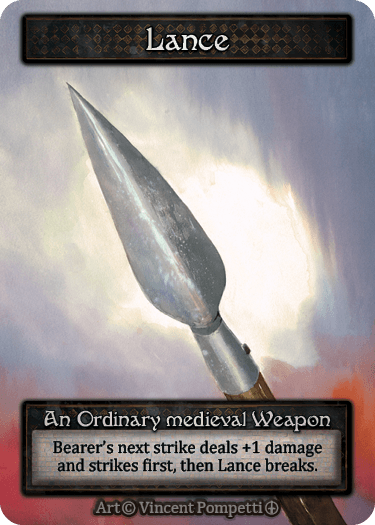
Lance by Vincent Pompetti — via Curiosa
3. Excess damage. Damage above a unit's defense is lost. Sorcery has no trample-style overflow by default. If your 5/5 attacks a 2/2, the extra 3 damage is wasted. Some keywords (e.g. effects that say "deal X damage to a site if this unit kills its target") can carry damage across, but the default is no overflow.
Edge cases and special abilities
A short reference. Each of these is worth a longer article in its own right (keywords are getting their own piece) — the version below is just enough so you don't mis-resolve a fight.
Stealth. A Stealthy unit can't be targeted by enemy spells, abilities, or projectiles. It can still be fought in normal close combat. Per the July 2025 update, Stealth breaks the moment the unit interacts with the realm — casts a spell, strikes, activates an ability, or deals damage. No more shadowy fireball-throwers; the first strike from a Stealth unit reveals it.
Ranged. Strike from one step in cardinal directions without moving into the target's square. Post-July-2025, Ranged cannot target sites directly — only units on them. Ranged minions still get hit back in the fight (they're not invulnerable), but they don't have to commit to the destination square.
Airborne. Fly above the surface; move diagonally; gain elevated defense. Only fights other Airborne units or units that have specific reach. As of July 2025, Avatars that gain Airborne (Dragonlord, primarily) can use the full keyword — including Avatars who pick up Airborne mid-game via spells or artifacts.
Immobile. Cannot move itself. Can still attack and defend at its current location. The July 2025 update was explicit on this: "stillness is not helplessness." An Immobile unit at an adjacent location is still a defender like any other.
The Curiosa Codex has the full keyword glossary, including newer additions like Voidwalk, Submerge, Burrow, Stealth, and Ward.
A worked full example
One combat from start to finish.
Board state. You're playing a Bladedancer-led aggro deck. Your Bladedancer (1/1, 20 life remaining) is on a site adjacent to an enemy Sorcerer (1/1, 18 life). One square diagonally from Bladedancer is an enemy Albespine Pikemen (3/3, strikes-first) — adjacent to the enemy Sorcerer, but two cardinal steps from Bladedancer. You have an untapped Footman (2/2) on a site cardinally adjacent to the enemy Sorcerer.
Your turn. You decide to kill the enemy Sorcerer to drain the enemy's life. Two attackers. You also know the enemy Pikemen could intercept if you give it a window.
Move 1. You tap Bladedancer. She's already adjacent — no movement needed. Declared target: enemy Sorcerer.
Step 2: defender check. The Sorcerer is at the target site; the Sorcerer is the defender. No intercept window — Bladedancer didn't use Move-and-Attack-without-attacking, she tapped to attack.
Step 3: first-strike step. Neither Bladedancer nor the Sorcerer has strikes-first. Skip.
Step 4: regular strike step. Bladedancer (1) and Sorcerer (1) strike simultaneously. Both take 1 damage.
Step 5: damage step. Bladedancer is at 0/1 — dies. Sorcerer is at 0/1 — dies. Both go to the cemetery. The enemy life total drops by 1 (Sorcerer's life). Your life is unaffected — the Sorcerer dealt damage to your Avatar's attack value, not to your player life (the player life isn't on the line in a routine fight).
Move 2. You move the Footman with Move-and-Attack, but the Sorcerer is dead and the site is undefended. Now post-July-2025, you can attack the undefended site directly. You declare: Footman attacks the enemy site.
Step 2: defender check. The site is undefended — no unit there. The Pikemen is adjacent to the site but is on a different square; it qualifies as a potential interceptor only if the Footman used Move-and-Attack-without-attacking. Footman is attacking, so no intercept.
Step 3: first-strike step. Footman is vanilla; site doesn't strike. Skip.
Step 4: regular strike step. Footman deals 2 damage to the site.
Step 5: damage step. The site takes 2 to its life. The enemy player's life total drains by 2. If the site survives, it stays; if it dies, it becomes Rubble.
End of your turn. Net result: traded Bladedancer for Sorcerer (clean), and slammed 2 damage into an undefended site. If you'd had a Lance on the Footman, it would have shattered on this hit.
What you've learned
Combat in Sorcery is positional, simultaneous, and gated by movement keywords. The five-step skeleton — declare, defender/intercept, first-strike, regular strike, damage — holds for every fight. Once you know it, the keyword text on individual cards stops feeling like 12 separate rules and starts feeling like 12 modifiers on the same base flow.
The biggest mistakes new players make:
- Trying to intercept on the way in. Post-July-2025, intercept only fires after movement is complete and only if the attacker chose not to attack. You can't pop out and stop a unit mid-route.
- Forgetting first-strike kills before regular strikes fire. A 3/3 first-striker into a 3/3 vanilla is not a trade — the first-striker wins clean.
- Thinking Stealth makes a unit invincible. It doesn't. You can still fight a Stealth unit in close combat. And the moment that Stealth unit acts, it loses Stealth.
- Forgetting Lance shatters on site attacks. Worth it if the site dies; expensive if it doesn't.
If you came from Magic, the Magic-to-Sorcery comparison article covers the bigger conceptual shifts. If you want the deeper "what's a Site, what's a threshold" version, read Threshold and Sites.
If you want to drill combat without losing money on misplays, play it on Tabletop Simulator — the mod won't auto-resolve fights for you, which is good for learning the order. You have to walk through every step yourself. The TTS mod plus the other deckbuilders and tools in the directory are the fastest path to reps.
Where to go from here
- Sorcery Threshold and Sites, Explained — what a Site does, and why Rubble matters when a site dies in combat
- Sorcery vs Magic: The Gathering, Explained — broader rules comparison if you're coming from MTG
- Every Sorcery Format, Explained — combat rules are identical across Constructed, Draft, and Sealed; only deck construction changes
- How to Play Sorcery Online, Explained — drill combat resolution on the official TTS mod
Sources
- Sorcery: Contested Realm, How to Play — official rulebook home, the canonical rules reference
- Sorcery: Contested Realm Rules Update (July 2025) — intercept simplification, undefended site rules, Lance shatter on sites, Stealth-break-on-interaction, Avatars-can-Airborne — published 2025-07-10
- Sorcery: Contested Realm December 2025 Rulebook Update — Gothic-era glossary additions (Ward, Collection, Can't Be Modified) — published 2025-12-19
- Sorcery: Contested Realm Rulebook 2024 — canonical pre-July-2025 rulebook for reference
- Curiosa Codex — keyword glossary and rules clarifications
- GameNerdz — Sorcery: Contested Realm FAQ — supplementary clarifications for newer players