If you've come from Magic, the rule that breaks your brain first isn't threshold and it isn't the grid. It's this one: reducing your opponent's Avatar to 0 life doesn't end the game. It puts them at Death's Door — a one-turn window where they cannot take damage and cannot heal. The match ends on the next damage they take, and not before.
That's the whole mechanic. The implications are everywhere. Damage-race math changes. "Lethal on board" stops meaning what it means in Magic. Finishers — cards that exist to deliver the final point on a subsequent turn — become more valuable than raw damage. This article walks through what the rule actually says, why it changes the game's strategy, and the specific places MTG players miscount themselves out of wins.
The rule, in plain English
From the rulebook, verbatim:
"When an Avatar's life is reduced to 0, they are now at death's door and can no longer gain life. At that moment, the wounded Avatar becomes immune to damage for the rest of that turn."
Two clauses, both load-bearing.
Clause one — no more life gain. Once an Avatar hits 0, they're locked at 0 for the rest of the game. Healing spells, life-gain abilities, soothing-balm artifacts — none of it works. You don't recover from Death's Door; you survive at the edge of it.
Clause two — immune for the rest of this turn. The moment the Avatar drops to 0, they take no further damage for the remainder of the current turn. Combat damage, spell damage, triggered damage, on-your-own-turn self-damage — none of it lands. The window is until end of turn, not until next damage.
Then, the next damage on any subsequent turn:
"After that brief and desperate window, any damage dealt to the Avatar is a death blow, finally severing their connection to the realm and signaling their defeat."
That's the win condition. Not 0 life — 1 more point of damage after 0 life on a later turn.
Why the rule exists
The rulebook doesn't editorialize, so neither will I. What the mechanic creates, observably:
A defender's turn. You can't get blown out by a single combat phase. Even if your opponent assembles a board that does 20 damage in one turn, you survive that turn. You then get one full turn of your own — untap, mana from sites, draw a card, play your board, cast spells. The game gives the player at Death's Door an entire turn to find an answer.
Multi-turn finishing. Killing an opponent is at minimum a two-turn project once they're below threat range. Turn one: chip them to 0. Turn two: deliver the Death Blow. There is no "one-shot" cheese. Even the most explosive board state cannot end a game starting from 1+ life.
A real distinction between damage and finishing. Damage that drives the opponent toward 0 is one resource. Damage that arrives after 0, on a future turn, is a different resource. Decks need both — the curve to get there, and the threat to close.
That's the design space the mechanic opens. Whether Erik intended each of those is his business. The rulebook commits to the mechanic; I'm describing what it does.
What you can and can't do at Death's Door
The Avatar at Death's Door is at 0 life, and locked there. Three things follow:
They cannot take damage for the rest of the current turn. This is automatic — no flag to set, no timer to track. Any damage source that targets the Avatar during the same turn it hit 0 simply fizzles on impact. Other minions still take damage normally; the immunity is Avatar-only.
They cannot gain life — ever, again, for the rest of the game. No spell, no triggered ability, no card text restores life to an Avatar at Death's Door. The "0 life" state is permanent. This is the trickiest clause of the mechanic; the rule isn't temporary immunity, it's a permanent floor at zero.
Everything else still works. The Avatar can still attack, defend, cast spells, activate abilities, move, be targeted by non-damage effects, be moved by opposing effects, lose abilities, gain abilities. The only restrictions are damage-in and life-gain-in. They are not "dead." They are precarious.
If you survive the turn you hit 0, you get a full turn at Death's Door before any next-damage punishes you. Use it. That turn is the entire reason the rule exists.
The Death Blow — closing the game
On any subsequent turn, any damage to the Death's-Door Avatar ends the game. The damage can come from anywhere:
- Combat damage from an attacking minion
- Direct damage from a spell or activated ability
- A triggered ability that deals damage on a board state
- An end-of-turn or start-of-turn trigger that ticks damage
- Your own self-damage source — yes, even your own — though you'd have to be having a particularly bad day to put yourself there
The damage need only be 1 point. There is no "overkill" math, no "damage minus toughness" subtraction beyond the standard. One point of damage is one Death Blow.
This is the second mental flip from Magic: you cannot end the game by reaching lethal on a single turn. You end it by holding lethal across two turns. The mid-turn-window calculus that drives lethal-on-board commentary in MTG — "they have lethal next turn, do they have a removal spell in hand?" — translates badly. In Sorcery, the equivalent question is "they're at Death's Door — do they have a board-clearing turn-defense in hand that survives until I can attack again?"
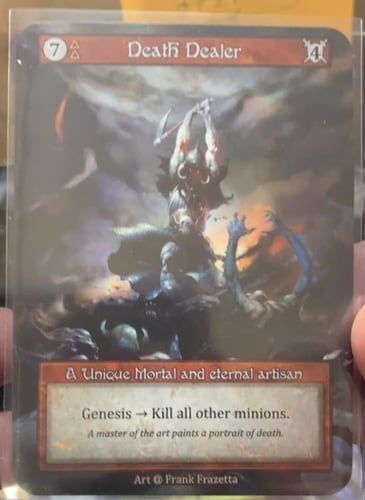
Death Dealer by Frank Frazetta — via Collector Arthouse
How this changes how you build and play
The strategic consequences are real. Three of them matter:
Reach matters more than raw damage. A deck that can put your Avatar to 0 but cannot reliably deal one more point on the next turn does not, by the rules, win. Aggro decks need a finisher — typically a flying minion, a burn spell with mana flexibility, or a triggered "deal X damage" ability that survives a turn. Burn decks specifically should hold one finisher spell, because the worst version of an aggro deck in Sorcery is one that runs out of damage in the Death's Door window.
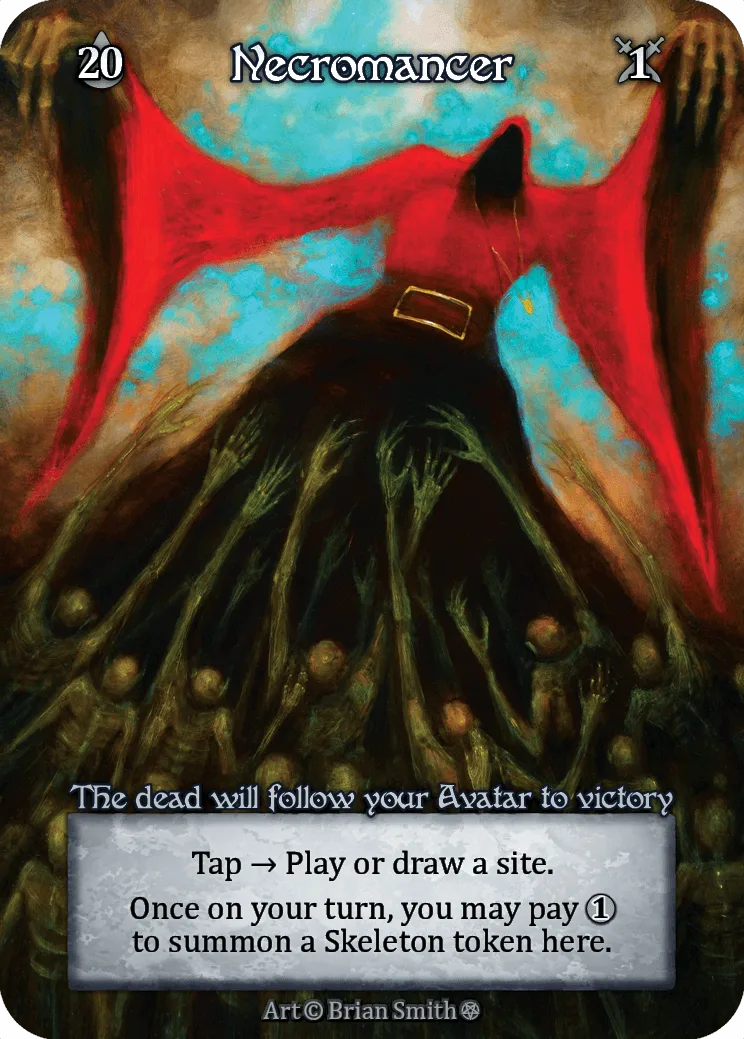
Necromancer by Brian Smith — via Curiosa
Stabilization is real. A defender's turn isn't a metaphor — it's a literal turn of game time. If you can survive the strike that puts you to 0, you have a Start Phase, a Main Phase, and an End Phase to find an answer. Block damage, kill the threats that would deliver the Death Blow, cast something that wins the game on the spot, anything. The pace of "the death turn" in Sorcery is much closer to a chess endgame than to an MTG combat step.
Damage-race math is "to 0, plus 1." When you're calculating whether you're racing your opponent, the actual number you need is one more than zero, on a turn after they reach zero. Two combat phases. Two sources. A 19-life opponent isn't 19 damage away from losing — they're 19 damage plus a finisher next turn away from losing. The Magic shortcut "I'm at 7, they swing for 7, I'm dead" doesn't carry over. The Sorcery version is "I'm at 7, they swing for 7, I go to Death's Door, and if I can't kill them or block their finisher next turn, I die on their next attack."
Common confusions, cleared up
A short list of misconceptions I see new players (and MTG transplants specifically) hit:
"Damage from a spell at 1 life still puts me at Death's Door, right?" Yes. Any damage that reduces life to 0 triggers Death's Door, regardless of source. Combat, spell, triggered ability, self-damage from your own card — all of it.
"Can I gain life back the turn after I survive Death's Door?" No. Life-gain is locked off the moment you hit 0, permanently. You will be at 0 for the rest of the game.
"If my opponent runs out of damage, can I just hang out at 0 forever?" Effectively, yes. If they can't deliver any further damage, you keep playing the game from 0. You don't die from "being at Death's Door"; you die from a Death Blow. Many close games involve at least one player camping at 0 for several turns while the other player tries to assemble damage.
"Does Death's Door apply to Sites?" No. Sites don't have life and aren't damaged the way Avatars are. Sites are removed by card effects that explicitly destroy them, and when destroyed they leave Rubble — a neutral non-mana, non-threshold land — on the same square. Death's Door is Avatar-only. For the Sites side of the rules, the Threshold and Sites primer is the prerequisite read.
"Does Death's Door apply to minions?" No. Minions die when damage equals or exceeds their power on the board, the standard creature-death rule from most TCGs. Only the Avatar gets the Death's Door window.
"Is there a Deathblow keyword on cards?" Not in the current rulebook as a card keyword distinct from the rule itself. Some cards reference "an Avatar at Death's Door" in their text — those work as you'd expect, gating an effect on the state. But there is no standalone "Deathblow" trigger ability the way Magic has "morbid" or "raid." Treat Death's Door as a board state your other cards may check for, not a trigger word you'll see on every other card.
A worked turn-by-turn example
Let's walk a tight version. Both players Mono-Fire, Avatar of Fire on both sides, mid-game.
Turn N (opponent's turn). Opponent attacks with a 4-power Spitting Cobra and casts Fireball for 3 from hand. Your Avatar takes 7. You were at 6.
You go to Death's Door. You are now at 0 life. You take no further damage this turn. Opponent's remaining 1 mana can't push through. They pass.
Turn N+1 (your turn). Start Phase: untap, sites refill mana, draw one card from your Spellbook. You see Crackling Bolt. You cast it on their 4-power Cobra to clear the threat that would deal the Death Blow next turn. You also play Avatar of Fire's tap ability, sacrificing a Fire site from hand to deal 3 to opponent — they were at 5, now at 2. End your turn.
Turn N+2 (opponent's turn). Opponent has no Cobra, no spells in hand with damage > 0. They draw, untap, cast a 2-power non-attacking minion. Pass.
Turn N+3 (your turn). You draw another Fire site, sacrifice it for 3 more damage. Opponent at 2 — wait, no, sacrificing Fire sites takes them off the board, you tap a Fire site to deal 3, opponent at 0. They're now at Death's Door themselves. You're still at 0 (Death's Door survivor). Mutual Death's Door.
Turn N+4 (opponent's turn). They need ≥1 damage to deliver your Death Blow. You need ≥1 damage on the next turn to deliver theirs. The next damage source resolves first, wins.
That's the rule in motion. The race isn't to zero; the race is to one more after zero. Whoever has the cleanest finisher in hand at that moment wins.
How Sorcery's Death's Door differs from Magic
There is no clean Magic analog. In Magic, life reaches 0 → state-based action → game ends. There is no "you survive the next combat step." There is no "you get a turn to recover." The closest you get is the gap between damage being dealt and state-based actions being checked — a single layer of priority before the loss is committed.
In Sorcery, Death's Door is structural. The game expects both Avatars to reach 0 at some point and runs the win condition from there. Practically, this means:
- No "combat math = lethal" shortcuts. Lethal-on-board reads differently when "lethal" requires two separate damage events on two separate turns.
- The defender's turn is precious. It's the only window to find an answer, and it's a full turn — not an instant-speed response slot.
- Stabilization tools are stronger. Card effects that wipe a board, kill a threat, or restore a position have higher leverage when they're cast during the Death's Door window. They're not just "winning the turn"; they're winning the survival turn.
For broader context on how the game diverges from Magic, the Sorcery vs Magic: The Gathering, Explained comparison covers the structural differences side by side. For the turn-by-turn flow that gives the Death's Door survivor their defender's turn, see The Sorcery Turn Structure.
How to actually win games with this rule in mind
The rule isn't a curiosity — it's a deckbuilding constraint. Three things to internalize:
Run finishers, not just damage. Every deck needs cards that can deliver one point of damage on a turn after the opponent hits Death's Door. Aggro lists tend to over-rely on the burst that gets to 0; you need a card that survives or arrives later. Reach, evasion, ranged damage, flexible spells.
Hold a finisher in hand once you're close. When the opponent is in single digits, your card-economy priority shifts. Spend the bulky midrange threats first; bank the cheap reach for the Death's Door window.
Plan your own Death's Door survival. Decks that can survive a turn at 0 — defensive minions on the board, removal in hand, life-gain irrelevant because you can't use it past 0 — are decks that can rip games back from the edge. Don't deckbuild like 1 life is the same as 20. Deckbuild like 1 life is one combat phase away from a defender's turn, and a defender's turn is gold.
If you're new to combat in Sorcery, the How Combat Works primer covers the attack-and-defend mechanics the Death's Door window depends on. And if you're still building decks, the Avatar guide lists which Avatars play naturally as finishers versus stabilizers — useful filter when you're picking a deck spine.
Where to go from here
- How Combat Works in Sorcery — the attack-and-defend mechanics the Death's Door window is built on
- The Sorcery Turn Structure, Explained — why your defender's turn after Death's Door is a full turn, not an instant-speed window
- Every Sorcery Avatar, Explained — which Avatars are natural finishers vs. natural stabilizers
- Start Here directory section — the curated newcomer reading list for picking up the rule fundamentals fast
Sources
- Sorcery TCG official "How to Play" page — rulebook home, accessed 2026-05-26
- Sorcery: Contested Realm Rulebook 2024 — published 2024-01-28, rule revisions including Start Phase reordering
- Sorcery: Contested Realm December 2025 Rulebook Update — published 2025-12-19, glossary additions
- Sorcery Companion — Rules — community-formatted full rulebook with Death's Door verbatim text
- Collector Arthouse — River Styx (Alpha Curio) — confirms River Styx was redesignated as the Death's Door token during the March 2022 Kickstarter
- Curiosa.io — card database and Codex glossary, listed alongside the other deckbuilders and tools in the directory