Sorcery's mulligan rule changed in July 2024, and a surprising number of players are still operating under the old one. Here is the current rule, as of the July 2024 update and unchanged through Gothic: one mulligan per game, capped at three total redrawn cards, drawn from either or both of your decks at your discretion. If you take a mulligan that puts more than three cards back, you are playing under the old rule.
This article unpacks the mechanics, the publisher's reason for capping it, and a workable framework for when to keep and when to mulligan. The framing here is intentionally honest: I am not your professional Sorcery coach. The rule mechanics are sourced; the keep/mulligan heuristics are general TCG logic adapted to Sorcery's two-deck structure.
The rule, in one paragraph
Your opening hand is three cards from your Spellbook plus three cards from your Atlas — six cards total, with a fixed 3+3 split. After the opening hand is dealt, each player gets one mulligan. You choose how many cards (up to three total) to put back, and from which deck(s) — the put-back cards can come from your Spellbook, your Atlas, or any combination of the two. You then draw replacements equal to the number you put back, with one constraint: the cap is three. Total. Replacements come from the same deck(s) you put back to. Once the mulligan resolves, that is your starting hand for the game — there is no second mulligan, and there is no Magic-style scry afterward.
That single rule is the whole thing. The interesting question isn't how to mulligan; it's when.
What changed in July 2024 — and why
Prior to July 2024, the mulligan rule let you mulligan any number of cards from each deck independently. You could put back all three of your Spellbook cards and all three of your Atlas cards, draw six fresh ones, and effectively re-roll your entire opening hand. That mulligan was both decks, full depth.
Per Erik's Curiosa, the problem was consistency:
One of the effects of the old mulligan rule was that you could really dig into your spellbook and atlas to find those critical cards. This ability made the decks far too consistent and overly reliant on a certain set of powerful cards.
The math is in the publisher's own post. In Constructed, a full mulligan exposed about 15% of your Spellbook and 30% of your Atlas. In Draft and Sealed, where decks are smaller, that figure jumped to 25% of your Spellbook and 50% of your Atlas — enough to make games feel scripted around finding lynchpin cards. The 3-card cap re-introduces variance into the opening, and forces a real strategic choice: dig into your Atlas, or dig into your Spellbook, but not both.
The publisher's own example of what the new rule still permits: digging into your Atlas for the Roots of Yggdrasil — at the cost of accepting whatever spells you opened.
The shape of a starting hand: 3+3
You always open with three sites and three spells. Three from the Atlas, three from the Spellbook. This is fixed; you don't choose a different split.
That fixed 3+3 is structural. Sorcery's two-deck design is deliberately asymmetric, and the asymmetry shows up in the mulligan decision. Sites are your resource base — every Site you control gives you mana and contributes to your threshold floor. Spells are what you actually win with. A hand that has spells but nothing to cast them with is dead. A hand with sites but no spells to cast is also dead — just slower.
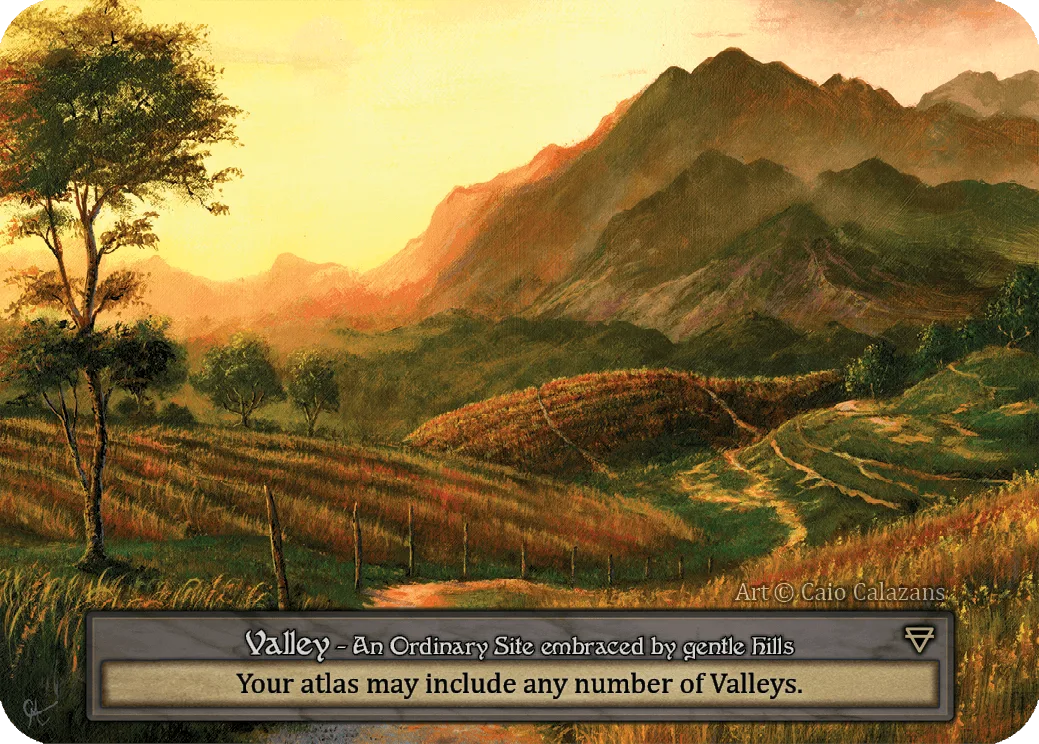
Valley by Caio Calazans — via Curiosa
So when you look at your opening six, you're asking two questions simultaneously: Do my three sites give me a playable curve and the threshold I need? and Do my three spells include something I can cast on turns 1-2 with the sites I have? The answer to both has to be yes for a clean keep. Either being a soft maybe is when the mulligan question starts to matter.
You can read the official deck construction rules in full on the Constructed format page — 60-card minimum Spellbook (raised from 50 in the December 2025 update) and 30-card minimum Atlas.
When to keep your opening hand
A working heuristic, in priority order:
1. At least one site you can play turn 1. The first Site you play sets your first turn's mana (1 mana) and your first turn's threshold. If none of your three sites unlocks the threshold you'd need for your cheapest spell, you're starting on a back foot.
2. At least one spell you can cast in turns 1-3. Two-cost spells in your opening hand are gold. Three-cost spells are fine if your Atlas gives you the threshold. Four-plus spells in an opening hand are dead weight unless your deck specifically wants to ramp into them and you have the sites for it.
3. Atlas threshold continuity. Three Sites in hand should not all share the same liability — three Sites that all give Earth threshold are great if you're mono-Earth, terrible if your Spellbook needs Fire and Water. Mismatched threshold against your Spellbook is the most common reason an otherwise reasonable hand is actually a mulligan.
4. No card that strands you. A high-cost Unique you can't cast for six turns is functionally a dead draw in your opening. If two of your three spells fit this profile, the hand mulligans.
The first two are the most important. If you have a turn-1 site and a turn-2 spell that lines up with your threshold, the rest is usually fine even if it's mediocre. Sorcery games are won and lost in the early board state — sites in the right places, threats on the table by turn 3 — and a slow opening is usually a losing opening regardless of what's behind it.
When to mulligan
The mirror of the above. Mulligan when:
No playable Site for turn 1. Three Sites in your opening hand, none of which match your Spellbook's threshold needs. This happens. Don't keep.
No cheap spell to cast. Three spells in hand, all costing four or more, and your Atlas isn't double-threshold enough to ramp into them. This is a clear send-back.
Hand requires perfect topdecks. If your hand is "keep these and hope I draw the right thing the next three turns," that's not a hand. That's a prayer. The 3-card cap exists exactly to make these moments meaningful, not to be sidestepped by hoping.
Threshold doesn't develop. Your three sites give you (1 Earth), and your Spellbook needs (1 Air)(2 Water) by turn 4. The sites would all be live as mana, but useless for unlocking anything. Send back.
Aggro decks mulligan more aggressively than control. If your deck wins by curving out a turn-1 cheap minion into a turn-2 stronger minion into a turn-3 finisher, a slow opening is a loss in motion — mulligan for the curve. Control decks can absorb a slower opening; their game plan stabilizes later.
How the 3-card cap actually works
This is the part most people get wrong.
The cap is 3 total cards drawn in the mulligan, not "3 from each deck." You choose how to distribute. Three valid distributions:
- Put back 3 from your Spellbook → draw 3 fresh from your Spellbook. Your Atlas opener is locked.
- Put back 3 from your Atlas → draw 3 fresh from your Atlas. Your Spellbook opener is locked.
- Put back 1 from your Atlas and 2 from your Spellbook → draw 1 fresh Atlas card and 2 fresh Spellbook cards. Any split that adds to 3 or less is legal.
You cannot put back 4 cards and draw 3. The cap is on the total cards drawn in the mulligan. If you somehow wanted to put back more than three (you probably don't, but let's name it for completeness), you are limited to three back, three drawn.
You also cannot mulligan a second time. One window per game. Whatever you have after the mulligan is your starting hand.
A worked example. Opening hand: three sites you like (a Water site, an Air site, and a Fire site) and three spells, two of which are too expensive for the first four turns. You decide to keep all three sites and put back the two expensive spells. You draw two replacement spells. You're done — you ended on a 6-card hand (3 sites + 3 spells), but two of those spells are now different. You didn't use the full 3-card cap; you used 2 of it. That is allowed. There is no penalty for under-using the cap, and no benefit for using all 3 if you don't need to.
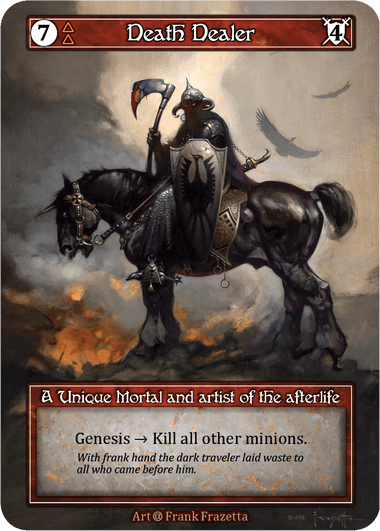
Death Dealer by Frank Frazetta — via Curiosa
The strategic implication is this: you mulligan toward fixing the worst thing in your hand, not toward perfection. Three new cards is a tight budget. Don't waste pulls trying to find a specific spell — pull what you don't want and accept what comes back. If you're chasing a Death Dealer or a similar premium late-game piece, your mulligan won't fix that. The 3-card cap is designed to keep that kind of card a real reveal, not a search result.
Mulligan strategy by avatar and archetype
Different decks want different opening hands. A rough taxonomy:
Aggro (curve-out). Mulligan harder for early-cost spells. A 4-cost minion in your opening hand is often dead weight; a 1- or 2-cost minion in your opening hand is win-rate gold. Send back high-cost cards aggressively.
Ramp/Atlas-heavy. Mulligan harder for an early Atlas curve. You need to land sites turn 1, turn 2, turn 3, ideally hitting your threshold for a key payoff by turn 4. If your Atlas opener doesn't develop fast, the deck's win condition is delayed.
Control. Mulligan softer. Control decks have answers in their Spellbook designed for any board state, so a "weird" opening with a strange mix of cards is often still keepable. The risk of mulliganing into something worse outweighs the upside of optimizing the opening.
Combo. Mulligan harder, narrower. You need specific cards to assemble a combo, but the mulligan only gives you 3 redraws across both decks. Don't burn the cap chasing a specific piece — keep openings that put you on the path even if they're slow, send back openings that have nothing combo-related at all. Browse the deckbuilders and tools in the directory to pull a public archetype list and practice mulligan calls against real decks.
These are heuristics, not rules. The reason there is no canonical "mulligan guide by archetype" yet is that Sorcery's competitive scene is still young and most archetypes are still being refined post-Gothic.
What about Gothic and the Collection?
A common question worth answering directly: the Collection does not affect mulligan rules.
Gothic introduced the Collection, a third zone of up to 10 cards outside your Spellbook and Atlas. The Collection is accessed during play via specific card effects (cards that read "from your Collection") — it is not part of your starting hand, not part of your mulligan, and not drawn from in any opening procedure.
You still open with 3 from Spellbook + 3 from Atlas. You still get one mulligan with a 3-card cap. The Collection sits on the side, untouched at game start. The opening hand mechanics are unchanged from the original 50-card-Spellbook era, even though the Spellbook itself is now 60 cards minimum.
That also means the math has shifted slightly. A 3-card Atlas dig from a 30-card Atlas is the same 10% peek it always was. A 3-card Spellbook dig from a 60-card Spellbook is 5%, where it used to be 6% from a 50-card Spellbook. The cap got marginally more conservative when Spellbooks grew — which is consistent with the publisher's design intent of making opening-hand variance meaningful.
Drilling the decision
The fastest way to internalize when to mulligan is to play a hundred openings and pay attention to which keeps lost early and which mulligans rescued a game. The cheapest place to do this is on Tabletop Simulator — the official Sorcery TCG mod handles the deal honestly and you can re-rack and re-deal endlessly without burning paper sleeves. Combine that with a deck built in Curiosa and you have a free, repeatable openings drill.
A few hands in, the keep/mulligan call becomes faster than reading this article. It just takes the reps.
Where to go from here
- Sorcery Threshold and Sites, Explained — why your three opening Sites matter more than they look
- Every Sorcery Format, Explained — Constructed, Draft, and Sealed all use the same mulligan rule
- How to Play Sorcery Online, Explained — drill openings on the official TTS mod
- Curiosa.io, the Official Sorcery Deckbuilder, Explained — build the deck you'll be mulliganing
- Start Here directory section — the curated newcomer reading list if mulligan strategy still feels abstract
Sources
- Sorcery: Contested Realm Rules Update (July 2024) — the 3-card mulligan cap announcement and publisher's design rationale — published 2024-06-28
- Sorcery: Contested Realm Rulebook 2024 — canonical opening hand rules
- Sorcery: Contested Realm December 2025 Rulebook Update — Spellbook expansion to 60 cards, glossary additions — published 2025-12-19
- What You Carry With You — Collection and Deck Sizes in Gothic — Collection mechanic explainer
- Sorcery TCG Constructed format — deck construction rules
- Sorcery: Contested Realm Rules Update (July 2025) — most recent rules update; mulligan rules unchanged