Every game of Sorcery: Contested Realm starts the same way. Two players, two Avatar cards face up on the table. Each Avatar has 20 life printed on it — that's the win condition for everyone. Reduce your opponent's Avatar to zero before they do the same to you. The element on the Avatar card (Fire, Air, Water, Earth, or none) gates which spells you can play. The ability on the card is what you tap to do every turn.
Pick wrong and you'll struggle for half the game before you figure out what your deck wants to do. Pick right and the Avatar carries the whole strategy.
This article walks through every playable Avatar — 34 in total, across Alpha, Beta, Arthurian Legends, Dragonlord, Gothic, and one Draft-Kit promo — what each one does, what kind of deck it builds, and who it's for. Ability text is pulled verbatim from the official Sorcery TCG card API and cross-checked against Curiosa — the directory's Deckbuilders & Tools section lists Curiosa alongside the smaller utilities that orbit it.
How to read this
For every Avatar below: card image with artist credit, a one-line flavor read, then a short editorial take — what the ability does in plain English, the archetype it builds, who it's for (beginner / intermediate / competitive), and any meta context worth knowing.
Starting life is always 20 — every Avatar in the game. Skipping that field per entry.
Alpha Avatars (11)
Alpha is the foundation set. Eleven of the game's 34 Avatars are Alpha cards — the four elementals plus the seven no-element generics. Most got reprinted in Beta and as promos; the design DNA of every later Avatar traces back to this pool.
The four elementals. Beta's preconstructed decks shipped with four "Avatar of [Element]" cards — the training-wheels set, all mono-element, all designed to teach you what the element does. They're Alpha cards reprinted in Beta. If you're new, pick one of these.
Avatar of Air
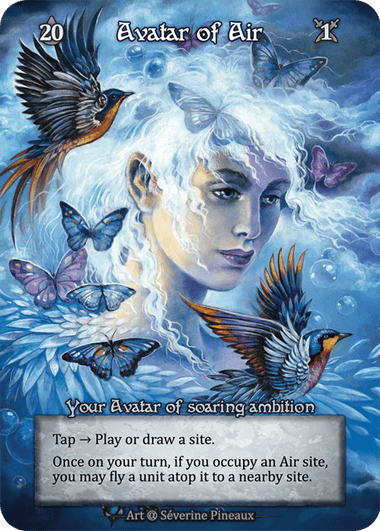
Avatar of Air by Séverine Pineaux — via Curiosa
All wind, no walls. Move first; argue later.
Once a turn, if you're standing on an Air site, you can pick a unit on top of you and teleport it to an adjacent square. That's the whole engine — a free repositioning every turn. It rewards players who learn to think about the board first and the cards second, which is the lesson every Sorcery player needs eventually. Beginner archetype, mobility deck. Aggressive flyers, board control via positioning. The conditional ("if you occupy an Air site") is the only friction, and it's exactly the friction that teaches you to read the grid.
Avatar of Earth
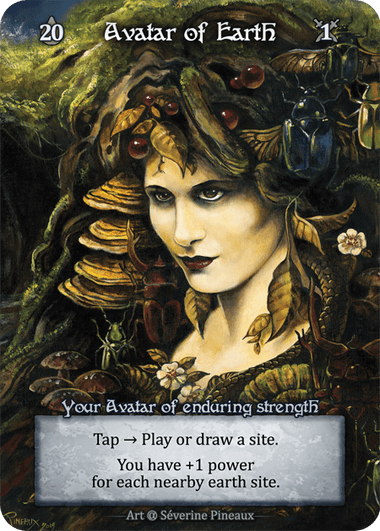
Avatar of Earth by Séverine Pineaux — via Curiosa
Plant the feet. Punch with the mountain.
Every earth site adjacent to you adds +1 power, full stop. No conditions, no timing window — your Avatar simply gets bigger the more Earth you build. This is the closest Sorcery gets to a Voltron deck in Magic terms: you are the win condition, and minions exist to clear lanes. Beginner-friendly because the plan reads in one sentence. The cap is the grid itself — only four squares can ever be adjacent to you, so the ceiling is built in.
Avatar of Fire
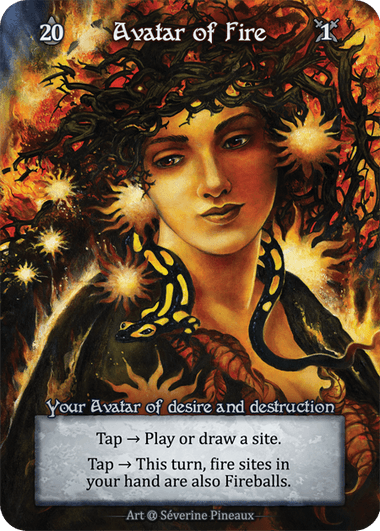
Avatar of Fire by Séverine Pineaux — via Curiosa
Every site in hand is a bomb you haven't thrown yet.
For one turn at a time, the Fire sites in your hand become Fireballs you can cast. The trade is the whole game: every site you burn for damage is a site you don't have for mana later. Pure burn archetype, and the most legible introduction to resource conversion in the game — you're trading tomorrow's economy for today's reach. Beginner-friendly because the math is right there on the table. You'll learn to count when to push and when to land sites by losing a few of these.
Avatar of Water
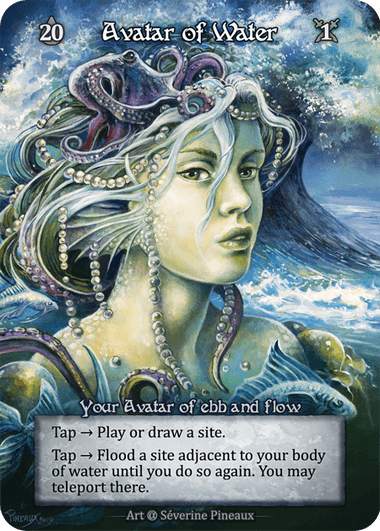
Avatar of Water by Séverine Pineaux — via Curiosa
Patience as a weapon. The flood arrives on schedule.
Tap to convert an adjacent enemy site into a body of water — flooded sites can't host most units, and anything stranded there is effectively benched. Board control archetype, and the slowest read of the four elementals. Water rewards patience and punishes premature commitment, which is a hard sell to a new player. If you find yourself losing the first few games not because you misplayed but because you ran out of game while still ahead, this is the Avatar teaching you to clock yourself.
The seven no-element Avatars. Alpha also shipped seven Avatars with no element. They have an additional cost to play (you bring your own elemental threshold via spells and sites), but the abilities are interesting enough that competitive lists pick them often. All seven were reprinted in Beta.
Sorcerer
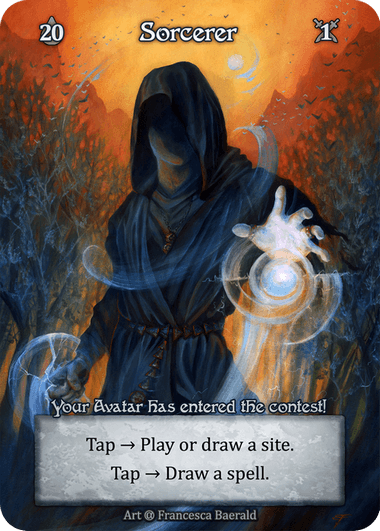
Sorcerer by Francesca Baerald — via Curiosa
Card draw is the deck. Card draw was always the deck.
A colorless engine with the bluntest ability in the Alpha set: spend your tap to draw a spell, every turn, no conditions. It looks plain on paper and over a long match it's the most useful thing on the table, because card advantage is the single most reliable resource in any deck game. Sorcerer is the genuinely good first pick for a Magic player — you already know what to do with a draw engine. Beginner-to-competitive, archetype-agnostic. Collector note: the Organized Play foil promo features alternate art by Frank Frazetta — the highest-profile illustrator in the game's roster and a secondary-market heavyweight.
Elementalist
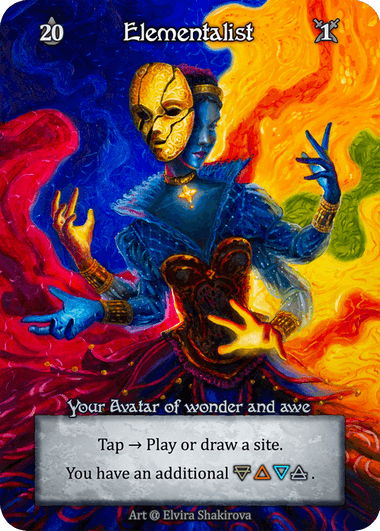
Elementalist by Elvira Shakirova — via Curiosa
Speaks every element fluently. Specialises in none.
A colorless four-color enabler: you start the game with one free threshold in every element — Earth, Fire, Water, Air, all at one. That sounds modest until you remember most multi-element cards only need a single point of off-element threshold to cast. Elementalist makes a four-color spellbook viable without committing your Atlas to it, which is otherwise nearly impossible. Intermediate. Deckbuilding gets harder, not easier — you have access to everything, which means every cut becomes a real choice.
Battlemage
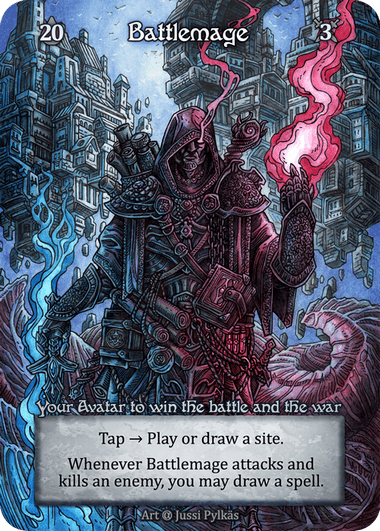
Battlemage by Jussi Pylkäs — via Curiosa
Swing into harm; cards fall out.
Every time Battlemage attacks and kills something, you draw a spell. A colorless attacker — the Avatar wants to be the one swinging, which is unusual for the no-element pool where most Alpha generics sit back. The trick is that "kill" is the trigger, not "attack," so you need to bring the Avatar into fights it actually wins. Intermediate. Pairs naturally with buffs and removal that clear a path — give yourself the kill, take the card, repeat.
Deathspeaker
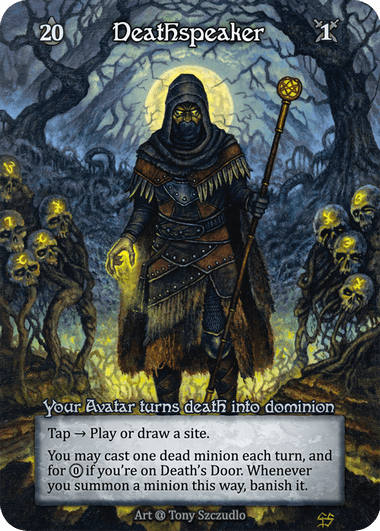
Deathspeaker by Tony Szczudlo — via Curiosa
Death is recyclable. Use both sides.
A colorless reanimator built around the Death theme. Once a turn, exile a dead minion to cast a free copy of it — and when you're on Death's Door, the copy costs zero, which turns the worst position in the game into your best engine turn. The whole deck is built around feeding the graveyard and then mining it. Intermediate, and a textbook sleeper: every potential opponent fears graveyard hate against this Avatar, and almost no one actually runs it. The few who do will wreck you; everyone else hands you the game on a plate.
Enchantress
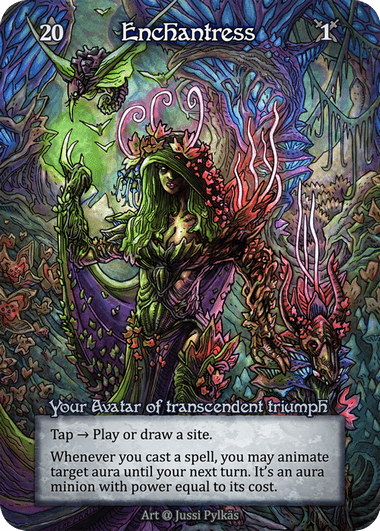
Enchantress by Jussi Pylkäs — via Curiosa
Auras want a body. She provides.
A colorless aura-combo Avatar. Every spell you cast lets you temporarily animate an aura — turning a passive enchantment into a living minion whose power equals its cost. The cards that benefit most are the expensive auras almost nobody plays, because suddenly that 6-cost buff is also a 6-power body. Aura-combo archetype, intermediate. It's narrow — you need a critical mass of auras worth animating, and most boards have one or two — but when the gears mesh the deck does things no other Avatar can.
Pathfinder
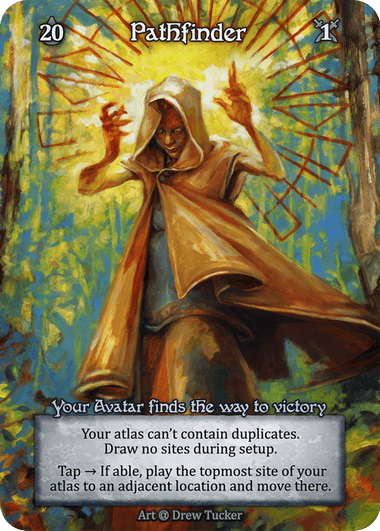
Pathfinder by Drew Tucker — via Curiosa
Sites are weapons. Throw them faster.
A colorless tempo Avatar with hard restrictions: no duplicate sites in your Atlas, no opening site draw. The payoff: every turn you flip the top of your Atlas, slam it onto an adjacent empty square, and step onto it. Free site, free movement, free repositioning, every single turn. The most aggressively tempo-positive Avatar in the game and the closest Sorcery gets to a pure speed deck. Intermediate. The pre-game cost (a tighter Atlas) and the variance (you play what you flip, not what you want) are both real, but a Pathfinder pilot who can think two squares ahead is brutal to face.
Seer
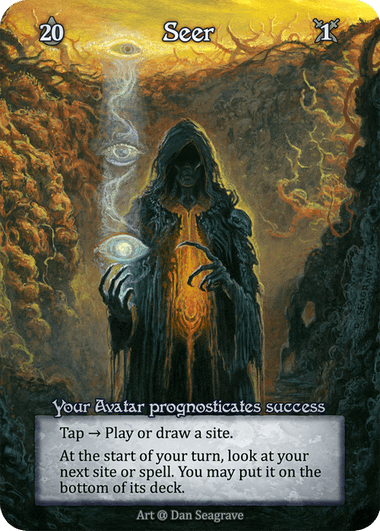
Seer by Dan Seagrave — via Curiosa
Sees what's coming. Decides what stays.
A colorless toolbox/control Avatar. At the start of every turn you scry one — peek at the top of either deck and choose whether to keep it on top or bury it. Quiet, constant deck sculpting that compounds across a long game. Intermediate. The skill is knowing what your future self actually needs to draw, which is harder than it sounds; most newer pilots blink the top card past situations where they should have buried it. When you start consistently making the right call, you stop losing games to luck.
Beta Avatars (4)
Beta's booster set added four named Avatars for the four elements — same color identity as the training-wheels four, sharper abilities, harder to pilot. These are what you graduate to when the elementals start feeling shallow.
Sparkmage
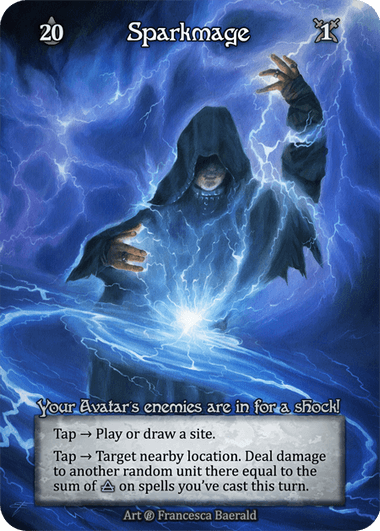
Sparkmage by Francesca Baerald — via Curiosa
Cheap spells, expensive endings.
Every Air spell you cast in a turn adds up — and Sparkmage can then tap to deal that total as damage to a random unit on the same square. The "random" clause is the catch: you can't pick the target, so the whole game becomes about engineering boardstates where every potential target is one you'd happily kill. Spellslinger archetype, intermediate. Skill ceiling is high because lining up the spike means controlling what's standing on a square three turns before the trigger.
Geomancer
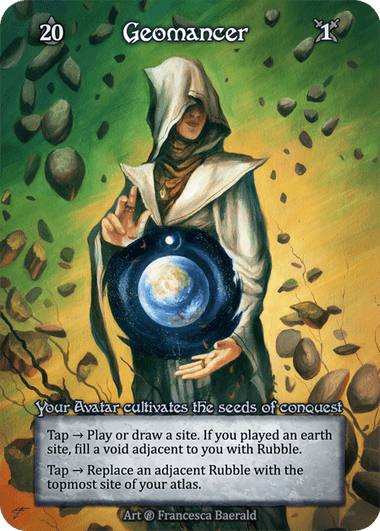
Geomancer by Francesca Baerald — via Curiosa
Earth grows under the feet. So does the atlas.
Playing an earth site drops free Rubble onto an adjacent empty square; tapping Geomancer converts that Rubble into the next site off your Atlas. Two abilities, one feedback loop — your board builds itself faster than any other Avatar in the game. Beginner-to-intermediate, ramp + sites-matter. The engine is easy to start; the skill is choosing which adjacent square gets the Rubble, because that decision locks in your geography for the rest of the match.
Flamecaller
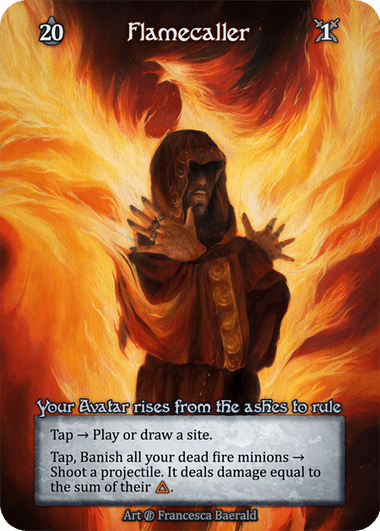
Flamecaller by Francesca Baerald — via Curiosa
Burn what's dead so the living don't see it coming.
Exile every dead Fire minion in your cemetery as fuel for one projectile, damage equal to the total Fire threshold spent. The deck explicitly wants its own creatures to die — dead Fire minions aren't a loss, they're ammunition. Cemetery-fuel burn, intermediate. The actual decision is timing: pop the ability too early and the spike is weak; hold too long and the opponent stabilises. Picking the right turn is the whole skill, and Flamecaller is the Avatar that teaches you to recognise that turn.
Waveshaper
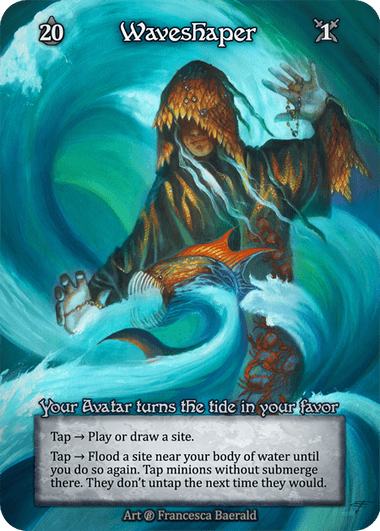
Waveshaper by Francesca Baerald — via Curiosa
Lock the board. Drown the rest.
Flood a site near your body of water and every non-submerge minion on it gets locked down — tapped, and unable to untap on its next turn. It's stronger than Avatar of Water because it's persistent: the flood stays until you move it. Lockdown control, intermediate. Brutal against decks without submerge keyword cards, which is most decks. The skill is target selection — picking which square to drown matters more than the mechanic itself, because you only have one active flood at a time.
Arthurian Legends Avatars (4)
Arthurian (October 2024) added four new Avatars themed around the cycle.
Templar
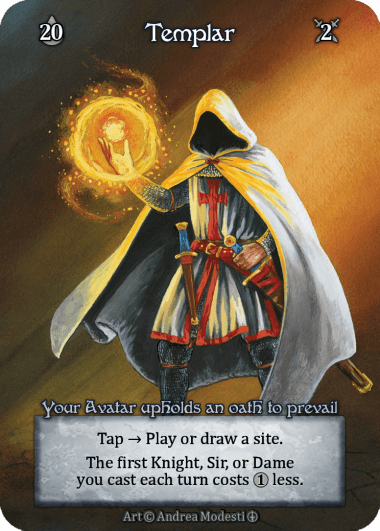
Templar by Andrea Modesti — via Curiosa
Knights cost less when the Templar's leading.
A colorless Knight-tribal Avatar. The first Knight, Sir, or Dame you cast each turn costs one less. Modest in isolation; structural across a full Knight-tribal Spellbook. The Avatar essentially gives you a free mana every turn provided you're casting on-tribe, which compounds into a tempo lead Knight decks otherwise struggle to find. Intermediate, tribal payoff. Worth noting: tribal is one of the smaller archetype pools in Sorcery, so Templar is also the Avatar that makes the archetype playable in the first place.
Druid
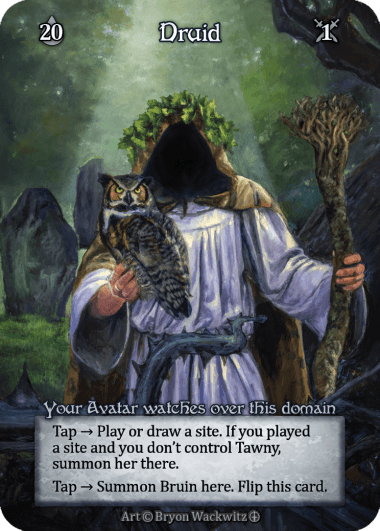
Druid by Bryon Wackwitz — via Curiosa
Front or back, the bear comes too.
A colorless transforming Avatar — the only one in the game that flips. The front side summons Tawny on your first turn for free; later, you can transform to the back side which summons Bruin on demand and flips you back into front-side mode the next turn. Two companion creatures, free, and the Avatar's effective threat density is doubled before you cast a single spell. Competitive — Druid won 2025 Crossroads Melbourne in a mono-Water shell. The transform mechanic is unique to this Avatar, which makes it the closest thing the game has to a planeswalker.
Archimago
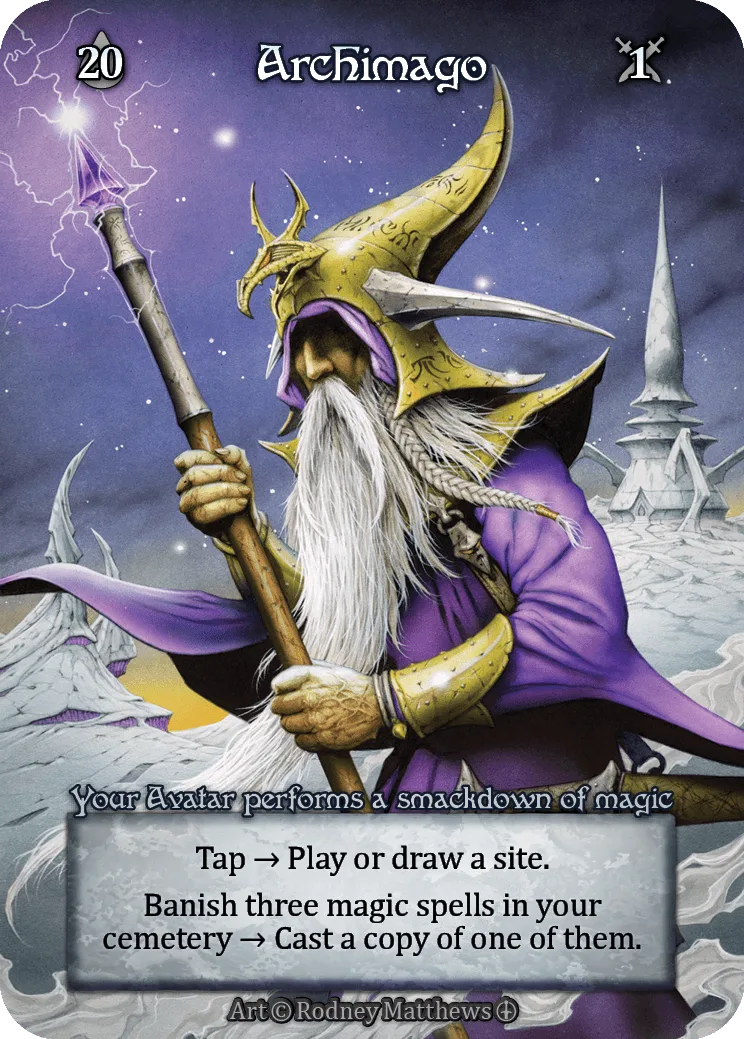
Archimago by Rodney Matthews — via Curiosa
Cast it. Cast it again. Cast it once more for luck.
A colorless spell-recursion Avatar: exile any three magic spells from your cemetery and cast a free copy of one of them. The math is generous: three for one, with full choice of which one. The deck wants you to dump cheap magics early and bank the value for a late-game flood of free copies of your best spell. Intermediate-to-competitive, the same sleeper profile as Deathspeaker — feared dead by cemetery hate that almost nobody runs. One of the most under-played strong Avatars in the format right now.
Witch
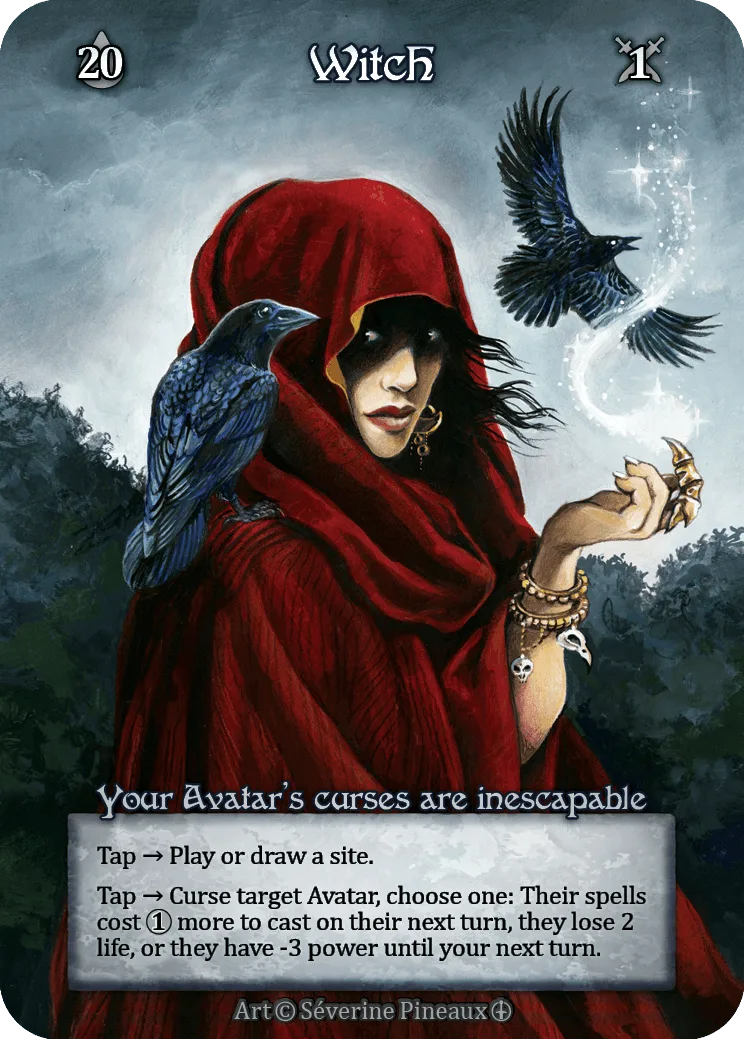
Witch by Séverine Pineaux — via Curiosa
Curses don't ask. They land first; the rules catch up later.
A colorless pure-disruption Avatar. Each turn, pick one curse and slap it on the opposing Avatar: their next-turn spells cost more, or they take two damage, or they swing for three less. Three answers in one slot, every turn, no resource cost. The most flexible "hurt the other Avatar" engine in the game. Intermediate. The mode you pick is read-the-board work — there's no wrong answer, but the wrong sequence still loses you tempo. Collector note: the Alpha Investments foil promo features alternate art by Frank Frazetta — the same Frazetta promo treatment Sorcerer gets, and it commands a similar premium.
Dragonlord Avatars (1)
Dragonlord (August 2025) is a 13-card mini-set themed around dragons and the people who command them. It adds exactly one Avatar — the eponymous Dragonlord, the mechanic-defining card for the whole expansion's identity.
Dragonlord
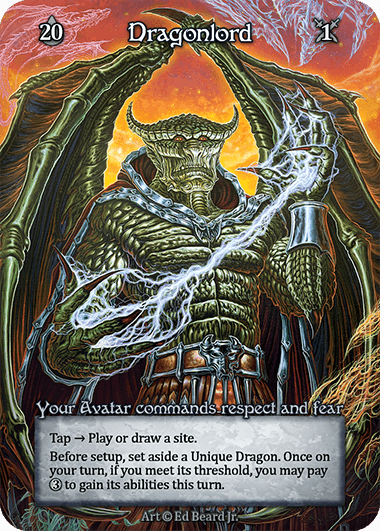
Dragonlord by Ed Beard Jr. — via Curiosa
Borrow the dragon's power. Keep the throne.
A colorless Avatar built entirely around Dragon synergy. Before setup you set aside a Unique Dragon outside your Spellbook. Each turn, if you have its threshold, you can pay three mana and become it for the turn — your Avatar inherits every ability the dragon has printed. The pick happens before any cards are dealt, so the dragon you choose isn't a draw, it's a deckbuilding commitment. Intermediate-to-competitive, ramp + payoff. The format-defining feature of the Dragonlord mini-set, and the closest Sorcery has come to a sideboard mechanic — picking the right dragon for the expected meta is half the work.
Gothic Avatars (13)
Gothic (December 2025) shipped thirteen new Avatars, the largest single-set Avatar drop in the game's history. Four of them ship in alternate-art form inside the Prophets of Doom preconstructed decks; the other nine come exclusively from boosters.
The four Prophets of Doom precon Avatars. These each ship inside a dual-element Prophets of Doom deck. The element symbol isn't printed on the Avatar card itself — the precon deck supplies the threshold. Dan Seagrave painted alternate-art versions of all four for the precon decks themselves; the entries below show the main printings.
Savior
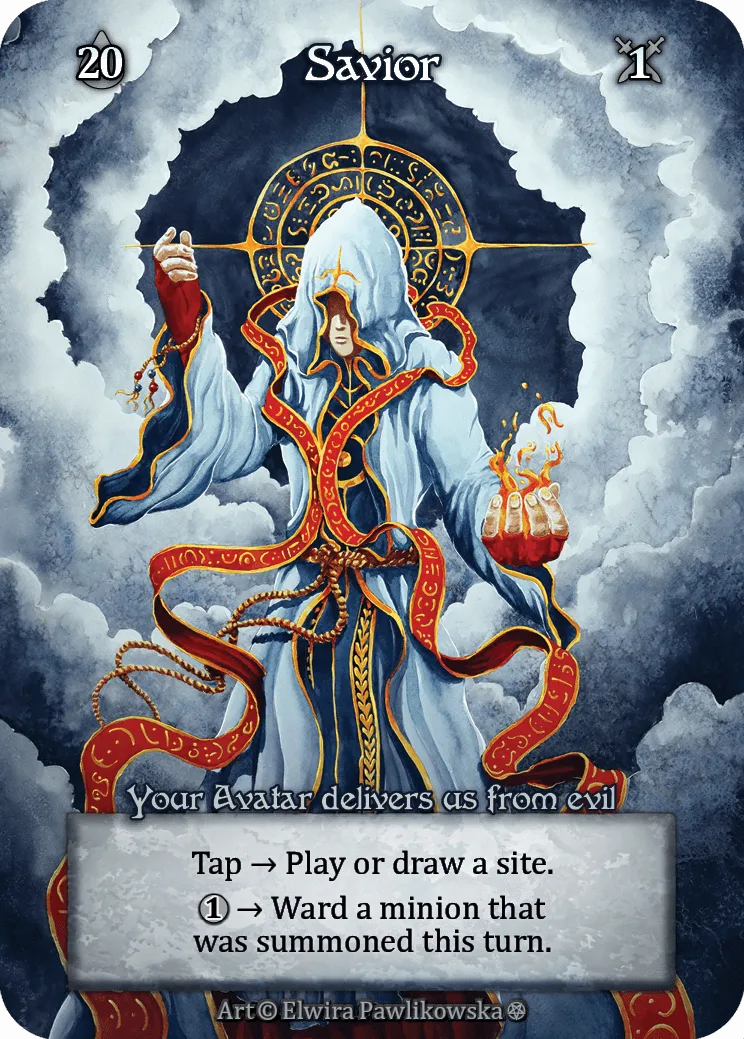
Savior by Elwira Pawlikowska — via Curiosa
Stand between the minion and the consequence.
A colorless protection Avatar. For one mana, Ward a minion that was summoned this turn — making it immune to the next instance of damage or targeting. Pure protection economy. Defensive archetype, beginner-to-competitive. Looks unremarkable on the card but it converts your most fragile turn (the one where you just dropped a big-cost minion into removal range) into your safest. Pairs with anything expensive enough to justify the ward.
Necromancer
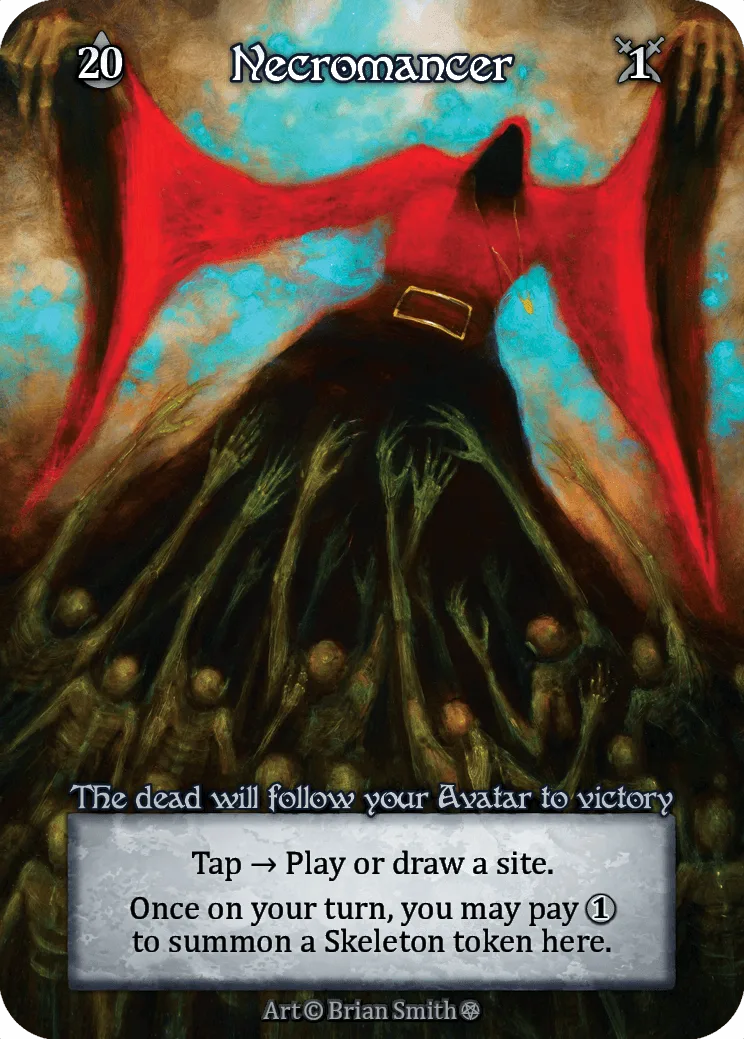
Necromancer by Brian Smith — via Curiosa
Bones build economies.
A colorless token engine. One mana, one Skeleton token, every turn, no synergy required. The simplest possible token engine and an underrated one — a permanent stream of free 1/1 bodies is enough to block, chump, and feed sacrifice effects without ever touching your Spellbook. Token-swarm archetype, beginner-to-competitive. The deck is cheap to pilot and brutally consistent; the ceiling depends on what you stack the tokens with. Pairs naturally with anything that rewards minion count or sacrifice.
Persecutor
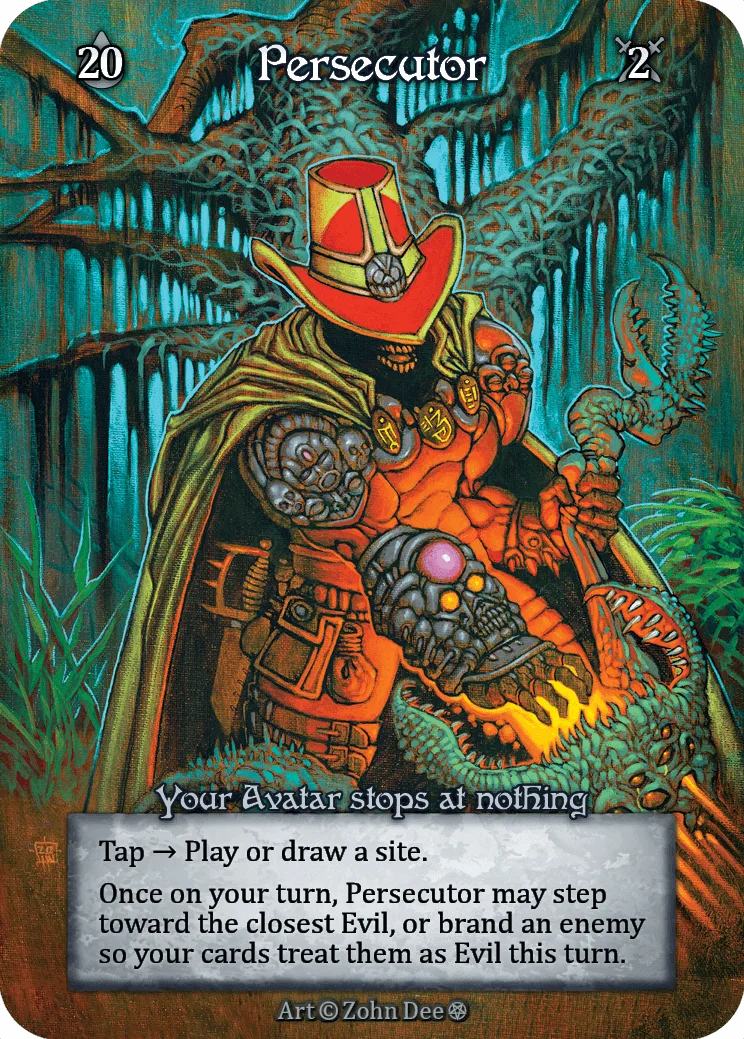
Persecutor by Zohn Dee — via Curiosa
Names every enemy. Then walks toward them.
A colorless Evil-tribal hunter. Each turn, pick one: step toward the nearest Evil in your region for free, or "brand" any enemy so your cards treat them as Evil for the rest of the turn. The brand option is what makes the kit work — it converts the entire Evil-tribe payoff suite into a generic anti-target package, because any enemy can be the target. Competitive, aggressive movement. Strong but underrepresented in the current meta; the brand mode in particular is one of the more elegant pieces of design in Gothic and most pilots don't squeeze enough out of it.
Harbinger
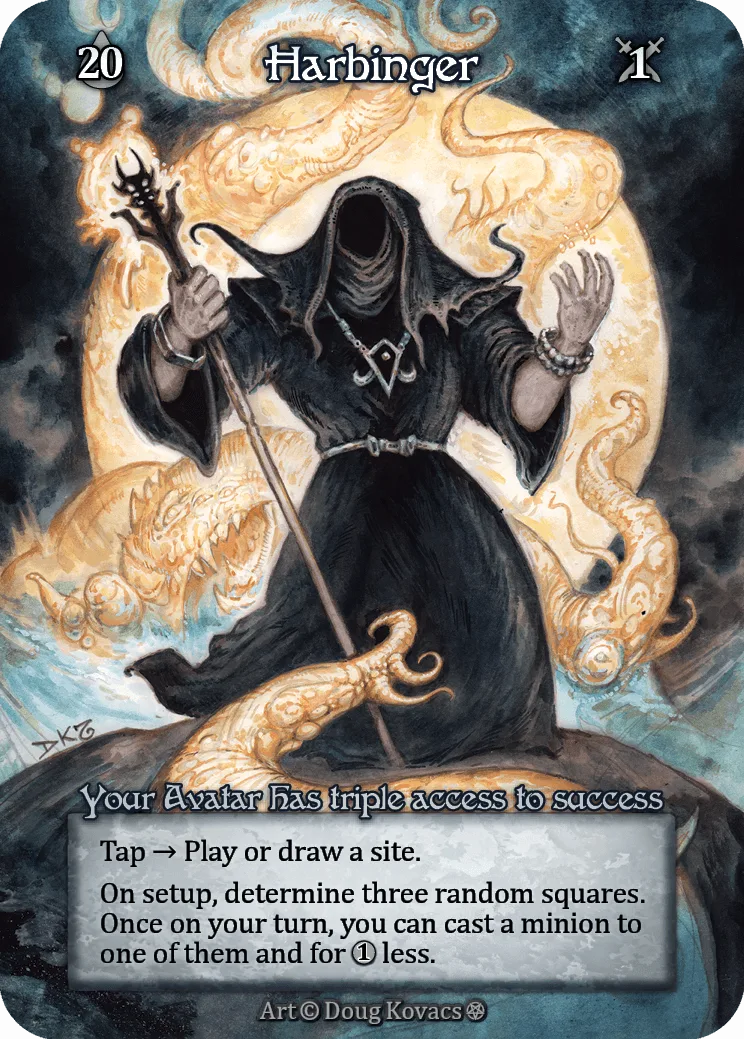
Harbinger by Doug Kovacs — via Curiosa
Sets three landmarks. Drops something terrible on each.
A colorless teleport-ramp Avatar. At setup you randomly mark three squares. From then on, any minion you cast onto one of those squares costs one less. The reach is the trick — your three "landing zones" can be anywhere on the grid, including squares deep in enemy territory you'd otherwise never reach. Big-minion ramp, competitive. Particularly punishing in matchups where the opponent expects threats to come up the board slowly; Harbinger lets you teleport-cast a top-end minion onto their doorstep for a discount.
The nine Gothic booster Avatars. These nine ship exclusively from Gothic booster packs — no precon shortcut.
Ironclad
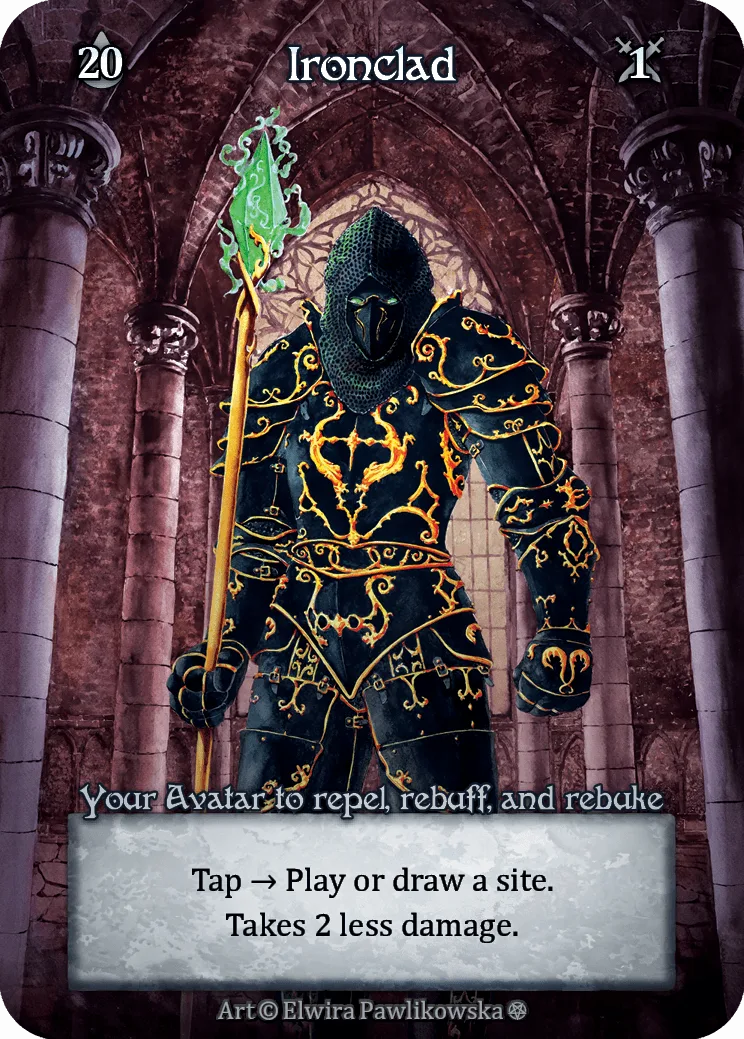
Ironclad by Elwira Pawlikowska — via Curiosa
Two less damage. Indefinitely.
A colorless defensive Avatar with a permanent, passive -2 to every damage instance hitting it. No tap, no trigger, no condition — every incoming hit just deals two less, every time. Turns three-damage burn spells into ones and two-damage chip swings into zero. Defensive voltron archetype, intermediate. The Avatar that punishes burn decks for existing, and probably the cleanest hate piece in Gothic. Doesn't shut anything off — it just taxes everything by two, every time, forever.
Bladedancer
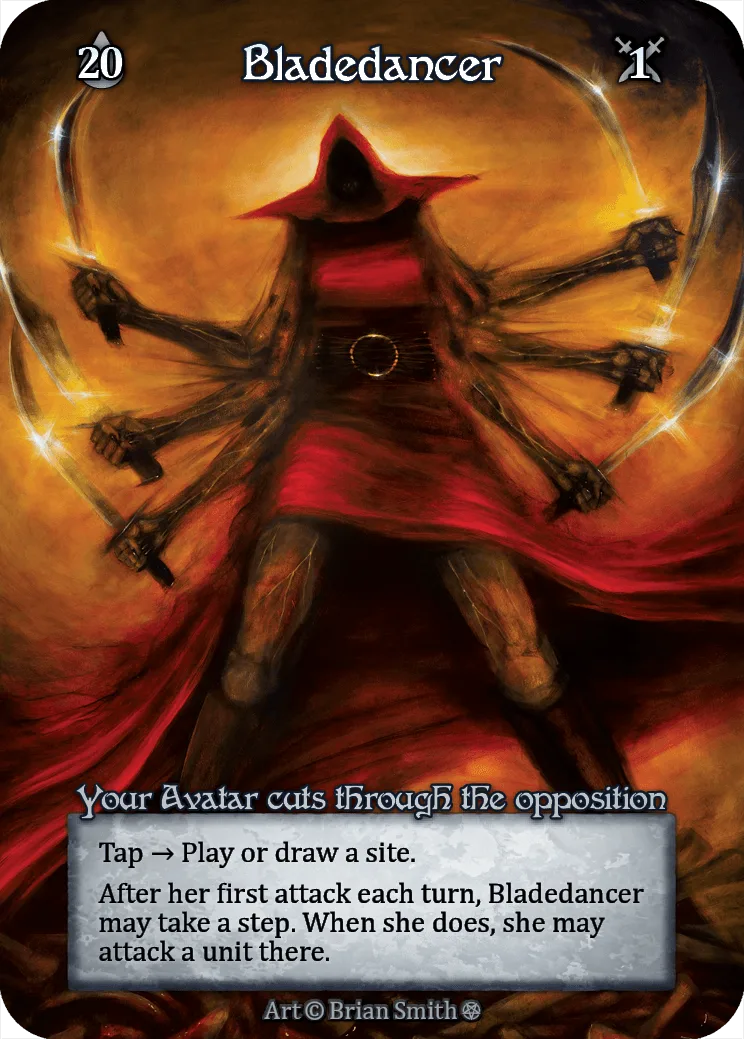
Bladedancer by Brian Smith — via Curiosa
Strike. Step. Strike again.
A colorless attacker. After Bladedancer's first attack each turn she can take a step — and if she ends that step next to something, she can attack again. Two attacks, free repositioning between them. The Avatar is the win condition; you don't need a minion package to close, just buffs and protection for the body that's already there. Intermediate, aggressive Voltron. Brutal in open boards because the second attack can almost always find a target; falls off in cluttered grids where she can't maneuver.
Interrogator
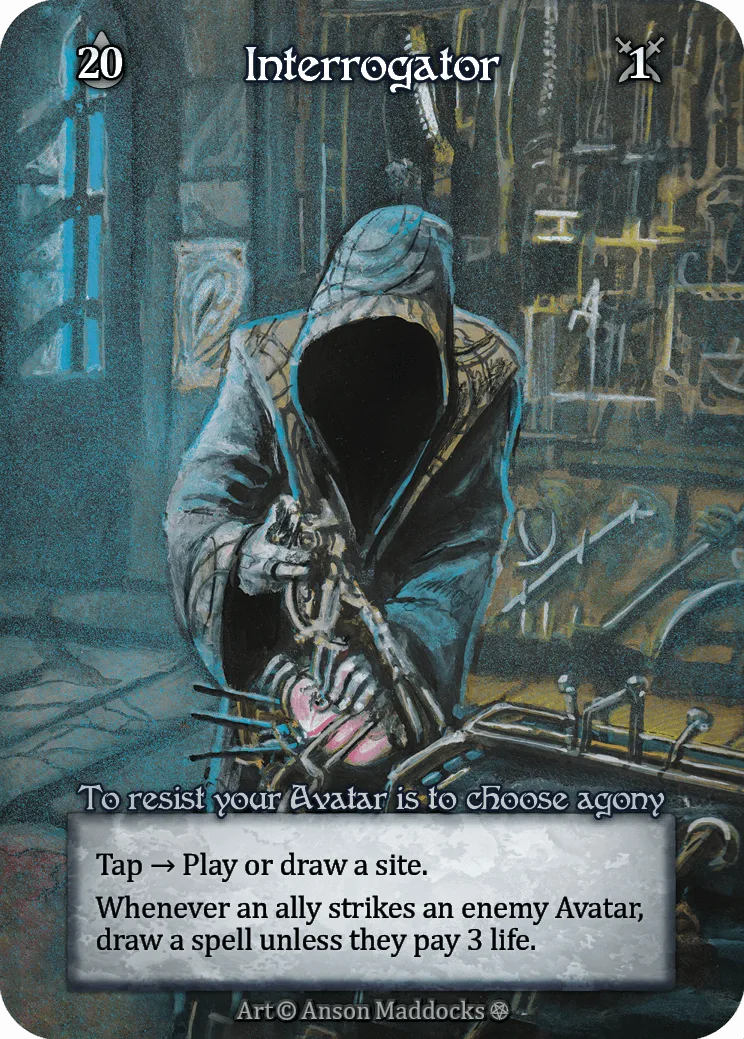
Interrogator by Anson Maddocks — via Curiosa
Cards or life. Either way, the deck gets paid.
A colorless card-advantage engine. Every time one of your minions hits the enemy Avatar, you draw a card unless they spend three life to deny it. That's the entire ability and it's the most dangerous trigger in the game right now. Three life is a real cost — about 15% of starting total — and refusing the draw means you've still taken the hit, so the opponent is bleeding either way. The Bardsword "Month into Gothic" report has Interrogator as the most-played competitive Avatar in the Gothic format for exactly this reason: it converts any aggressive minion package into a card-advantage engine without asking the pilot to commit to a single archetype.
The skill is on the other side of the table. Opponents have to triage every potential connection — pay the life, eat the card, or block — and the right answer changes every turn. Against an inexperienced pilot it just snowballs; against a thoughtful one it's still positive value most of the time. Competitive. The Avatar to beat in any tournament metagame conversation right now, and the Anson Maddocks art (his first credited Sorcery commission) makes it the most visually distinctive Gothic Avatar too.
Realm-Eater
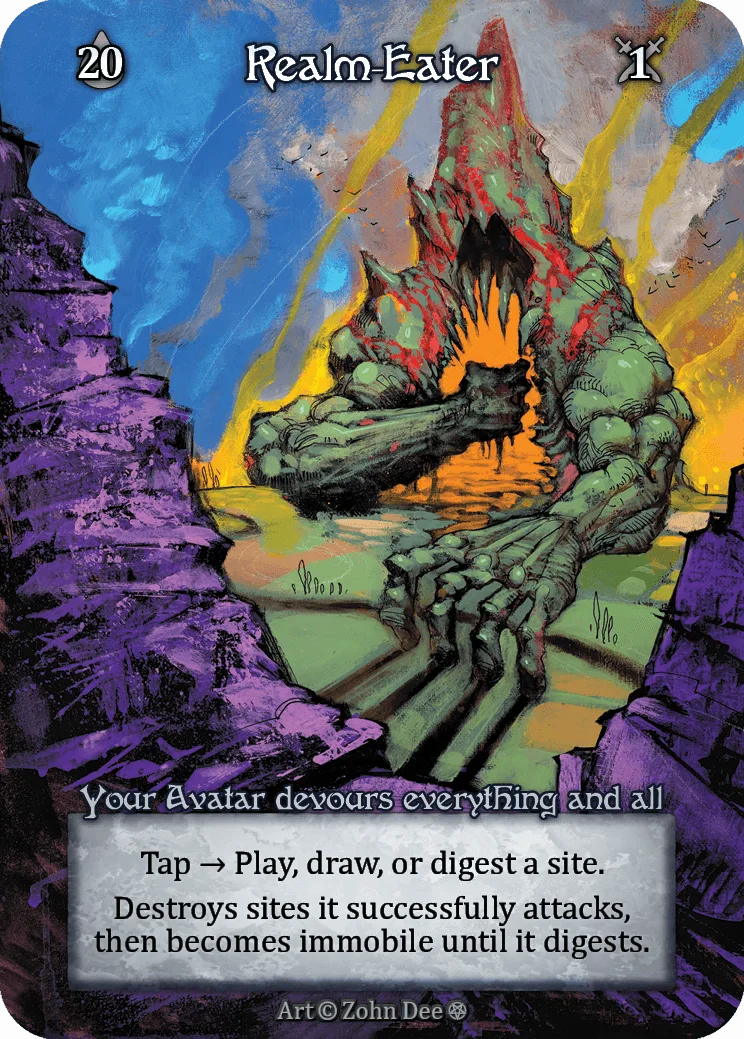
Realm-Eater by Zohn Dee — via Curiosa
Sites are food. Atlases are dinner.
A colorless site-disruption Avatar. Attack a site successfully and the Avatar eats it — the site is destroyed and Realm-Eater sits there immobile until it finishes digesting. That's the cost: every meal puts you on a timer where you can't move. Pure disruption, competitive. Punishes any deck that relies on a specific site footprint to function (which is most decks). The drawback is symmetrical and self-imposed — if your opponent has answers ready and you eat into the wrong square at the wrong time, the post-digest immobility window is a free turn for them.
Animist
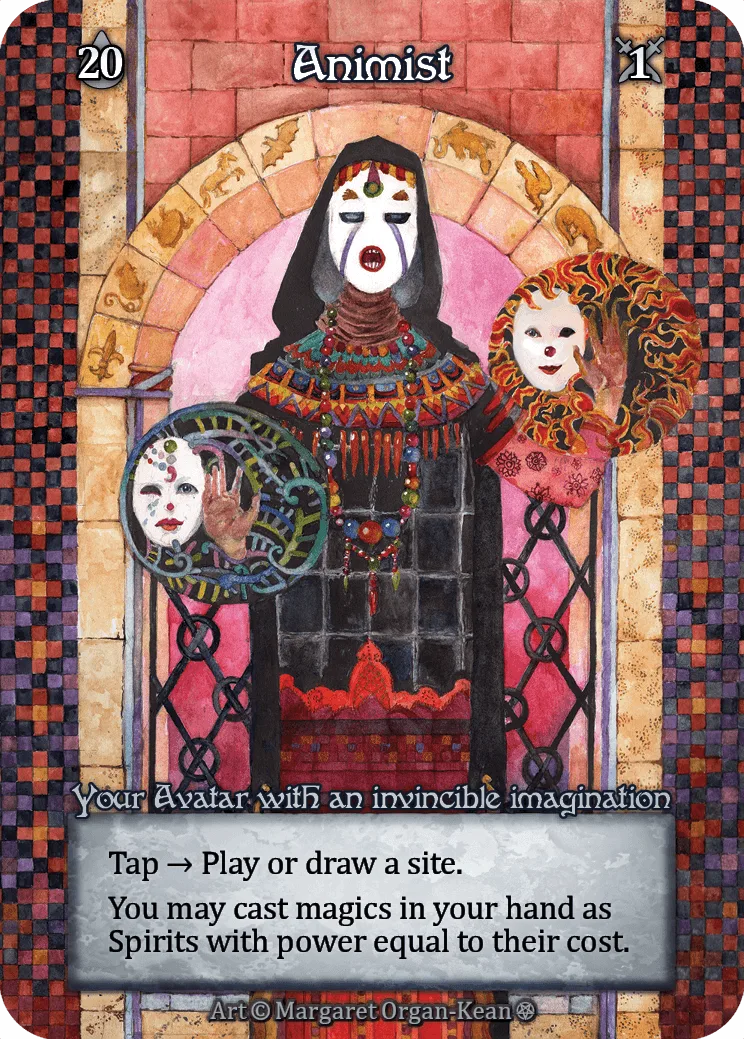
Animist by Margaret Organ-Kean — via Curiosa
Every spell wants to become a creature.
A colorless magic-as-minion Avatar. Any magic in your hand can be cast as a Spirit minion instead — power equal to the spell's cost. Suddenly your one-shot magics are minions that stick around. A 5-cost spell becomes a 5-power body; a 2-cost cantrip becomes a 2-power flex piece. Intermediate, magic-as-minion flexibility. The deckbuilding cost is real: the more magics you load up, the more vulnerable you are to magic-specific counters, and the Spirits don't keep their original spell effect. You're trading effect for body, which is sometimes the right trade and sometimes very much not.
Imposter
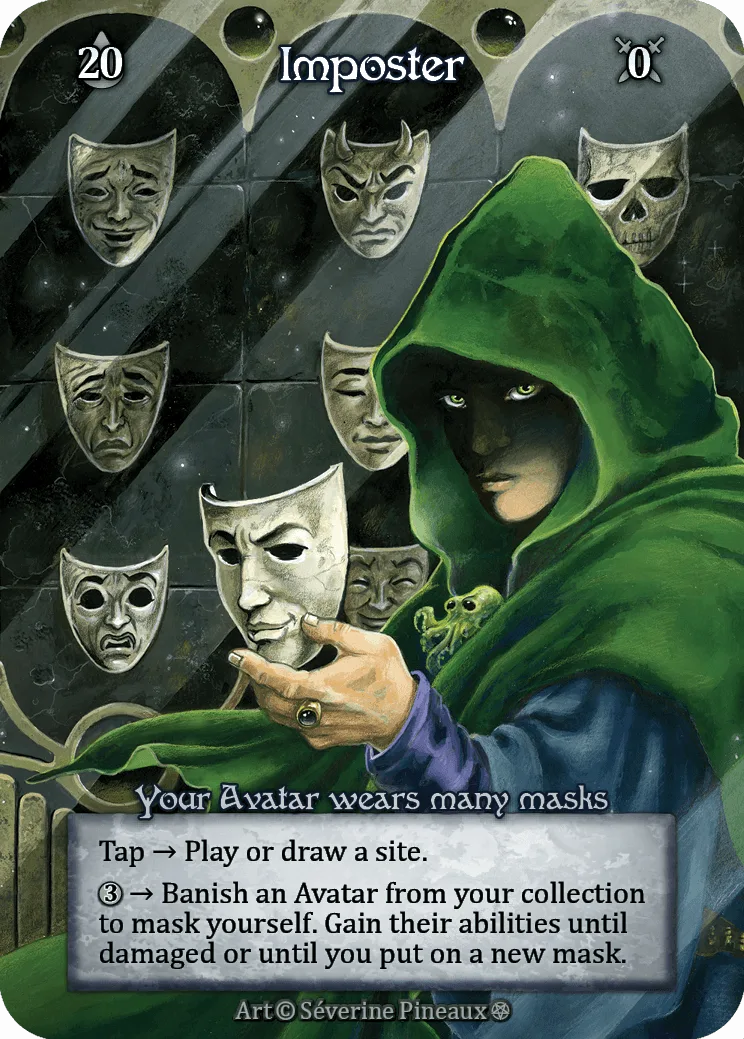
Imposter by Séverine Pineaux — via Curiosa
Steals abilities the way she steals masks.
A colorless adaptive toolbox. Spend three mana and any Avatar from your collection to put on a mask — Imposter now has that Avatar's abilities until she takes damage or swaps masks. The mask pool comes from outside your Spellbook, which means deckbuilding involves choosing which Avatars you bring as silver bullets. Adaptive toolbox, competitive. By a wide margin the most deck-building-intensive Avatar in the game — you're effectively designing a tiny sideboard of full Avatars, each one a different answer to a different matchup. Strong but requires the deepest collection of any Avatar to actually pilot well.
Corruptor
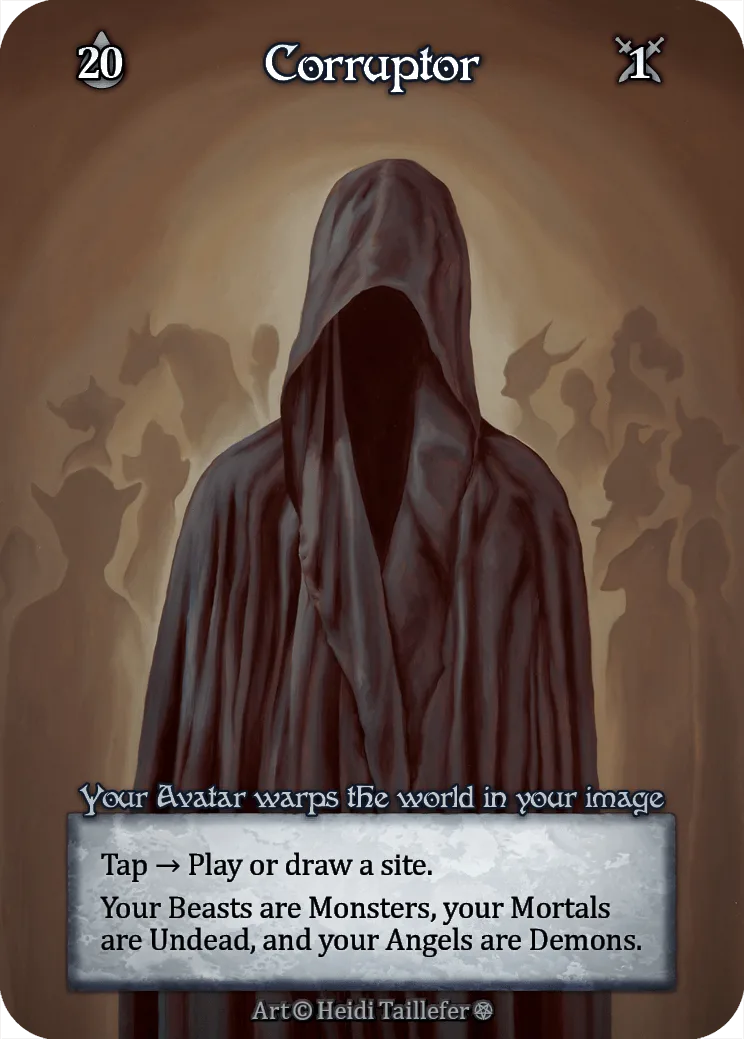
Corruptor by Heidi Taillefer — via Curiosa
Reframes the world's monsters. Then plays them.
A colorless tribal-shifter. Your Beasts count as Monsters, your Mortals count as Undead, your Angels count as Demons. Static, passive, and on at all times. The use case is purely deckbuilding: you can run any tribal payoff on the "evil" half of those pairs while filling the body slots from the "good" half. Intermediate, deckbuilding expansion. Niche but quietly powerful — there are payoffs in Gothic that explicitly reward Monster/Undead/Demon synergy, and Corruptor's the Avatar that lets you play those payoffs without committing to those tribes' weaker creature bases.
Duplicator
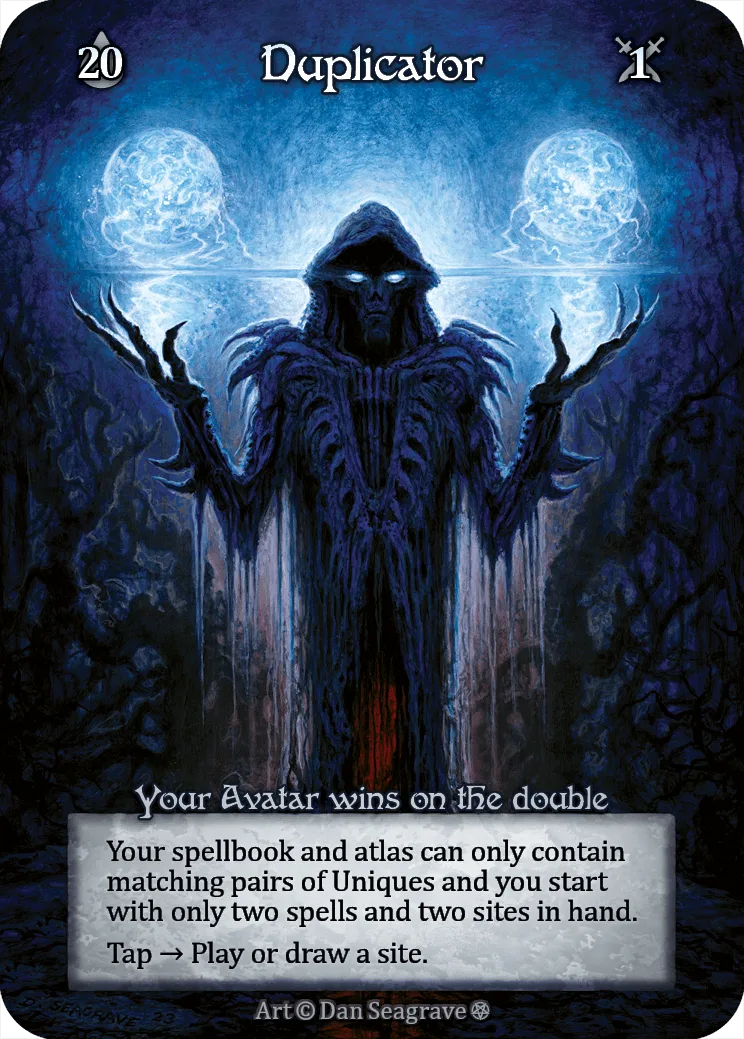
Duplicator by Dan Seagrave — via Curiosa
Wins on doubles. Loses on singles.
A colorless restricted-combo Avatar. Your Spellbook and Atlas can only contain matching pairs of Uniques, you open with two-and-two instead of seven-and-three, and any time you have a pair of the same Unique on the board the game cracks open in unpredictable ways. Pure restricted combo, jank tier. The deck either does something disgusting on turn six or rolls over. Loved by combo pilots, near-unfaceable for everyone else.
Magician
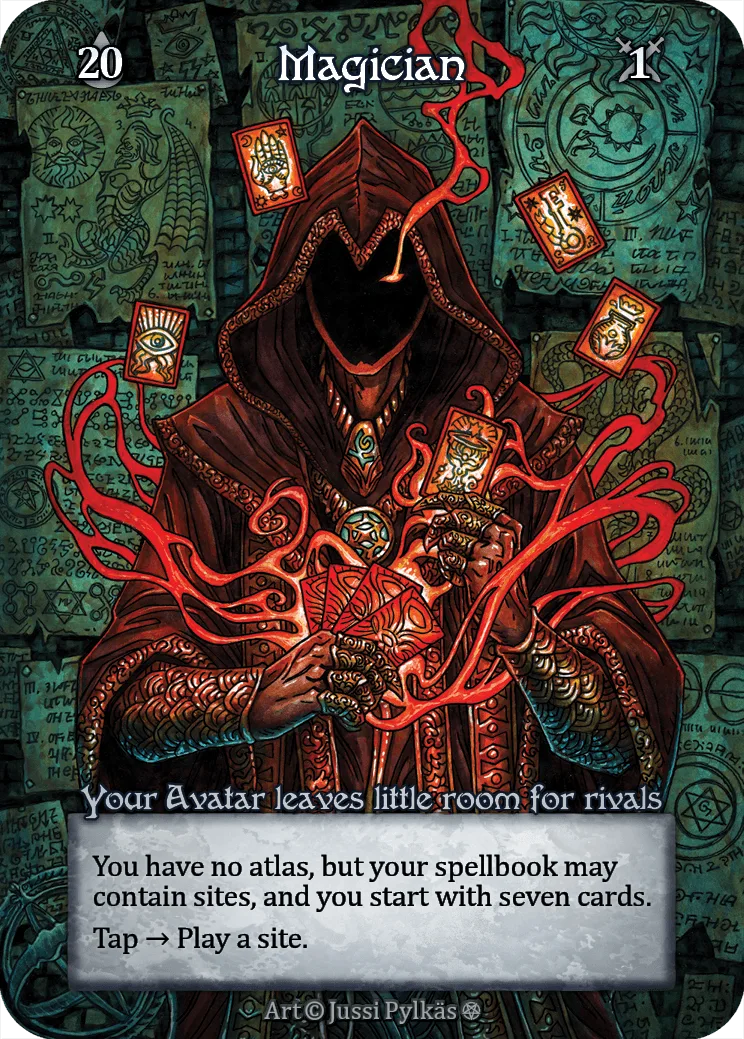
Magician by Jussi Pylkäs — via Curiosa
No atlas. No floor. Just spells, all the way down.
A colorless all-spells Avatar with no Atlas, period. Sites live in your Spellbook alongside everything else, you open with seven cards, and you can play a site on your tap. The whole resource model the rest of the game runs on is rewritten for this Avatar specifically. All-spells, jank tier. Wild variance — the opening hand is the entire game — but when it works you've got more flexible draws than anyone at the table. Deckbuilder's puzzle disguised as an Avatar.
Promotional Avatars (1)
One Avatar exists outside the main-set release cadence — distributed as a Draft Kit insert at conventions.
Spellslinger
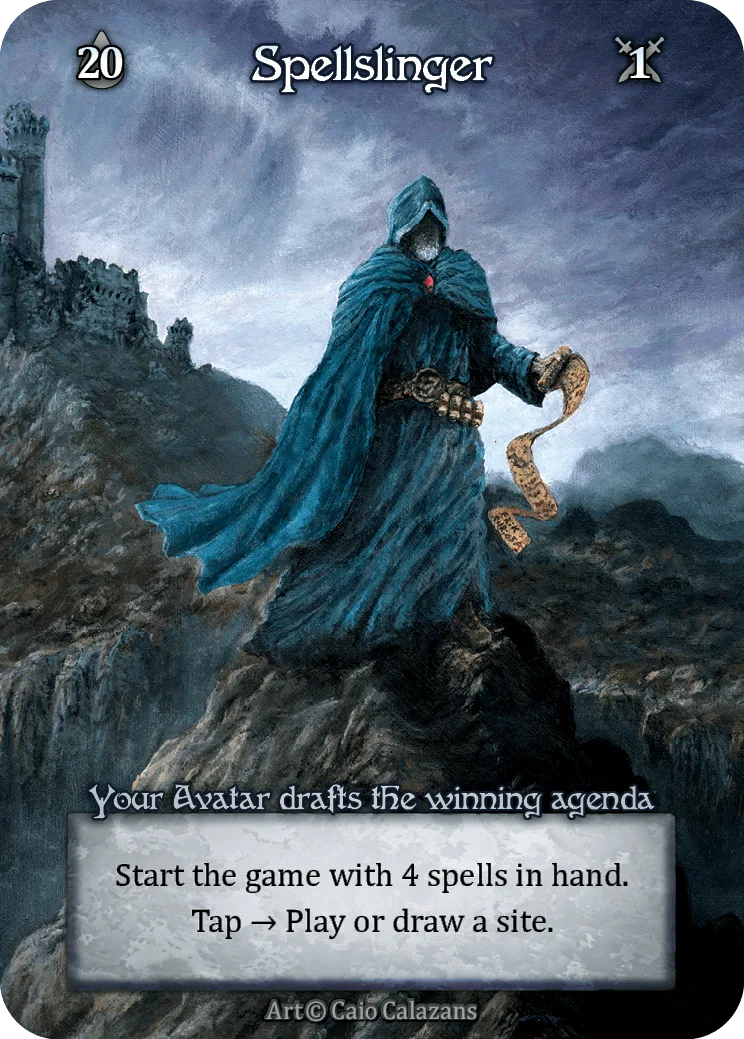
Spellslinger by Caio Calazans — via Curiosa
Four in hand, before the first turn. The pod knows what it's for.
A colorless Limited/Draft default. You start the game with four spells in hand instead of three; the tap ability is the vanilla play-or-draw-a-site. No combat trick, no synergy, no archetype payoff — just one extra opening card. That's the whole point: it's the designated default for Limited / Draft / Sealed, the Avatar a pod hands you when you don't bring your own. 2024 convention promo, beginner / Draft. In Constructed it's a strictly weaker generic; in Limited the extra card-pick is worth more than any conditional ability could be.
Where the meta is
A few signals from Gothic-era competitive play, drawn from the Bardsword "Month into Gothic" report, recent tournament results, and the broader Play & Compete circuit the directory tracks:
- Interrogator is the most-played competitive choice. Its card-draw clause punches opponents into bad trades.
- Druid won the 2025 Crossroads Melbourne event in a mono-Water configuration — the Arthurian Avatar still has legs.
- SCG Atlanta showed 16 distinct Avatars in top results. The format is diverse, not solved.
- Archimago and Deathspeaker are sleepers — feared by hypothetical graveyard hate, but few players actually run it.
- Persecutor and Pathfinder are strong but underrepresented in the current meta.
- Dragonlord is a hard pick to evaluate at the time of writing — the deck-building cost of picking the dragon up front is real, but the ceiling is genuinely high.
Thirty-four playable Avatars means roughly a dozen are competitively viable at any given moment. Sorcery's competitive ladder isn't a tier list — it's a rotating set of viable picks.
How to pick your first Avatar
Element-first decision tree:
- Want to attack with minions? Pick Avatar of Earth (mono-Earth, voltron + minion ramp) or Geomancer (when you're ready to step up).
- Want to cast spells? Pick Avatar of Fire (burn) or Sparkmage (when you want the engine to scale).
- Want to control the board? Pick Avatar of Water (flood lock) or Waveshaper (when you want it lethal).
- Want card draw and don't know what you want yet? Pick Sorcerer. Most flexible deckbuilder. Forgives a lot of mistakes.
When in doubt, the four Avatar of [Element] options exist for exactly this — they're not the strongest but they teach you the most. Once you've narrowed it down, the directory's Start Here section collects the newcomer-friendly resources that get you from "I picked an Avatar" to "I'm playing a real game."
Where to go from here
- Every Sorcery Format, Explained — Constructed, Sealed, Draft, and the OP pipeline your Avatar will compete in
- How to Play Sorcery Online, Explained — the Tabletop Simulator path for testing any Avatar before you buy paper
- The directory's Play & Compete section — sanctioned events, leagues, and the matchmaking community
Sources
- Sorcery TCG card API — the official, canonical card-data endpoint. Primary source for verbatim ability text and per-variant artist credits.
- Curiosa.io card library — the official deckbuilder, the consumer-facing surface of the same data. Per-Avatar card pages are linked above.
- TCGplayer — All 15 Avatars
- TCGplayer — Ranking All 13 New Avatars in Gothic
- Bardsword — Gothic Avatar Inspiration Guide
- Bardsword — A Month into Gothic
- Sorcery TCG — Gothic
- Sorcery TCG — Dragonlord
- Sorcery TCG — Rulebook 2024
- Eternal Durdles — Interrogator deep dive