The first Sorcery card ever finished is also the company's logo. Erik's Curiosa, painted by Francesca Baerald in 2019 at double the usual card-illustration size, shows a medieval cluttered table — globe, maps, spell books, the objects Baerald keeps in her own studio. Tucked into the composition between the skull and the globe is a small glowing orb that doesn't belong to any of Sorcery's medieval imagery: it's an Exalted Orb, the currency item from Path of Exile. Olofsson asked for it during the painting phase. The Curio sketch, painted before the request, doesn't have it. The retail card does.
That's most of what you need to know about the man and the game in one card. Erik Olofsson spent fifteen years co-founding and creative-directing the studio behind Path of Exile, then walked away to make a hand-painted, hand-shipped, paper-only trading card game on a 5×4 grid. The Exalted Orb is a wink to where he came from. The rest of Erik's Curiosa — the painting, the company name, the medieval bric-a-brac, the fact that it's the publisher's logo and not a hidden first card — is where he's going.
This piece is about both. Who Erik Olofsson is, what he did before Sorcery, and how those fifteen years at Grinding Gear Games show up in every design choice the game has made since.
Before Sorcery: fifteen years at Grinding Gear Games
Grinding Gear Games was founded in 2006 in Auckland, New Zealand by Chris Wilson and Jonathan Rogers, who had met studying computer science at the University of Auckland. The third co-founder was a Swedish gamer Wilson had met online. He flew out to New Zealand a few months later and stayed. That's Erik Olofsson.
For roughly the next decade and a half — Olofsson himself uses "around fifteen years" — he worked on Path of Exile. His title evolved with the studio. Wikipedia lists him as Art Director. The 2017 New Zealand Game Developer Conference billed him as a "founder and Creative Director." Path of Exile's own social channels at the time used Art Director. By the time he started speaking publicly about Sorcery he had settled on Creative Director as the working description. The lineage is unambiguous either way: founding member, ran the art side, was in the room for every major decision Path of Exile made from 2006 onwards.
The relevant context for Sorcery is what happened next. Tencent took a majority stake in Grinding Gear Games in May 2018, eventually moving from 86.67% to full ownership by March 2024, when the three founders sold their remaining shares. In a 2025 interview with Sorcery's own publishing arm, Olofsson described the Tencent acquisition as a turning point: the deal raised the studio's quality ceiling and budget, but the trade was that the founders ended up "not working closely and directly on the game itself." For a founder who'd spent fifteen years shipping decisions into a live product, that was the wrong trade.
What's interesting about the timing is that Sorcery didn't start after the exit. Per a 2020 Out of Games profile, the project began in 2017 — a year before Tencent's first stake. The first batch of Sorcery art was commissioned in 2018. The 2022 Kickstarter wasn't a pivot; it was the culmination of five years of side-project design work that began while Olofsson was still running the art for one of the largest ARPGs on the market.
He's been candid about why. In the same publisher interview, Olofsson describes "a thought process that starts in the back of his head that keeps swirling around and getting refined." The thought, in his telling, was that the kind of game he remembered loving in the early 1990s — Revised-edition Magic, hand-painted card faces, artists with distinct individual styles — wasn't being made anymore. He decided to make it.
The TCG resume nobody had
Most people who try to start a TCG company come in from one of two directions: tabletop game designers without the deep card-game pedigree, or competitive TCG players without the production-scale experience. Olofsson came in from a third direction nobody had used before. He's a competitive Magic player with a fifteen-year track record running art and creative for a massively complex commercial game.
The Magic side is real. "My TCG experience started with MtG, and more precisely with the revised edition," he told sorcerytcg.com, putting his first exposure squarely in 1994. He played competitively. Draft was his favorite format. He qualified for a Pro Tour once on a team that included Hall of Famer Jens Thorén — though, as he characteristically deadpans, "considering the team had people like the hall of famer Jens Thoren, maybe I got carried?"
He kept a foot in the Magic world long after going pro on Path of Exile. Per Collector Arthouse — catalogued alongside the rest of the directory's Art House & Collectors section — he's been "heavily involved in the Old School MtG format," the player-driven community that plays with cards from the game's earliest sets. Before Sorcery existed he was commissioning custom Magic cards from Dan Frazier (the artist who originally painted the Moxes) and calling them his "Alternate Universe Cards." Sorcery, in that sense, isn't a left turn. It's the natural extension of a hobby Olofsson had been quietly running for years.
The Grinding Gear side is what made it possible at scale. Path of Exile launched in 2013 and ran continuously for a decade-plus under Olofsson's creative direction — millions of players, dozens of expansions, a live-service art pipeline that doesn't stop. Whatever else Sorcery needed, the founder already knew how to commission, direct, and ship hundreds of pieces of fantasy art a year.
Founding Erik's Curiosa Limited
Erik's Curiosa Limited was registered in 2019 in Auckland, the same city Grinding Gear Games is based in. (Olofsson's team communicates through the official site at sorcerytcg.com — indexed in the directory's Start Here section — plus its Discord, YouTube, and social feeds.) The company is small. The current public surface includes Erik Olofsson and co-creator/co-designer Nickolas Reynolds, plus a credited design and production team — Rafa Novellino, Michael Haught, Rhezette Fiel, Ira Fay, and Sean Goodison — and Director of Operations Simon Swan. Wikipedia also credits Novellino as a designer alongside Olofsson and Reynolds. Compared to a publisher like Wizards of the Coast (1,500+ employees), Erik's Curiosa is closer in scale to a small indie game studio than to the corporate-card-game machine its product is competing with.
The company name is doing a lot of work. Erik's Curiosa is both the legal entity and an in-fiction card — the one with the table and the Exalted Orb. It's also the name of the canonical Curio archive run by the Sorcery community (Collector Arthouse). And it's a thesis: the publisher isn't called Erik's Studio or Sorcery Games or Realm Entertainment. It's named after a cabinet of curiosities — a Renaissance-era collection of miscellaneous wondrous objects, the kind of room a wealthy 16th-century gentleman would fill with stuffed animals, ancient coins, painted miniatures, and unexplained relics. The framing of the company is exactly the framing of the cards: a curated, eclectic collection of beautiful objects with stories attached. Not a product line.
The third piece of the founding team is Reynolds — Nickolas, often Nick. He's the co-creator and co-designer of the game, and the contribution that mattered most for what Sorcery actually became.
The grid was Nick's idea
Olofsson's original Sorcery prototype was — by his own account — a Magic clone. "At the very beginning, the game-play was actually very similar to the MtG style game engine, with some minor tweaks to expand the possible room for game design." Reynolds and Olofsson had met through their shared interest in custom card design (Reynolds was running his own MTG alternate-universe project, like Olofsson's). They started collaborating, and per the publisher interview Reynolds pitched the single mechanic that turned the project from a Magic homage into something genuinely new.
"The square grid is something that got pitched to me by Nick, and in the very first game there was great and fun things happening." Olofsson recalls watching early playtests in which cards like Cloud City (high-ground spatial play) and the not-yet-named Devil's Egg (then "Hot Potato") demonstrated "the tactical impact that cards like that had." That's the moment Sorcery stopped being one of the dozens of Magic-imitators that get prototyped every year and started being itself.
The change of name went with the change of design. The earliest Sorcery prototype was called "Omnipotence." Other working titles included "Spellcraft" and "Gridlord" — the last of which survives on a single Alpha Curio card as a fossilized back-text variant where the word "GRIDLORD" appears in place of "Sorcery" on the card back, as documented in Every Curio in Alpha, Documented. By the time the Kickstarter launched the game was Sorcery: Contested Realm, the cards had a 5×4 board, and the entire game existed because Reynolds had pitched a single idea Olofsson took seriously enough to throw out the original engine for.
The 5×4 grid is now the most-cited mechanical difference between Sorcery and Magic. (Sorcery vs Magic, Explained walks through the full list.) It was an outsider's contribution — Olofsson wouldn't have invented it on his own. The right interpretation isn't that Sorcery is Olofsson's game; it's that Sorcery is a game Olofsson built around a contribution he was willing to let dominate his own original draft. That's a Creative Director instinct trained over fifteen years of Path of Exile, not a TCG-designer instinct.
The design philosophy: simplify, simplify, simplify
The phrase Olofsson uses about Sorcery's design intent is, verbatim, "easy to learn, hard to master." It's a cliché when you write it down, but it cashes out in specific choices.
The Atlas/Spellbook split — separating sites into their own deck so every turn you choose between drawing a spell and drawing a site — removes mana flood and mana screw entirely. You can't have a draw step ruined by variance because variance is replaced by choice. The 5×4 board imposes a finite, knowable geography — twenty squares, no more — so the complexity isn't from infinite open space but from how the constrained space evolves. The four elements are Fire, Air, Water, Earth — the four most legible elements in any fantasy tradition, no exotic colors, no factions, just the elemental quartet anyone who's ever read a book about magic already understands.
"Simplify, simplify, simplify," Olofsson told Collector Arthouse. "The graphic design of Sorcery very much puts the art in the focus, both by giving it a lot of space, but also by not having many other colorful and high contrast elements that competes with the art." Look at a Sorcery card next to a Magic card sometime. The Magic card has a textbox that takes up roughly a third of the surface, mana cost icons that pop visually, set symbols, rarity coloring, multiple frame colors keyed to format. The Sorcery card is mostly painting. The text is small. The frame is muted. The art is the point.
That's the design thesis Path of Exile veterans recognize immediately. Path of Exile is famous for not simplifying — gear is a wall of stats, the passive tree has hundreds of nodes, the crafting system requires a wiki to understand. But that complexity is systemic. The visual presentation, especially the art direction Olofsson ran for over a decade, is consistent, atmospheric, and committed. Sorcery flips the polarity: simple system, complex art commitment. The principle is the same. Pick one axis and go deep.
The art commitment, in detail
If you take only one thing away from understanding why Sorcery exists, take this: every Sorcery card is hand-painted. No digital illustration. No AI generation. No exceptions across roughly a thousand cards from Alpha through Gothic. Oils, acrylics, watercolours, ink. Real paint on real surfaces, scanned and laid out behind a small text box.
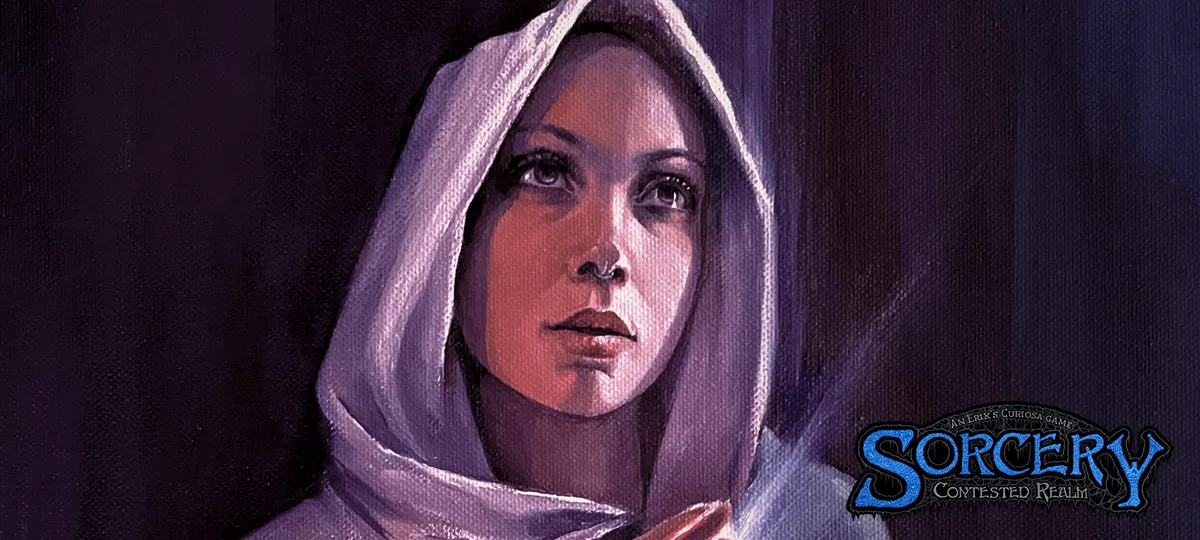
Sorcery: Contested Realm character art — via sorcerytcg.com
The decision is rooted in nostalgia for a specific era. "Games that I really remember from my early gaming days were all using hand-painted art where artists had their own personal style," Olofsson said, "and I think there is something evocative and special that was lost since then." When digital illustration tools went mainstream in the mid-2000s, the industry standard for fantasy game art shifted with them. Hand-painted card faces became the exception. By the early 2020s, with AI image generation joining the toolkit, the gap had widened further. Sorcery's art commitment isn't just a stylistic preference; it's a deliberate refusal of two decades of industry drift.
Olofsson has also been explicit about how he selects artists, in a way that distinguishes Sorcery from the cohesion-first art direction most modern card games practice. "I have also been specifically looking for people that have a personal style that is distinctly theirs," he said. "Art directors often strive to make everything look coherent and 'perfect', but [in a] card game a lot of the personality and sense of wonder and discovery can be lost with that approach. Sorcery instead embraces it." The roster reads accordingly:
- Frank Frazetta — the foundational name in sword-and-sorcery illustration. Conan paperback covers, the original Death Dealer paintings (one of which appears below), six decades of work that defined what fantasy art looks like. Sorcery licensed his work for the Alpha Death Dealer Curio and the Alpha Investments promo foils of Sorcerer and Witch.
- Brom (Gerald Brom) — 1990s Dungeons & Dragons, Dark Sun, the visual language of a generation of TSR books. His art appears on the Alpha Deathspeaker Curio (a piece originally painted for the early-1990s Guardians CCG) and was formally integrated into the Gothic expansion in December 2025 on the retail Fallen Angel.
- Rodney Matthews — British prog-rock album covers (Asia, Magnum, Praying Mantis), Michael Moorcock book covers, decades of trippy psychedelic-fantasy work. Painted the Archimago avatar in Arthurian Legends.
- Ian Miller — early Fighting Fantasy book covers, Games Workshop illustration, the dense pen-and-ink style most British fantasy gamers grew up with. Painted the Gothic-set The Void playmat artwork and Free City in Alpha.
- Liz Danforth and Quinton Hoover — original Magic artists whose work goes back to Arabian Nights and Antiquities. Sorcery formally honored Hoover (posthumously) by including his work in Arthurian Legends.
- Anson Maddocks, Drew Tucker, Melissa Benson, Jeff A. Menges — more original-era Magic painters, all reactivated for Sorcery commissions.
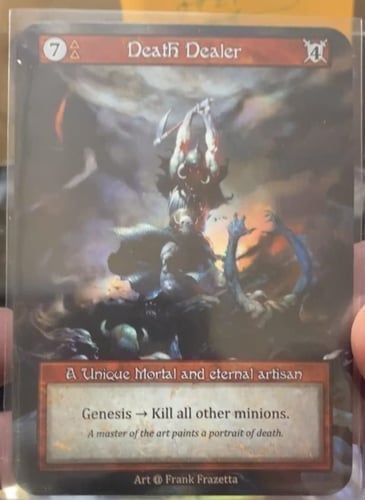
Death Dealer by Frank Frazetta — via Collector Arthouse
This list is not curation by genre. It's curation by name recognition — these are exactly the painters a fortysomething TCG collector would already know by sight. Olofsson's stated target demographic, in his own words, is "people in the mid forties" who "lived through the golden age of TCGs" and have the discretionary income to buy beautifully-printed cards. The roster is the demographic's nostalgia roll call.
The breadth is broader than the famous names. The Gothic expansion alone commissioned roughly 35 artists; across the full Sorcery catalogue the count is in the hundreds. The point of the all-hand-painted commitment isn't that every card is a Frazetta — it's that no card is a procedurally-generated stylesheet exercise, and no card is AI output. Every painting was made by a person.
Every Sorcery Avatar, Explained catalogs the Avatar roster with its artist credits — the per-card view of the philosophy. The four base elemental Avatars are all Séverine Pineaux; the Beta Avatars are mostly Francesca Baerald; the Gothic ones add Doug Kovacs, Heidi Taillefer, Margaret Organ-Kean, Brian Smith, Zohn Dee, and others. The set-by-set spread of credits is a portrait of Olofsson's address book.
Kickstarter, 2022
The Kickstarter campaign launched on March 15, 2022 and ran for 21 days, ending April 4, 2022. By the end it had raised NZ$5,784,804 from 6,456 backers — about thirteen times the original NZ$445,000 goal. Per Kicktraq, the funding ratio was 1,299%. For a card game from a first-time TCG publisher with no retail distribution and no existing audience, that's an anomaly. By most measures it was one of the largest tabletop Kickstarters in the platform's history.
The pledge tiers funded the Alpha print — the version of the game that exists only as a Kickstarter exclusive, 403 cards, never reprinted. That scarcity is now structural to the secondary market: Alpha Curios are the most-chased and most-valuable cards in the game (Curio Cards in Sorcery, Explained covers the full archive), and the existence of the Alpha print at roughly 6,400 sealed boxes is the supply ceiling that drives every secondary-market dynamic the game has now.
The campaign description leaned hard on the things that distinguish the game from its competition: hand-painted art, an "old school" aesthetic, a target demographic of TCG players who remembered the early 1990s. The pitch worked because it was honest — the game shipped looking exactly the way the Kickstarter promised — and because the artist roster the campaign showed was already evidence the publisher meant it.
The Kickstarter was not a pre-launch gimmick. It was the founding capital event for the entire studio. Olofsson has been clear that the campaign's success is what enabled Erik's Curiosa to become a real company rather than a side project: the 6,456 backers funded the Alpha print, which paid for Beta's retail rollout in October 2023, which paid for Arthurian Legends in October 2024, Dragonlord in 2025, and Gothic in December 2025. (Every Sorcery Set, Explained covers the post-Kickstarter release history in detail.) The studio is on its fifth set in less than three years because the Kickstarter overdelivered by a factor of thirteen.
The Path of Exile Easter eggs
Olofsson has been deliberately discreet about Path of Exile references inside Sorcery. Per Collector Arthouse, he's said directly that "Erik's Curiosa and Sorcery are intended to be its own distinct company and project," with "some nuanced subtleties that appear in the game." Two of those subtleties are documented.
The first is the Exalted Orb in the Erik's Curiosa card composition — the painting that became both the publisher's logo and the in-fiction representation of the studio. Baerald's original sketch shows the medieval table without it; Olofsson asked for the Orb to be added during the final painting phase. The Alpha Curio of the same painting (without the Orb) survives as documentation that the addition was a deliberate post-sketch insertion. It's the only PoE reference that appears on a card every Sorcery player owns.
The second is on Tony Szczudlo's Wraetannis Titan, where the prefix "Wrae-" is a nod to Path of Exile's continent of Wraeclast. There may be others. Olofsson hasn't confirmed a list, and the discretion is the point — these aren't badges, they're a fifteen-year resume folded quietly into one new card game's visual language.
The deeper Path of Exile inheritance isn't the Easter eggs. It's the production model. Both projects are art-first commitments shipped by small founder-led teams from Auckland on a continuous release cadence. Both lean into complexity their players can grow into rather than dumbing the experience down. Both rejected industry standards in favor of a specific aesthetic point of view — Path of Exile's grimdark gothic-fantasy direction in 2013 was contrarian against the WoW-style polished-cartoon school that dominated MMOs at the time, and Sorcery's hand-painted commitment is the same kind of contrarian bet on a different axis. "Building on something that you already know that people like is a much more grounded way of finding and developing new projects," Olofsson said. He spent a decade and a half learning what worked for Path of Exile players. He's applying the same instincts now to a different game.
The studio now: organized play, fulfillment, the next set
Erik's Curiosa today is structurally the same small Auckland studio that ran the Kickstarter, scaled up modestly. Per a September 2024 studio update from Director of Operations Simon Swan, the team is actively hiring, fulfillment has improved from "multi-month delays" on Alpha and Beta to delays measured in "weeks or even days," and global partner fulfillment hit 93% on the Arthurian Legends wave-one rollout. The most-quoted constraint in the update is the product pipeline itself: more sets, more cards, more art — that's where the studio's energy is going.
The other big project on the table is organized play. Sorcery Organized Play launched on March 24, 2025 with three event tiers: Cornerstone (local store championships), Crossroads (regional gatherings), and the capstone Avatar of the Realm event. The first Cornerstone events ran the weekend of July 19, 2025. By the 2026 season the structure had refined into Cornerstone, the upgraded Store Kit events, Grand Contests replacing the regional Crossroads tier, and Avatar of the Realm as the capstone — confirmed for November 13–15, 2026 in Boston.
The OP rollout is the studio's biggest commitment to the part of TCG culture that isn't directly product. Erik's Curiosa is not just shipping cards; it's funding the social architecture players need to actually use them at scale. The 2026 calendar includes Grand Contests at the SCG CON Washington D.C. on May 29 (the year's first US capstone tier), SorceryFest in Europe July 3–5, and announcements still pending for Asia-Pacific. For a studio whose flagship game launched only three years ago that's a fast scaling on what's still a small base — and the closest analogue is, predictably, the way Grinding Gear Games built ExileCon as a community-tier event for Path of Exile players.
The next product isn't formally announced as of this writing. The pattern of recent years — one large set per year plus a small mini-set — suggests the next big release lands in late 2026 or early 2027.
What this all means for the game
Sorcery is, in plain language, what happens when a Creative Director who spent fifteen years shipping Path of Exile decides he wants to make a card game that looks like the ones he grew up with. That's a particular combination of skills and aesthetics, and it produces a particular kind of product.
Production-side: it's an indie game from a small Auckland studio that ships on its own timeline, owns its IP outright, is privately held, doesn't answer to a publisher above it, and can afford to be opinionated. Olofsson left Grinding Gear Games in part because the Tencent acquisition left the founders "not working closely and directly on the game itself" anymore. Erik's Curiosa exists specifically so that doesn't happen again. The lack of digital client, the absence of rotation, the hand-painted-only mandate, the refusal of AI art — these are all things a publicly-traded card-game publisher would have at least one quarterly meeting about. Erik's Curiosa doesn't have to.
Player-side: the game's design choices read as expression of a single creative voice rather than committee output. The grid, the Atlas/Spellbook split, threshold-as-floor instead of mana-as-cost (Sorcery Threshold and Sites, Explained covers the mechanic that confuses Magic converts most), the lean toward beautiful objects over thick rulebooks — they fit together because they came out of the same head. Whether that's better or worse than design-by-committee is a personal judgment, but the style of Sorcery is the style of a Creative Director, not of a brand.
Collector-side: you're buying physical objects from a publisher that has, so far, treated those objects as the actual product rather than as the loss-leader for a subscription-driven digital ecosystem. That's rare in the current landscape and the secondary market reflects it.
None of which guarantees Sorcery's long-term success. Five sets in three years is a fast cadence to maintain, the artist-roster ceiling will be tested eventually, the organized-play infrastructure has to actually scale, and the hand-painted-only commitment has a cost that compounds with every set. But the question this article opened with — why does Sorcery exist — has an honest answer. It exists because a Creative Director with the rare combination of TCG-player nostalgia, Path-of-Exile-scale production experience, and the freedom of a private company decided to spend the next decade making the kind of card game he wanted to play. Everything else is downstream of that.
Where to go from here
- Every Sorcery Set, Explained — the release history that followed the Kickstarter
- Every Sorcery Avatar, Explained — the artist credits per Avatar, which is where Olofsson's address book is most legible
- sorcerytcg.com — Erik's Curiosa's official site and announcement channels
Sources
- Interview with Game Creator, Erik Olofsson — primary source for Olofsson's MTG background (Revised edition start, Pro Tour qualification with Jens Thorén), the design philosophy ("simplify, simplify, simplify"), the artist-selection approach, and the Nick Reynolds grid story
- Sorcery: Contested Realm TCG — An Interview with Game Creator, Erik Olofsson — primary source for the GGG-to-Sorcery transition, the Tencent context, the Path of Exile/Sorcery parallel quote, the hand-painted-art philosophy quote, the "mid forties" target demographic
- Wikipedia — Sorcery: Contested Realm — corroborates publisher name, Kickstarter figures (NZ$5,784,804 from 6,456 backers), designer credits (Olofsson, Reynolds, Novellino), set release dates and card counts
- Wikipedia — Grinding Gear Games — founding year (2006), three-founder structure (Wilson, Rogers, Olofsson), Olofsson's role as Art Director, Tencent acquisition timeline (May 2018 → March 2024)
- Erik's Curiosa Ltd — Fandom wiki — corroborates 2019 NZ company registration and Auckland base
- Kicktraq — Sorcery: Contested Realm campaign — campaign dates (March 15 to April 4, 2022), 1,299% funding ratio, NZ$445,000 goal
- NZGDC17 Speaker — Erik Olofsson — 2017 confirmation of "founder and Creative Director" title at Grinding Gear Games
- Out of Games — A Look at Sorcery: Contested Realm — 2020 profile, source for 2017 project start and 2018 first art commissions
- Sorcery: Contested Realm — Curio Cards — source for the Exalted Orb Easter egg detail (Curio sketch without Orb, retail with), the Wraeclast/Wraetannis reference, and Olofsson's quoted intent to keep PoE and Sorcery as distinct projects
- Sorcery About — official publisher team list (Olofsson, Reynolds, Novellino, Haught, Fiel, Fay, Goodison), Auckland NZ base, Kickstarter framing
- Erik's Curiosa Studio Update — September 2024 update by Director of Operations Simon Swan: hiring status, fulfillment performance, Arthurian Legends wave-one numbers
- Introducing Sorcery Organized Play — March 24, 2025 launch date for Cornerstone / Crossroads / Avatar of the Realm structure
- 2026 Grand Contests — Where the Realm Gathers — 2026 OP refinement (Grand Contests replacing Crossroads), Avatar of the Realm November 13–15 Boston date, SCG CON and SorceryFest schedule