Curio Cards are the rare alternate-art and pre-production variants slipped into the Ordinary slot of Sorcery boosters. For the full primer — what they are, the publisher's silence, the community archive — see Curio Cards in Sorcery: Contested Realm, Explained. This piece focuses on Alpha.
Alpha's Curios are the most thematically coherent of any set: overwhelmingly pre-production design history. Sketches that became finished paintings. Cards with the abandoned "Legendary" rarity tier that later became "Unique." Cards with separate attack and defense values from before those were unified. Reading the Alpha Curio pool is reading Erik Olofsson's design notebook.
A smaller subset of Alpha Curios are back-variants rather than art variants — the front art matches retail, but the text above the Sorcery logo on the card back differs from the standard "An Erik's Curiosa Game" label. Bridge Troll, Cave Trolls, Bosk Troll, and Gridlord Sorcerer all fall into this group. The rest are art variants.
Every entry below is sourced from the Collector Arthouse Curio archive, which is the canonical reference the community maintains — alongside other art-and-archive resources in the directory.
The 18 known cards
Jump to any entry:
- Erik's Curiosa (Sketch)
- Bloom of Frogs (concept)
- Grim Tangle
- River Styx
- The 9-Piece Collage
- Bridge Troll
- Devil's Egg
- Selfsame Simulacrum
- Belfry
- Cave Trolls
- Mirror Realm
- Windblast
- Death Dealer
- Free City
- Murder of Crows
- Bosk Troll
- Deathspeaker
- Gridlord Sorcerer
Erik's Curiosa (Sketch)
Commissioned in 2019 during Sorcery's earliest development. The illustration depicts a table laid with medieval curios — an old-fashioned globe, maps, spell books — each item inspired by objects Baerald owns personally, painted at double the usual card-illustration size. The shipped Alpha printing has an Exalted Orb in the composition that the Curio sketch is missing — the Orb was added during the painting phase at Erik Olofsson's request. Olofsson was a founding member and former Art Director at Grinding Gear Games, the studio behind Path of Exile, where the Exalted Orb is a currency item.
Bloom of Frogs (concept)
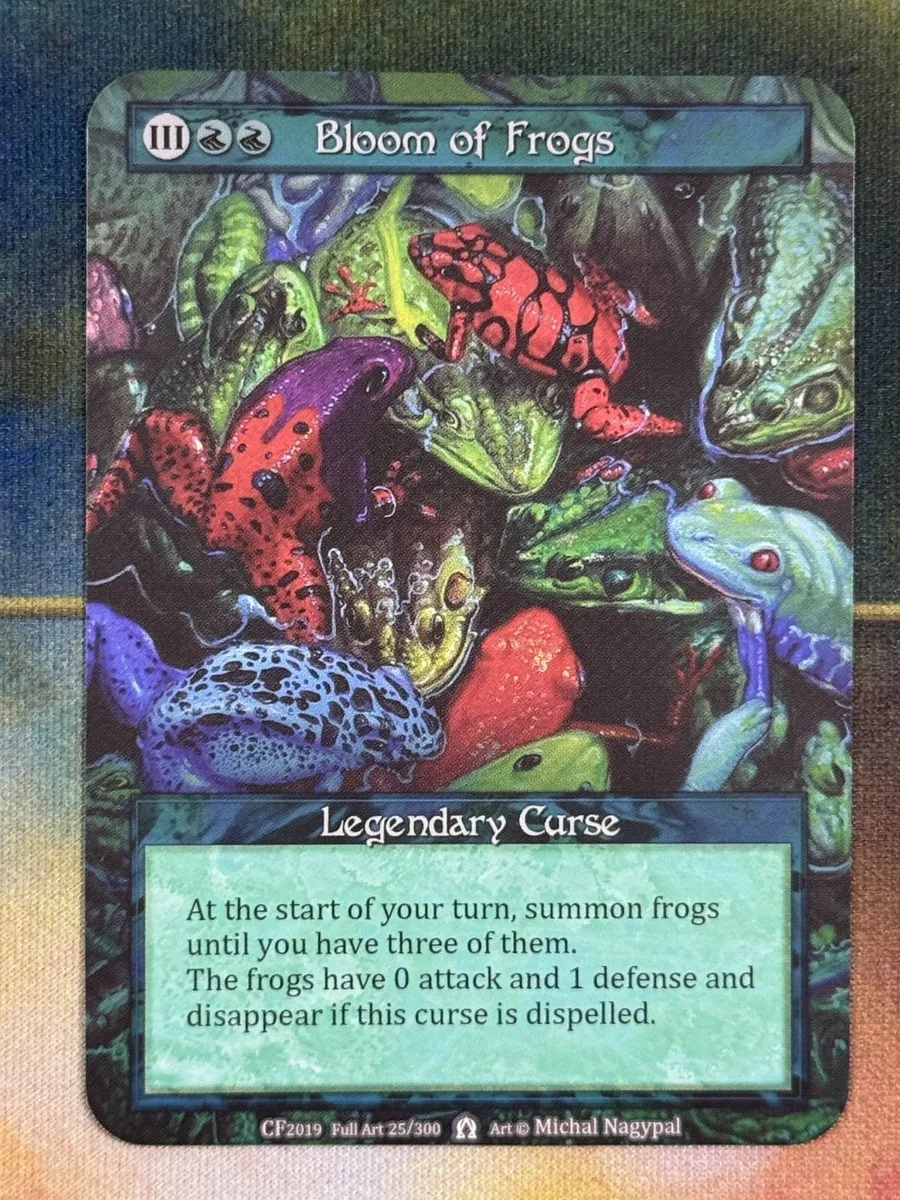
Bloom of Frogs (concept) by Michal Nagypal — via Collector Arthouse
A prototype that became Alpha's Plague of Frogs. Designed in 2019 — three years before the Kickstarter, four before fulfillment. Three early-design markers survive on the Curio: a type line reading "Legendary" (the predecessor term for what became "Unique"), a split attack/defense stat block (0 attack, 1 defense — those values were unified into a single power number following Fall 2021 community discussions), and casting-cost symbols that don't match current Sorcery standards. Three elements absent from the final Alpha layout: year of release, set number, and a set symbol.
Grim Tangle
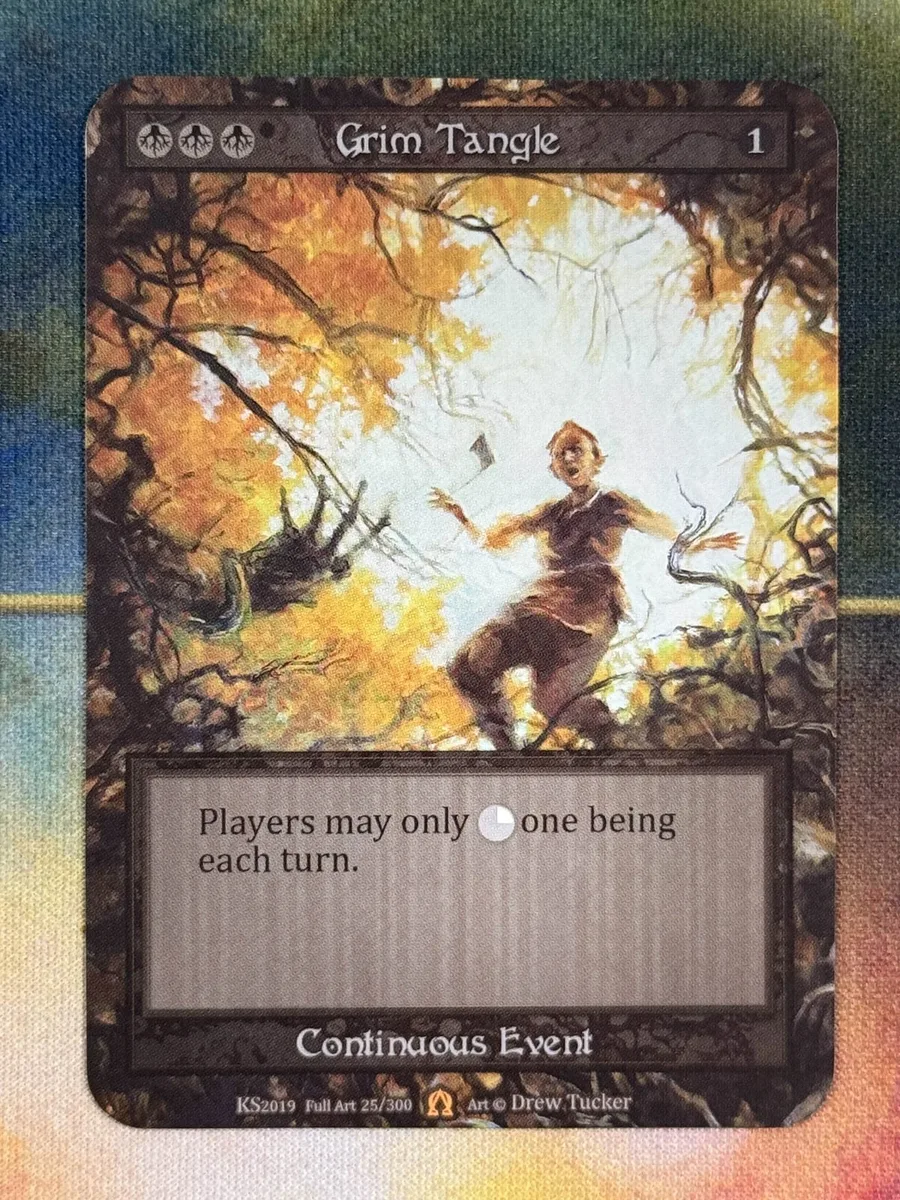
Grim Tangle by Drew Tucker — via Collector Arthouse
Originally commissioned under the name "Grim Tangle"; renamed to "Entangle" for the Alpha/Beta retail release. Footer notation "KS2019 Full Art 25/300" matches Bloom of Frogs — the two share the early Alpha template. The Curio surfaces several design firsts that didn't ship: new element resource symbols in the title box, threshold and cost separated to the right side, a circle/pie-chart gameplay symbol, a type line positioned below the mechanic box, the scrapped "Continuous Event" card type, and a gold set symbol instead of the standard white.
River Styx
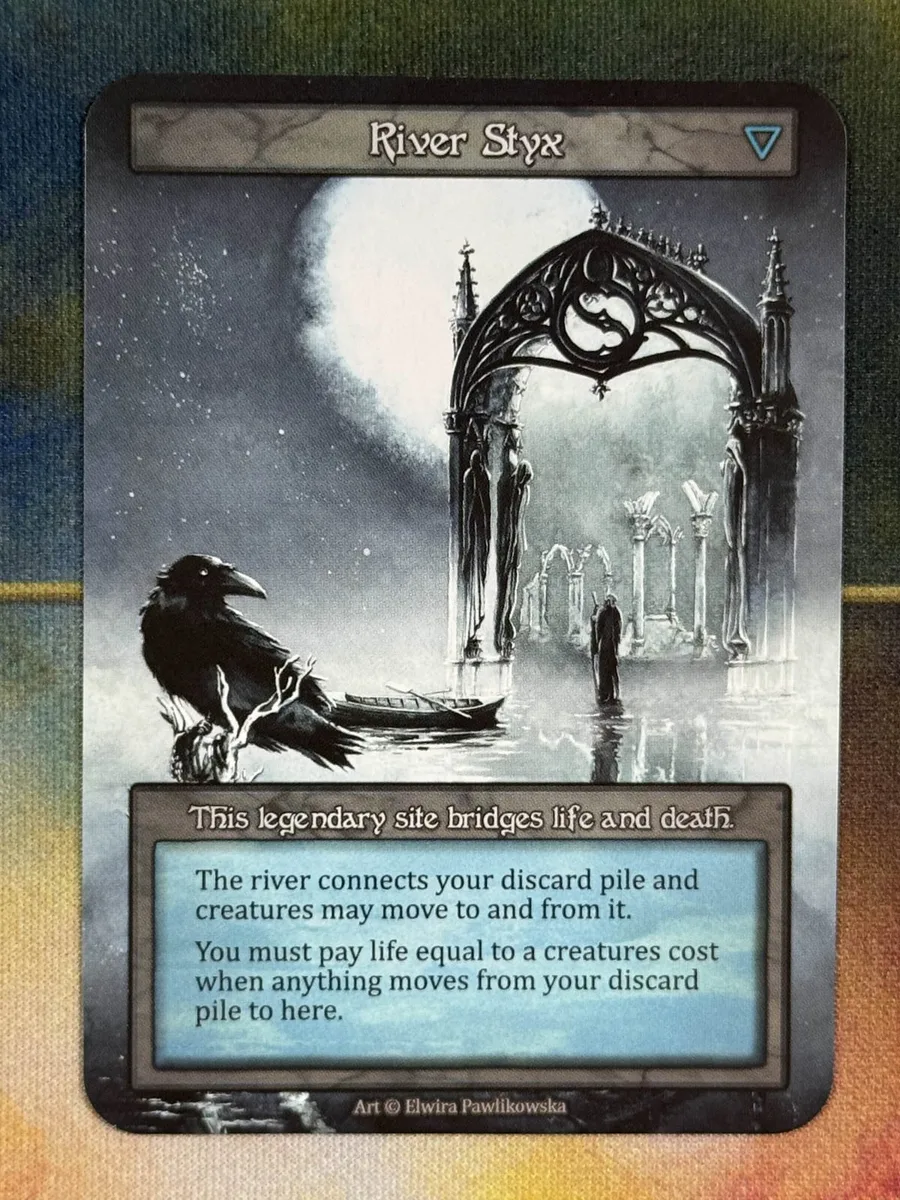
River Styx by Elwira Pawlikowska — via Collector Arthouse
The first full-size Curio collectors found in Alpha packs after the 9-Piece Collage. Originally conceived as an Atlas site in portrait orientation with "Unique" rarity. The art and title were repurposed during the March 2022 Kickstarter — redesignated as the Death's Door token, representing an Avatar reduced to zero life. The Curio harks back to the original portrait Site form with pre-shipment mechanics. Pawlikowska has named it her personal favorite from her Sorcery commissions.
The 9-Piece Collage
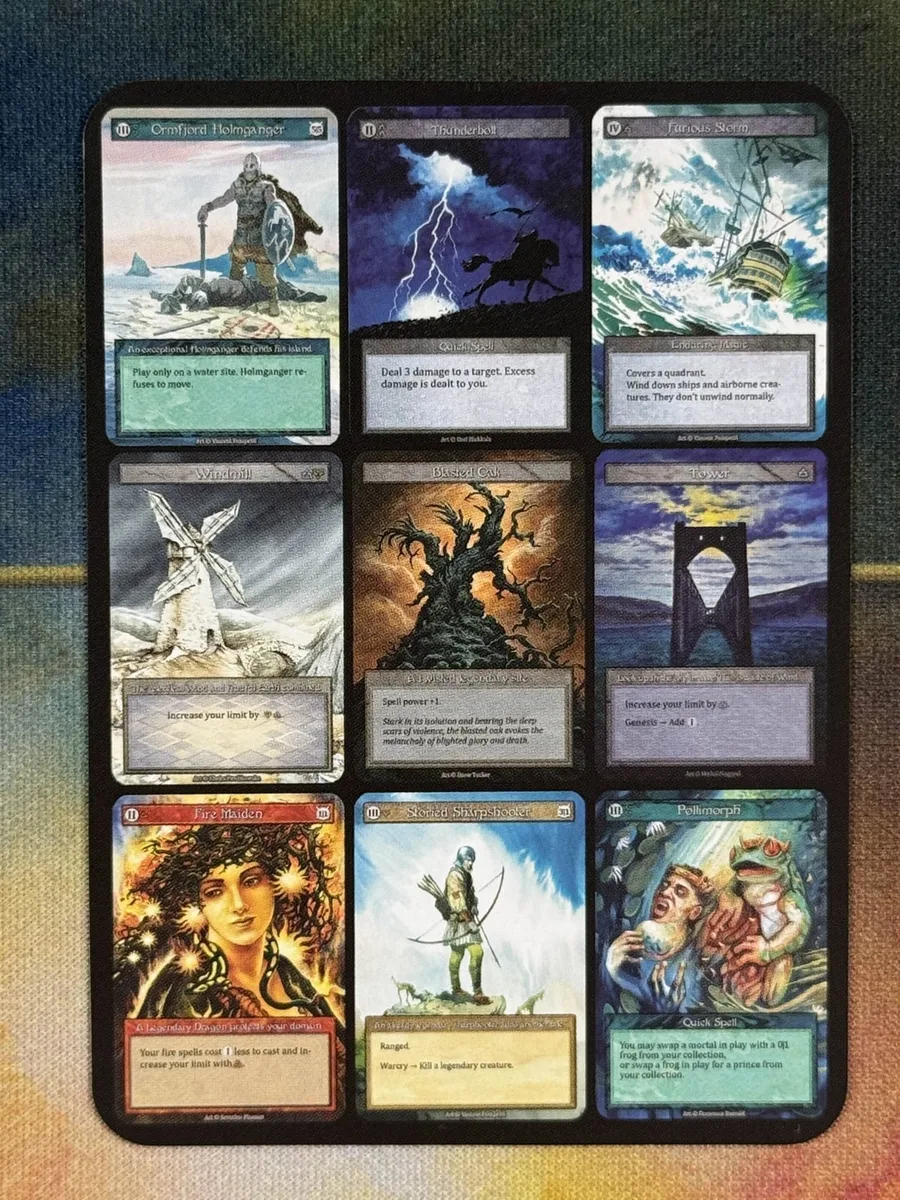
9-Piece Collage (multi-artist) — via Collector Arthouse
One Curio card, nine miniature pre-production designs in a single frame. Each panel documents a different developmental iteration of a card that later shipped — or didn't:
- Ormfjord Holmganger by Vincent Pompetti — references medieval Scandinavian dueling; tied to Olofsson's "Holmganger" MTG registry handle. Was a prize card in the Kickstarter "innkeeper" tier, later renamed The Champion and removed from the playable pool.
- Thunderbolt by Ossi Hiekkala — now Lightning Bolt. Shows historic cost symbols and the scrapped "Quick" mechanic.
- Furious Storm by Vincent Pompetti — became Stormy Seas. Its "Enduring" mechanic evolved into "submerge."
- Windmill by Elwira Pawlikowska — portrait original; redesigned to landscape for retail. Mana yield moved from the title box to the type line.
- Blasted Oak by Dan Seagrave — early portrait Atlas site yielding spell power. Marked "Legendary."
- Tower by Michal Nagypal — portrait Atlas site depicting Rievaulx Abbey at night.
- Fire Maiden by Séverine Pineaux — one of four pre-Alpha elemental avatars who served as the game's primary face. Her original oil painting shipped with top-tier "Avatar of the Realm" Kickstarter pledges. Rebranded as "Dragon" type in Alpha; foil-only in retail boosters.
- Storied Sharpshooter by Vincent Pompetti — retains the early "Ranged" effect. The "Warcry" mechanic was replaced by "Genesis" (an enter-play trigger). Composition was zoomed outward for the watercolor framing in retail.
- Pollimorph by Francesca Baerald — historic cost symbols; originally used "Quick." The frog-to-prince flavor concept was stripped, leaving simple minion-to-frog conversion.
The format is unique to Alpha Curios — no other set has used this nine-panel collage layout. As a single card, the 9-Piece Collage is essentially nine Curios at once.
Bridge Troll
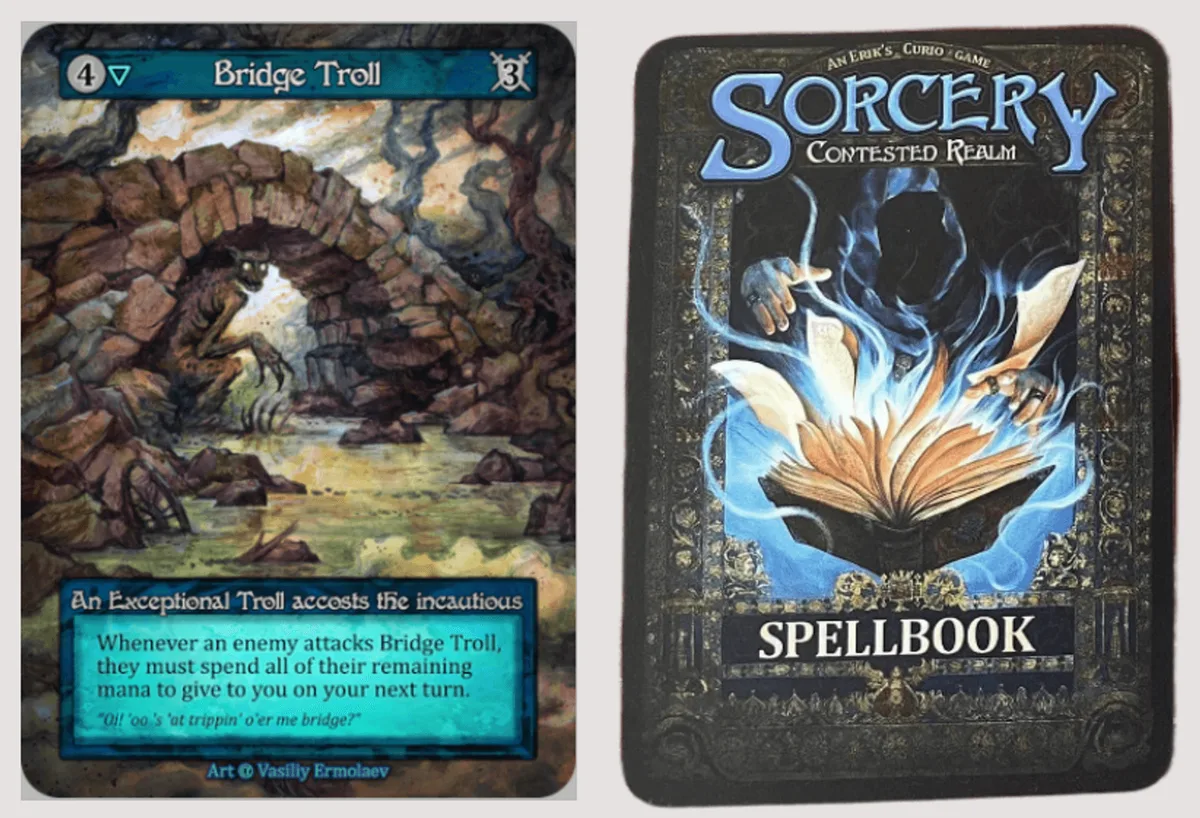
Bridge Troll — via Collector Arthouse
A back-variant Curio, not an art variant. Above the Sorcery logo on the card back, the text reads "An Erik's Curio Game" instead of the standard "An Erik's Curiosa Game." The front art is otherwise unchanged from the retail Bridge Troll. One of three Troll Curios that share this exact back-text gimmick (the others are Cave Trolls and Bosk Troll).
Devil's Egg
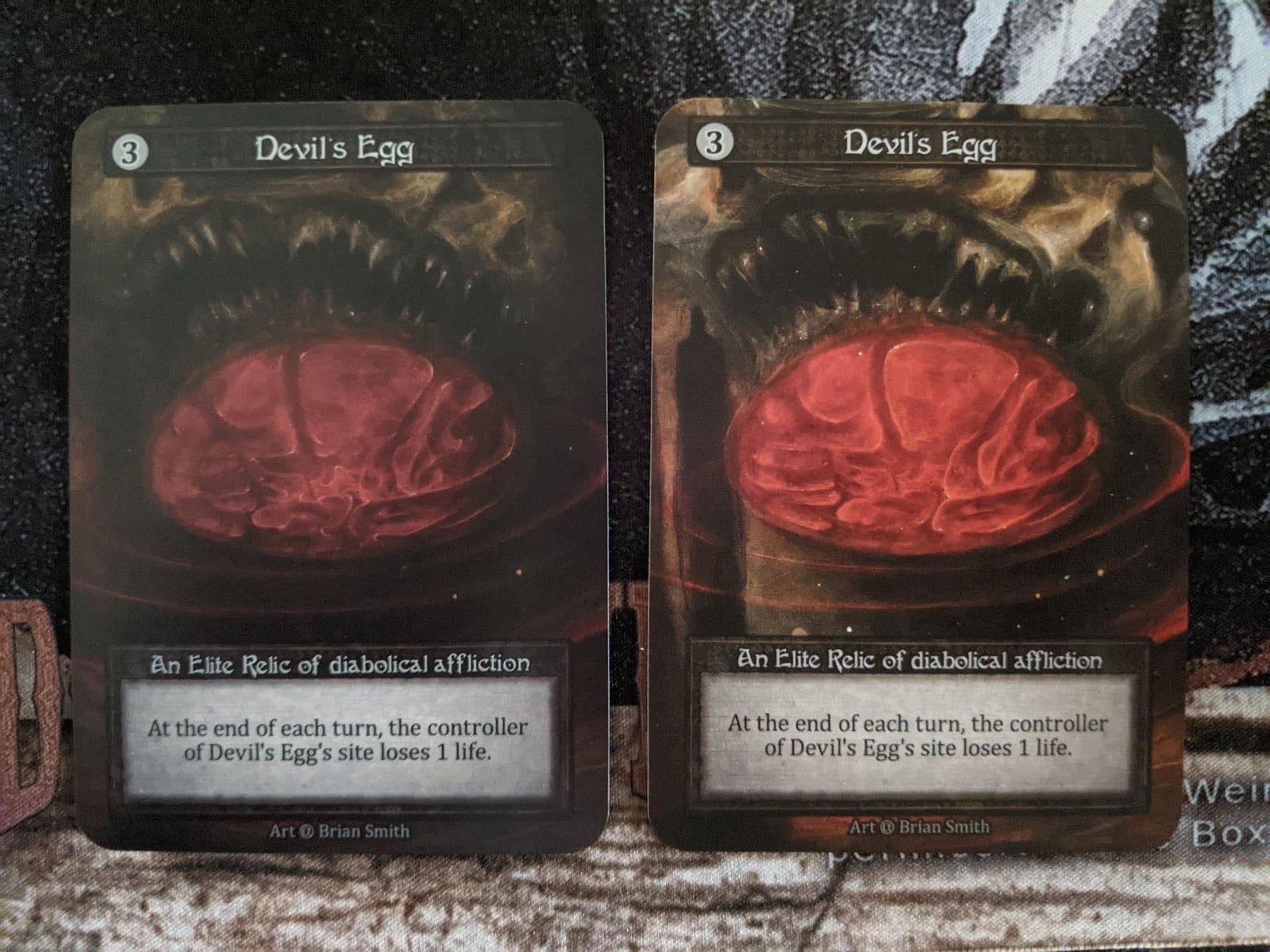
Devil's Egg by Brian Smith — via Collector Arthouse
The Curio sits beside the retail Alpha version on Collector Arthouse's page for direct comparison. The defining difference: the Curio retains a shadowed figure in the composition that was removed from the final retail Alpha art. Same painting, earlier development state, with the figure intact. Collector Arthouse also links an interview with Brian Smith about the original painting from the card's archive page.
Selfsame Simulacrum
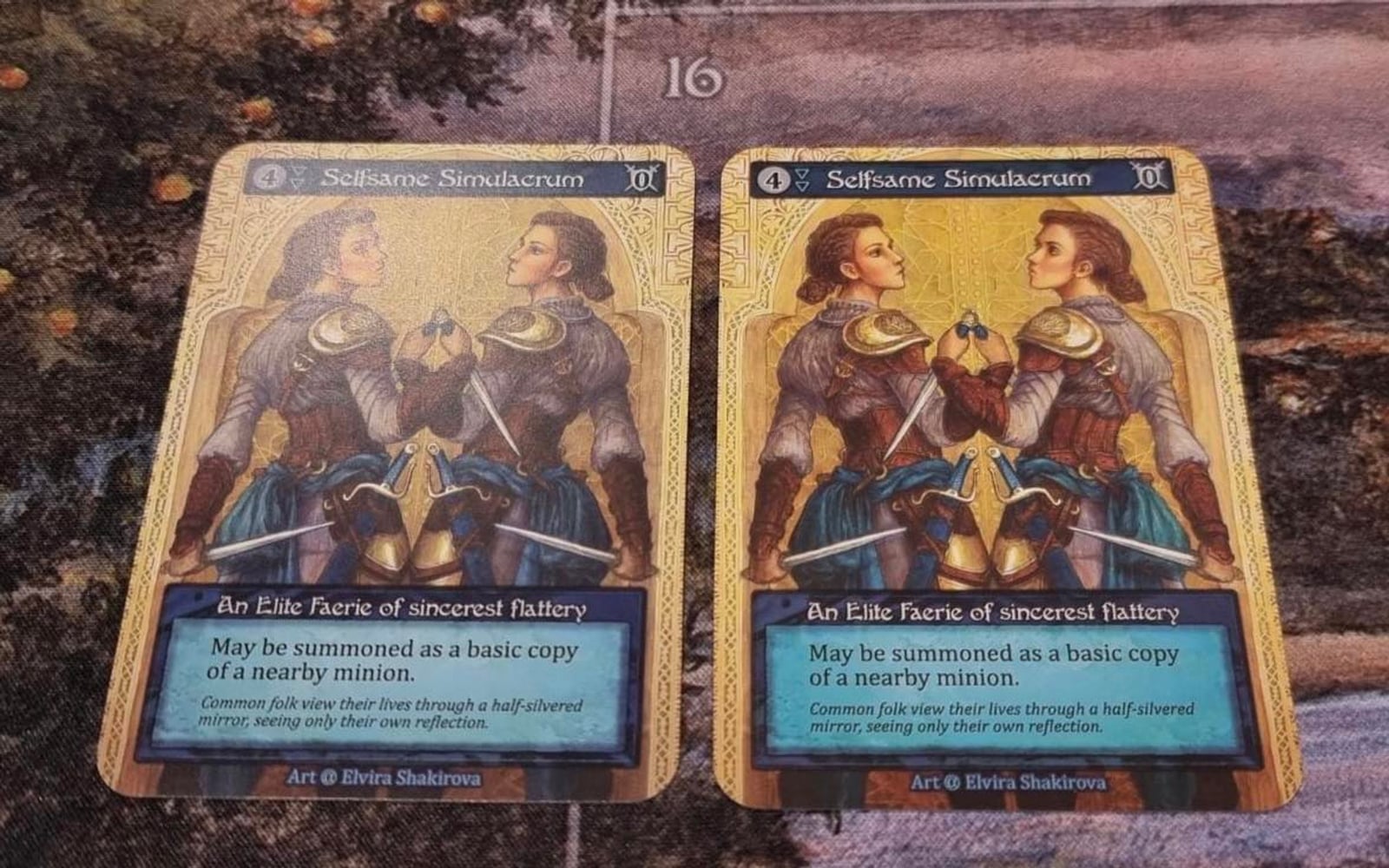
Selfsame Simulacrum — via Collector Arthouse
The Curio is a mirrored variant of the retail Selfsame Simulacrum — a playful nod to the card's mirroring concept. The dagger on the right side of the retail composition appears on the left in the Curio. Famously hard to identify in the wild because no type-line wording changed; the difference is purely the inverted composition. Per Collector Arthouse, Erik's team likely adjusted later Curios — Beta's Extinguish is the cited example — to use distinct type-line wording in response to this identification challenge. The page credits "the artist Elvira," likely Elwira Pawlikowska.
Belfry
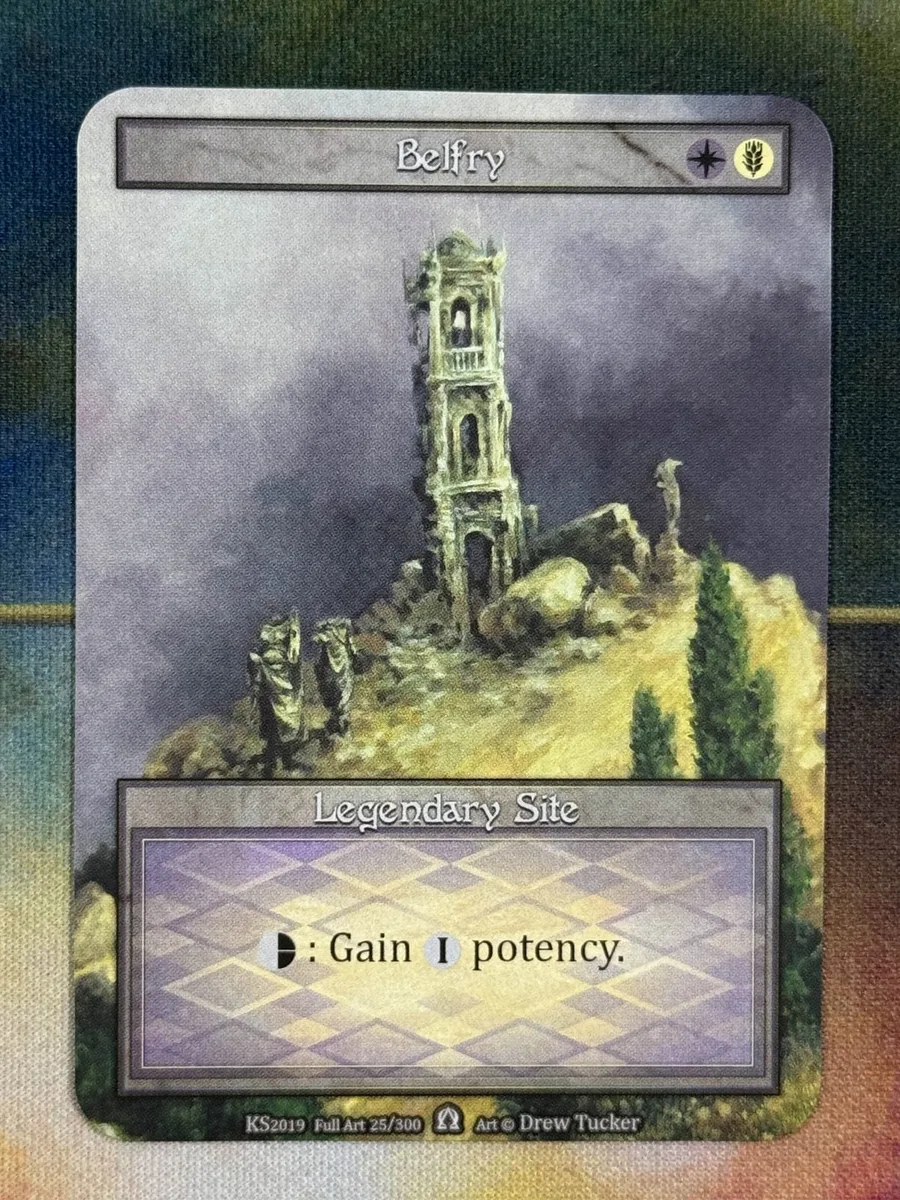
Belfry by Drew Tucker — via Collector Arthouse
Part of the developmental-era Curio cluster alongside Grim Tangle, Bloom of Frogs, River Styx, and Beta's Water Castle. In Alpha the card kept its name but its type changed — from Site to a Monument-type Artifact that remains in the realm. The Curio carries portrait layout, white/black mana costs in the top-right corner, the abandoned "Legendary" keyword, and a diamond pattern behind the text box (the same motif also appears on Water Castle). Set number 25/300 reflects the 2019 Kickstarter plan's intended Alpha set size.
Cave Trolls
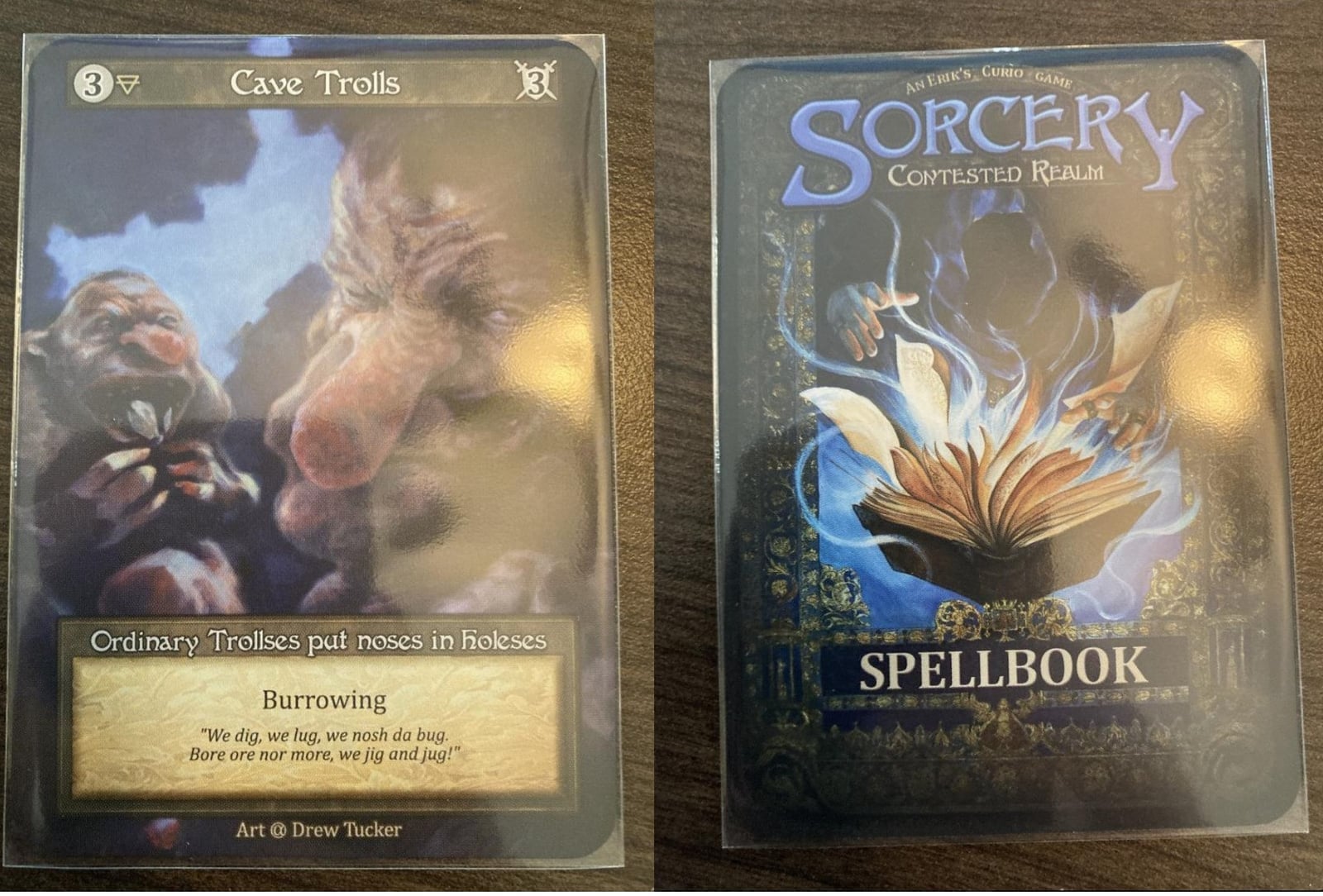
Cave Trolls — via Collector Arthouse
A back-variant Curio, plural form. The defining feature: "An Erik's Curio Game" on the back instead of the standard "An Erik's Curiosa Game." Same gimmick as Bridge Troll and Bosk Troll — the three together form the Alpha "Troll back-variant" subset.
Mirror Realm
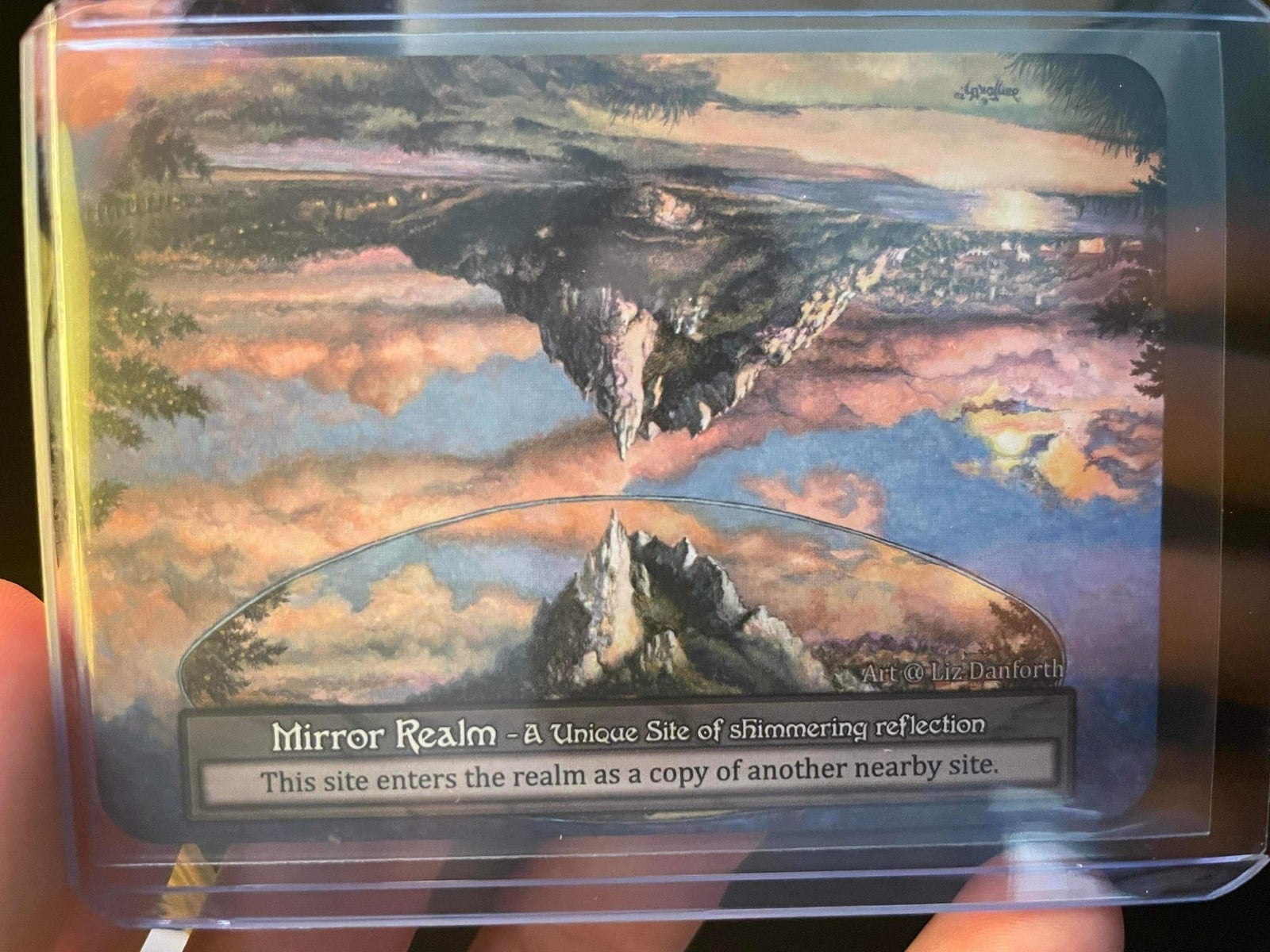
Mirror Realm by Liz Danforth — via Collector Arthouse
The Curio is an inverted rendition of the original Mirror Realm — a floating landmass overhead with its reflection arching beneath, the title bar dropped to the bottom of the frame instead of the standard top. Per Collector Arthouse, "not true to the original painting, and thus does not have real historical development relevance" — a playful take on the card's mirror mechanic rather than a design fossil. Visually inverted, mechanically identical.
Windblast
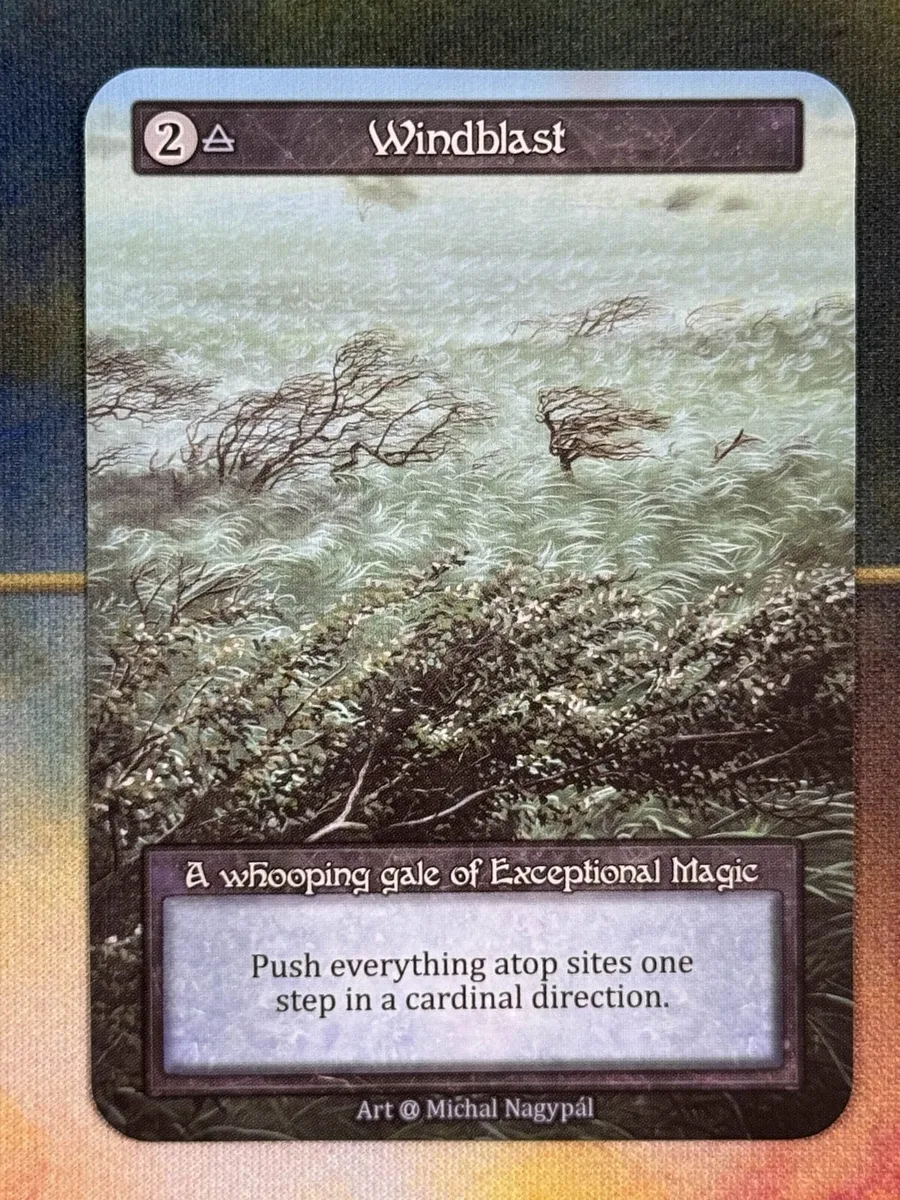
Windblast by Michal Nagypal — via Collector Arthouse
Alternate artwork by the same artist as the retail Alpha version. Per Collector Arthouse, this variant art remained un-used in Sorcery — the original commission was likely this design before Olofsson requested revisions that shifted the dominant palette from green to brown. Formatting, card text, and symbols all match Alpha's standards, which places this among the later Alpha Curios chronologically. Only the art differs.
Death Dealer
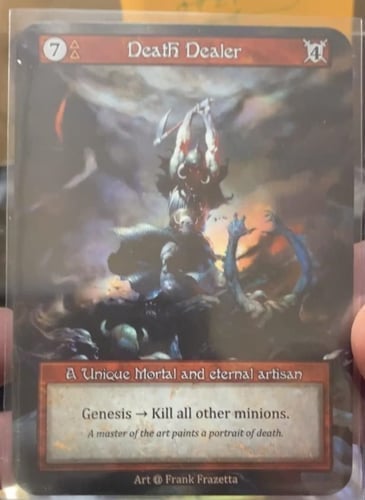
Death Dealer by Frank Frazetta — via Collector Arthouse
Alternate art drawn from Frank Frazetta's extensive portfolio — a Sorcery-licensed reproduction of one of his most famous fantasy paintings. The Curio adopts the painting whole-cloth and re-frames it as a Unique Mortal: "Genesis → Kill all other minions," with the flavor line "A master of the art paints a portrait of death." Per Collector Arthouse: one of the most-chased and valuable Curios in the game. Frazetta — Conan the Barbarian, the original Death Dealer paintings, decades of sword-and-sorcery imagery — is the most-recognised single artist credit anywhere in the Sorcery Curio catalogue.
Free City
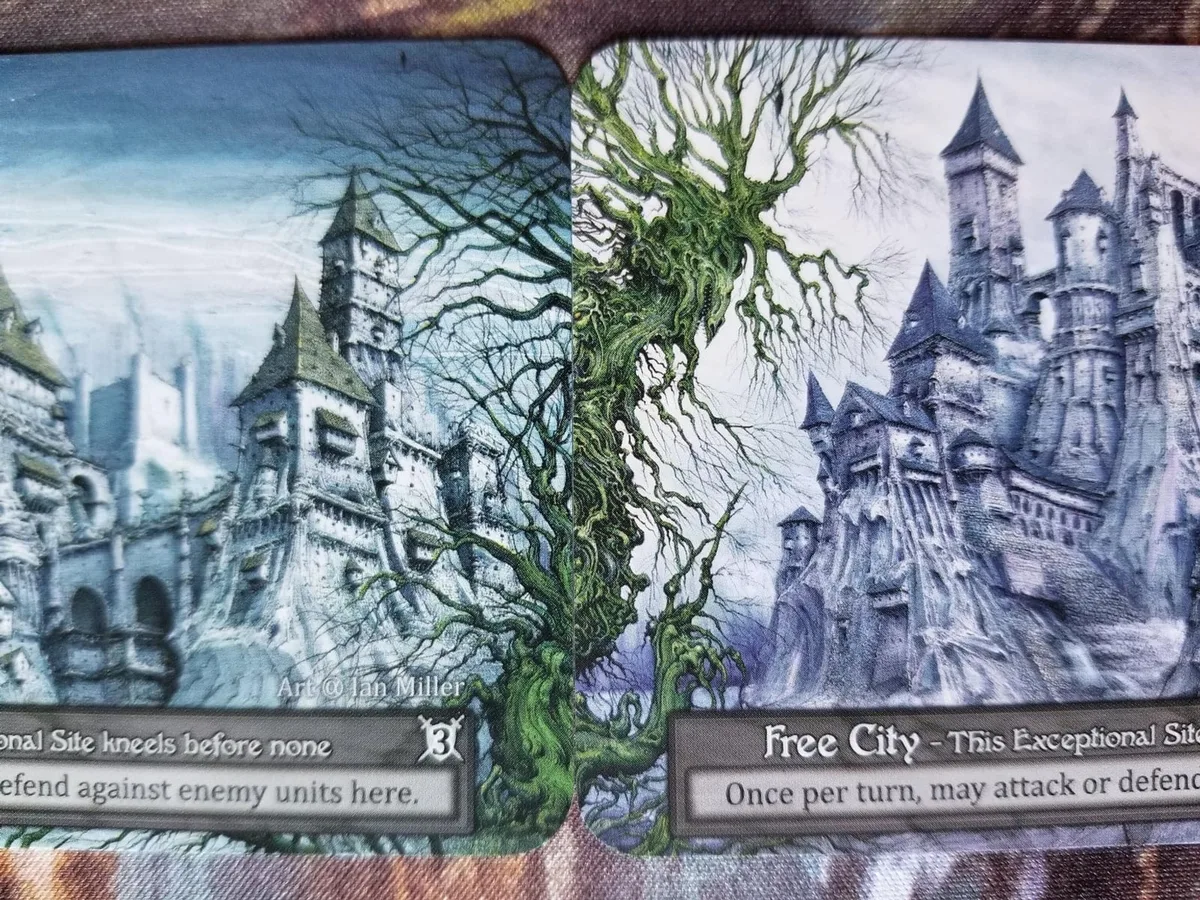
Free City by Ian Miller — via Collector Arthouse
Several of Ian Miller's Sorcery artworks were sourced from his existing book-cover illustrations. Miller is known for two-page cover spreads that span front and back. This Curio is noteworthy because it shows the second section that unites the extended illustration — the cover-spread counterpart that the retail Alpha card omitted. The retail print used one half; the Curio shows the other.
Murder of Crows
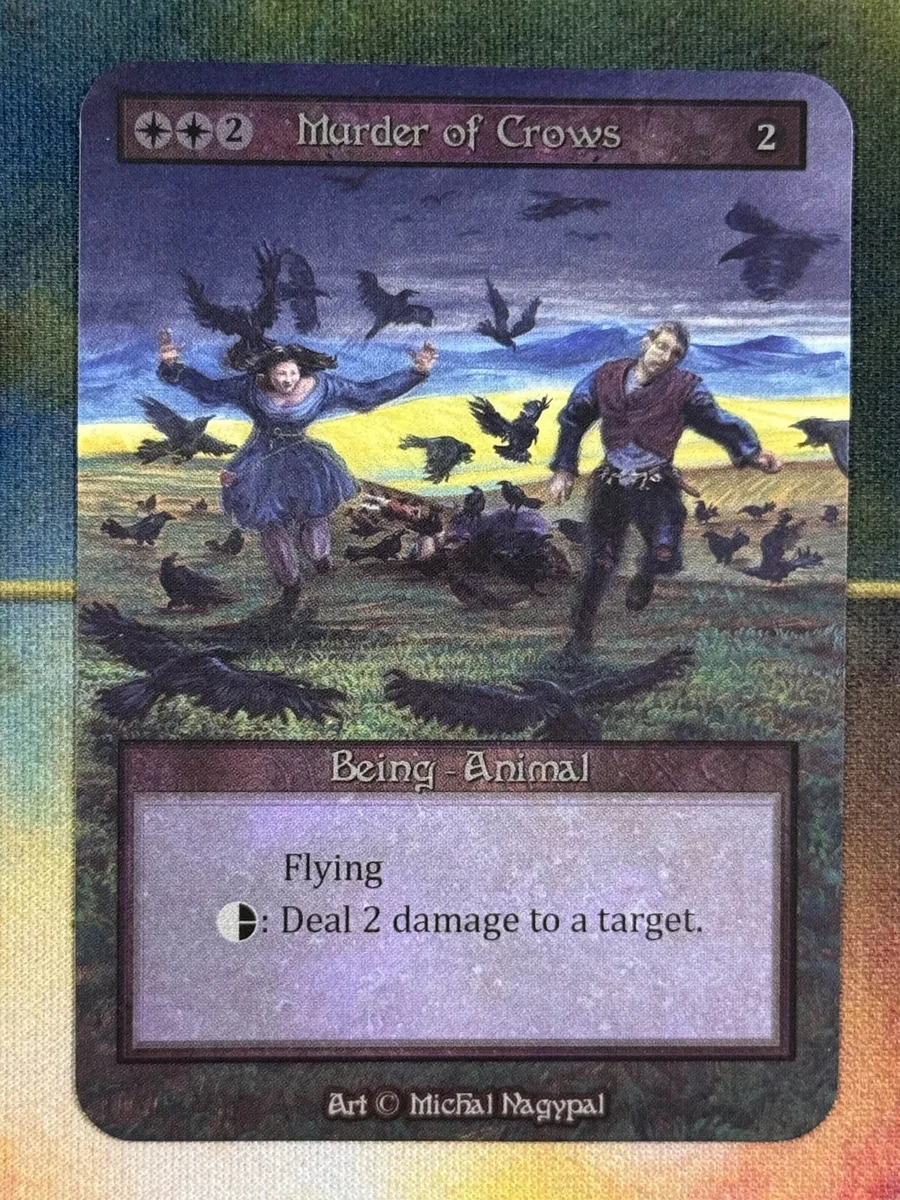
Murder of Crows by Michal Nagypal — via Collector Arthouse
The Curio art has never appeared in any standard Sorcery set. The card was mechanically reimagined for the Gothic expansion (December 2025) with new art and new mechanics — but this earlier Curio art remains Curio-exclusive. Visual markers from the experimental period: resource symbols that didn't ship, a circular power indicator (instead of Alpha's sword/shield), "Being - Animal" typing with no flavor text. Minimal bottom-of-card information — only copyright — suggests it was produced earlier than peers like Grim Tangle.
Bosk Troll
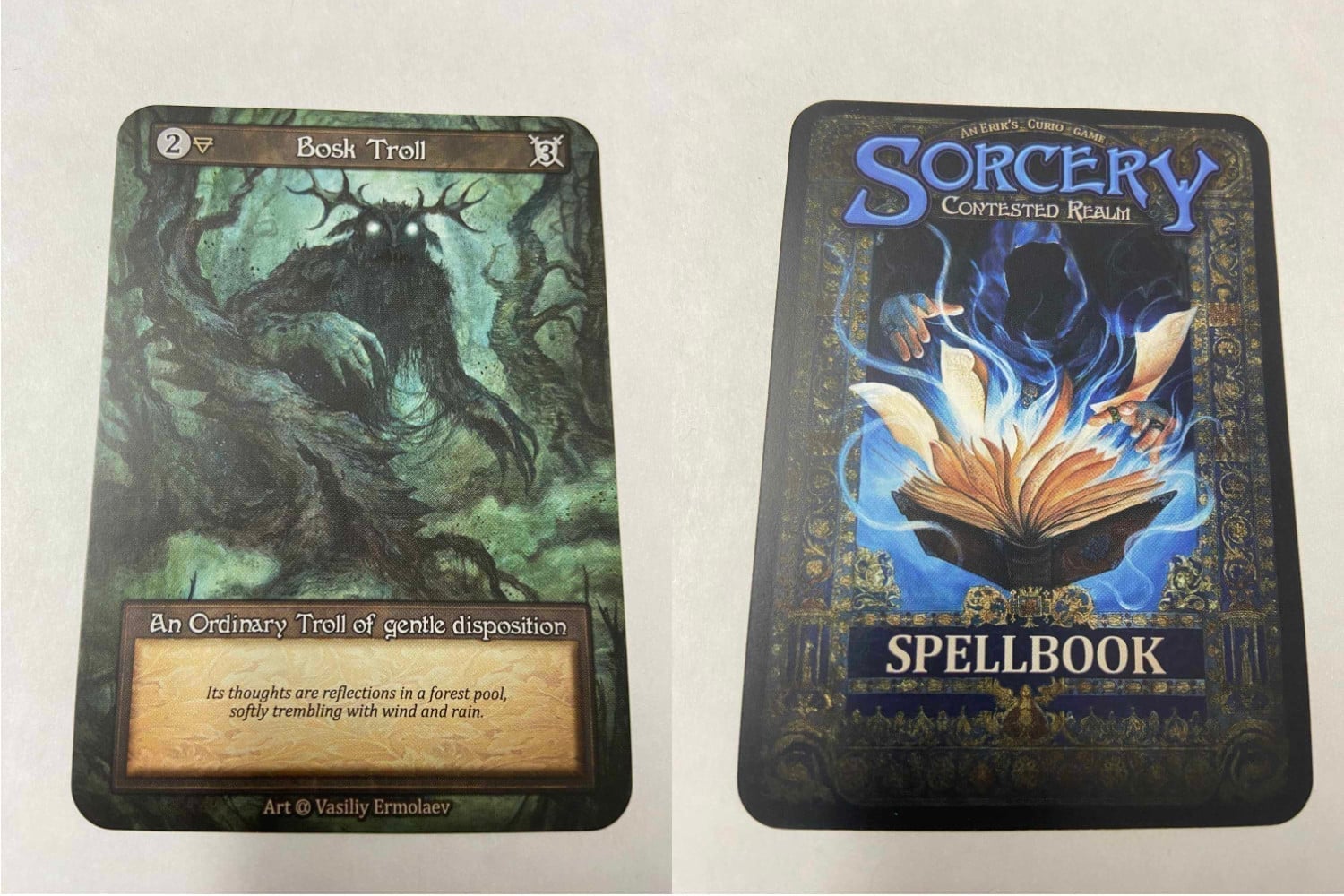
Bosk Troll — via Collector Arthouse
A back-variant Curio rounding out the Alpha Troll trio. Same gimmick as Bridge Troll and Cave Trolls: the back reads "An Erik's Curio Game" instead of the standard "An Erik's Curiosa Game." "Bosk" is an archaic word for a small wood or thicket. The front art matches retail; the back text is the entire variant.
Deathspeaker
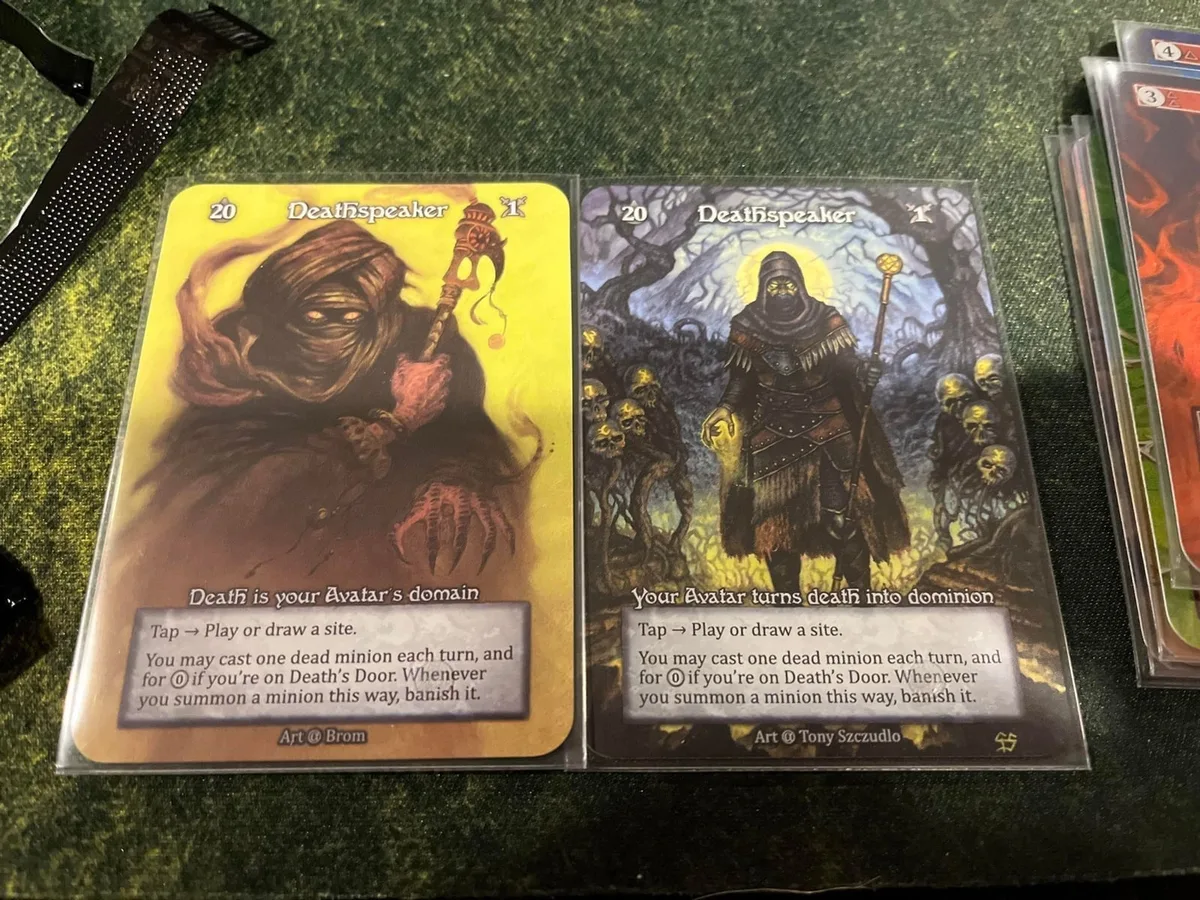
Deathspeaker by Gerald Brom — via Collector Arthouse
Alternate art by Gerald Brom, the painter behind 1990s D&D and Dark Sun. The illustration originally appeared in the Guardians CCG in the early 1990s — predating Sorcery by three decades. Per Collector Arthouse, the card's striking presence, low population count, and connection to the history of fantasy art drive collector demand. Treated by the archive as an early precursor to Brom's formal integration into Sorcery via the Gothic expansion (December 2025), where his work appears on the retail Fallen Angel against Scott Kirschner's Curio commission. The Alpha Deathspeaker is the first Brom–Sorcery crossover.
Gridlord Sorcerer
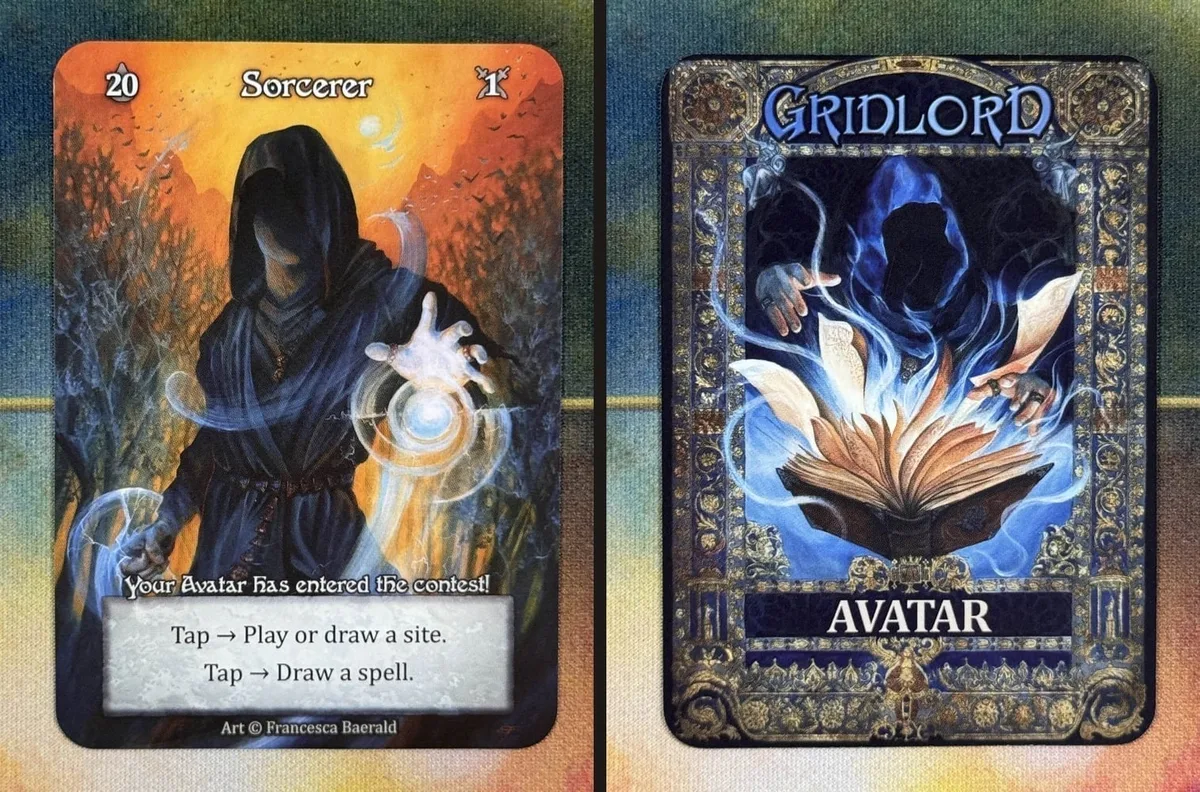
Gridlord Sorcerer (front and back) — via Collector Arthouse
A back-variant Curio — but with a different back-text gimmick from the Trolls. Where the Troll variants read "An Erik's Curio Game," Gridlord Sorcerer's back reads "GRIDLORD" instead of the standard "Sorcery." Significance is entirely developmental: "Gridlord" was one of three early working titles for the game, alongside "Spellcraft" and "Omnipotence." The Curio is a fossil of pre-release naming.
What "Legendary" tells us
Several Alpha Curios carry rarity tiers or text-box terminology that doesn't appear in any retail printing. "Legendary" (later "Unique"). "Continuous Event" (scrapped entirely). Separate attack/defense (consolidated into single power values following Fall 2021 discussions). Cards carrying these markers are reliably dated to the pre-shipment design window. The Curio is, in those cases, less a chase card and more an archival object.
Why Alpha Curios are scarce
Alpha itself never had a retail printing — it was Kickstarter-exclusive at roughly 6,400 backers — so the population of Alpha boxes still in existence to crack is small. Most known Alpha Curios are in long-term collector hands. Most never resurface publicly — when they do, it's typically through the marketplace channels the community uses for high-value cards. If you do encounter one, authenticate carefully — both PSA and CGC now grade Sorcery, and the authentication guide covers the visual tells.
What we still don't know
- The exact pull rate per box or per case.
- Whether the documented 18 is the full Alpha Curio pool or whether more remain undiscovered.
- Whether Erik's Curiosa will ever publish an official list. Per community reports, the publisher's position is unchanged across multiple direct asks.
Sources
- Collector Arthouse Curio archive — canonical community archive. Source for every card image and editorial detail in this article; individual card pages linked inline above.
- Sorcery: Contested Realm Kickstarter (2022) — original "very rare Mystery cards" framing
- Sorcery: Contested Realm Wiki — Alpha Pledge Pack — Kickstarter pack contents and Alpha set history