
Ian Miller is a British illustrator and writer, born November 11, 1946. He trained at Northwich School of Art in the mid-1960s, then at Saint Martin's School of Art in London, where he started in sculpture, switched to painting, and graduated with honours in 1970. The sculptural origin shows: his drawn forms have a built, load-bearing quality, like architecture that grew teeth.
The career that followed touched almost every corner of British and American genre illustration. For a generation of UK gamers his name is welded to two things. First, the Fighting Fantasy gamebooks — the Steve Jackson and Ian Livingstone choose-your-own-adventure series that defined mid-1980s tabletop for British teenagers. Miller painted covers for early titles including The Citadel of Chaos, House of Hell, and Creature of Havoc. Second, Games Workshop: he contributed to White Dwarf magazine and supplied covers and interiors across the company's late-1980s output — Terror of the Lichemaster, Death on the Reik, Warhammer City, illustrations for the Realm of Chaos supplements, and work in the first edition of Warhammer 40,000. The decaying-gothic, body-horror register that became Warhammer's house look owes a real debt to the way Miller drew rot and ruin.
Outside gaming, the credits keep going. He illustrated paperback covers for H. P. Lovecraft, contributed to David Day's illustrated Tolkien compendiums including A Tolkien Bestiary, worked on Ralph Bakshi's animated features Wizards and Cool World, did pre-production work for DreamWorks on Shrek, and produced two graphic novels — The Luck in the Head with M. John Harrison, and The City with the horror novelist James Herbert. In 2014 Titan Books published a career retrospective, The Art of Ian Miller. He lives and works in Brighton, England.
Style
Miller calls his approach the "Tight Pen Style" — pen-and-ink and wash, with deliberately restricted use of colour. It's a drawing practice, not a painting practice, and the difference is total.
A painter like Séverine Pineaux or Francesca Baerald builds an image out of light and mass: a figure emerges from a background, the brush smooths transitions, the eye lands on the subject first. Miller does the opposite. His images are built out of line — thousands of individual pen strokes cross-hatched into shadow and texture, with no smoothing anywhere and no comfortable focal point. The detail is uniform and relentless, so the eye crawls across the whole surface looking for somewhere to stop and never quite finds it. The claustrophobia is the point. Where Frazetta gives you a hero, Miller gives you a place that wants to eat the hero.
The recurring vocabulary is specific and strange: fish, flies, robotic and biomechanical forms, and gnarled haunting trees, recombined into structures that read as half-grown and half-built. He cites Albrecht Dürer and Leonardo da Vinci as influences — the Old Master engravers and anatomists whose precision he inherited — alongside the German Expressionists, the French Impressionists, Japanese landscape art, the science-fiction writer Alfred Bester, and the old Flash Gordon serials. On a card grid where the dominant note is painterly warmth, a Miller piece is a cold, etched intrusion from an older and weirder tradition of fantasy illustration.
Cards on Sorcery
Miller's Sorcery work is small in card count and large in presence. Two pieces anchor it.
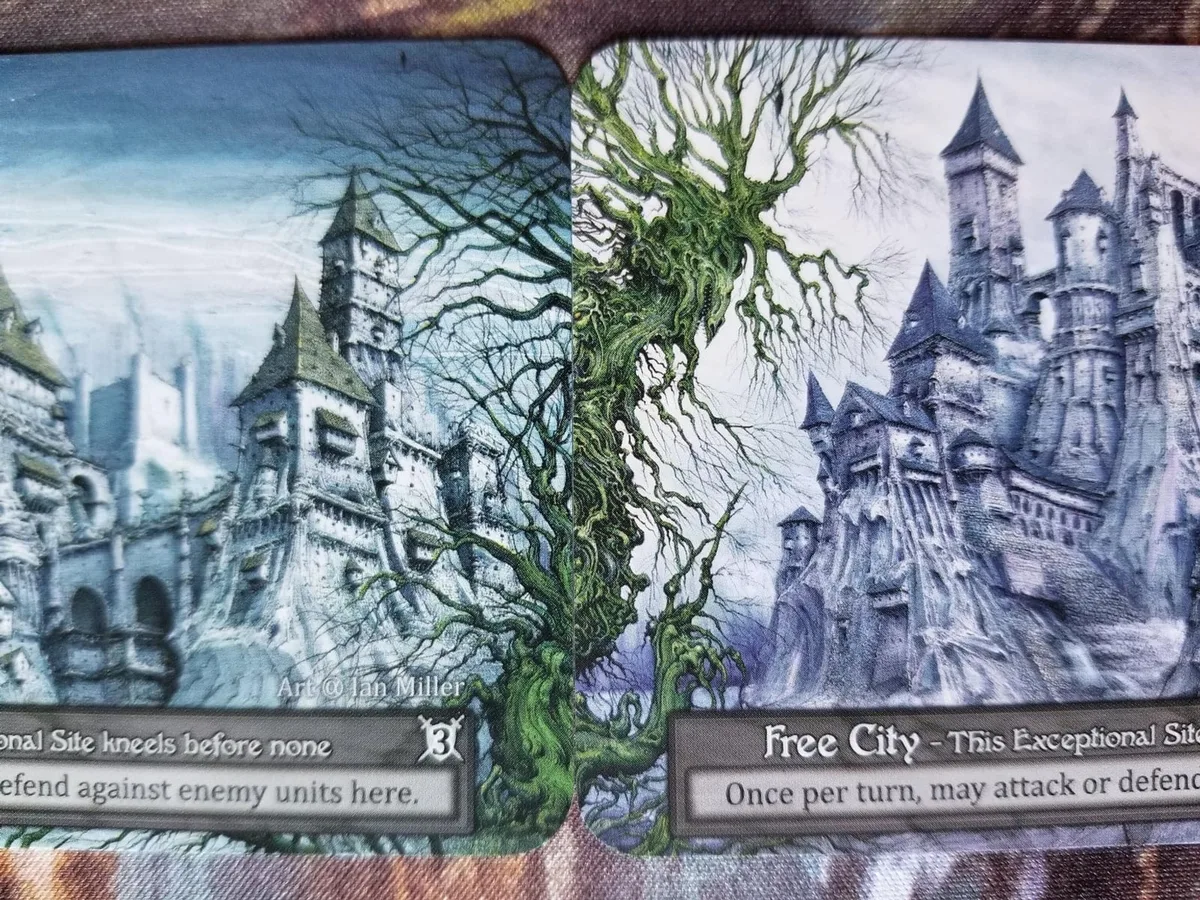
Free City by Ian Miller — via Collector Arthouse
Free City (Alpha Site). The publisher's own artist page calls Free City "one of Ian Miller's iconic sites" in the game. Like several of Miller's Sorcery artworks, it was sourced from an existing book-cover illustration rather than commissioned fresh — and that detail produced one of the most quietly clever Curios in the catalogue. Miller is known for two-page cover spreads that span a book's front and back as a single continuous image. The retail Alpha Free City uses one half of that spread; the Alpha Curio shows the second section that completes the extended illustration — the counterpart half the retail card cropped out. Put the two side by side and the panorama reunites. It's a rare case where a Curio isn't a sketch, a back-variant, or a colour-swap, but the literal other half of a picture — the kind of detail the collector side of the game lives for. Documented in Every Curio in Alpha.
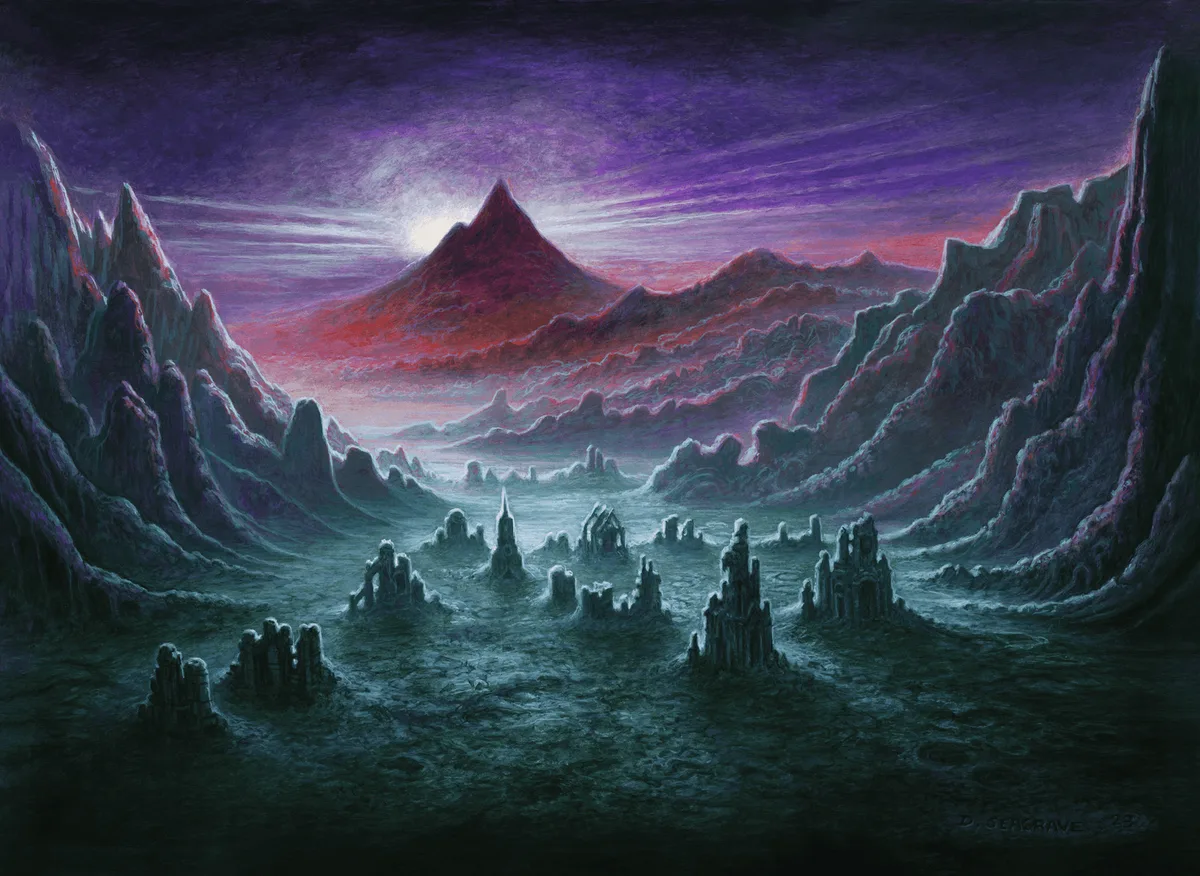
The Void by Ian Miller — the Gothic set's neoprene playmat artwork — via sorcerytcg.com
The Void (Gothic playmat). The Gothic expansion — December 2025, the game's largest set to date, themed around "dread, devotion, and despair" — shipped with a neoprene playmat carrying Miller's painting The Void. It's the surface a Gothic game is literally played on, which makes it one of the most-seen Miller pieces in the whole ecosystem: not a card you might or might not open, but the board itself. The match between artist and set is almost too neat. A supernatural realm of angels, demons, and reluctant prophets is exactly the territory Miller has been drawing since the Realm of Chaos days. If you're reading this on sorceryguide.com, you've already been looking at it — The Void is the low-opacity image bleeding behind the homepage hero, setting the tone before you've consciously registered it.
There's a pattern here worth naming. Miller doesn't paint Avatars — the devotional single-figure portraits that the Pineaux and Baerald commissions cover. His footprint is in places: a Site, and the playmat that represents the board the Sites are laid across. Miller has always been an artist of environments rather than heroes — his images are about the world being hostile, not the protagonist being strong — and Sorcery used him for exactly the thing his line does most naturally.
Where to see more Miller
- ianmiller.studio — his current official site. Miller describes himself there simply as "Artist, Illustrator & Writer," living and working in Brighton, England. Portfolio of recent work, a journal of upcoming projects, ongoing personal projects (Grim Tarock and The Shingle Dance), and a shop.
- The Art of Ian Miller (Titan Books, 2014) — the career retrospective, compiled with Tom Whyte and Brian Sibley. Four decades of pen-and-ink in one volume. ISBN 978-1781167793.
- alisoneldred.com — Miller is represented by the agent Alison Eldred, whose site carries galleries of his fine-art prints and originals for sale.
- The source material itself — the 1980s Fighting Fantasy paperbacks (The Citadel of Chaos, House of Hell, Creature of Havoc) and the David Day Tolkien bestiaries are still findable secondhand.
Sources
- Ian Miller (illustrator) — Wikipedia — birth date (November 11, 1946), art education (Northwich School of Art 1964–1967, Saint Martin's School of Art, honours 1970, sculpture to painting), the "Tight Pen Style" pen-and-ink-and-wash description, stated influences (Dürer, da Vinci, German Expressionists, French Impressionists, Japanese landscape art, Alfred Bester, Flash Gordon serials), recurrent motifs (fish, flies, robotic forms, gnarled trees), Fighting Fantasy covers (The Citadel of Chaos, House of Hell, Creature of Havoc), Games Workshop work (Terror of the Lichemaster, Death on the Reik, Warhammer City, Realm of Chaos, first-edition Warhammer 40,000, White Dwarf), Tolkien bestiary contributions, Lovecraft covers, Bakshi films (Wizards, Cool World), graphic novels (The Luck in the Head with M. John Harrison 1991, The City with James Herbert 1994)
- Ian Miller — artist profile, Erik's Curiosa — primary source for the Free City "one of Ian Miller's iconic sites" framing, the "renowned British fantasy illustrator and writer celebrated for his unique gothic and macabre style" description, and the DreamWorks Shrek pre-production credit
- Free City — Collector Arthouse Curio archive — primary source for the Free City Curio attribution and the two-page-spread / second-section detail
- Sorcery: Contested Realm — Gothic — source for The Void neoprene playmat artwork credit and the Gothic set's December 2025 release
- ianmiller.studio — official site — Miller's self-description ("Artist, Illustrator & Writer," Brighton), the portfolio / journal / shop, and the Grim Tarock and The Shingle Dance projects
- The Art of Ian Miller — Titan Books, 2014 — career retrospective, contributors Tom Whyte and Brian Sibley, ISBN 978-1781167793
- Ian Miller — Alison Eldred (agent) — fine-art prints and originals for sale, representation of record