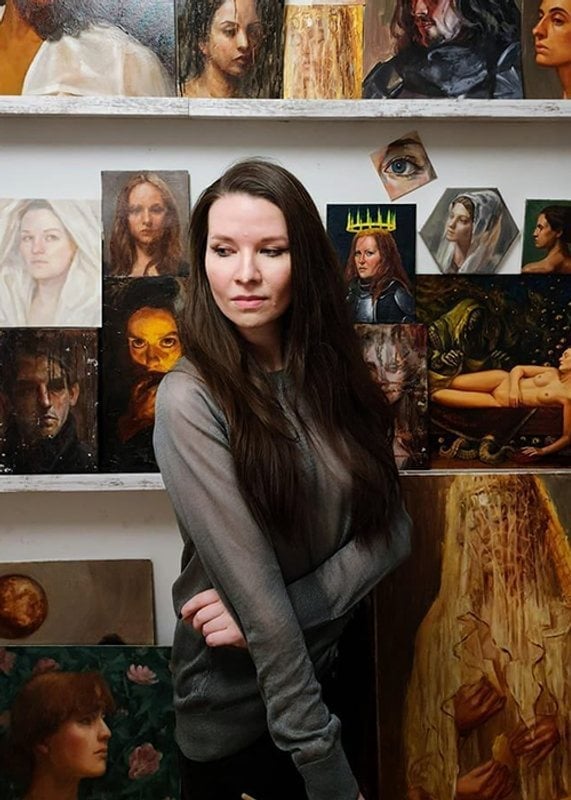
Elvira Shakirova is a Russian fantasy illustrator, now based in London. Per her artist profile with Erik's Curiosa, she "stumbled into art by accident, pushed to study book illustration at the Moscow State University of the Printing Arts by her ex-boyfriend's mom" — one of the more candid origin stories on the publisher's roster. From there she spent eight years working in theatre before transitioning into card-game illustration. The TCG work began with card alters, then moved to original commissions. She has been painting for Sorcery since 2019 — the same early-design window that brought Baerald, Pineaux, and the rest of the founding-era artists into Erik Olofsson's project. In 2023 she relocated from Russia to London, where she works now.
Her medium is traditional and recombinant. "I drift between oils and acrylics with colored pencils," she told Erik's Curiosa. "As soon as I grow tired of acrylics drying on the brush before I can get it to the paper, I switch to oils." That's not a formal rotation; it's a working painter's pragmatism — pick the medium the current piece needs and switch when it stops cooperating. Mixed media is on the table the same way. Her broader fantasy-illustration work spans book covers, tarot art, and trading-card alters from before the Sorcery commissions started.
Style
The Shakirova look is character-forward. Where some of Sorcery's roster works in atmospheric impressionism (Tucker) or manuscript-illuminated tradition (Pineaux), her pieces sit closer to the contemporary fantasy-book-cover register — figures rendered with precise anatomy, costume detail held tight, a strong central subject. The Gilded knights subseries is the clearest demonstration: twelve portraits with consistent heraldic posture, manuscript-style borders, and the kind of iconographic legibility that medieval-court illumination relied on to identify named figures at a glance.
Asked which of her own Sorcery pieces she likes best, she named Dream-Quest from the Arthurian Legends set. "I like drawing a lot of little details and making the scene very lived-in. I think I achieved it in this piece, also I enjoy witchy stuff." The lived-in detail is the through-line — every Shakirova card on the roster carries the kind of rendered surface that rewards close inspection rather than landing as a clean stylised gesture.
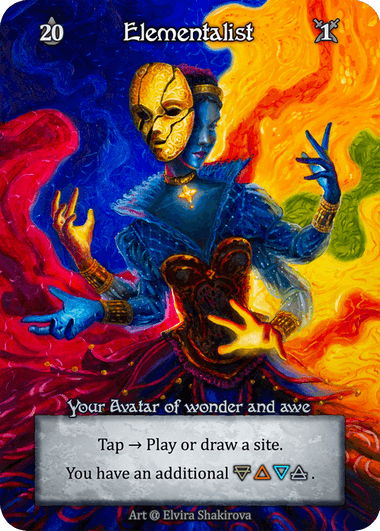
Elementalist by Elvira Shakirova — via Curiosa
Cards on Sorcery
Her catalogued footprint, working set by set. She's credited across Alpha, Beta, Arthurian Legends, and Gothic — every shipped set so far. Shakirova's name surfaces in three separate parallel-commission stories across the corpus — Pineaux's Far East Assassin original was replaced by Shakirova's in retail; Tucker's Gossamer Ghost Halloween piece became the Gothic Curio paired with Shakirova's retail painting; and the twelve Gilded knights are her commission alone.
Alpha — the Mix series. Per Collector Arthouse — cornerstone of the game's art-house and collector resources — Shakirova's "signature paintings for Sorcery include the Mix series from the Alpha set." The Mix is a thematically-linked cluster of Alpha cards: Aaj-kegon Ghost Crabs, Abaddon Succubus, Asmodeus, Chaoswish, Deathwish. They share a visual register that holds across the group — the kind of subseries cohesion the publisher would later formalise with the Gilded twelve. The Alpha printings reprinted into Beta.
Beta — Far East Assassin retail and the Guile Sirens foil Curio. Far East Assassin in retail is Shakirova's painting. The Pineaux version exists only as a Beta Curio, treated by the archive as a what-might-have-been — original commission replaced before shipment, with Shakirova's painting becoming the standard print everyone draws from. The reverse story holds for Guile Sirens: Shakirova painted the retail Alpha/Beta card and the Beta foil Curio variant, with the Curio printed on a regular Atlas back rather than the full-art Spellbook back that the Sirian Templar / Critical Strike foil Curios use. That makes the Guile Sirens foil a category of one in the Beta pool. Both entries are catalogued in Every Curio in Beta.
Beta — Rimland Nomads. Her painting on the Movement-keyword baseline card the Codex uses as a teaching example: a unit with Movement +1 that takes no damage from Deserts.
Arthurian Legends — Elementalist (Avatar). Her playable marquee. Elementalist is the four-color enabler Avatar: you start the game with one free threshold in every element, which makes a four-color Spellbook viable without committing your Atlas to it. Skill ceiling is high — access to everything means every deckbuilding cut becomes a real choice.
Arthurian Legends — six standard credits. Alvalinne Dryads, Amazon Warriors, Archangel Raphael, Crown of the Victor, Deep-Sea Mermaids, and Dream-Quest — six retail-printed Arthurian cards beyond the Elementalist Avatar. Dream-Quest is the one she names as her own favourite Sorcery piece.
Arthurian Legends — the Gilded twelve. Twelve foil/gilded Curios painted by Shakirova: nine Round Table knights (Kay, Galahad, Gawain, Lancelot, Mordred, Morien, Percival, Tristan, plus the keystone Arthur), Queen Guinevere, and the Holy Grail itself. Same manuscript-style portrait register across all twelve, gold accent borders, premium foiling, Curio rarity slot. Per Collector Arthouse, Shakirova received Artist's Proofs for each Gilded card — the only Curio commission where Erik's Curiosa has formally acknowledged the artist's work behind the scenes. Erik's Curiosa's standing policy on Curios is silence; the exception was made for the artist who painted them, and it's not a vote the publisher has cast for anyone else. The full twelve is catalogued in Every Curio in Arthurian Legends.
Gothic — Gossamer Ghost retail. The standard Gothic print of Gossamer Ghost is Shakirova's. The Curio variant — by Drew Tucker, originally a personal Halloween painting of a real Bangor, Maine window — became the second documented parallel commission in Gothic. The full story is in the Tucker profile and the Gothic Curio walkthrough.
Gothic — Blaze and Fade. Two additional standard-print Gothic credits, continuing her run across every shipped set.
Where to see more Shakirova
- elvira-shakirova.com — her personal site. The source of record for her broader illustration catalogue.
- ArtStation — nextdoorgalaxy — the deepest public archive of her work outside Sorcery. Fantasy illustration, tarot, character studies.
- Patreon — elvirashakirova — process work, prints, and a more candid stream of in-progress pieces than the curated portfolio.
- Instagram — @nextdoorgalaxy — short-form posts and works-in-progress.
- Erik's Curiosa — Elvira Shakirova artist page — the verbatim publisher quotes about her process, favourite card, and transition from theatre into TCG illustration.
Sources
- Elvira Shakirova — artist profile, Erik's Curiosa — primary source for the "stumbled into art" framing, the Moscow State University of the Printing Arts training, the eight years in theatre, the 2019 join date, the 2023 relocation to London, the medium quote ("I drift between oils and acrylics with colored pencils"), and the Dream-Quest favourite-card quote
- Elvira Shakirova — Collector Arthouse artist page — primary source for the set-by-set Sorcery card index (Mix series, Arthurian standards, Gilded twelve, Gothic credits), the "signature paintings ... Mix series ... Gilded collection" framing, and her UK location
- Far East Assassin — Collector Arthouse Beta Curio archive — primary source for the Pineaux original-commission framing and the Shakirova replacement in retail ("the artwork was replaced by the current art of Elvira Shakirova")
- Gossamer Ghost — Collector Arthouse Gothic Curio archive — primary source for the Shakirova retail attribution and the Drew Tucker parallel-commission Curio
- Gilded knights subseries — Collector Arthouse Arthurian Legends Curio archive — primary source for the twelve Gilded Curios and the Artist's Proof acknowledgment
- Guile Sirens — Collector Arthouse Beta Curio archive — primary source for the Beta foil Curio variant and the regular-Atlas-back distinction
- Elementalist — Curiosa.io card data — Shakirova attribution and the four-color enabler ability text
- Rimland Nomads — Curiosa.io card data — Shakirova attribution and Movement +1 / Desert immunity ability text
- Elvira Shakirova — personal site — broader portfolio and biographical confirmation
- Elvira Shakirova — ArtStation portfolio (nextdoorgalaxy) — public fantasy-illustration archive