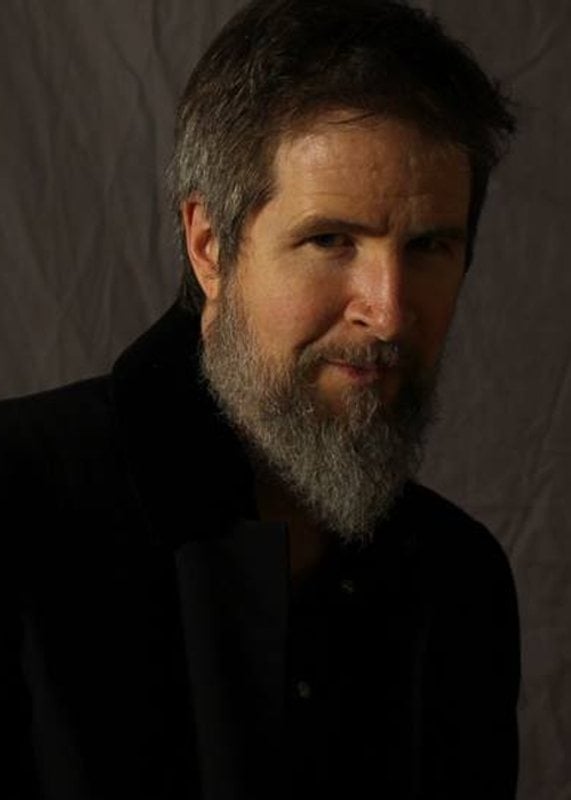
Brom (Gerald Brom, born March 9, 1965, in Albany, Georgia) is an American dark-fantasy painter, illustrator, and novelist. He signs his work with the single name his family has called him from boyhood. He never took a formal art class, went full-time as a commercial illustrator in Atlanta at twenty, and by twenty-one had two national art reps and clients including Coca-Cola, IBM, CNN, and Columbia Pictures.
TSR hired him full-time in 1989, age 24. In 1991 he designed the look of Dark Sun — Athas, the burnt desert world of psionic gladiators and obsidian cities — before the writers wrote it. "I pretty much designed the look and feel of the Dark Sun campaign," he told the Athas fan archive. "I'd do a painting or a sketch, and the designers wrote those characters and ideas into the story." For three years he painted almost exclusively for Athas, then left for freelance in 1993 — and over the next three decades worked on the video games Doom II, Heretic, and Diablo II, and the collectible card games Magic: The Gathering, Warlords, and Guardians (whose paintings would resurface on Sorcery cards thirty years later).
He's also a novelist. The Plucker (2005), The Devil's Rose (2007), The Child Thief (2009 — a brutal Peter Pan retelling), Krampus: The Yule Lord (2012), Lost Gods (2016), and Slewfoot: A Tale of Bewitchery (2021 — a USA Today bestseller) all carry his own paintings throughout. He's an author-illustrator in the old N.C. Wyeth sense, not a cover-for-hire who happens to sketch. His honors include the Spectrum Fantastic Art Grand Master award (2013), the Chesley Lifetime Achievement award, and induction into the Origins Award Hall of Fame (2019).
Style
The Brom look is dark fantasy rendered in oil with a storyteller's restraint. Theatrical light, deep shadow, anatomy that owes more to classical figure study than to reference photography, and a recurring cast of the beautiful and the monstrous occupying the same frame. He cites Frank Frazetta, N.C. Wyeth, and Norman Rockwell as the painters who shaped him — an instructive trio, because it explains both the dark-fantasy muscle (Frazetta) and the storytelling clarity and surface technique (Wyeth, Rockwell) that keep his work from tipping into pure shock.
It's gothic by temperament, not just by subject — which is exactly why a Gothic-themed Sorcery set is the right place for it. The work is also notable for being thick: his impasto surface is one of the print-fidelity tells the Sorcery authentication guide lists, because a flat scan of a real card can't reproduce the raised brushwork that catches light on the genuine print — worth knowing before chasing his cards through the buy/sell/trade channels.
Cards on Sorcery
The Brom footprint comes in two distinct waves, and they arrived years apart.
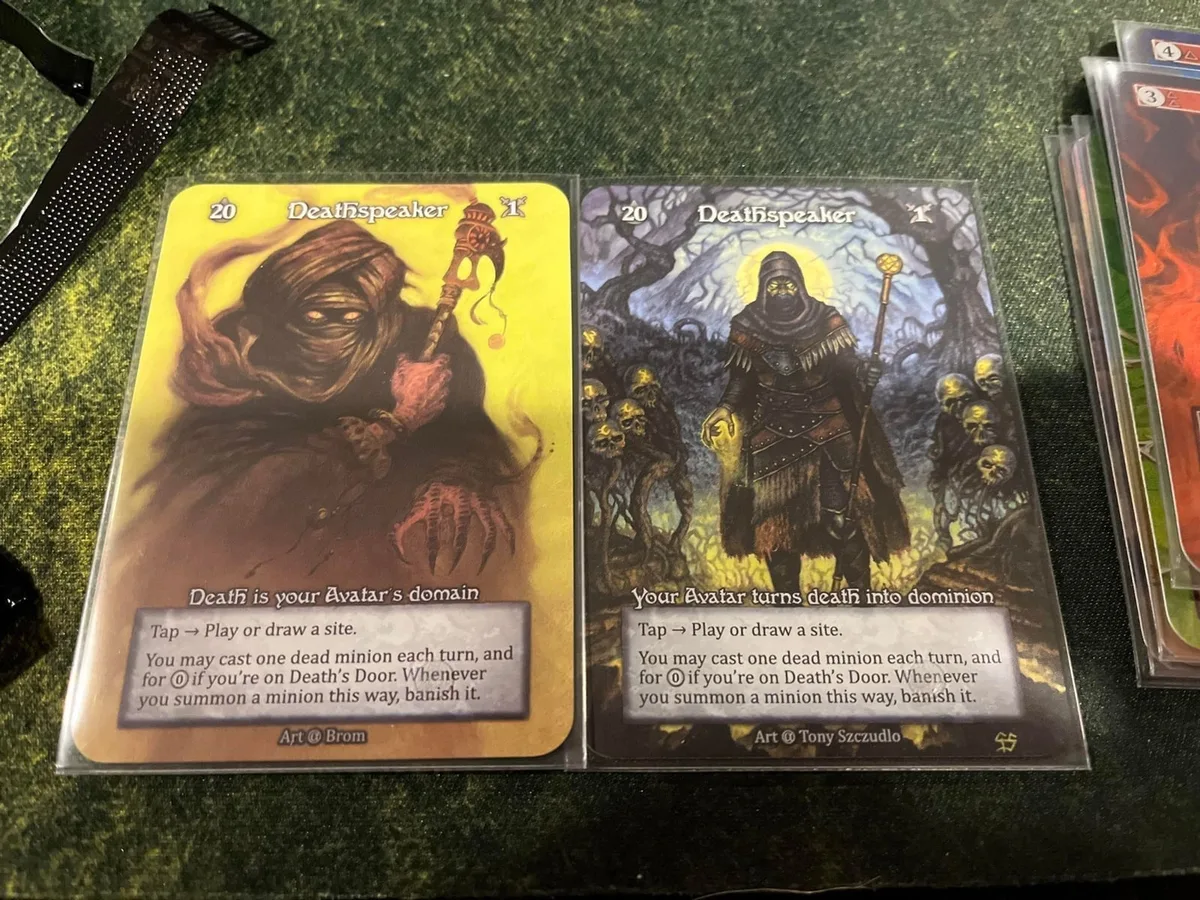
Deathspeaker by Gerald Brom — via Collector Arthouse
Deathspeaker (Alpha Curio). Before Brom was a named retail artist on Sorcery, his work slipped in through the Curio channel. The Alpha Deathspeaker Curio uses a Brom painting that originally appeared in the Guardians CCG in the early 1990s — three decades before Sorcery shipped. Per Collector Arthouse, the card's striking presence, low population, and connection to fantasy-art history drive its collector demand. The archive treats it as the precursor to Brom's later formal integration. Documented in full in Every Curio in Alpha.
Fallen Angel (Gothic). The standout Curio of the entire Gothic set turns on a Brom card. The standard, retail Fallen Angel carries Brom's art. The Curio variant is a separate, parallel commission by Scott Kirschner, painting the same card from a different angle — a ragged angel curled in the crater where it landed, violently, after losing its halo (Erik Olofsson's brief to Kirschner was, almost verbatim, "a ragged angel curled up in a crater where it would have landed rather violently"). The catch: per Collector Arthouse, Kirschner wasn't told his version would be the Curio — "Scott did not know it was destined to be a Curio card, and had no idea of the rarity level at all." The publisher printed Brom's painting for the retail run and reserved Kirschner's for the Curio slot, unilaterally. The full story is in Every Curio in Gothic.
The rest of the Gothic body of work. Fallen Angel is not a one-off. Brom was "officially added to the game with a plethora of commissions" in Gothic, per the Collector Arthouse artist page, which credits him on fifteen Gothic cards: Bitter Departed, Bone Jumble, Demonic Contract, Dreadwing, Fallen Angel, Ghoul, Grasping Ground, Hearkening Kraken, Intrepid Hero, Khamaseen Mummy, Monstermorphosis, Plague Rat, Ravenous Werewolf, Renatus Trueblood, and Sinterfee. The provenance is the same as Deathspeaker's: the archive states the Gothic commissions draw on his 1990s Guardians CCG work. The "formal integration" isn't a fresh batch of new paintings so much as a licensing-and-reframing of an existing Brom catalogue from a defunct card game — the same move that put Frazetta and Quinton Hoover paintings onto Sorcery frames, applied at a fifteen-card scale to a living artist's back catalogue.
Where to see more Brom
- bromart.com — the artist's official site. Galleries, biography, print sales, and the canonical record of which paintings and novels exist.
- His novels — The Child Thief, Krampus: The Yule Lord, Lost Gods, and Slewfoot are all in print from Harper Voyager and Tor Nightfire, each illustrated throughout by Brom himself. Slewfoot is the easiest entry point.
- Spectrum Fantastic Art — the annual anthology that functions as fantasy illustration's critical record named Brom a Grand Master in 2013, and his work recurs across volumes.
- Collector Arthouse — Gerald Brom — the Sorcery-specific gallery and the canonical credit list for his Gothic body of work.
Sources
- Gerald Brom — Wikipedia — birth date (March 9, 1965, Albany GA), military-dependent childhood, self-taught, TSR full-time 1989, Dark Sun 1991–1993, video-game and CCG credits (Doom II, Heretic, Diablo II, Magic: The Gathering, Guardians), Origins Award Hall of Fame 2019
- Art of Brom — official site, About page — career start in Atlanta at age 20, Dark Sun "for the next three years I worked exclusively on the bleak desert world," novel list, Spectrum Grand Master and Chesley Lifetime Achievement awards, Slewfoot USA Today bestseller
- Burnt World of Athas — An Interview with Brom — "I pretty much designed the look and feel of the Dark Sun campaign" quote
- Gerald Brom — Collector Arthouse artist page — the fifteen Gothic card credits, the Deathspeaker-first integration note, and the 1990s Guardians CCG provenance for the Gothic commissions
- Deathspeaker (Alpha Curio) — Collector Arthouse — Guardians CCG origin, low population, collector-demand context, precursor-to-formal-integration framing
- Fallen Angel — Collector Arthouse — Brom on the standard print, Scott Kirschner on the Curio, "Scott did not know it was destined to be a Curio card," and the art-direction brief
- Sorcery Gothic speculation — Collector Arthouse — Brom's Ghoul as one of a trio of plain 3/3 minions (with Ian Miller and Mattias Frisk)
- Sorcery: Contested Realm — Wikipedia — Gothic as a December 2025 440-card set; Kickstarter-exclusive Alpha background