Arthurian Legends is the first standalone Sorcery expansion — October 2024, 220+ cards themed around the Round Table cycle. It carries an estimated 24 Curio variants, the largest documented pool of any set so far. For the full primer on what Curios are and why the publisher won't acknowledge them, see Curio Cards in Sorcery: Contested Realm, Explained.
The shift Arthurian introduced wasn't volume so much as structure. It's the first set where Curios formed a deliberate themed subseries — twelve foil/gilded Round Table cards designed to be collected as a group. Until Arthurian, every Curio was a one-off.
Every entry below is sourced from the Collector Arthouse Curio archive, which is the canonical reference the community maintains — alongside the broader art-and-archive resources in the directory.
The 24 known cards
Jump to any entry:
- The Gilded knights — overview
- The four squires — overview
- Wizard's Den — Japanese version
- Unladen Swallow
- Unseelie Court (sketch)
- The Green Knight
- Site Trolls
- Broceliande
- Dozmary Pool
- Toll Bridge
- Wyvern
The Gilded knights
Twelve Curios painted by Elvira Shakirova — each a foil/gilded treatment of a card already in the Arthurian retail set. Same art, gold accent border, premium foiling, Curio rarity slot. The set hangs together: nine knights of the Round Table, plus Arthur, Guinevere, and the Holy Grail itself.
Collectors treat the full twelve as a single completion goal rather than individual chases. If you complete the Gilded twelve you have the closest thing Sorcery has to a "binder set" — a coherent themed collection where the parts mean more together. There's also a quiet first inside this subseries: per Collector Arthouse, Shakirova received Artist's Proofs for each Gilded card, the only Curio commission where the publisher has acknowledged the artist's work behind the scenes at all.
Gilded Sir Kay
Kay — Arthur's foster brother and seneschal in the Round Table cycle — gets Shakirova's manuscript-style portrait treatment with the signature gold foiling. The extreme rarity in pull rate plus absence from Curiosa and TCGPlayer is what holds the card's Curio status; it's not the only Gilded card to enter the world this way, but it's the one we used for the hero image because the foiling reads cleanest on Kay's burgundy palette.
Gilded King Arthur
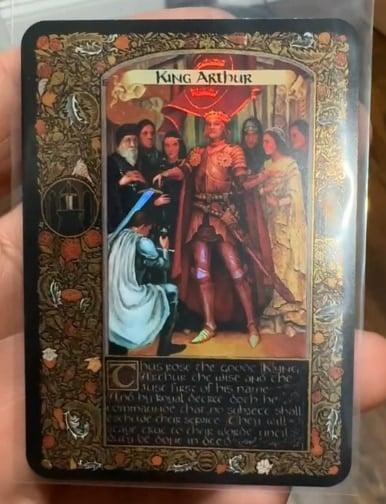
Gilded King Arthur by Elvira Shakirova — via Collector Arthouse
The keystone of the Gilded twelve. Arthur sits at the center of the subseries the same way he sits at the center of the matter of Britain. Shakirova's manuscript style — gilded crown, illuminated borders, the heraldic posture — leans into the medieval-manuscript register the entire Gilded run is referencing.
Gilded Queen Guinevere
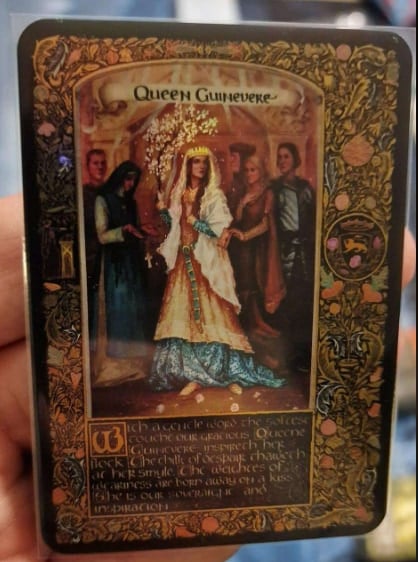
Gilded Queen Guinevere by Elvira Shakirova — via Collector Arthouse
The only crowned non-knight in the Gilded subseries other than Arthur himself. Same manuscript-style portrait treatment, same gold foiling. Guinevere's inclusion alongside Arthur and the knights anchors the "court at Camelot" framing of the full twelve — without her, the Round Table is a list of men, and the binder reads as a duty roster rather than a court.
Gilded Sir Galahad
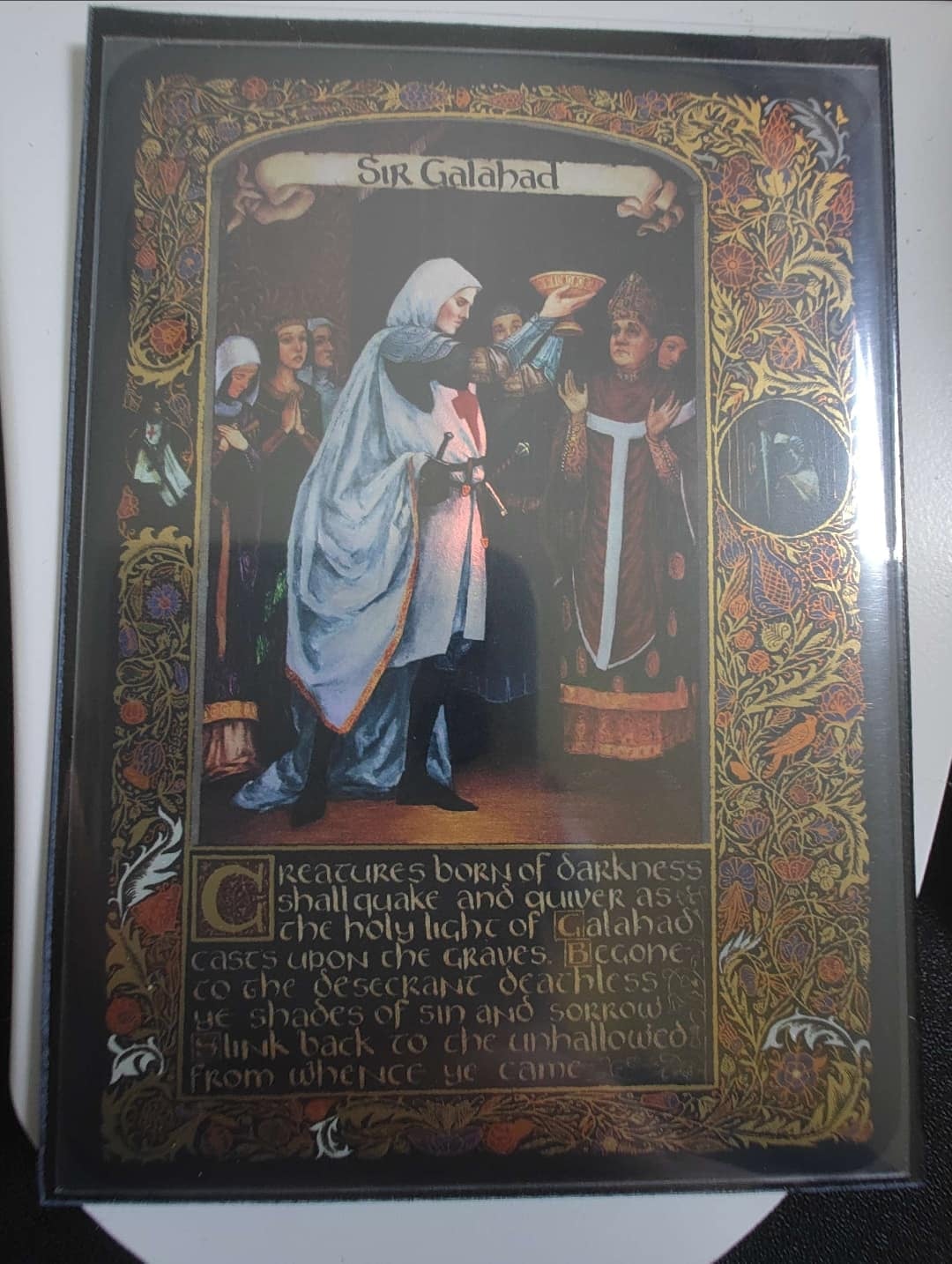
Gilded Sir Galahad by Elvira Shakirova — via Collector Arthouse
Galahad — son of Lancelot, the pure-hearted knight who completes the Grail Quest in the Vulgate Cycle. Shakirova's portrait gives him the iconographic weight the medieval sources do: he's the one who actually achieves what every other knight in the binder is reaching for, and the Gilded foiling reads as halo-adjacent in this context.
Gilded Sir Gawain
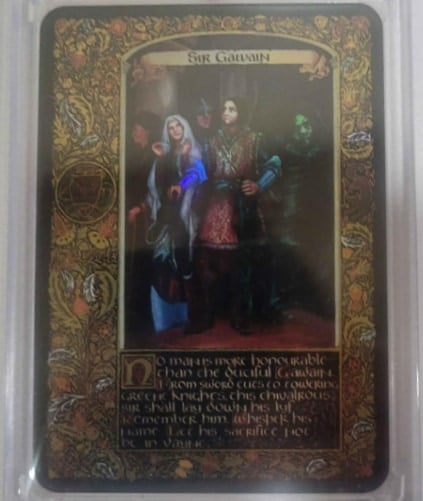
Gilded Sir Gawain by Elvira Shakirova — via Collector Arthouse
Gawain — Arthur's nephew, the protagonist of Sir Gawain and the Green Knight and one of the oldest names in the British Arthurian tradition. The Gilded portrait sits in deliberate visual conversation with the Curio Green Knight elsewhere in this set, where Melissa Benson reinterprets Gawain's most famous antagonist as a separate Curio.
Gilded Sir Lancelot
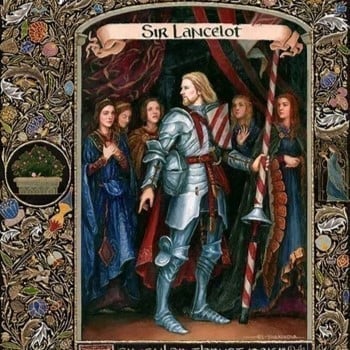
Gilded Sir Lancelot by Elvira Shakirova — via Collector Arthouse
The most famous knight after Arthur himself — Guinevere's lover, the catalyst for the kingdom's eventual collapse. Manuscript-style portrait with the gold foiling that defines the subseries. Cataloguing Lancelot next to Guinevere in the same Gilded run gestures at the Vulgate-era romance reading of the cycle without spelling it out.
Gilded Sir Mordred
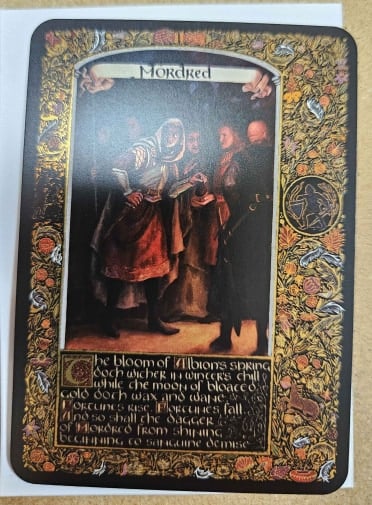
Gilded Sir Mordred by Elvira Shakirova — via Collector Arthouse
Mordred — Arthur's nephew (or son, depending on the source), the traitor whose mutual killing of Arthur ends the Round Table at the Battle of Camlann. Including him in the Gilded twelve is the right editorial call: the Round Table without Mordred is incomplete, because the Round Table without Mordred never breaks.
Gilded Sir Morien
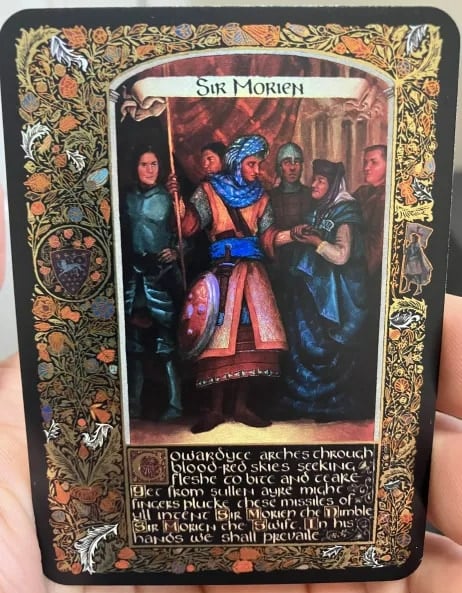
Gilded Sir Morien by Elvira Shakirova — via Collector Arthouse
The deepest cut in the Gilded subseries. Morien is the Black knight of the medieval Dutch Roman van Moriaen, son of a Moorish princess and one of Arthur's knights — included in the Round Table tradition for centuries but rarely surfaced in modern Arthurian retellings. His inclusion here is the kind of choice that rewards readers who know the source material beyond Malory.
Gilded Sir Percival
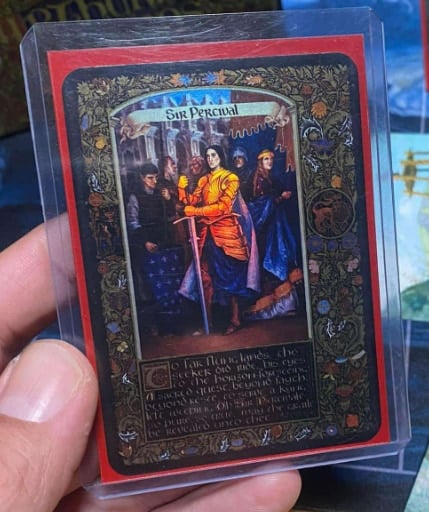
Gilded Sir Percival by Elvira Shakirova — via Collector Arthouse
Percival — the original Grail Knight in Chrétien de Troyes' Perceval, le Conte du Graal before Galahad displaced him in the later Vulgate tradition. Both are present in the Gilded twelve, which is the kind of completeness that makes the subseries read as deliberate rather than incidental.
Gilded Sir Tristan
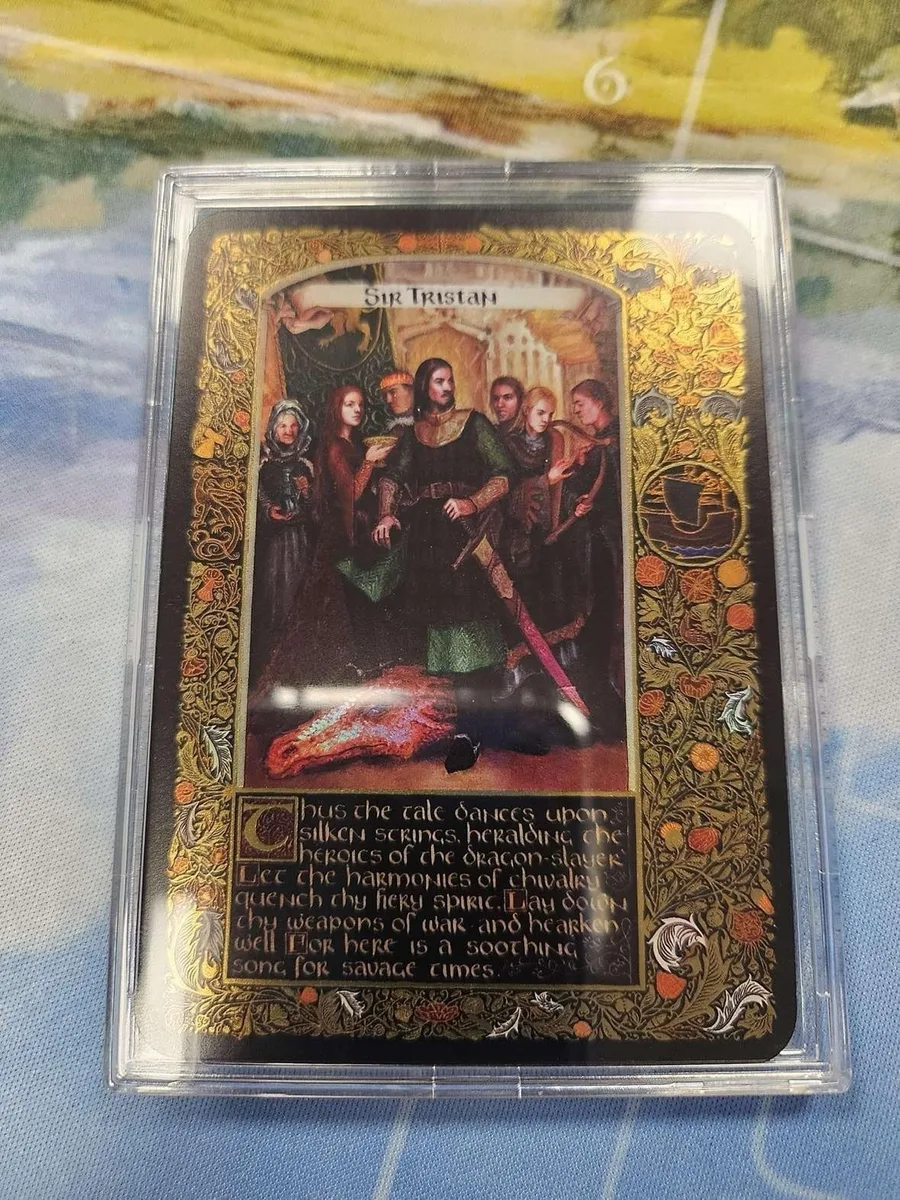
Gilded Sir Tristan by Elvira Shakirova — via Collector Arthouse
Tristan — the knight from the Tristan-and-Iseult cycle, often grafted onto Arthurian material in later medieval sources. The Gilded portrait pulls him into the Round Table proper, consistent with how Malory framed him in the Morte d'Arthur.
Gilded The Holy Grail
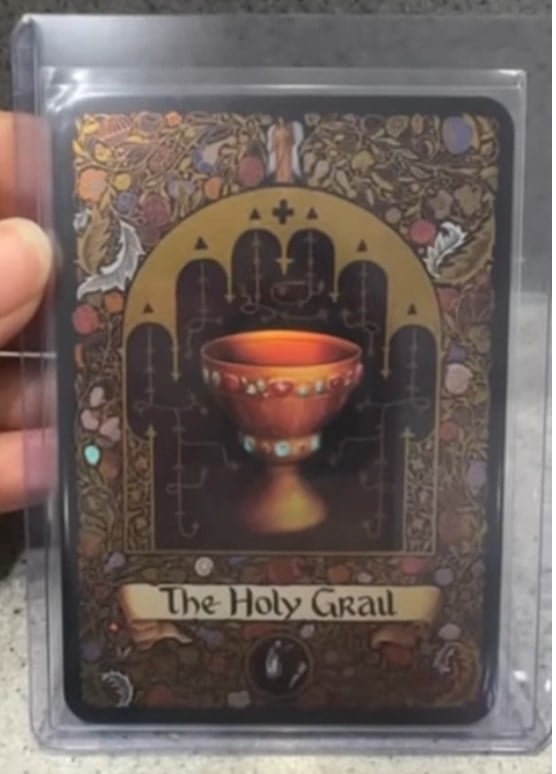
Gilded The Holy Grail by Elvira Shakirova — via Collector Arthouse
The structural outlier. Per Collector Arthouse, the Holy Grail is the only Gilded Curio that doesn't correspond to an actual playable card in the retail Arthurian set — it exists only as the Gilded artifact at the symbolic center of the Round Table cycle. Painting it into the Gilded twelve makes the subseries thematic rather than purely roster-based: it's the object the knights are seeking, given the same manuscript treatment as the knights themselves.
The four squires
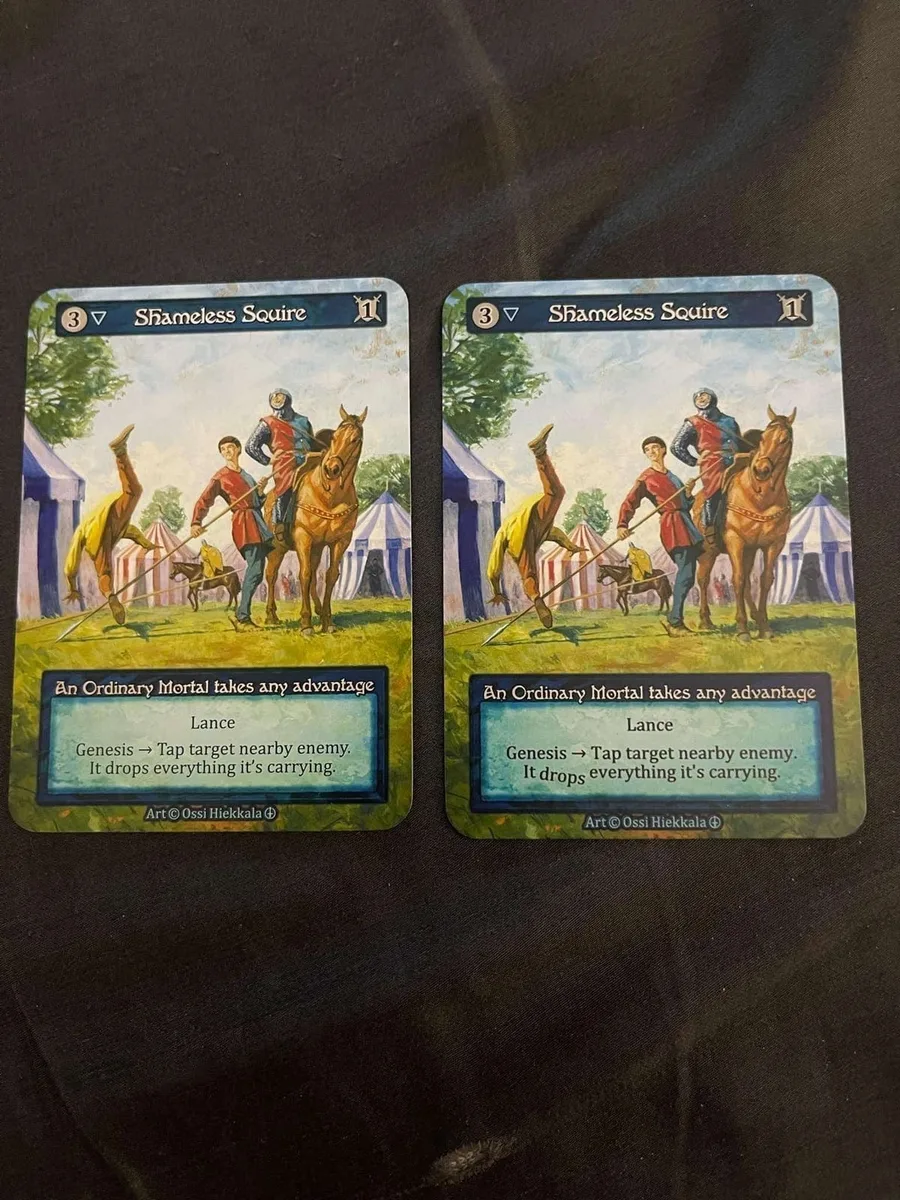
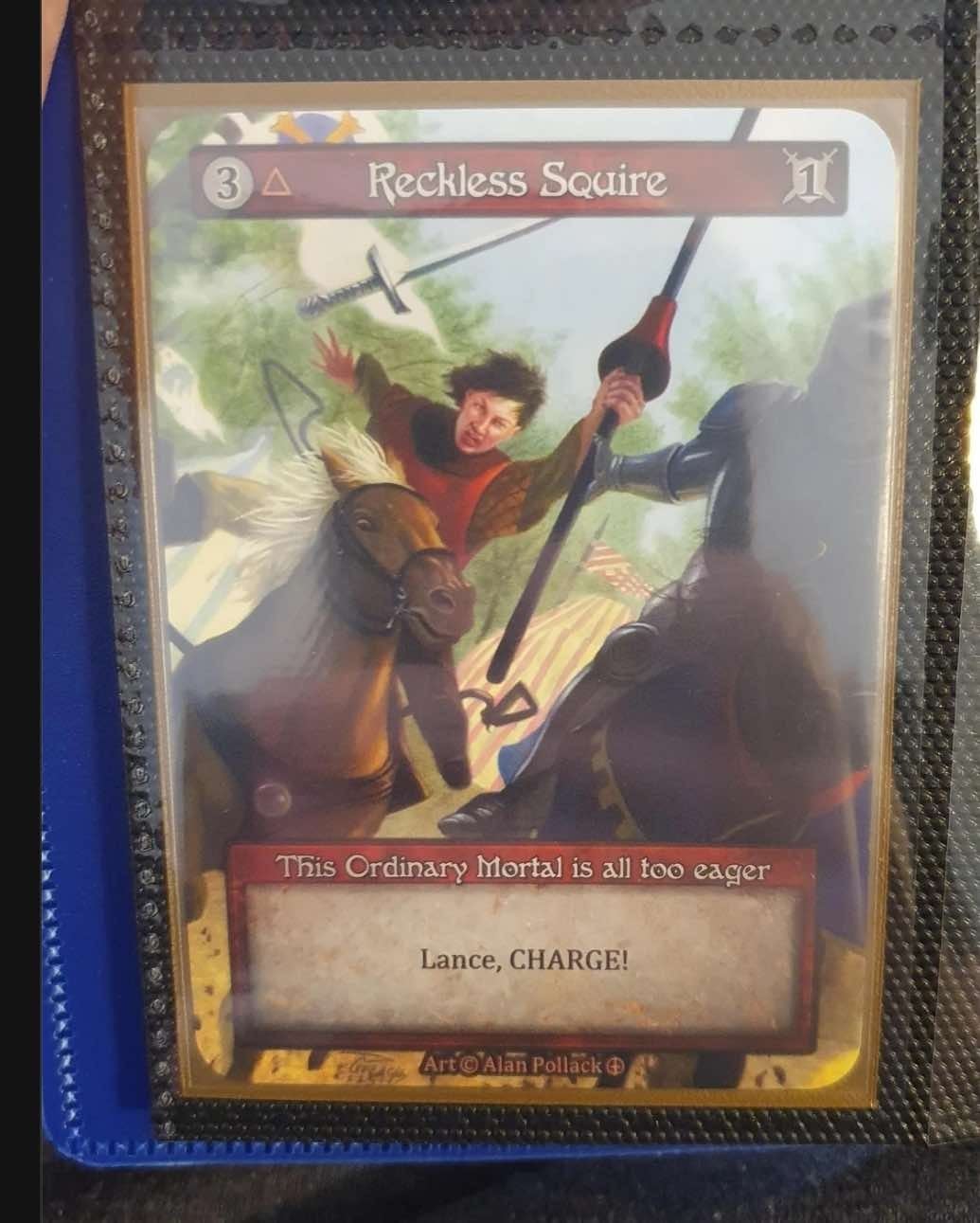
A different kind of variant series. Four cards, all named "Squire" with a prefixed adjective, all subtle visual gags built into the card text itself rather than the art. The retail Arthurian set has a single "Squire" card; the Curio variants name-shift it and then do something playful with the rules text.
The Squire run is Arthurian's lighter counterweight to the Gilded subseries. Where the Gilded twelve is reverent and manuscript-style, the Squires are the publisher (silently, characteristically) winking.
Weightless Squire
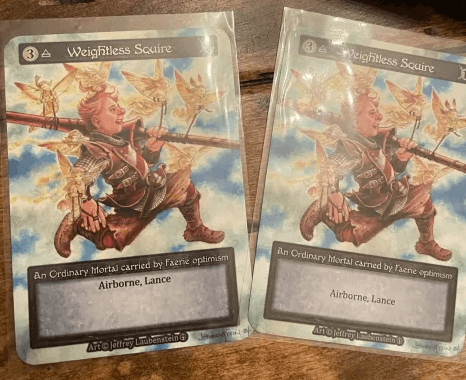
Weightless Squire — via Collector Arthouse
Per Collector Arthouse, the gag here is that the "Airborne, Lance" text on the card is literally airborne — the words have drifted up to the top of the text box, leaving the rest of the card-text region empty beneath them. The visual joke is the only difference; the card name is the only other tell.
Thankless Squire
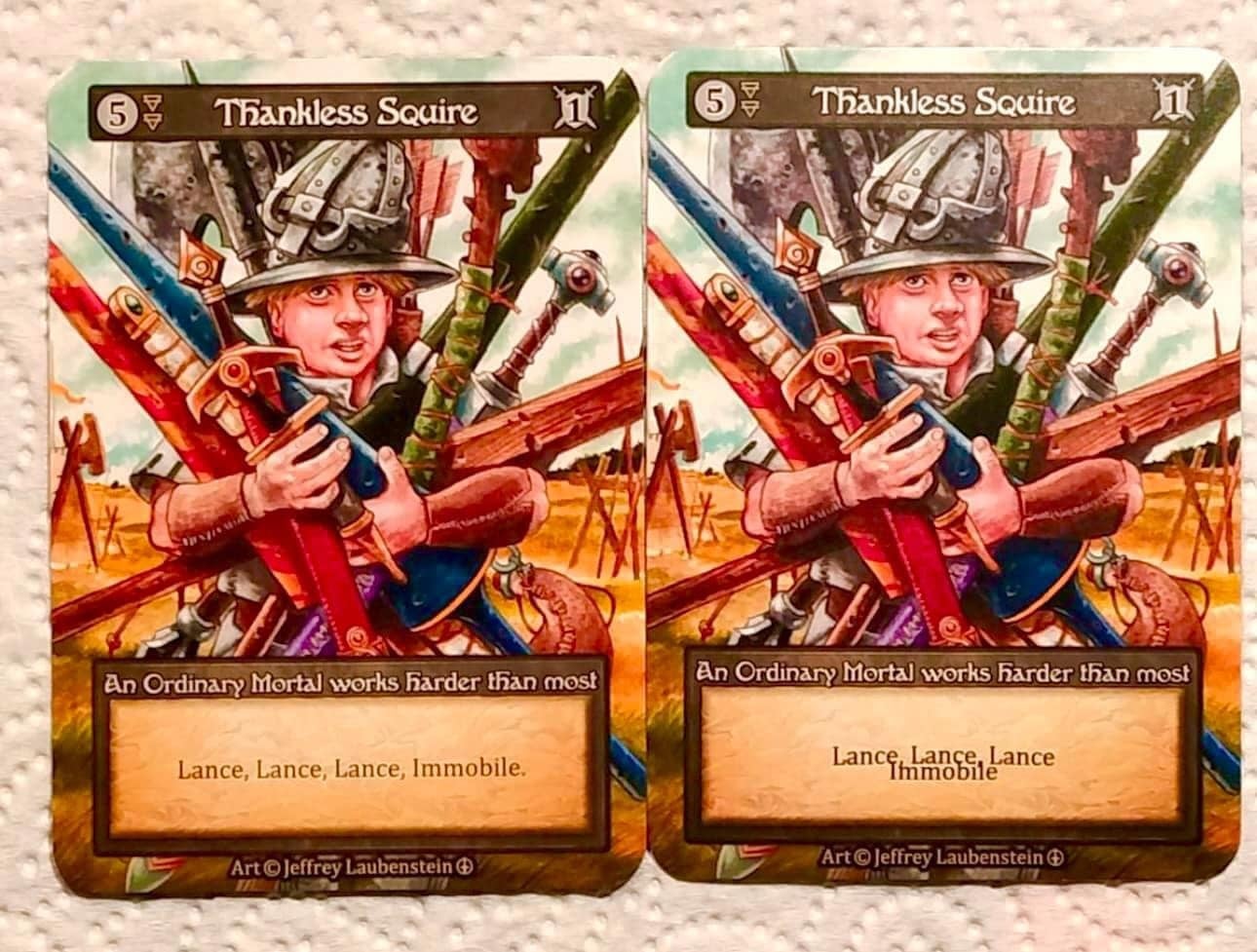
Thankless Squire — via Collector Arthouse
The gag: the Immobile keyword on the card sits underneath the "Lance, Lance, Lance" text, refusing to move out of the way, so the Lances have to route up and around it. The thankless squire is, mechanically and visually, the one who won't budge.
Shameless Squire
Shameless Squire — via Collector Arthouse
The gag: the word "drops" in the card text actually drops off the text box entirely, falling out of frame. The visual pun is the entire variant — same base card, same art, the rules text just refuses to behave.
Reckless Squire
Reckless Squire — via Collector Arthouse
The gag: the Charge keyword in the text box is set in ALL CAPS — the only Squire of the four whose joke is just typographic emphasis rather than positional. Charge, but louder.
Wizard's Den — Japanese version
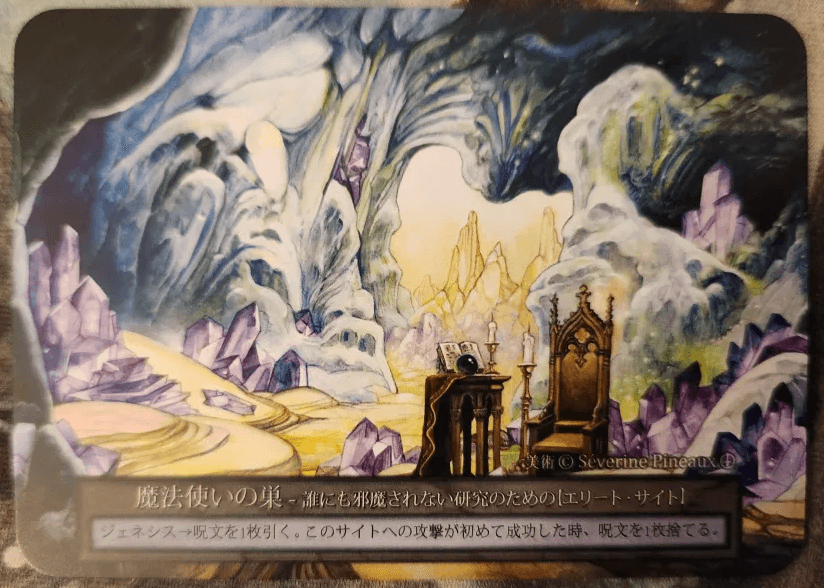
Wizard's Den (Japanese version) by Séverine Pineaux — via Collector Arthouse
A Curio printed with Japanese-language text and Japanese set markings, despite appearing in standard English-print Arthurian booster boxes. Per Collector Arthouse, the painting itself — originally titled Crystal Cave — was renamed by Erik's Curiosa to Wizard's Den as a tribute to Haine, a Japanese early adopter and YouTube content creator who goes by the same name. The Japanese-language Curio is the second half of that tribute, honoring Haine's heritage. There's no Japanese-localized Sorcery release for it to belong to; it exists as a one-off production curiosity inside an English-language print run.
Unladen Swallow
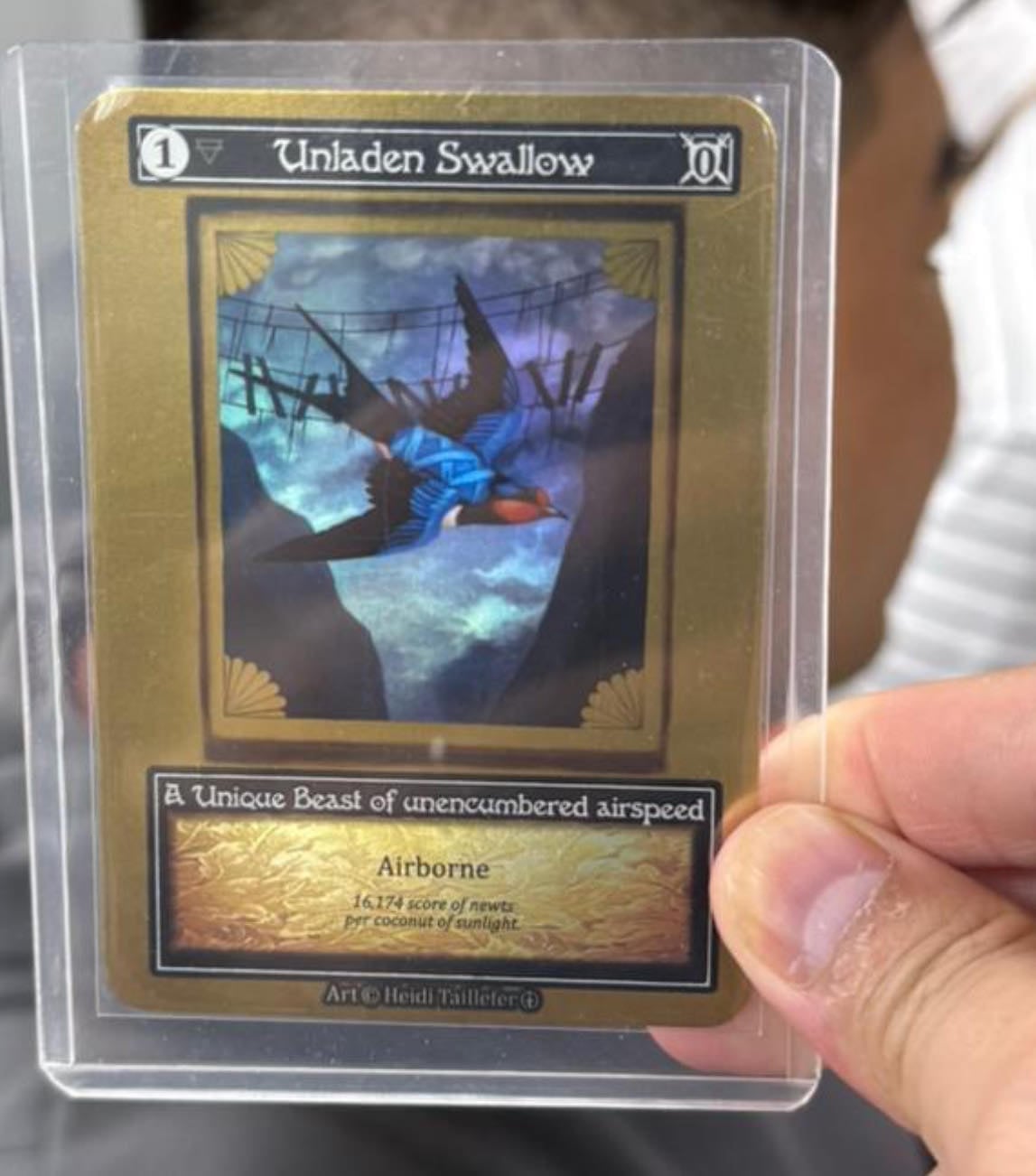
Unladen Swallow by Heidi Taillefer — via Collector Arthouse
The full Monty Python deep cut. Per Collector Arthouse, Unladen Swallow has no retail counterpart at all — the card and Heidi Taillefer's artwork only exist as this Curio, framed in a unique fully gold border. The reference, of course, is the Monty Python and the Holy Grail bridge scene: King Arthur and the knights approach a troll-guarded crossing (Bridge Troll being another Arthurian card), the troll lobs easy questions, then hits Arthur with "What is the airspeed velocity of an unladen swallow?" — Arthur replies "What do you mean, an African or a European swallow?" and the troll launches off the bridge in confusion.
Arthurian has been described as a love letter to British myth. Unladen Swallow is the most pointed easter egg in any Sorcery Curio so far, and it's the only one whose entire reason for existing is a joke from a 1975 film.
Unseelie Court (sketch)
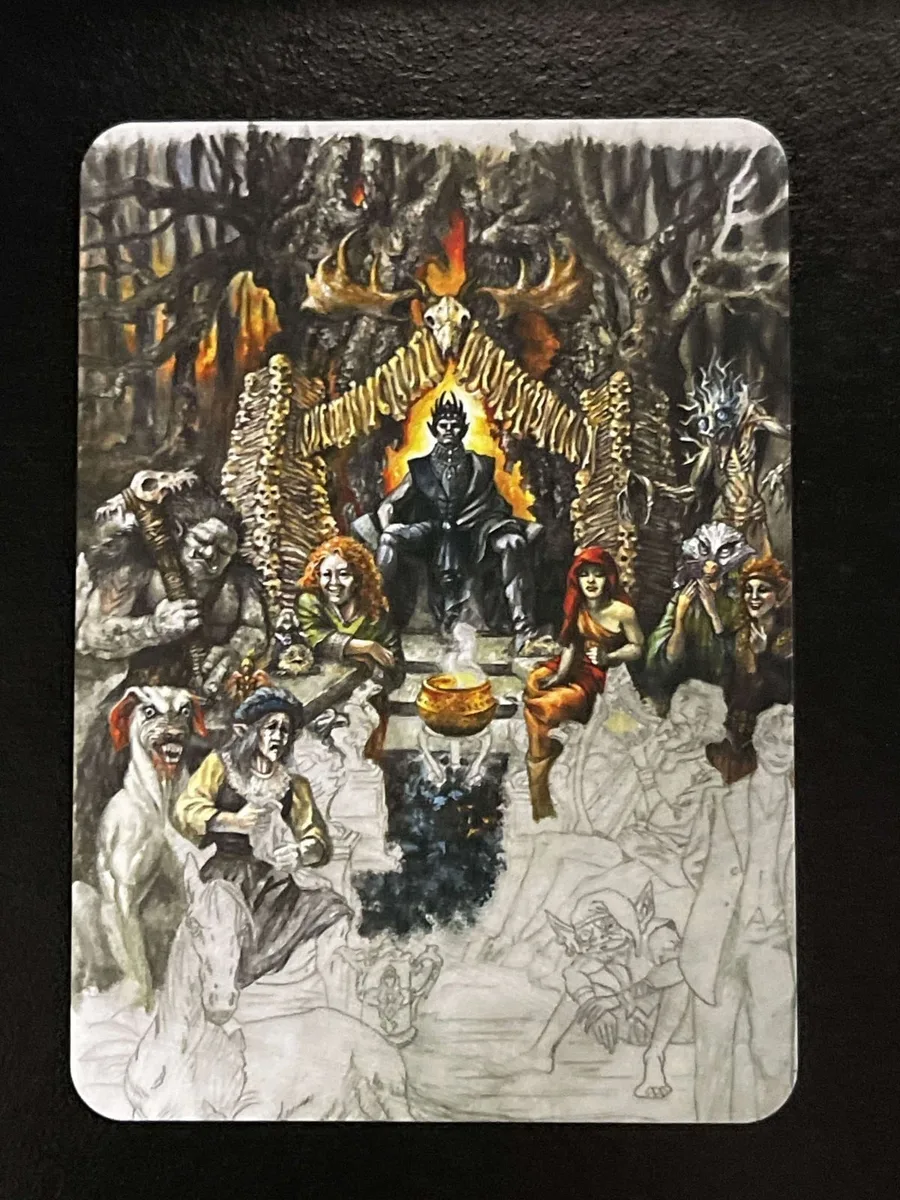
Unseelie Court (Sketch) by Liz Danforth — via Collector Arthouse
The set's only documented design-history Curio — a sketch variant in the Alpha-era tradition, painted by Liz Danforth (a Magic original-artist alum). Per Collector Arthouse, Sketch Curios have surfaced in Alpha and Beta, but this is the first to be a half-finished, half-painted rendering rather than a pure pencil draft. The Curio fits the Alpha pattern (pre-production reveals) rather than the variant-printing or themed-subseries patterns that otherwise define Arthurian.
A footnote with teeth: when the community was scrambling to catalog Arthurian Curios on release, another half-finished sketch surfaced — a Witch by Séverine Pineaux, formatted to mimic this one. It was eventually revealed as a fake Curio, and Erik's Curiosa broke their standing silence on Curios to denounce it publicly. The publisher who won't acknowledge that Curios exist will, apparently, acknowledge when they don't.
The Green Knight
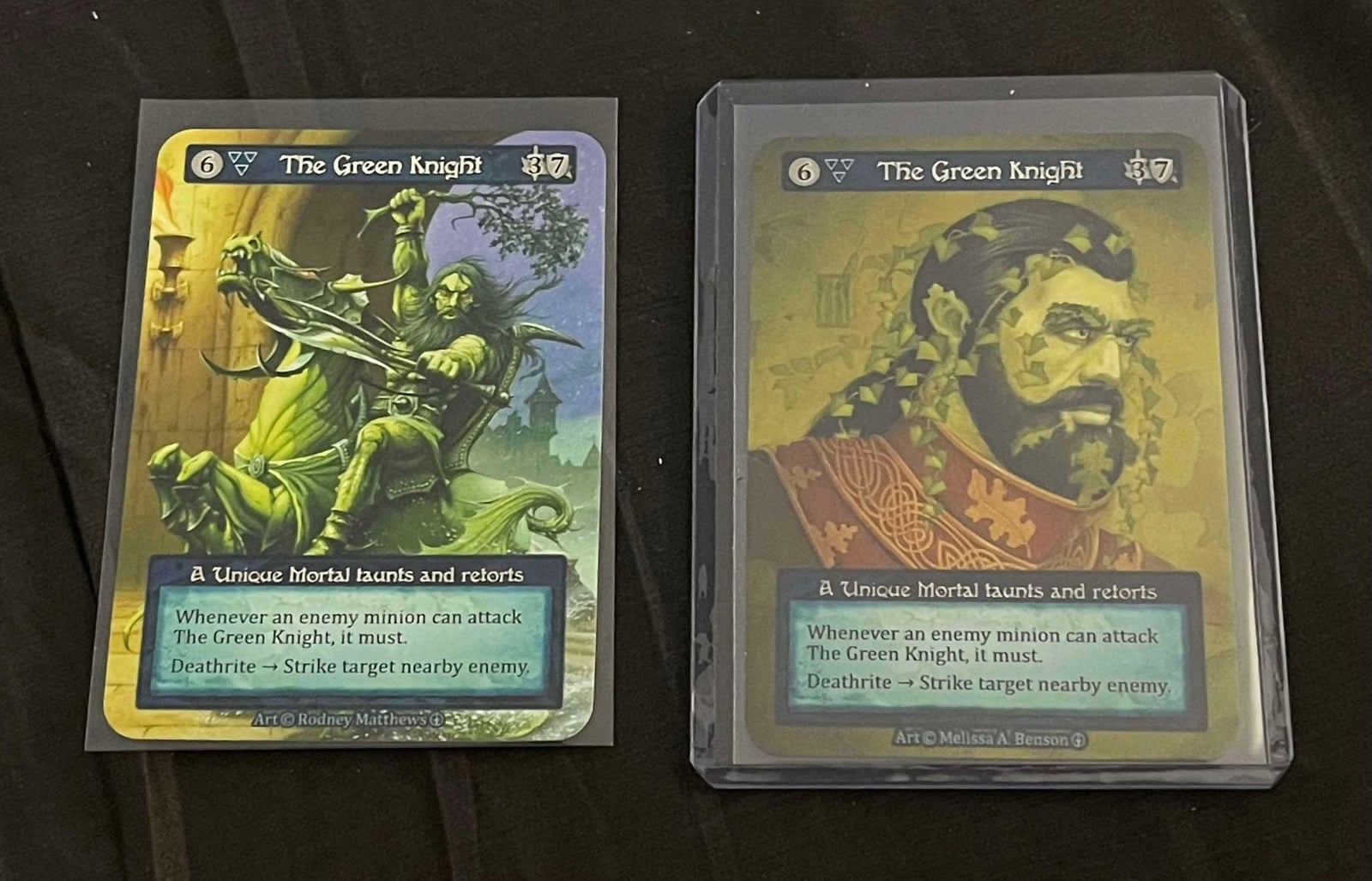
The Green Knight by Melissa Benson — via Collector Arthouse
The retail Arthurian Green Knight uses a licensed older work by Rodney Matthews. The Curio swaps in a new interpretation by Melissa Benson — same character, different painter, different visual register. The Green Knight is the antagonist of Sir Gawain and the Green Knight, the late-14th-century Middle English alliterative romance, so having two distinct Gawain-adjacent Curios in the same set (this one and the Gilded Sir Gawain portrait) is a quiet bit of cross-referencing.
Per Collector Arthouse: Benson was also commissioned at the same time to paint Gringolet, Gawain's horse. The artwork lived on her website under the Sorcery: Arthurian Legends tab without ever appearing on an Arthurian card — but later resurfaced as an alt-art War Horse during a refresh of the Dust Store Rewards in the Sorcery shop. A commission that quietly took the long way to the playable pool.
Site Trolls
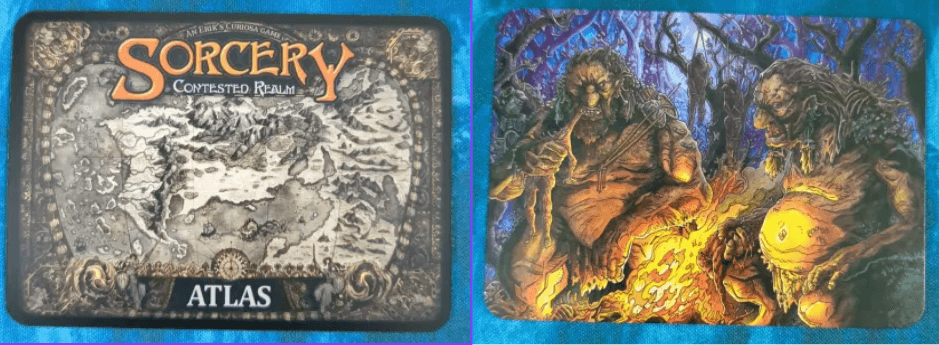
Site Trolls by Jussi Pylkas — via Collector Arthouse
Per Collector Arthouse, Site Trolls depicts the giants Blunderbore and Rebecks sharing a meal — friends, enemies, or something else entirely, depending on how you read the composition. The structural Curio note is more interesting: foil cards normally carry foil embossing with full art on the back. Site Trolls is the first Curio with full art and no text on the front — the entire face of the card is painting, no rules box, no name plate.
Broceliande
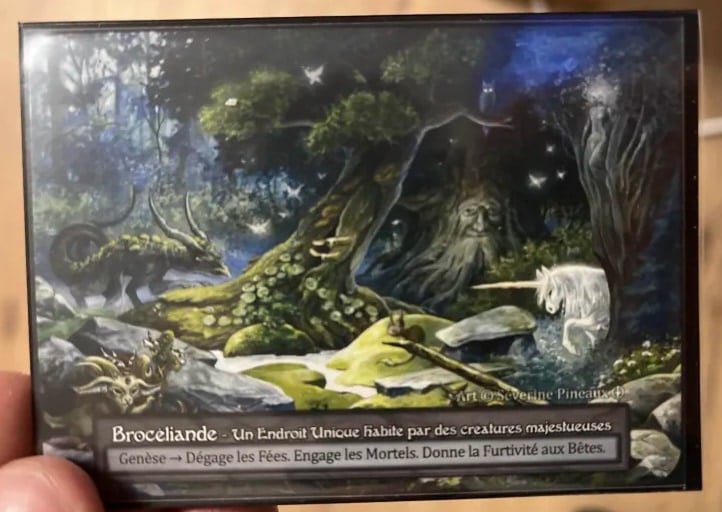
Broceliande by Séverine Pineaux — via Collector Arthouse
Per Collector Arthouse, Broceliande is a tribute to Séverine Pineaux, one of Sorcery's most beloved artists. Séverine lives near the historic Broceliande Forest in France — the enchanted woodland of medieval Arthurian romance, the legendary home of Merlin's tomb and Vivien's spells — and takes great pride in the connection. The Curio prints the card in French to honor her heritage.
The card title is the same; the language is the entire variant. A second tribute card in the same set (Wizard's Den) does the equivalent for a Japanese collaborator. Two Curios, two languages, two artists honored on home turf inside an English print run.
Dozmary Pool
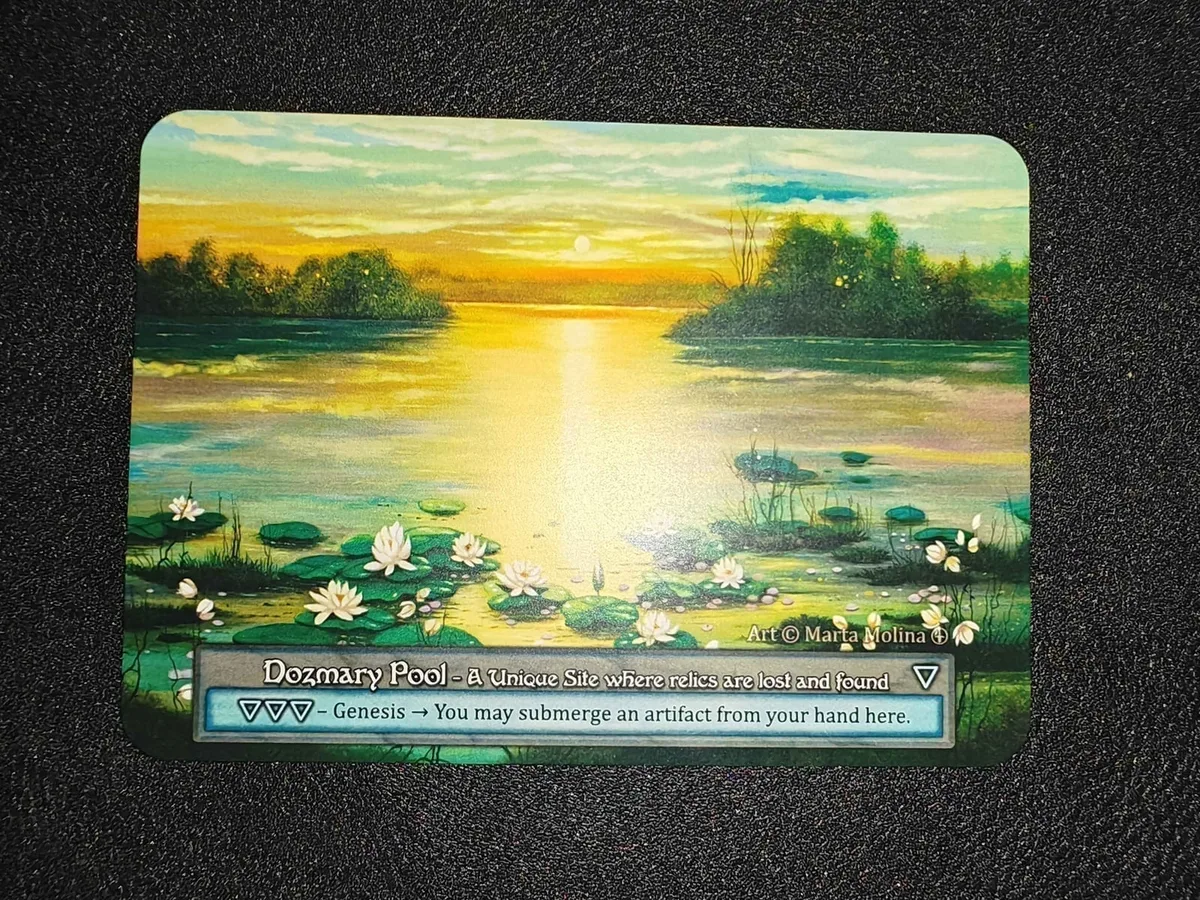
Dozmary Pool by Marta Molina — via Collector Arthouse
The retail Dozmary Pool uses a licensed work by Rodney Matthews. The Curio swaps in an alternate by Marta Molina — a fitting tribute given Molina's background as one of the top card alterists from the MTG alters scene who now does original commissions and alters centered around Sorcery. Dozmary Pool, in the legend, is the lake where Excalibur is returned to the Lady of the Lake after Arthur's mortal wounding — geographically a real tarn on Bodmin Moor in Cornwall. Both versions sit on the same Arthurian beat; only the painter changes.
Toll Bridge
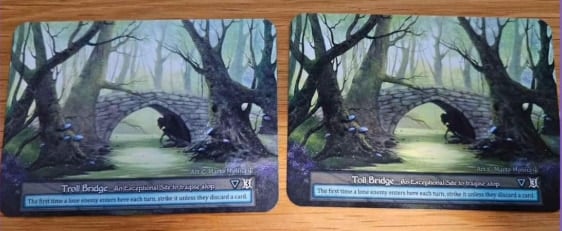
Toll Bridge — via Collector Arthouse
The Curio renames Arthurian's Troll Bridge to Toll Bridge — a one-letter shift that Collector Arthouse explicitly traces back to the Alpha tradition, where all the Troll cards had subtle hard-to-spot Curio variants. Nothing else about the card changes, and despite the name shift the game doesn't let you run six copies between the two; they're still the same card for deckbuilding purposes. The whole variant lives in the title.
Wyvern
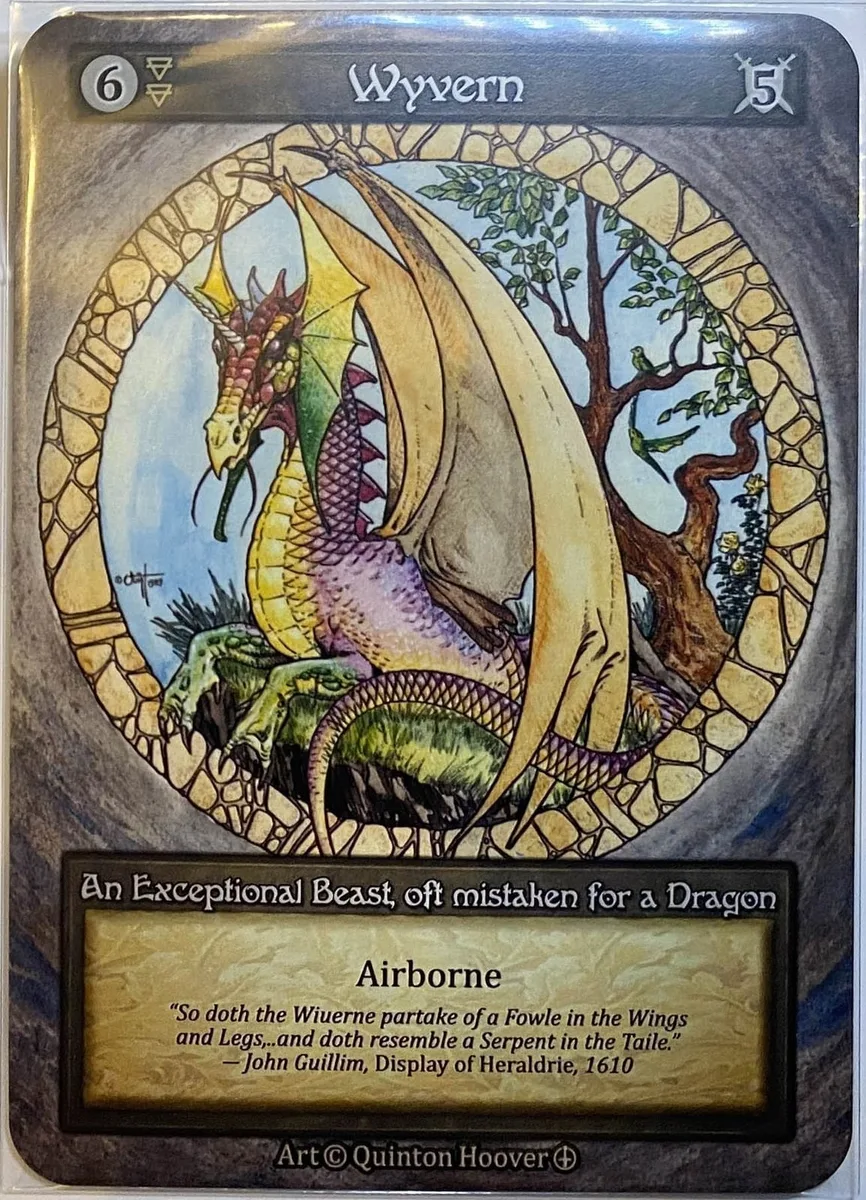
Wyvern by Quinton Hoover — via Collector Arthouse
The retail Wyvern was painted by Truitt Parrish and revealed at GenCon 2024. The Curio swaps in a previously unpublished work by Quinton Hoover — the late MTG illustrator whose original-era Magic work (especially Limited Edition Beta and Arabian Nights) is woven into the fabric of 1990s fantasy art. Per Collector Arthouse, a special arrangement was made with the Hoover family to include some of his works in Sorcery, announced just before Arthurian's release. The Curio is the first card to surface under that arrangement — a posthumous tribute that doubles as one of the most directly-MTG-coded Curio commissions yet.
What Arthurian taught the community
Three things, in order of importance:
- Curios can be themed subseries, not just one-offs. The Gilded twelve broke the assumption that every Curio was an independent variant — and the publisher's quiet decision to give Shakirova Artist's Proofs is the closest thing to behind-the-scenes acknowledgment Erik's Curiosa has ever made.
- Variant pools can include localized prints that have no other context for existing. The Japanese Wizard's Den and the French Broceliande each exist purely as tributes to a collaborator's heritage, with no parent localized Sorcery release.
- Easter-egg references are on the table. Unladen Swallow established that the publisher's silence isn't just stoic — there's a sense of play behind it that extends to building an entire Curio around a Monty Python gag.
What we still don't know
Whether the 24 count is final. Arthurian has a longer retail tail than either Alpha or Beta, more boxes still cracking, and the publisher has not commented either way. Mid-2026 numbers may be undercounting by one or two cards.
Two cards from the original 24-card list aren't pictured above because Collector Arthouse hasn't archived them yet: the Round Table Gilded variant (which would complete the twelve-card Gilded subseries to its full theoretical twelve), and the Archimago Spellbook variant.
Sources
- Collector Arthouse Curio archive — canonical community archive. Source for every card image and editorial detail in this article; individual card pages linked inline above.