
Quinton B. Hoover (1964–2013) was an American fantasy illustrator best known for his card-game and tabletop work. Born March 16, 1964, in Fruita, Colorado — a town of a few thousand on the western Colorado plateau, near the Utah border — he lived most of his adult life in Oklahoma City, Oklahoma. He was married, with four children. He died on April 20, 2013, at forty-nine.
He worked across the formative-era tabletop and card-game industry, but the credit that made his name was Magic. Hoover painted seventy-three Magic: The Gathering cards between 1993 and 2008, debuting in Limited Edition Alpha in August 1993 and finishing his last new piece for Morningtide in February 2008. Per the Wikipedia list of Magic artists, that puts him in the same strict category as Drew Tucker — a genuine original-Alpha painter, present at the very first print run rather than arriving a set or two later.
The single Hoover credit that gets named in every Magic retrospective is Proposal — the unique, never-tournament-legal card that Richard Garfield commissioned Hoover to paint so Garfield could use it to propose to his then-girlfriend Lily Wu. One painting, one printed copy, one of the few sentimental objects in the Magic catalogue, and Hoover was the artist Garfield trusted to make it. Outside Magic, Hoover illustrated for the Middle-earth Collectible Card Game, did work for Dungeons & Dragons sourcebooks — Monster Manual II (2002) and Book of Vile Darkness (2002) — and co-created the comic Morgana X.
His children continue to manage his estate. Per Collector Arthouse — the hub of the game's art-house and collector scene — they "continue on his legacy, licensing artwork for Sorcery and connecting with art fans across the country." Sorcery is, so far, the most visible public license they've granted.
Style
What stood out about a Hoover Magic card in 1993, and still does on a Sorcery card in 2026, is the linework. Fans reach for words like ornate, stained-glass, art-nouveau-adjacent, but the verifiable thing on the page is the discipline: a tightly drawn ink foundation, decorative pattern worked into clothing and architecture and frame edges, colour laid on top of a drawing that already holds its weight. In a set dominated by oil-on-board fantasy realism, Hoover's cards read closer to illustrated-book plate work than to Boris Vallejo, and they're identifiable across the table at a glance.
That discipline is also why his work survives reproduction at small scale. Sorcery cards are high-quality reproductions of physical artwork, and the publisher's process preserves enough of the source that detail-driven work holds up where loose painting would blur. The same observation goes for Drew Tucker (loose paint reads as a brushwork signature) and for Hoover (ink linework reads as decorative precision); both are part of why the Sorcery authentication guide treats print fidelity as a counterfeit-detection signal.
Cards on Sorcery
The publisher announced the Hoover license on August 30, 2024, framing it as a posthumous tribute and naming Brother Knight as the first card. The announcement is worded carefully: "Our heartfelt thanks to the Estate of Quinton Hoover for entrusting Sorcery: Contested Realm with showcasing Quinton's incredible work, beginning with the Arthurian Legends set." The beginning with is operative — the deal was always meant to extend past one card.
Per the Collector Arthouse artist page, Hoover's Sorcery footprint now spans both Arthurian Legends and Gothic, with four documented cards: Aino, Brother Knight, Serava Townsfolk, and Survivors of Serava. The cluster around Serava (two cards explicitly tied to the same setting) hints at the Sorcery team picking Hoover paintings that fit groups of card concepts.
The most visible Curio under the arrangement so far is Wyvern:
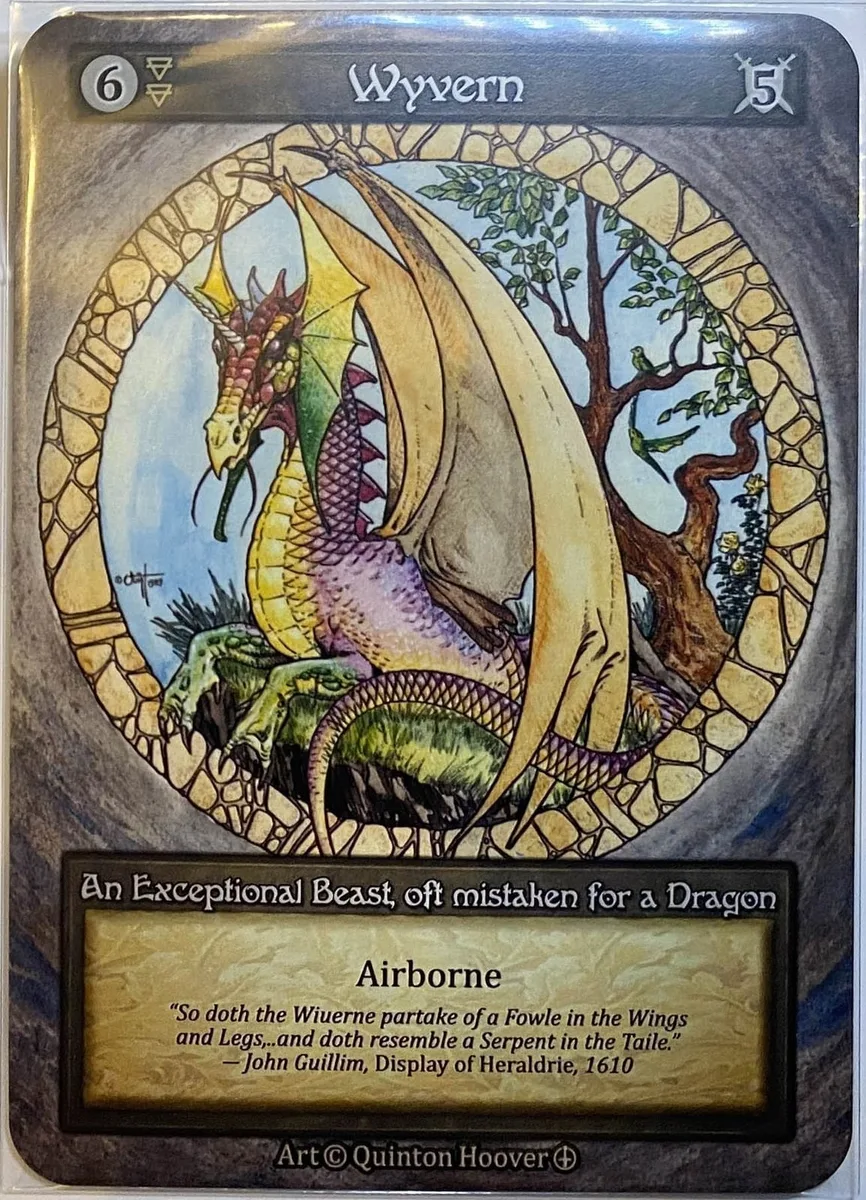
Wyvern by Quinton Hoover — via Collector Arthouse
The retail Wyvern was painted by Truitt Parrish and revealed at GenCon 2024. The Curio swaps in a previously unpublished Hoover work, also under the family arrangement. Per Collector Arthouse, this is a parallel-commission Curio in the same spirit as the Gossamer Ghost Drew Tucker variant in Gothic — the retail card and the Curio card share a subject but were painted by different artists. Documented in full in Every Curio in Arthurian Legends.
Of the four standard-printing Hoover cards, Aino is the one a typical reader will recognise from the price grids rather than from collector chat. It's a Gothic Unique Minion drawn from the deeper Finnish-mythology corner of the set's roster, and the Alpha-tier foil printing trades around $800 NM — high enough to put it on The Most Expensive Sorcery Cards Right Now. That places Hoover on the price ladder in the same neighbourhood as the marquee Alpha foils, on a Gothic card painted entirely posthumously.
A note on the framing the publisher used. The announcement called this a tribute, not a commission, and the wording matters. Erik's Curiosa cannot ask Hoover to paint anything. What the family licenses is existing paintings from his catalogue, and the Sorcery team picks which painting fits the card concept. The same mechanic governs the Frazetta licensing, with the obvious difference that Frazetta's catalogue is enormous and globally recognised; Hoover's is smaller, narrower, and almost entirely tied to the 1990s and early-2000s card-game era his children are now stewarding into a second life.
Where to see more Hoover
- His Magic cards. The full seventy-three-card catalogue runs from Alpha 1993 through Morningtide 2008. Proposal is the famous one, though only one copy was ever printed; the more accessible canonical Hoovers are scattered through Limited Edition Beta, the early expansions, and the Ice Age-through-Mirage middle period. Scryfall's artist filter (
a:"Quinton Hoover") is the cleanest catalogue. - His D&D work. Monster Manual II (2002) and Book of Vile Darkness (2002) are the most-cited rulebooks featuring his interior art. Both are still findable in used-book shops and online for $20–40 each. Worth seeing because his D&D pages are full-page or near-full-page renderings rather than card-cropped — you can see the linework do what it was actually built to do.
- Collector Arthouse — Quinton Hoover — the canonical Sorcery card index this piece draws on, plus the estate-stewardship context.
Sources
- Quinton Hoover — Wikipedia — birth and death dates (March 16, 1964 / April 20, 2013), birthplace (Fruita, Colorado), residence (Oklahoma City, Oklahoma), four grown children, "drew over 70 pieces" for Magic, Proposal card commissioned by Richard Garfield for Lily Wu, Middle-earth Collectible Card Game and D&D work (Monster Manual II and Book of Vile Darkness, 2002), co-creator of Morgana X
- List of Magic: The Gathering artists — Wikipedia — 73 artworks total; debut in Limited Edition Alpha (1993); last new artwork in Morningtide (2008); listed as Deceased
- Honoring a Legend: Quinton Hoover's Art Joins Sorcery TCG — Erik's Curiosa announcement — published August 30, 2024; Brother Knight named as first card; "Our heartfelt thanks to the Estate of Quinton Hoover for entrusting Sorcery: Contested Realm with showcasing Quinton's incredible work, beginning with the Arthurian Legends set"
- Quinton Hoover — Collector Arthouse artist page — 1964–2013 dates; children's stewardship of the estate; appearance in Arthurian Legends and Gothic; four documented cards (Aino, Brother Knight, Serava Townsfolk, Survivors of Serava)
- Wyvern — Collector Arthouse Arthurian Legends Curio archive — retail Wyvern by Truitt Parrish (revealed GenCon 2024); Curio version by Quinton Hoover under the family arrangement
- The Most Expensive Sorcery Cards Right Now — Aino Gothic foil ~$800 NM reference pricing