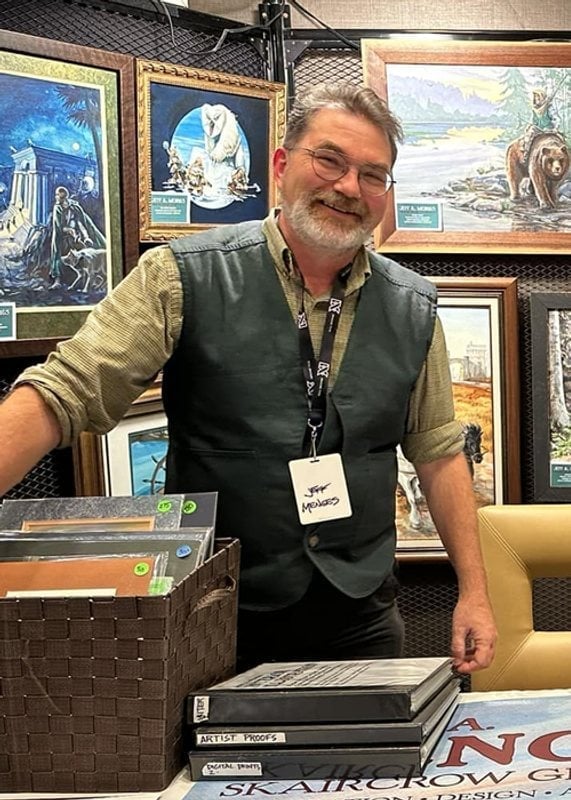
Jeff A. Menges is an American fantasy illustrator and art editor, born in 1965 in a small seaside town in New Jersey. By his own account, his teen years were shaped by Star Wars, sword-and-sorcery paperbacks, and Heavy Metal magazine — the standard cultural intake of a future fantasy illustrator coming of age in the 1970s and early 80s. He worked his way into the game-art pipeline early; by 1992 he was on the call list for a Wisconsin start-up named Wizards of the Coast trying to launch a trading-card game.
He's one of the original twenty-five Magic: The Gathering artists — present in Limited Edition Alpha, the August 1993 first printing, with roughly fifteen paintings in that set. Among them is Swords to Plowshares, one of the most-played and most-reprinted white removal spells in the history of the game. From Alpha he ran on through Arabian Nights, Antiquities, Legends, The Dark, Fallen Empires, Ice Age, Homelands, and Alliances — roughly fifty-five unique pieces total across the formative-era expansions.
Alongside the freelance illustration practice he has, for over twenty years, been an art director, designer, and steady collaborator with Dover Publications in New York. He compiles and edits fantasy and Golden Age illustration collections for Dover's "Fine Art, History of Art" series — Visions of Camelot: Great Illustrations of King Arthur and His Court (2009), Doré's Knights and Medieval Adventure, Maidens, Monsters and Heroes (an H. J. Ford retrospective), Great Illustrations by N. C. Wyeth, standalone volumes on Edmund Dulac, Warwick Goble, and the Victorian fantasy painters. He has produced more than twenty books of this kind, and they are — for a wide swathe of working illustrators and art students — how the Golden Age canon gets into the studio in the first place.
Style
His preferred medium is acrylic on a gessoed board, and he's been working that way since high school. In the Sorcery first-look on his Camelot card, the publisher quotes him directly: "My preference is for acrylics on a gessoed board. I've been working with acrylics since my high school days, and I learn to think a painting through with that medium in mind." That's not a stylistic boast — it's a working-method note from a painter who plans the picture inside the constraints of the paint. Acrylic dries fast, layers cleanly, and forgives less than oil; thinking in acrylic means thinking through the structure of an image before the brush hits the board.
The Dover work explains some of how the Magic and Sorcery work reads. Visions of Camelot opens with N. C. Wyeth's King Arthur, runs through the Pre-Raphaelite knights, includes the great Beardsley Morte d'Arthur plates from the 1893 Dent edition, and finishes in the early-twentieth-century chivalric revival. Menges wrote the introduction and curated the plate selection. When he then painted Camelot for Sorcery — the actual Site card of Arthur's court — he was painting it after having literally edited the canonical anthology of how everyone else has painted it. There's no other Magic veteran on the roster with that kind of overlap between specialism and assignment.
Cards on Sorcery
Menges's Sorcery footprint is one of the larger ones on the roster. Collector Arthouse, the backbone of the game's art-house and collector scene, lists him as appearing across Alpha, Beta, Arthurian Legends, and Gothic — most of the game's run so far — and he himself put the working tempo plainly: "15+ pieces … with assignments spaced out over 3½ years, averaging about 6 per year. Erik's creative direction has been open to the artist's individual vision, which has been wonderful to work that way."
No Menges Curio variants are documented in the Alpha, Beta, Arthurian, or Gothic Curio archives. His footprint on the game is the standard print runs — the cards as released — not the design-history sketches and parallel commissions that the Curio system catalogues.
Alpha and Beta — the broader cluster includes Aqueduct (a Site of Earth and Water that appears in both the Alpha and Beta printings), Blizzard, Bone Rabble, Brown Bears, Buried Treasure, Felbog Frog Men, Flame of the First Ones, Garden of Eden, Ghost Town, and Harassing Ruffians. The mix is characteristic — a Site, a weather-effect Magic, a Minion, a treasure card, a creature swarm. In the Collector Arthouse interview Menges noted that Felbog Frog Men in particular almost didn't leave the studio: his wife "made a plea to keep that painting on the wall."
Arthurian Legends — the set he was uniquely qualified for. His Arthurian work includes Camelot — the Site card of Arthur's court itself — alongside 13 Treasures of Britain, an Aramos Mercenaries piece, Blessed Village, and Invasion, an acrylic-on-board painting Menges walked through his process for in the publisher's own Painting the Realm video series. The Sorcery TCG news post framed his Camelot alongside the historical interpretations he himself collected in Visions of Camelot — N. C. Wyeth, Beardsley, and the rest.
Gothic — per the April 2025 Gen Con announcement, Menges had "never-before-seen illustrations" from the Gothic set on display at the convention, and his per-artist Collector Arthouse listing confirms he appears across the Gothic print run as well. Specific Gothic card attributions are still being catalogued.
That's a working illustrator on the active roster, six paintings a year for three and a half years running, doing exactly the kind of card-art-as-archival-illustration that his Dover catalogue has spent fifteen years training him for.
Where to see more Menges
- jeffamenges.com — his own site, Skaircrow Graphics. Originals, prints, scheduled-appearance listings, and the long client list, including the 2020–2024 Sorcery acrylic paintings.
- His early Magic cards — Swords to Plowshares (Alpha) is the famous one, still played in every white Commander deck thirty years on. Full set-by-set list on Scryfall, which is also the cleanest way to confirm he really was in Alpha 1993.
- His Dover anthologies — the second career. Visions of Camelot (2009) for the Arthurian work specifically; Doré's Knights and Medieval Adventure, Great Illustrations by N. C. Wyeth, and Maidens, Monsters and Heroes: The Fantasy Illustrations of H. J. Ford for the broader Golden Age archive. Dover still keeps these in print at paperback prices.
- The "Painting the Realm" video — Erik's Curiosa's own Painting the Realm YouTube series includes a Menges episode walking through his process on Invasion for Arthurian Legends.
Sources
- Jeff A. Menges — Sorcery TCG artist profile — Sorcery commission listing and the publisher's biographical framing ("legendary fantasy illustrator with over 30 years of experience"; "one of the original twenty-five Magic: The Gathering artists")
- Jeff A. Menges — Collector Arthouse artist page — "Appears In: Alpha, Beta, Arthurian Legends, Gothic"; the per-card gallery (13 Treasures of Britain, Aqueduct, Aramos Mercenaries, Blessed Village, Blizzard, Bone Rabble, Brown Bears, Buried Treasure, Camelot, Felbog Frog Men, Fenvale Muse, Flame of the First Ones, Garden of Eden, Ghost Town, Harassing Ruffians)
- Sorcery Artist Interview: Jeff Menges — Collector Arthouse — published 27 February 2022; the "15+ pieces … 3½ years … about 6 per year" tempo and Menges quotes on Felbog Frog Men ("my wife made a plea to keep that painting on the wall") and Erik's creative direction ("open to the artist's individual vision")
- Arthurian Legends First Look: "Camelot" by Jeff A. Menges — Sorcery TCG news — published 12 June 2024; the "Visions of Camelot" / Dover anthology authorship reference, the Wyeth and Beardsley framing, and the direct Menges quote on acrylic on gessoed board
- The Art of Arthurian Legends: Jeff A. Menges' Vision for Invasion — Sorcery TCG news — published 27 September 2024; the "Painting the Realm" video reference and the Invasion acrylic-on-board commission for Arthurian Legends
- Gothic Shadows Stir — Jeff A. Menges Returns to Gen Con 2025 — Sorcery TCG news — published 14 April 2025; "never-before-seen illustrations from our upcoming set Gothic" at the Sorcery booth
- Jeff A. Menges — Scryfall card search — verified Magic card list: roughly 55 unique pieces from Limited Edition Alpha (August 1993, ~15 paintings including Swords to Plowshares) through Arabian Nights, Antiquities, Legends, The Dark, Fallen Empires, Ice Age, Homelands, and Alliances
- Jeff A. Menges — official site (Skaircrow Graphics) — 2020–2024 Sorcery acrylic-on-board commissions for Arthurian Legends and Gothic; Dover Publications collaboration; portfolio in acrylic and graphite
- Visions of Camelot: Great Illustrations of King Arthur and His Court — Dover Publications (2009) — Menges as editor and introducer; 148 colour and black-and-white plates
- Jeff A. Menges — author bio at Biblio (Visions of Camelot listing) — born 1965, New Jersey; Star Wars, sword-and-sorcery, Heavy Metal magazine teen influences; "more than 20 books on Golden Age illustration"