Sorcery: Contested Realm has grown faster than most people expected. What started as a Kickstarter project in 2022 is now five sets deep, with a rotating cast of avatars, sites, and mechanics that can make the card pool feel intimidating if you're coming in cold.
This guide walks through every set released so far — what was in it, when it dropped, and why it mattered. If you're trying to figure out which boosters to chase, or you just want to understand what people mean when they say "an Arthurian deck," this is the long version of the answer.
A quick refresher on the game
Before getting into the sets, the shared vocabulary:
- Sorcery is designed by Erik Olofsson and published by Erik's Curiosa Limited.
- Two players face off across a 5x4 grid called The Realm, each commanding an Avatar whose life total is the target.
- Every player brings two decks: a 30-card Atlas of sites that fill the empty Void spaces of the board, and a 60-card Spellbook of minions, magics, and relics. (The Spellbook minimum bumped from 50 to 60 in the December 2025 Gothic rulebook update.)
- Spells and sites are tied to four elements — Fire, Air, Water, and Earth — and each element wants a different kind of board.
- All artwork is hand-painted: oils, acrylics, watercolours, ink. No digital illustrations. It's the most visible thing that sets the game apart from its peers.
With that out of the way, the sets.
Alpha (May 2023)
The first printing, funded by the Kickstarter campaign that raised roughly NZ$5.78 million from over 6,400 backers, was exclusive to those backers. 403 unique cards shipped in the Alpha frame, and they have never been reprinted.
Because of that scarcity, Alpha is mostly a collector's set today. The card pool is mechanically identical to Beta — every Alpha card has a Beta equivalent — so Alpha is essentially a fancier-bordered version of the base game.
If you're trying to play, you don't need Alpha. If you're trying to collect, you'll be paying secondary-market prices.
Beta (October 2023)
Beta was the first proper retail release, and it's still the foundation of the game. The card list mirrors Alpha — 402 cards (Alpha had 403; Erik's Curiosa is the one Alpha card the retail Beta set drops, returning as a Beta Curio) — same elemental split — but with a new border treatment that became the standard frame going forward.
Beta is where most players start. Preconstructed boxes contain four 53-card elemental decks (one per element), which is the cheapest way to introduce four people to the game at once without anyone having to build from scratch.
If you're picking one set to buy first, this is the one.
Arthurian Legends (October 2024)
The first standalone expansion, adding over 220 new cards with art and flavour drawn from the legends of King Arthur — knights, the Holy Grail, the matter of Britain, the whole cycle.
Arthurian Legends introduced new avatars and reframed a lot of the existing archetypes around quest-style play. Because it's standalone, you can play Arthurian boxes against each other without needing any Beta cards, which made it a popular jumping-on point for groups who missed the first wave.
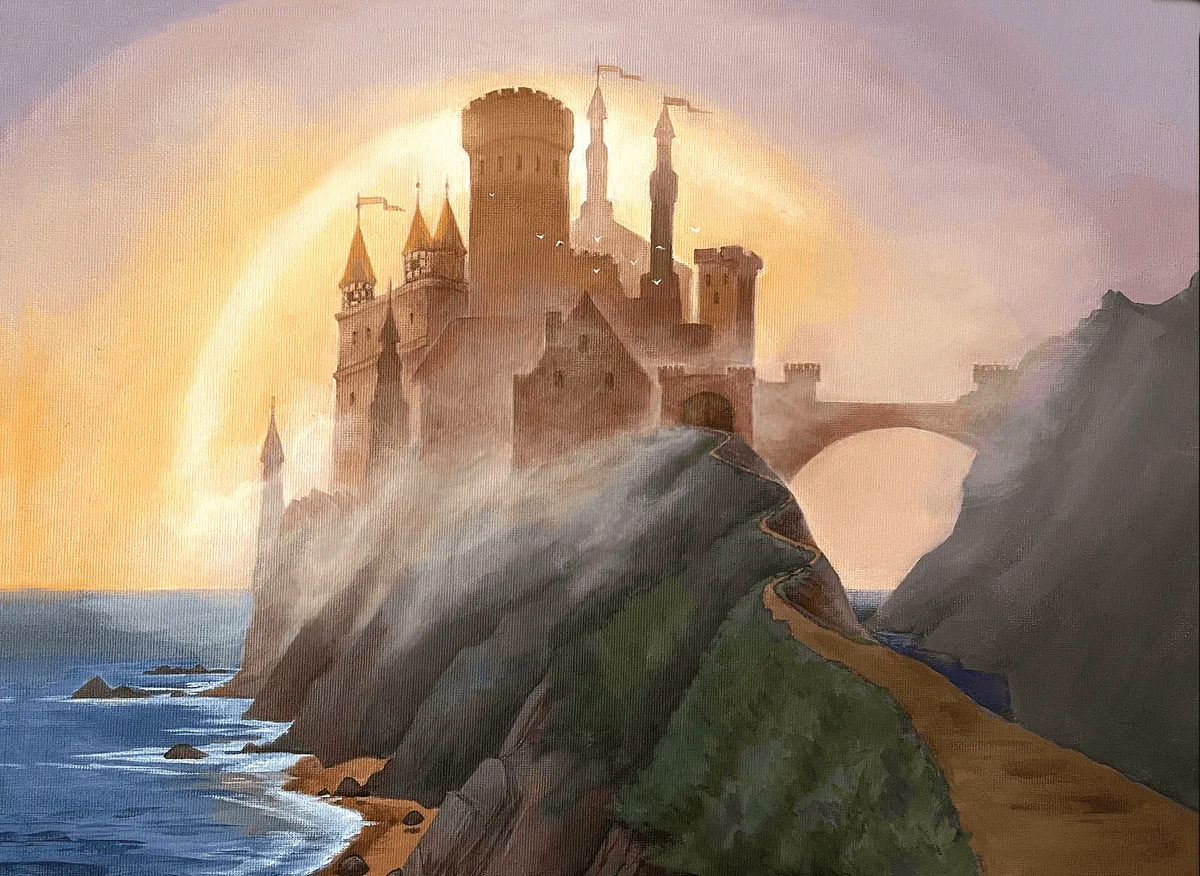
Tintagel — via sorcerytcg.com
The set leans hard into its theme. If you've ever wanted to run a Round Table deck, this is where that starts.
Dragonlord (August 2025)
A 13-card mini-set released between the two large expansions. Dragonlord is exactly what it sounds like — a small drop of dragon-themed cards designed to slot into existing decks rather than support an archetype on its own.
Mini-sets like this are useful for keeping the metagame moving between large releases. Thirteen cards isn't enough to overhaul anyone's deck, but it gives competitive players new tools and gives casual players a few chase rares to open packs for.
If you only buy one product from Dragonlord, the singles market is probably more efficient than chasing the cards in packs.
Gothic (December 2025)
The current set, and the biggest one to date. 440 cards, released on December 5, 2025, themed around what the official copy calls "dread, devotion, and despair" — a darker, supernatural realm of angels, demons, and reluctant prophets.
Gothic added 13 new playable avatars and shipped with four preconstructed decks called Prophets of Doom: Harbinger, Necromancer, Savior, and Persecutor, each with an alternate-art avatar. The booster boxes are 36 packs of 15 cards, the largest pack count of any Sorcery release so far.

The Void by Ian Miller — the Gothic set's neoprene playmat artwork — via sorcerytcg.com
Notably, the set's neoprene playmat features artwork by Ian Miller, the British illustrator whose work appeared in early Fighting Fantasy books and on Games Workshop covers. The Sorcery team's habit of bringing in established fantasy and metal-album artists is one of the reasons the visual identity stays consistent across sets.
Gothic is mechanically the most expansive set so far. If you've been away from the game and want to come back, this is where the meta is right now.
How the sets fit together
Sorcery doesn't rotate. Every card printed since Alpha is still legal in every constructed format, which means the card pool grows monotonically — old decks don't get invalidated, they just get more competition.
For a new player, the practical order is:
- Pick up a Beta preconstructed box to learn the four elements.
- Add an Arthurian Legends box once you know which element clicks.
- Buy Gothic singles or a Prophets of Doom deck for whichever archetype interests you.
- Skip Alpha unless you collect. It's the same cards as Beta with a different border.
- Treat Dragonlord as a singles purchase. Thirteen cards is too few to justify boxes for most players.
For where to actually buy any of this, the directory's Where to Buy section lists the vetted retailers carrying each set.
Where to go from here
If you want to actually play with any of this, the Curiosa deckbuilder is the standard tool — it has the full card library, can export decks to Tabletop Simulator, and is where most online discussion of decks links to. The directory's Deckbuilders & Tools section catalogs Curiosa and the smaller utilities that orbit it.
For organized play and tournament reports, the official Sorcery Discord is the central hub — and the directory's Community Spaces section indexes the other servers that cover set-by-set deck talk.
The next set hasn't been formally announced as of this writing. When it is, this directory will list it.
Sources
- Sorcery: Contested Realm — Gothic — set page, source of the hero and Gothic inline imagery
- Sorcery: Contested Realm — Arthurian Legends — set page, source of the Tintagel inline imagery
- Sorcery: Contested Realm — Kickstarter (2022) — historical funding figures