Buy Beta first. Add Gothic second. Make Arthurian Legends the third box, treat Dragonlord as a singles purchase rather than a sealed one, and leave Alpha to the collectors. That's the order, stated up front — the rest of this piece is the argument for it. What each set actually is — themes, mechanics, release history — is covered in the set-by-set overview; this one is purely about which to buy, in what order, and why.
The ranking applies four tests, in falling order of weight for a new player: cost per playable card (what a dollar buys in cards you can actually shuffle), availability (whether the product can be had this week at a sane price), onboarding (whether the set sells something that teaches the game, or boosters only), and collector ceiling (held value — weighted last on purpose, which is why the most expensive set finishes fifth). Every price below is a TCGplayer market figure from this site's Market Data, snapshot June 5, 2026. Sorcery's market is small enough that the date is half the information — re-check against the price guides the directory catalogues before money moves.
| Rank | Set | The one-line case |
|---|---|---|
| 1 | Beta (Oct 2023) | The base game at about $2 a playable card, plus a $53 box of four ready-to-play decks |
| 2 | Gothic (Dec 2025) | The current set: precons trading under MSRP, 440 cards, stocked at retail |
| 3 | Arthurian Legends (Oct 2024) | The lowest-sticker booster box — but no precons, so it expands a collection rather than starting one |
| 4 | Dragonlord (Aug 2025) | 13 cards; the box trades near 7x MSRP, so buy the singles |
| 5 | Alpha (May 2023) | Beta's card list at 8.6x the price — a collector artifact, not a starter set |
1. Beta — the game itself, at about $2 a card
Beta is the October 2023 retail printing of the base game: 402 cards, 36-pack booster boxes, and the Four Elementals preconstructed box — four 52-card decks, one per element, that the publisher's own product page describes as containing "all the cards you need to get started."
Every test points the same direction. Cost per card: one copy of every Beta non-foil runs about $829 at market — roughly $2 a card, less than half the per-card cost of any other pool in the game. The booster box at $160.02 works out to about $4.45 a pack, the lowest pack rate of any sealed Sorcery product. Onboarding: the Four Elementals box trades at $52.83 market, with listings from $38 — four playable decks, two of which can face each other across the table ten minutes after the shrink comes off, at roughly $13 a deck. No other product in the game does that at any price. And because Sorcery doesn't rotate sets out of constructed legality, the Beta pool isn't a starter you outgrow — it stays the spine of decks you'll build years from now.
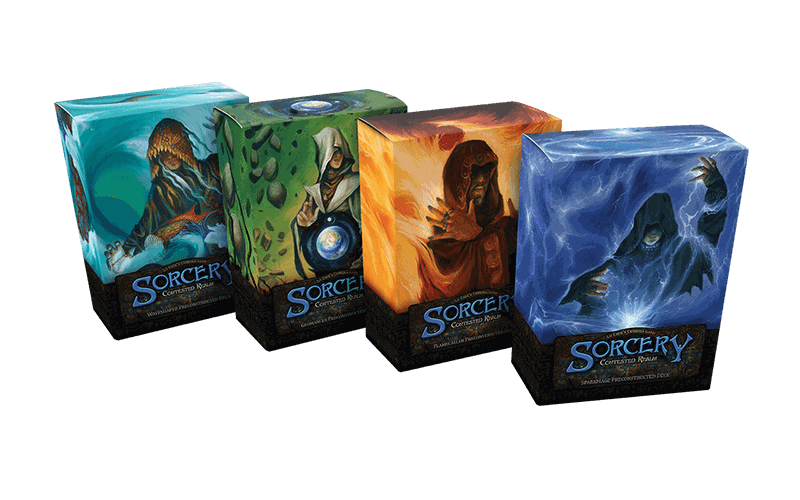
Beta's Four Elementals preconstructed decks — via sorcerytcg.com
The one caution is the gap between the TCGplayer market figure and hobby-shop stickers. Brick-and-mortar retailers in the directory have listed the four-pack in the $150–200 range as supply tightens, while the market price says patience and comparison shopping beat paying the first sticker you see. Which Sorcery Precon Should You Buy First? walks the four decks individually — short version: pilot the Geomancer first.
2. Gothic — the current set, with the cheapest live onboarding
Gothic is where the availability test stops being theoretical. It's the current set — December 5, 2025, 440 cards, the largest release so far, 13 new avatars — and it's the one product line a stocking game store can reliably put in front of you this week.
The surprise in the price data is the precons. The Prophets of Doom decks — four 52-card precons the publisher pitches as "perfect for new players learning the game" — carry a $66.60 MSRP but trade at $35.73 market on TCGplayer as of the June 5 snapshot. That is the cheapest playable Sorcery product on sale right now, full stop. The booster math also runs better than the sticker suggests: a Gothic box at $193.92 looks pricier than Arthurian's $135.30, but Gothic boxes hold 36 packs to Arthurian's 24, so the per-pack rate lands at $5.39 against $5.64 — 540 cards in the box instead of 360. One of each Gothic non-foil runs about $1,948, roughly $4.40 a card across the biggest pool in the game: more than Beta, under Arthurian.
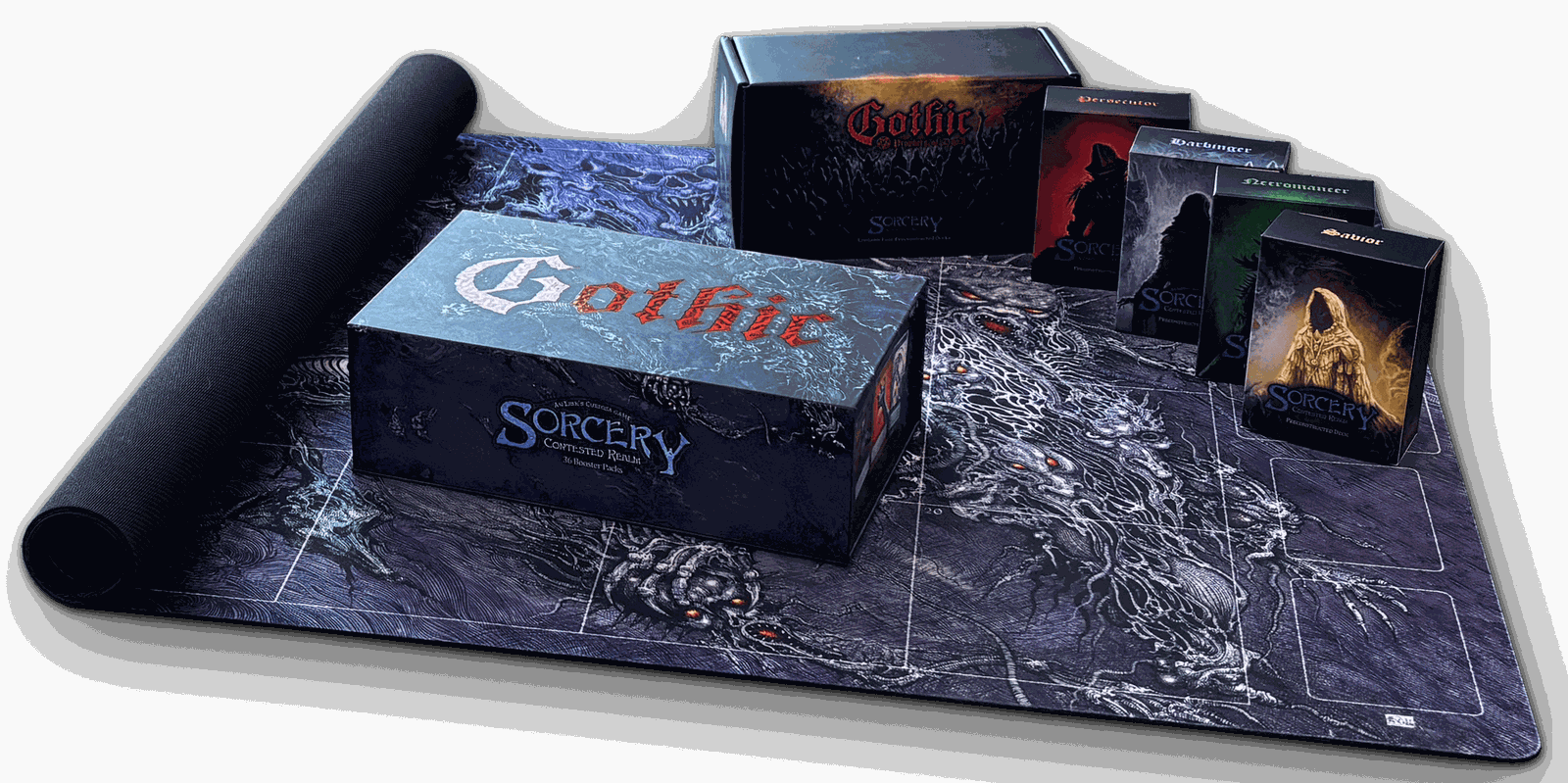
The Gothic product line — booster box, Prophets of Doom precons, and The Void playmat — via sorcerytcg.com
So why second and not first? Three reasons. A precon needs an opponent — two Prophets of Doom decks run about $71 where Beta's box puts four decks on the table for $53. The pool costs double Beta's per card. And mechanically, Gothic's keywords stack on top of the base-game grammar — the elemental fundamentals Beta's precons teach are assumed knowledge by the time you're sequencing Gothic's cemetery interactions. Buy it second, but buy it soon: this is where the current meta lives, and the precon guide rates Necromancer the strongest of the four decks if you're only picking one.
3. Arthurian Legends — the value box, once you can use it
On sticker price alone Arthurian Legends looks underrated at third: $135.30 market for a booster box, with active listings from $123.91 — the lowest-priced sealed box in the game. Two things hold it there.
First, the box is smaller than it looks. Arthurian boxes hold 24 packs, not the 36 of Beta and Gothic — $5.64 a pack, the highest pack rate of the three big retail sets, and 360 cards a box against their 540. The cheap sticker is real; the cheap set is not. One of each of its 221 cards runs about $1,069 — roughly $4.84 a card, more per card than either Beta or Gothic.
Second, and structurally more important: Arthurian sells no precons. The product line is a booster box and a playmat, nothing else. There is no on-ramp — the set assumes you already own decks worth expanding and know which element you favour. Which is exactly what makes it a strong third buy. By then the Round Table and quest archetypes slot into decks you already understand, and the set is standalone enough that two Arthurian collections can play each other without a Beta card in sight. Collectors have a separate reason to circle back eventually: Arthurian carries the largest documented Curio pool of any set, 24 variants including the Gilded knights subseries.
4. Dragonlord — buy the cards, skip the box
Dragonlord is the August 2025 mini-set: 13 cards, sold as a fixed box — the same 13 in every box, plus one random premium foil. It launched at a $59 MSRP in what the publisher's announcement called "limited quantities," and the market took that phrase seriously: the box trades at $409.42 as of June 5, 2026, with the cheapest active listing at $512. Roughly seven times MSRP in ten months.
Here is why that shouldn't matter to a new player: the contents are deterministic, and the singles are cheap. One copy of each of the 13 cards costs about $266 at market — with Shrine of the Dragonlord ($61.45) and Vatn Draconis ($48.58) doing most of the lifting, and most of the set sitting between $8 and $26. You likely don't even want all 13 — you want the two or three that fit the element you're building, which is a $30–80 singles order, not a $409 box. The sealed premium pays for shrink-wrap and a foil lottery, a trade-off the singles-versus-sealed piece generalises across the whole game. If you decide you want a sealed one anyway, Dragonlord boxes mostly surface through the buy/sell/trade channels rather than store shelves — treat it as the collector purchase it has become.
5. Alpha — a collector product wearing a set's clothes
Alpha finishing last isn't a verdict on its quality; it's the criteria doing their job. Alpha is the May 2023 Kickstarter printing — 403 cards, 39-pack boxes, never reprinted — and its card list is functionally Beta's. Per the side-by-side accounting in the Alpha booster box piece, every Alpha card except one (Erik's Curiosa, the publisher's namesake) exists in Beta with the same rules text. What Alpha sells that Beta doesn't is provenance: the first-printing frame, the licensed Frank Frazetta printings, a fixed and shrinking population.
The market prices that provenance without sentiment. Alpha box: $1,376.17 — 8.6x the Beta box that plays identically. Alpha booster pack: $43.39, more than five Gothic packs. The Alpha Four Elementals precon box: $744.50, fourteen times the $53 Beta version of the same product. One of each Alpha non-foil: about $3,149, nearly four times the Beta pool. For a player, every dollar past the Beta price buys zero additional gameplay. The collector case is real — appreciation history, exclusives, the origin-artifact pull — but it comes with liquidity qualifications, and it belongs at the end of your Sorcery journey, not the start.
The order, compressed
- ~$55: the Beta Four Elementals box. Four decks, two-player games out of the box, the whole base-game grammar.
- ~$90: add one Prophets of Doom precon (~$36) for a current-set archetype — Necromancer if you want the strongest pick.
- ~$250: add a Gothic booster box, or skip sealed and put the difference into targeted singles.
- ~$390: add an Arthurian box once you know which element clicks and want the Round Table material.
- Dragonlord: a singles order whenever a deck calls for it. Alpha: only when you've consciously switched from playing to collecting.
If you internalise one thing, internalise the shape of the argument: in a game with no rotation, the oldest retail pool is the cheapest and most permanent thing you can own, the current set is the cheapest thing to start with, and scarcity is the thing you pay for last.
Sources
- Sorcery market data — TCGplayer market prices via tcgcsv.com; all price figures from the 2026-06-05 snapshot
- Sorcery: Contested Realm — Beta Edition — 36-pack box, 402-card set, Four Elementals precon contents and quoted copy, product imagery — accessed 2026-06-06
- Sorcery: Contested Realm — Gothic — 440 cards, 13 new avatars, 36-pack box, Prophets of Doom contents and quoted copy, product imagery — accessed 2026-06-06
- Sorcery: Contested Realm — Arthurian Legends — 24-pack booster box composition; product line limited to booster box and playmat — accessed 2026-06-06
- Sorcery: Contested Realm — Alpha Edition — 39-pack box, 403-card set — accessed 2026-06-06
- The Dragonlord Awakens August 2 — Erik's Curiosa — published 2025-07-01 — $59 MSRP, "limited quantities," 13 cards plus one random foil per box, August 2, 2025 launch — accessed 2026-06-06
- Which Sorcery Precon Should You Buy First? — internal reference for the Beta four-pack ($40) and Prophets of Doom ($66.60) MSRPs, hobby-retail price ranges, and the Geomancer/Necromancer picks