Sealed is the format where the playing field is a stack of unopened booster packs. Every player at the event gets the same supplies, about twenty minutes of build time, and no help from their binder — the deck you pilot is the deck you assembled on the spot from whatever the wrappers held. No meta preparation, no singles orders, no advantage for the player who has been buying boxes since Alpha. It's the closest thing card games have to a standardized test, and Sorcery's version is unusually well documented: the publisher maintains a dedicated Sealed format page with the deck minimums, the supply math, and the recommended event structure.
Every Sorcery Format, Explained places Sealed among Constructed, Draft, and the casual variants. What follows is the longer version for the player actually sitting down to six packs: the published rules, what a pool really contains, how the Avatar choice works, and how to spend 24 Spellbook slots and 12 Atlas slots without wasting any of them. The rules below come from primary sources; the build heuristics are cited community analysis, and they're marked as such.
Awakened Mummies by Jeff Easley — via sorcerytcg.com
The rules, straight from the publisher's page
The official Sealed page defines the format in a handful of moves:
- Six boosters per player. This is the publisher's recommended pool size — "plus more for prizes" — chosen to give a wide enough spread of cards and elements while keeping the average deck's power in check. The supply math per four players: one booster box and one Draft Kit.
- One Avatar. Either the supplied default or any Avatar you open in your packs. More on this choice below.
- Spellbook: at least 24 cards. Your minions, magics, auras, and artifacts.
- Atlas: at least 12 cards. Your Sites.
- No rarity copy limits. Constructed's 4/3/2/1 caps don't apply — whatever you open is legal in whatever quantity you opened it.
- Supplied Sites are fair game. Players can use any number of the kit's basic Sites (or bring their own) to fill out the Atlas alongside what they opened.
- Your leftovers become your Collection. Every card that doesn't make the Spellbook or Atlas forms the Collection zone "in its entirety" — no 10-card cap, no curation.
The event logistics are spelled out too: roughly 20 minutes to open packs and build, around 45 minutes per game, Swiss pairings for two or three rounds, and players keep what they open. Player count is explicitly "any number" — unlike Draft, which wants a pod, Sealed scales from two people at a kitchen table to an eight-round convention hall. The game itself is unchanged: 20 life, the 5×4 grid, reduce the opponent to Death's Door and land the final blow.
What six packs actually give you
Pool size is arithmetic. Current Sorcery boosters are 15 cards; Gothic's set page specifies each pack as 11 Ordinary cards, 3 Exceptional cards, and 1 Elite or Unique. Six packs of Gothic therefore hand you about 90 cards: roughly 66 Ordinaries, 18 Exceptionals, and 6 cards from the top slot. (Sorcery Card Rarities, Explained covers what those tiers mean across the game.)
That distribution is the strategic skeleton of the format. The most useful framework in community writing comes from Death's Door — the Sorcery podcast whose written guides are catalogued with the rest of the community's podcasts and newsletters in the directory. Ahead of SorceryCon 2024, whose main event was eight rounds of Arthurian Legends Sealed, Brontë's format guide breaks pool evaluation into three axes: consistency (how castable and independently useful your cards are), synergy (cards that get better together), and bombs (the rare pulls that win games on their own). The guide's ordering principle: when the pool doesn't offer all three, lean on consistency — and because consistency is built from volume, "Ordinaries and Exceptionals are the most important cards in your pool." Your six Elite-or-Unique pulls might be spectacular, but they're six cards in a 36-slot deck. The other thirty slots decide most of your games.
The honest caveat, also from that guide: somebody at every Sealed event opens absurdly well in the top slots and rides it. With no rarity caps and no picks to equalize pools, variance is part of the format's price of admission. Build the pool you have.
The Avatar: take the default or play what you opened
The rule is one line — "either the supplied Avatar, or any Avatar you open in your boosters" — but the supplied half deserves explanation, because it's a real product. The Draft Kit, sold to stores and at-home players for exactly this purpose, contains four copies of the Spellslinger Avatar and 48 basic Sites. Spellslinger replaced the Beta-era Sorcerer as the suggested default for Limited play in 2024; its pitch is an increased starting hand of spells, which compounds with the mulligan to make whatever you opened more reliably castable. The publisher's stated intent was a default strong enough to be worth playing while "leaving room for drafted avatars to remain compelling choices." If your event has no Draft Kit, the Sealed page's fallback is the Alpha/Beta Sorcerer plus Ordinary Sites.
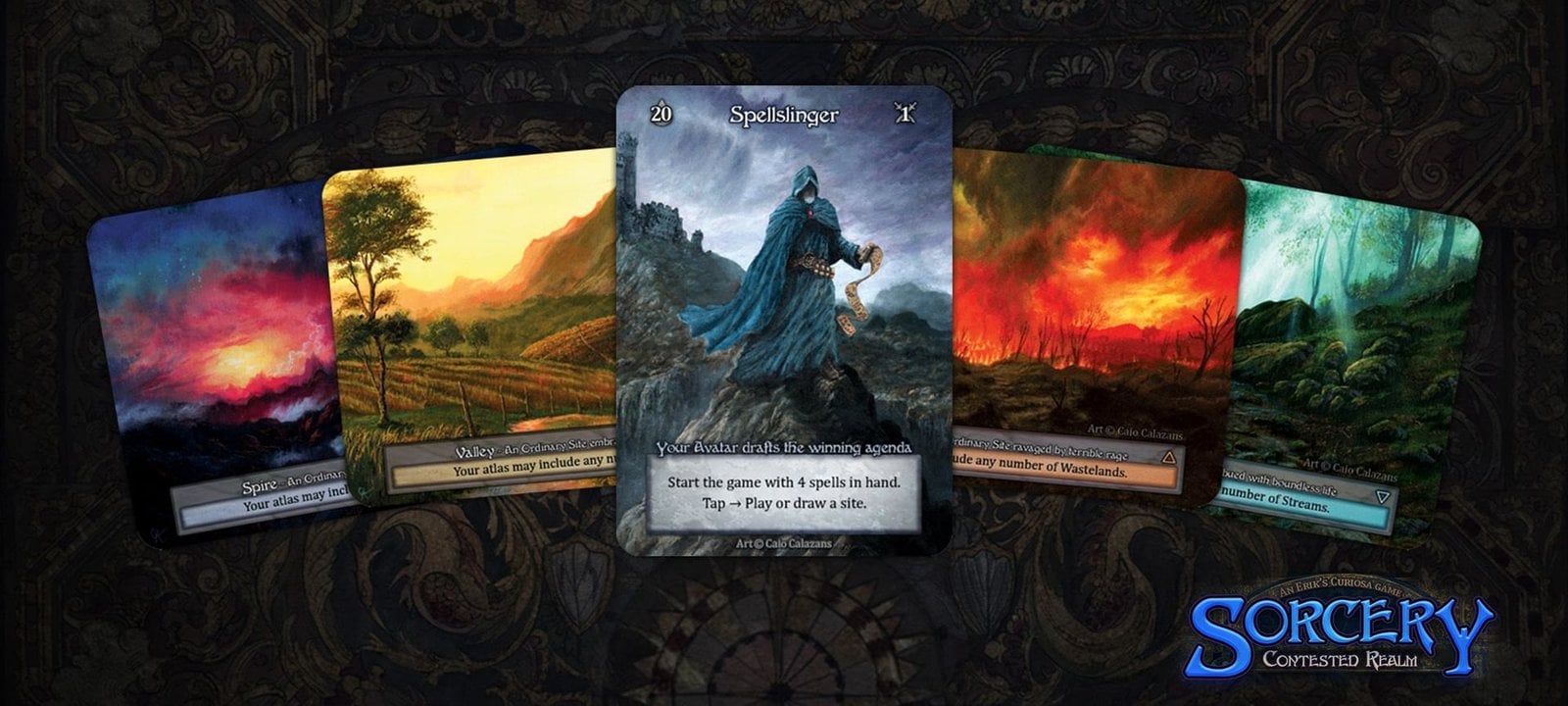
The Draft Kit's basic Sites and Spellslinger Avatar, art by Caio Calazans — via sorcerytcg.com
So when do you set the default aside? Based on how the pieces fit rather than any published tier list: an opened Avatar earns the slot when its ability lines up with what your pool already wants to do — its threshold identity matches the elements you're building toward, and its effect supports the minion-forward game plan most Sealed decks end up on. Spellslinger's card advantage is generically useful in a format where running out of action is a common way to lose, which makes it a high floor. An opened Avatar has to clear that floor for your specific 36 cards, not in the abstract. When in doubt, the default exists precisely so that this decision can't go too badly.
The Spellbook: count your removal, then fill with minions
Build at 24. Nothing published forces you to stop at the minimum, but every card past it dilutes the chance of drawing your strongest ones, and community deck guides do their slot math assuming exactly 24. Treat the minimum as the target.
The most concrete slot guidance in print is Brontë's: 18–20 minions in most decks — "fewer if you have premium removal, more if your non-Minion spells aren't that impressive." The reasoning was specific to Arthurian Legends Sealed, where direct-damage removal was scarce (nine damage-dealing magics in the entire set, most gated behind double threshold) and unevenly spread across elements. When you can't count on removal spells, minions have to do the removing — trades, Lance hits, ranged attacks, bodies blocking lanes — and the player with more board presence usually dictates the game.
Treat the number as a procedure rather than a constant. Set mixes change — Gothic's removal density isn't Arthurian Legends' — but the procedure falls straight out of the deck minimum: a 24-card Spellbook carrying 18–20 minions leaves four to six slots for every magic, aura, and artifact combined. So count your genuine removal first, hand those few slots to it, and fill the rest with creatures. If a first build comes out at twelve minions and twelve clever spells, the cited ratio says to rebuild it. The same guide's curve advice: concentrate the deck on 2-, 3-, and 4-mana spells with the occasional 5- or 6-cost card for a bomb, aiming to be on the board early and closing the game before it goes long.
The Atlas: 12 Sites, and fewer elements than you're tempted by
The Atlas floor is guaranteed — the Draft Kit's 48 basics (Spire, Streams, Valleys, and Wastelands, one per element, painted by Caio Calazans) mean you can always field a legal 12-Site deck no matter what you opened. The publisher describes the basics as "fundamental and equal, providing only threshold and mana," and that deliberate plainness is the point: nearly any Site with printed text outclasses them. Brontë's version of the same idea is blunter — in Arthurian Legends, all but one Ordinary Site was "almost always better than playing one of the generic draft sites," because a Site with an ability does extra work on a card type you're casting every turn of the early game. Play the Sites you opened; pad with basics only where the pool runs dry.
The harder Atlas decision is element count. Twelve slots is not many, and every element you add splits them: a two-element Atlas can offer six sources of each threshold type, a three-element Atlas barely four. Cards in your Spellbook that need double threshold get markedly harder to cast with each split — the full mechanics are in Sorcery Threshold and Sites, Explained. Brontë's Arthurian Legends analysis lands on a firm default: two elements when possible, with splashes reserved for pools that open the rare multi-element Sites to support them. The set-by-set details shift, but the constraint generating the advice — 12 slots divided by your ambitions — is the same in every Sealed pool.
Two rules that work differently here: the Collection and the mulligan
The Collection assembles itself. In Constructed, the Collection is a curated zone of up to 10 cards. In Sealed, the publisher's rule is that your leftovers — every opened card that didn't make the Spellbook or Atlas — are the Collection, with no cap. Better still for Limited: cards that fetch specific named targets treat those targets as freely available even if you didn't open them, with the most common ones included in Gothic's box topper. If you open one of the Gothic cards that reaches into the zone, it works at full power off cards you were cutting anyway. The Collection in Sorcery, Explained covers the whole mechanic, including why it's genuinely simpler in Limited than in Constructed.
The mulligan cap was written with Limited in mind. Sealed uses the same opening-hand rules as every format — three spells, three sites, one mulligan capped at three total redrawn cards. The July 2024 rules update that introduced the cap explains why it matters more here: under the old unlimited mulligan, a Limited player could expose about 25% of their Spellbook and 50% of their Atlas before the first turn, which made small decks play far too predictably. With the cap, your opening six in Sealed is mostly the hand you'll keep — How to Mulligan in Sorcery covers how to spend the three redraws you do get.
Where Sealed actually happens
Anywhere someone can supply the packs. At the top of the calendar, Sealed has carried main events — SorceryCon 2024 in Las Vegas ran its headline tournament as eight rounds of Arthurian Legends Sealed — and it remains a staple of convention side events; the format guide maps which organized-play tiers run which formats in 2026. The directory's Play & Compete section indexes the event calendars, conventions, and community leagues where Sealed events get announced, and the official Play Network listing is the canonical source for sanctioned dates near you.
The supply half is straightforward: six boosters per player plus a Draft Kit per four players, stocked through local game stores' kits or the publisher's own shop — both catalogued under Where to Buy. And if you want to learn the card pool before spending box money, the community's deckbuilders and card tools — Curiosa's card library for studying what a set's Ordinaries and Exceptionals actually do, the Tabletop Simulator mod for playing practice games — cover the homework for free. Sealed rewards exactly one kind of preparation: knowing the commons cold before you ever crack a pack.
Where to go from here
- Every Sorcery Format, Explained — Sealed in context: Constructed, Draft, and the OP pipeline above them
- The Collection in Sorcery, Explained — the zone your Sealed leftovers turn into
- How to Mulligan in Sorcery — the 3-card cap and how to spend it on a Sealed opening hand
- Sorcery Threshold and Sites, Explained — why the 12-Site Atlas punishes greedy element counts
- Sorcery Card Rarities, Explained — the slot structure behind the 90-card pool
- Which Sorcery Precon Should You Buy First? — the other low-pressure way into the game, if building under a timer isn't your idea of fun
Sources
- Sorcery TCG Sealed format page — 6 boosters per player, Spellbook 24+, Atlas 12+, Avatar rule, no rarity limits, supplied Sites, Collection-in-Limited, event logistics — accessed 2026-06-06
- Sorcery TCG Gothic set page — 15-card booster anatomy: 11 Ordinary / 3 Exceptional / 1 Elite or Unique, 36-pack boxes — accessed 2026-06-06
- Introducing the Sorcery: Contested Realm Draft Kit — 4 Spellslinger Avatars + 48 basic Sites, Spellslinger replacing Sorcerer as the Limited default, Caio Calazans art — published 2024-07-26
- Sorcery: Contested Realm Rules Update (July 2024) — the 3-card mulligan cap and the publisher's Limited-deck exposure math — published 2024-06-28
- Death's Door — Arthurian Legends Sealed guide — by Brontë; the 18–20 minion recommendation, removal-scarcity analysis, Site and element guidance, SorceryCon main-event context — published 2024-10-28