Sorcery matches are one game. There is no game two, no fifteen-card swap ritual between games, and — until Gothic — no sideboard at all. That changed with the Collection: up to 10 cards that sit outside your Spellbook and Atlas and enter the game while you're playing it, through specific card effects. Not between games. Mid-game.
That distinction is the whole mechanic. If you're arriving from Magic, set the word "sideboard" down before reading on, because the Collection borrows the deckbuilding shape of one and almost none of the behavior. What follows is what the publisher's announcement and rulebook actually establish, the two patterns Gothic's cards use to reach into the zone, what the first months of tournament play suggest about using it, and how to think about filling your 10 slots.
What the Collection is
Erik's Curiosa announced the mechanic in July 2025, ahead of Gothic's December 5, 2025 release. The definition is deliberately two-tiered. In casual play, your Collection is literally "the cards you own that aren't in the game" — the binder, the shoebox, the rest of the shelf. In formal settings such as tournaments, it's "a set of 10 cards that you've selected to complement your main decks."
So constructed Sorcery now runs three piles: the 60-card Spellbook and the 30-card Atlas — the two-deck system you choose between every draw step — plus a 10-card Collection you never draw from at all. All three numbers shipped together. The same announcement locked in the final deck sizes, effective with Gothic's release; the July 2025 rules update had deliberately left deck sizes out because, in the publisher's words, the card pool needed "to reach a certain depth to support the change."
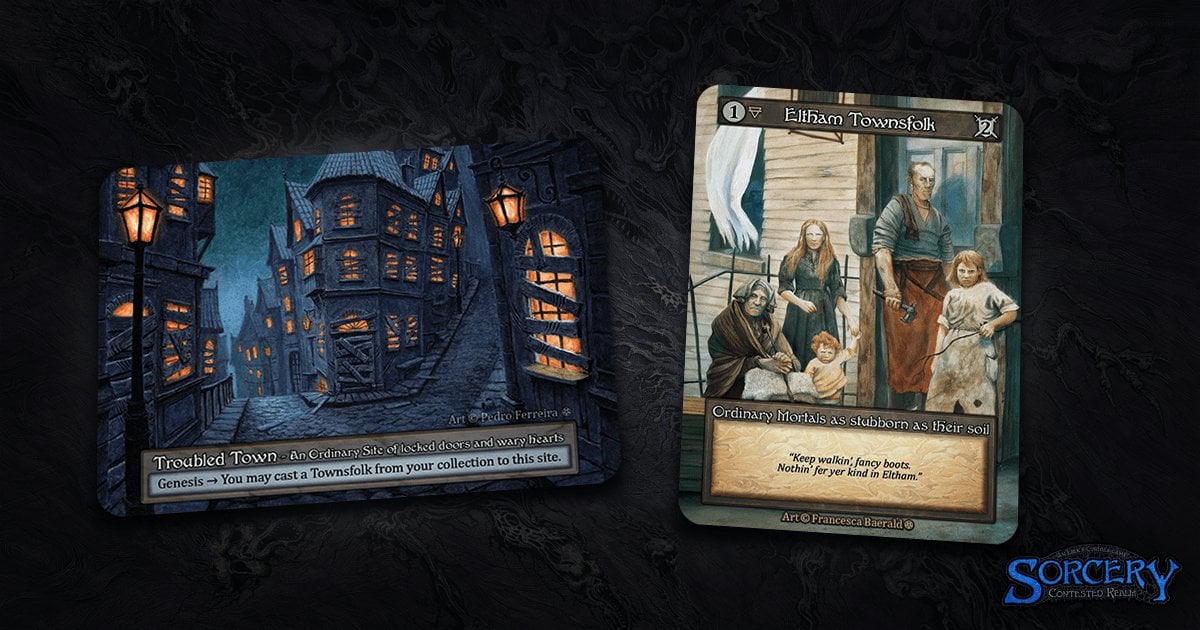
Troubled Town and Eltham Townsfolk, from the Collection announcement — via sorcerytcg.com
The December 2025 rulebook update then made it official vocabulary: Collection entered the glossary alongside Ward and Can't Be Modified, with the publisher noting the entry provides "a clear rules reference for how this new mechanic functions." If you played Gothic's first weeks on announcement text alone, nothing changed — the rulebook caught up to the cards, not the other way around.
An active sideboard, not a Magic one
The announcement opens with the design question directly: does Sorcery need a sideboard, and how do you build one that "works in a best-of-one world without feeling like it wandered in from another game"? A Magic sideboard is a between-games tool — you lose game one, you swap answers in, you play again. Sorcery matches don't have a game two to adjust for. So the Collection works during the game instead. The publisher's own summary: it gives players "an active sideboard, a flexible toolbox of up to 10 cards that can be accessed mid-game."
Two structural consequences fall out of that, and both matter for deckbuilding.
The Collection has no passive value. In Magic, your sideboard always matters because you are the access mechanism. In Sorcery, cards are the access mechanism. If your Spellbook and Atlas contain nothing that references the Collection, those 10 cards are scenery — there is no rule that lets you reach into the zone unprompted.
It's a flavor device as much as a rules device. The announcement is explicit that the Collection lets cards summon specific characters without drowning in templating: "Instead of 'Cast an Ordinary 1-cost 2-power Mortal Earth minion,' we get to say things like: 'Cast a Townsfolk from your Collection.'" The named card does the technical work, and the referencing card stays readable.
The two ways cards reach into it
The Gothic card pool uses the Collection in two distinct patterns. The keyword glossary covers Cast from Collection as an ability tag; here's how it actually shows up on cards.
Named fetches — the card tells you what to stock
Troubled Town, an Ordinary Site, reads: "Genesis → You may cast a Townsfolk from your collection to this site." The Townsfolk in question is Eltham Townsfolk — the 1-cost, 2-power Ordinary Mortal from the announcement's templating example, waiting in your Collection until the town summons it.
Gilman House, a Unique Site, does the same with a transform — at four Water threshold: "Transform a minion here into a Horrible Hybrids from your collection." Walk a 1-power skeleton token onto the site, and it becomes a 3-power horror pulled from the zone — "for zero mana investment," as the SorceryCon-winning pilot put it (more on that below).
The pattern: the referencing card names what it wants, and your Collection is where the named card physically lives. Stock the target or the text does nothing.
Open-ended toolboxes — Toolbox and Silver Bullet
The second pattern is the one that earns the word "sideboard." A small cycle of Gothic relics casts unnamed spells out of the Collection, gated by rarity:
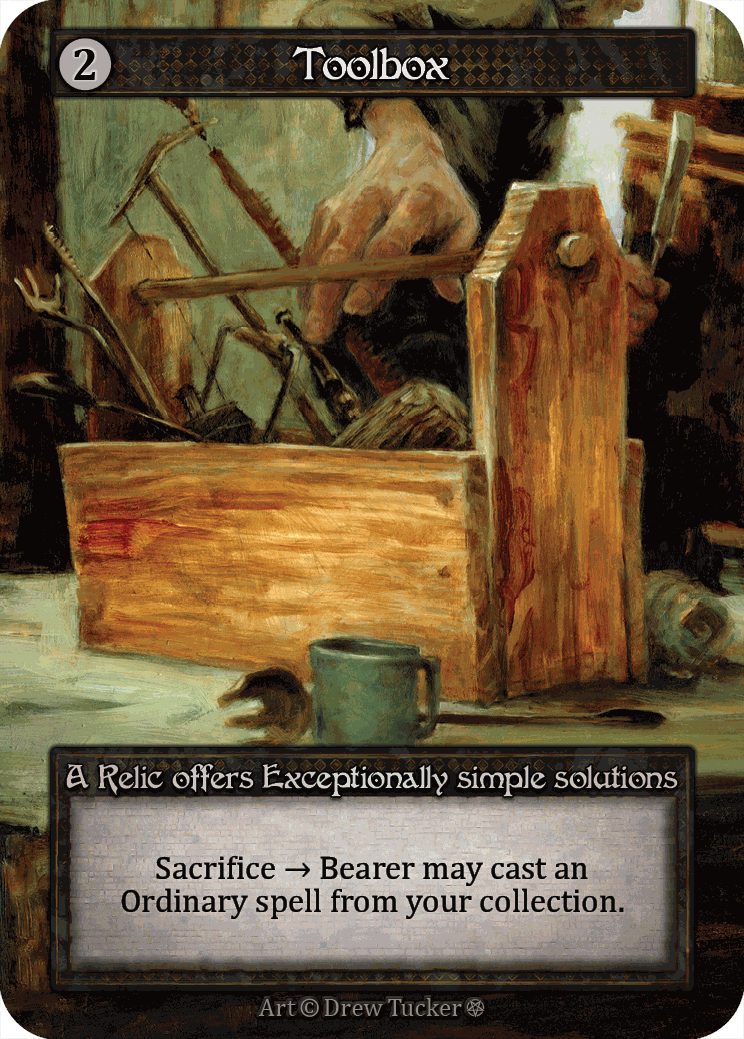
Toolbox by Drew Tucker — via Curiosa
Toolbox reads: "Sacrifice → Bearer may cast an Ordinary spell from your collection." Its Elite sibling Silver Bullet — yes, the announcement's "packing a Silver Bullet" line is a literal card — gives its bearer "Tap, Sacrifice Silver Bullet → This unit may cast an Exceptional spell from your collection."
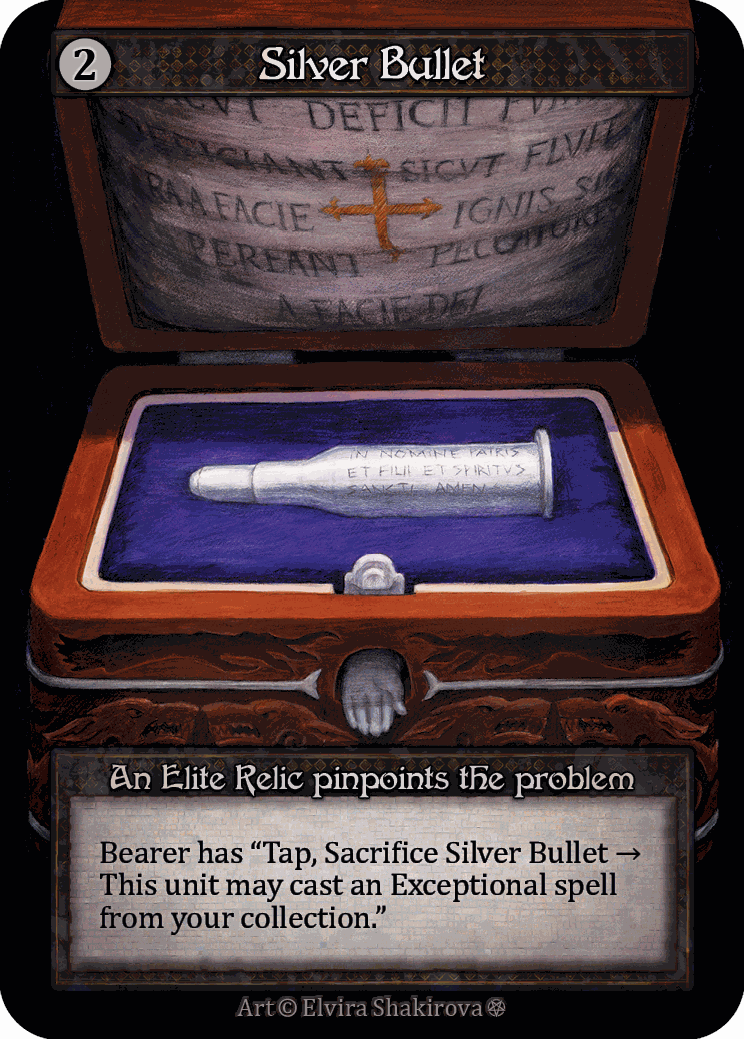
Silver Bullet by Elvira Shakirova — via Curiosa
These are the genuine answer-on-demand cards: you stock removal, site hate, or recursion hate in the Collection, carry the relic, and cash it in when the matchup demands it. The rarity gates are load-bearing — Toolbox only reaches Ordinary spells, Silver Bullet only Exceptional ones. A perfect answer at the wrong rarity is unreachable by that relic, which makes rarity a real deckbuilding axis for the first time in Sorcery's life.
What the rules say — and what they don't
Worth being precise about where the formal language actually lives, because it's spread across several documents.
The Constructed format page specifies 1 Avatar, a Spellbook of at least 60 cards, an Atlas of at least 30, and the per-rarity copy caps (4 Ordinary, 3 Exceptional, 2 Elite, 1 Unique) — and, as of this writing, doesn't mention the Collection at all. The phrase "10-card Collection Limit" appears, of all places, on the Sealed format page. The glossary definition lives in the December 2025 rulebook PDF. If you're checking a rules question at an event, the rulebook and the Codex on Curiosa — listed with the rest of the deckbuilders and card tools in the directory — are the references to pull up, not the format pages.
Three points the published materials support, and one they don't:
"Up to" 10 is a ceiling, not a floor. The announcement consistently says "up to 10 cards." Nothing published requires you to fill the slots — though if your deck plays Collection-referencing cards, every empty slot is a line of text you've voluntarily switched off.
Casting from the Collection is still casting. Cards cast out of the zone behave like cards cast from hand — cost paid, threshold checked. Don't stock spells your Atlas can't turn on.
The zone is finite and doesn't refill. Ten cards for the whole game, accessed as effects allow. There's no shuffle-back mechanism in any published rule I can point to.
Open question: copy limits across zones. Whether the 4/3/2/1 rarity caps count your Spellbook and Collection together — four copies total, or four plus four — isn't spelled out on the announcement or format pages cited here. As of the December 2025 rulebook materials I can verify, I can't point to a published line either way; for tournament play, check the current rulebook PDF or ask a judge rather than assuming.
The Collection in Limited
Sealed and Draft handle the zone completely differently, and the Sealed page is where the publisher says the most about it. In Sealed, you build a Spellbook of at least 24 and an Atlas of at least 12 from your six packs — and then "any extra cards you pick that don't go into your 24-card Spellbook or 12-card Atlas become your Collection in its entirety." No curation, no 10-card cap. Your leftovers are the zone.
Limited also relaxes the named-fetch problem: cards named by Collection-referencing effects are "freely available for use" even if you didn't open them, with the most common targets included in Gothic's box topper. In Constructed, those same named targets have to be stocked deliberately and count against the 10-card limit. It's the rare mechanic that's simpler in Limited than in Constructed — the format guide covers how the rest of the deckbuilding rules shift between the two.
What early tournament play shows
The Collection has only been in organized play since Gothic went live in December 2025, so treat these as early reads from cited players, not settled doctrine.
The cleanest data point is CJ's "Dank Magic" Necromancer, which won the constructed championship at SorceryCon 2026 in Indianapolis — the largest community-run event on the organized-play calendar. In the publisher's interview, CJ describes the Gilman House line in Collection-management terms: walk skeletons onto the site, leave them as skeletons, and transform them the following turn when they're untapped — so a board wipe doesn't make you "deplete your collection" for nothing. The zone is a finite resource, and the champion's heuristic is to sequence around protecting it: spend Collection cards when they convert to action immediately, not a turn early.
Bardsword's January 2026 meta writeup adds the insurance-slot angle. Surveying a field that under-prepared for cemetery recursion, the advice was blunt: "make sure you've got answers in your Collection to grab with Toolbox, if nothing else." That's the open-ended pattern working as designed — hate cards you'd never maindeck in a single-game format become playable when one relic can fetch them on demand. The same piece credits the 60-card Spellbook with making mono-Water archetypes viable at all, after lists "had a hard time packing enough punch" at the old 50-card size — a reminder that Gothic's deck-size change and the Collection arrived as one package, and the post-Gothic meta reshaped around both at once. The community writers tracking that shift are collected with the rest of the podcasts and newsletters in the directory.
How to think about your 10 slots
Based on the published card pool and the cited results above — not on a tournament record I don't have — the slot math works out to a rough priority order:
Named targets first. If your deck plays Troubled Town, a Townsfolk goes in the Collection or the Genesis is blank. Gilman House demands Horrible Hybrids — plural, if you intend to transform more than one skeleton per game. These slots aren't optional; count them before anything else.
Match the rarity gates. Toolbox reaches only Ordinary spells; Silver Bullet only Exceptional ones. Audit your answer suite against the relic you're actually carrying — an Elite removal spell in the Collection with only a Toolbox in the deck is a dead slot.
Respect threshold. A Collection card you can't meet threshold for is a card you don't have. Stock answers your Atlas already supports.
Budget for depletion. Ten cards, no refills. CJ's Gilman House timing generalizes: don't convert Collection cards into board presence until the conversion is safe or immediately profitable.
Insurance last. Whatever slots remain after the named targets, Bardsword's rule is a sound default — answers to the format's known predators, reachable by your toolbox relic.
And the degenerate case is worth saying out loud: if nothing in your 90 maindeck cards references the Collection, your 10 slots do nothing at all. Unlike a Magic sideboard, the zone has no value you don't build toward. That's not a flaw — it's the cost of a sideboard that works inside a single game instead of between two of them.
Where to go from here
- Every Sorcery Keyword, Explained — Cast from Collection in the context of the full Gothic-era glossary
- The Sorcery Meta in 2026 — the post-Gothic field the Collection is being built against
- Every Sorcery Format, Explained — Constructed vs. Sealed vs. Draft, including where deck minimums diverge
- The Sorcery Turn Structure — the Spellbook/Atlas draw system the Collection sits alongside
- Start Here directory section — the curated newcomer path if Gothic is your entry point to the game
Sources
- What You Carry With You: A First Look at the Collection and Deck Sizes in Gothic — published 2025-07-11, the primary announcement
- Sorcery: Contested Realm December 2025 Rulebook Update — published 2025-12-19, Collection glossary entry + 60-card Spellbook
- Sorcery: Contested Realm Rules Update (July 2025) — published 2025-07-10, the update that preceded the deck-size change
- Sorcery: Contested Realm Gothic Recap — published 2025-10-31, confirms the December 5 release date
- Sorcery TCG Constructed format page — deck minimums and rarity copy caps, accessed 2026-06-06
- Sorcery TCG Sealed format page — "The Collection In Limited" rules, accessed 2026-06-06
- Sorcery TCG "How to Play" — rulebook home, accessed 2026-06-06
- Curiosa.io — Troubled Town, Gilman House, Toolbox, Silver Bullet, Eltham Townsfolk — card text verification
- Where the Bones Lead: CJ's SorceryCon Necromancer — published 2026-03-04, champion interview with the Gilman House / Collection-depletion heuristic
- Bardsword — A Month into Gothic — published 2026-01-15, community analysis: Toolbox insurance slots, 50→60 Spellbook impact