Sorcery's keywords are scattered across three places: the printed reminder text on cards, the rulebook, and the Curiosa Codex glossary — Curiosa itself sits in the directory's Deckbuilders & Tools section alongside the other reference utilities. None of those is wrong — but none of them is whole on its own. The rulebook predates Gothic. The Codex is the most current reference but reads as a list of definitions, not a hub you can scan during a game. This article is the hub: each Sorcery keyword in print today, with the reminder text, what it actually does in plain English, and one canonical example card.
Scope: the rules as of the December 2025 rulebook update and the July 2025 update that preceded it. If you're reading this against a 2024-era guide, intercept, undefended sites, Lance, and Stealth all changed materially. The version below is what Sorcery is being played under in 2026.
How to use this hub
Each keyword has its own H3 with three parts: the printed or Codex-canonical reminder text, what it does in plain English, and a single example card you can pull up on Curiosa for visual reference. The article is organized by what the keyword does — movement, combat, detection, resilience, casting, alignment — not alphabetically, because alphabetic glossaries are how you forget which keyword is which.
If you want alphabetical, the Codex has you. If you want to understand the keywords by what they change about the game, this is the article.
A few that aren't on the list: subtype tags like Dragon, Knight, Mortal, Beast, and Elite aren't keyword abilities — they're tribal labels that other cards reference. We'll touch them briefly at the bottom but they don't get their own entries. Same for Genesis the trigger word: it's a timing label, not an ability, and it shows up everywhere.
Movement and positioning keywords
These four keywords determine which region of the board a unit can occupy. The board has four regions — Surface, Underground, Underwater, and Void — and most minions live on the Surface by default. The keywords below break that default. For the full regional model, see The Five Regions of Sorcery.
Airborne
Reminder text (Codex): A minion with Airborne flies above the surface of the realm.
Plain English: Airborne units move diagonally as well as cardinally, can fly over surface units when traveling, and can only fight other Airborne units (or units with a printed ability to reach them). They cannot be intercepted by non-Airborne units, and they cannot intercept non-Airborne units. The keyword is Surface-region-only — Airborne doesn't apply when a unit is Underground or Underwater.
The July 2025 update clarified one nuance: Avatars that gain Airborne mid-game can use it. A Dragonlord with Airborne is a Dragonlord that flies. Pre-July-2025 this was disputed in some forum threads; the publisher's update closed the question.
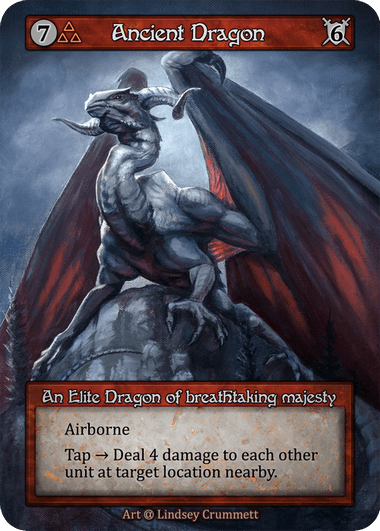
Ancient Dragon by Lindsey Crummett — via Curiosa
Example: Ancient Dragon — an Elite Airborne minion that taps to deal 4 damage to each other unit at a target nearby location. The Airborne keyword is what makes it usable on the back ranks of the board, where it's untouchable by ground-only opponents.
Burrow
Reminder text (Codex): A minion with Burrowing can be summoned to underground locations and survive underground.
Plain English: Burrowing units can occupy the Underground region — the subsurface of land sites. With one step, a Burrower moves between the surface and subsurface of the same land site, or between two adjacent underground locations. They cannot Burrow under water sites or Void squares; they need a land site overhead.
The strategic value of Burrow is dimensional flanking. A Burrowing unit can disappear from interaction for a turn, then resurface on a different site — Surface-only opponents can't reach it while it's underground, and most ranged effects don't cross the regional boundary.
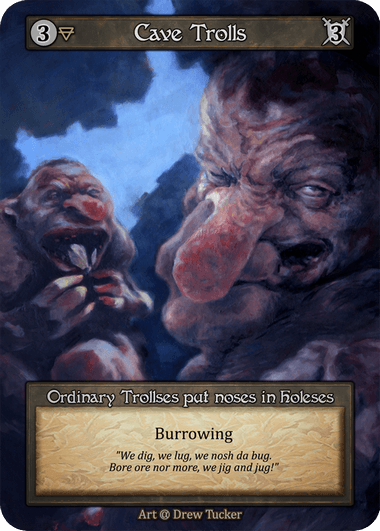
Cave Trolls by Drew Tucker — via Curiosa
Example: Cave Trolls — the Codex's own canonical example. Summon them underground, let summoning sickness wear off, then step them up to the surface to attack. The flavor text — "Ordinary Trollses put noses in holeses" — names the keyword inline.
Submerge
Reminder text (Codex): A minion with Submerge can be summoned to underwater locations and survive underwater.
Plain English: Structural twin of Burrow, different region. Submerge units occupy the Underwater region — the subsurface of water sites. One step moves them between the surface and subsurface of the same water site, or between two adjacent underwater locations. Land sites and Voids are not Submerge-accessible.
A minion with both Burrowing and Submerge can also move directly from an underground location to an adjacent underwater location in one step, and vice versa — the only minions that can cross subsurface regions without surfacing first. Those are rare and worth noting when you see them.
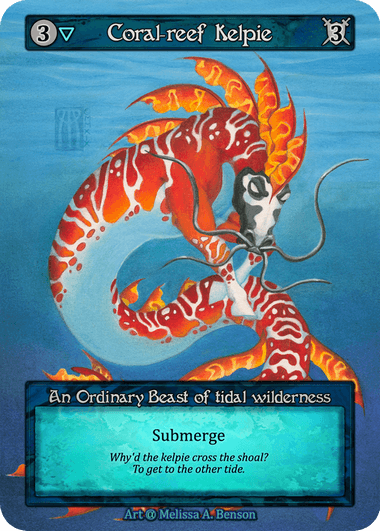
Coral-reef Kelpie by Melissa A. Benson — via Curiosa
Example: Coral-reef Kelpie — the Codex's canonical Submerge example. Summon to an underwater location; step up to the surface of a water site when you want to attack. The flavor — "Why'd the kelpie cross the shoal? To get to the other tide." — is the publisher being publishing-honest about what the keyword does.
Voidwalk
Reminder text (Codex): A minion with Voidwalk can be summoned to void locations and survive in the void.
Plain English: Voidwalk units can occupy the Void — any square without a Site on it. Normally any minion in the Void is banished immediately; Voidwalk is the exception. From the Void, a Voidwalking unit can take one step directly to the surface or subsurface of an adjacent Site, which makes it a fast-moving offensive tool. The opponent's Sites don't shield the Void corridors, so Voidwalk is route control in keyword form.
Avatars cannot voluntarily enter the Void — Voidwalk isn't an Avatar keyword. Forcing an Avatar into a Void by spell or ability is one of the more dangerous threats in the game.
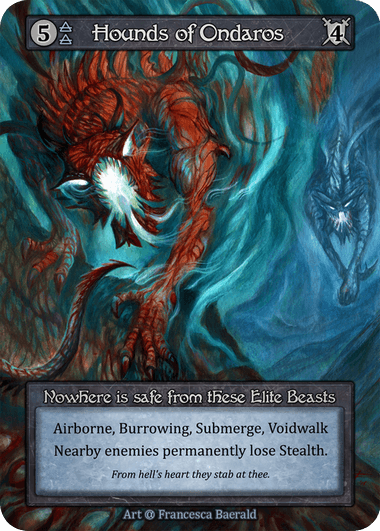
Hounds of Ondaros by Francesca Baerald — via Curiosa
Example: Hounds of Ondaros — the Codex's example for Voidwalk and one of the densest keyword stacks in the game. The card has Airborne, Burrowing, Submerge, and Voidwalk on a single minion, plus a passive that strips Stealth from nearby enemies. Pure region-crossing terror.
Movement +X
Reminder text: Movement +X grants additional steps per turn beyond the baseline one step.
Plain English: Each point of Movement +X is one extra step. A unit with Movement +1 can take two steps per turn; Movement +2, three; and so on. The July 2025 update simplified the stacking rules: multiple Movement +X effects on the same unit are additive, and there is no cap printed in the rulebook beyond the practical limit of the board.
Movement +X interacts with intercept. Per the July 2025 update, intercept only fires after all movement resolves, which means a faster unit can step past potential interceptors entirely — the interceptor's window only opens at the destination. Fast units bypass slow defensive clusters by construction.
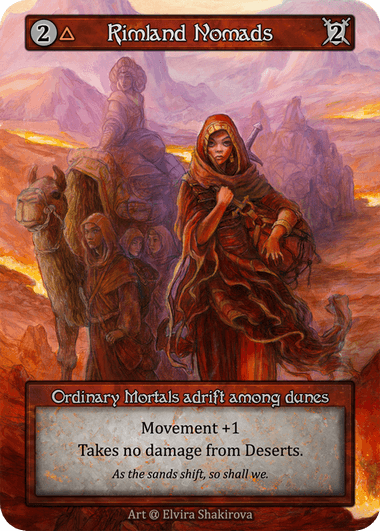
Rimland Nomads by Elvira Shakirova — via Curiosa
Example: Rimland Nomads — Movement +1 plus "Takes no damage from Deserts," giving them two steps a turn across terrain that hurts other minions. The clean Movement +X example: same baseline body, one extra step a turn, real positional pressure across a long match.
Combat and strike keywords
These keywords change how a fight resolves, not who can fight whom. For the full combat skeleton — declare, defender/intercept, first-strike, regular strike, damage — see How Combat Actually Works in Sorcery. The keywords below are modifiers on that flow.
Ranged
Reminder text: Ranged units can attack one step away in cardinal directions without moving into the target's square.
Plain English: A Ranged unit attacks at one cardinal step away. It does not have to enter the target's square; it strikes from where it stands. The target still strikes back if it survives (Ranged is not invulnerability), but the attacker doesn't commit position to the fight.
The July 2025 update added an important constraint: Ranged cannot target Sites directly. A Ranged unit can attack the minion on a Site, but it cannot deal damage to the Site itself. Site attacks are reserved for melee units who actually move onto the site.
Example: Most Spellslingers, Archers, and bow-bearing Mortals in the Sorcery pool have Ranged printed on them. Spellslinger is the canonical Beta-era example — Ranged combined with cheap-to-cast magic gives the deck reach without committing minions to fragile front-line positions.
First Strike (Strikes First)
Reminder text: Strikes first while attacking (or unconditionally, depending on the card).
Plain English: A unit with strikes-first deals its damage in the first-strike step, before the regular strike step. If the first-strike damage kills the opposing unit, the fight ends and the killed unit never strikes back. If both sides have strikes-first, they strike simultaneously in this step.
Two clarifications most newcomers miss. First, there is only one first-strike window per fight — stacking two weapons that both grant strikes-first doesn't grant "double first strike." Second, strikes-first can be conditional: many cards print "Strikes first while attacking," which means the keyword only applies when the unit is the attacker, not when it defends.
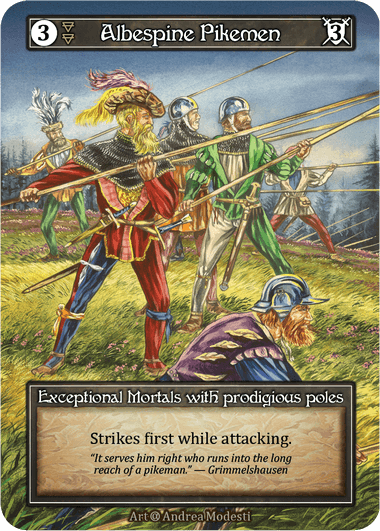
Albespine Pikemen by Andrea Modesti — via Curiosa
Example: Albespine Pikemen — printed reminder text reads "Strikes first while attacking." The conditional matters: as the attacker, the Pikemen kill 3-power minions clean; as the defender, they trade like a regular 3/3.
Lance (weapon keyword)
Reminder text (printed): Bearer's next strike deals +1 damage and strikes first, then Lance breaks.
Plain English: Lance is a one-shot weapon artifact. Equip it to a minion; that minion's next attack gets +1 damage and strikes-first; after the attack, the Lance breaks. It is consumed by the strike. The July 2025 update added a specific clarification: if you attack a Site with a Lance equipped, the Lance breaks on impact regardless of whether the Site survives. The publisher's framing: "Lances are made for dueling, not demolition."
Stacking Lances does not give double first-strike (only one first-strike window per fight), but it does effectively give you a second weapon-strike across two attacks — the second Lance breaks on the next attack after the first one shatters.
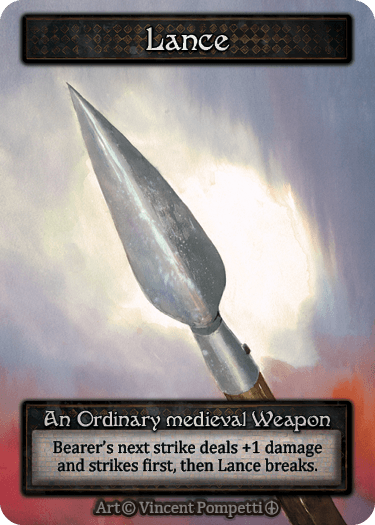
Lance by Vincent Pompetti — via Curiosa
Example: Lance — the namesake card. A 1-cost weapon that turns any minion into a duelist for one swing. The classic Pikemen-plus-Lance combo is a 3/3 strikes-first body that delivers 4 damage on its opening attack.
Intercept (mechanic, not keyword)
A short clarification because the word shows up in deck talk: intercept is a mechanic, not a printed keyword ability. No card reads "Intercept" as a stand-alone keyword. Intercept is the act of an adjacent friendly unit stepping in to fight an enemy attacker that moved into your zone but chose not to attack.
The July 2025 update is the canonical reference. From the update: "If an enemy used Move and Attack without attacking, you can intercept!" The timing window is after all movement resolves, which is what makes Movement +X effects so strong — they let you outrun the intercept window.
For the full combat resolution including intercept, see How Combat Actually Works in Sorcery.
Detection and visibility keywords
Stealth
Reminder text (Codex): A unit with Stealth cannot be targeted by enemy spells, abilities, or projectiles.
Plain English: Stealth is the "you can't see me" keyword. A Stealth unit is immune to enemy targeted spells, targeted abilities, and ranged projectile attacks. It is not immune to being fought in regular close combat — an opposing minion adjacent to the Stealth unit can still attack it.
The December 2025 update clarified a critical interaction: Stealth breaks the moment the unit interacts with the realm. Casting a spell, striking an enemy, activating an ability, or dealing damage all reveal the unit and strip Stealth for the rest of the game. The first action a Stealth unit takes is the action where it stops being Stealth.
That's the part new players miss. Stealth is not a permanent invisibility shield — it's a "free first strike" hidden under a temporary cover. The moment you cash in, the cover is gone. This is also why the Hounds of Ondaros card text matters so much: "Nearby enemies permanently lose Stealth" turns the Hounds into a hard counter to any Stealth-based archetype within range.
Example: Many Assassin- and shadow-themed minions in the Gothic pool carry Stealth. The keyword's behavior is uniform; the specific card list rotates with each set.
Resilience and protection keywords
Ward
Reminder text (Codex): A unit with Ward N cannot be targeted by a spell or ability unless its controller pays N additional mana.
Plain English: Ward is a tax on targeted interaction. Each unit with Ward has a number — Ward 1, Ward 2, Ward 3 — and any enemy spell or ability that targets the unit costs that much extra mana to cast. If the opponent can't pay the surcharge, the spell or ability is countered (or, by some rulings, simply uncastable).
Ward was consolidated in the December 2025 update into a single canonical keyword — pre-Gothic, several pre-Ward cards used wordy "cannot be targeted unless..." rules text that all now reads as Ward N. The update is backwards-compatible: an old Ward-equivalent card is now treated as Ward N for ruling purposes.
Ward does not protect from non-targeted effects — board-wipe spells that hit all minions, area-of-effect damage with no specific target, and damage from combat all bypass Ward. It is precisely targeted-interaction insurance, not a global shield.
Example: The Codex's Ward entry has multiple example cards. Any Gothic-era card printed with "Ward 1" or "Ward 2" follows the rule above. For a card that grants Ward to another minion — making it a protected target rather than just a sturdy one — check the Gothic enchantress pool.
Death's Door
Status: Death's Door is a game-state rule, not a card keyword. An Avatar at 0 life is "at Death's Door" — they cannot gain life, they take no further damage for the rest of the turn they hit zero, and any damage on a subsequent turn ends the game.
The reason it shows up in keyword lists is that some cards print rules text referencing "an Avatar at Death's Door" as a state-check. Those cards work as you'd expect — a triggered effect that fires when an Avatar is at zero. But there is no standalone "Death's Door" keyword ability and no "Deathblow" trigger word.
For the full mechanic and how it changes deckbuilding, see Sorcery's Death's Door Mechanic, Explained. The very short version: lethal-on-board isn't lethal. You need another point of damage on a future turn.
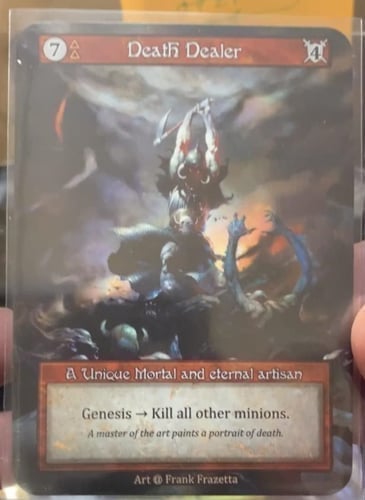
Death Dealer by Frank Frazetta — via Curiosa
Example: Death Dealer's Genesis → Kill all other minions is a finisher that exists precisely because of the Death's Door rule — you need a board-clearing turn to land cleanly into the Death's Door window without giving the opponent a survival turn.
Immobile
Reminder text: An Immobile unit cannot move from its current location.
Plain English: Immobile units are stuck where they are. They cannot use steps to move themselves; they cannot be moved by their controller. They can still attack adjacent enemies, defend their current location, and be moved by non-controller effects (some forced-movement spells override Immobile). The July 2025 update was explicit on this: "stillness is not helplessness." An Immobile unit at an adjacent enemy's location is still a perfectly good defender.
Immobile is most often a tradeoff on a minion that's strong in exchange for being unable to relocate. The deckbuilding question is whether you can place it on the right square to begin with.
Example: Most printed "Effigy" or "Statue" cards carry Immobile. Several large defensive minions in the Beta pool also use it as the printed cost on overstatted bodies.
Casting and summoning keywords
Genesis
Reminder text: Genesis → [effect]. The effect triggers when the card resolves onto the board (when it is summoned or "born").
Plain English: Genesis is the on-resolve trigger word. Whatever follows the arrow happens the moment the card enters the realm. Genesis → Kill all other minions fires when the unit lands. Genesis → You may submerge an artifact from your hand here fires when the site lands.
The important nuance: Genesis triggers regardless of co-location with the target. A Genesis effect on a minion that says "deal 3 damage to a target unit" can target a unit anywhere on the board unless the printed text says otherwise. Genesis is a one-shot, not a positional ability.
If the resolving card is countered, removed, or otherwise prevented from entering play, the Genesis does not trigger — the trigger is on resolution, not on casting.
Example: Death Dealer's Genesis → Kill all other minions is the headline example. Land Death Dealer and every other minion on the board dies. Land it on an empty board and the effect fizzles to nothing. The skill in the deck is timing the Genesis to a board state where killing every other minion is the right move.
Cast from Collection
Status: A Gothic-introduced ability tag. The Collection is a third zone of up to 10 cards outside your Spellbook and Atlas, accessed during play via specific card effects.
Plain English: Cards that read "You may cast this from your Collection" (or variants) can be cast from the Collection zone in addition to the Spellbook. The card otherwise behaves identically — cost paid, threshold required, resolution into the realm — but its origin is the Collection.
The Collection is not drawn from in normal play. Cards leave it only when a specific in-play effect references them. This makes the Collection a tutor-friendly zone for high-impact cards that you want to access predictably without relying on draws.
Example: Several Gothic minions and magics carry Cast-from-Collection variants. The list is set-specific and worth checking against the current Curiosa filters. For the full mechanic, see the publisher's Collection announcement.
Alignment and tribal references
A note on a distinction the Codex makes but new players often miss: tribal subtypes are not keyword abilities.
A unit printed as a "Dragon" has the Dragon subtype, which lets other cards reference Dragons specifically. A Knight is a Knight; a Mortal is a Mortal; a Beast is a Beast. These are tribal tags, not keyword abilities — they don't do anything by themselves. They exist for other cards to interact with ("All your Dragons get +1 power," "Search your Spellbook for a Knight," etc.).
The same is true for rarity tags: "Ordinary," "Exceptional," "Elite," "Unique." These are rarity descriptors that other cards reference, not keyword abilities. (For what the rarities actually mean, see Sorcery Card Rarities, Explained.)
The one alignment tag that is a keyword in the modern Codex is Evil, which functions as a tribal label and as a mechanical alignment for certain spells that affect "Evil" units differently. Evil is the only alignment with that dual role. The rest — Dragon, Knight, Mortal, etc. — are tribes only.
Recent additions and changes since Gothic
A short list of what the December 2025 update added or modified, with primary-source links:
- Ward consolidated into a single canonical keyword with the "Ward N" cost-to-target syntax.
- Stealth interaction clarified — Stealth breaks the moment a unit acts (casts, strikes, activates, deals damage).
- Collection added as a third zone with Cast-from-Collection cards. Spellbooks bumped to 60-card minimum to make room for the new card-type design space.
- Can't Be Modified added as a small glossary keyword for cards that explicitly resist auras and stat changes.
All of the above are documented in the December 2025 update post. If you're reading a pre-Gothic guide, those four items are the most likely places it's out of date.
The July 2025 update also made several earlier changes still relevant in 2026:
- Intercept timing simplified — fires only after all movement resolves, not mid-route.
- Undefended Sites attackable — adjacent units can attack a Site directly if no enemy unit is there.
- Lance shatters on Site attacks — explicit clarification for the Lance + Site interaction.
- Avatars with Airborne can use it — including Avatars who pick up Airborne mid-game.
Both updates compound. The 2026 rulebook is the 2024 rulebook plus those two layers of clarification. The Codex is the canonical glossary; the publisher's update posts are the canonical changelog.
Keyword-region quick reference
For when you're in the middle of a game and just need the lookup:
| Keyword | What it changes |
|---|---|
| Airborne | Diagonal movement; flies over Surface; fights only Airborne |
| Burrowing | Can occupy Underground (subsurface of land sites) |
| Submerge | Can occupy Underwater (subsurface of water sites) |
| Voidwalk | Can occupy Void (squares with no Site) |
| Movement +X | Extra steps per turn |
| Ranged | Attacks one step away without entering the target's square; cannot target Sites |
| Strikes First | Damage resolves in the first-strike step |
| Lance | Bearer's next strike: +1 damage and strikes-first; Lance breaks |
| Stealth | Cannot be targeted by enemy spells/abilities/projectiles; breaks on interaction |
| Ward N | Enemy spells/abilities targeting this cost N more mana |
| Immobile | Cannot move; can still attack and defend |
| Genesis → | Trigger word: effect fires when the card resolves |
| Cast from Collection | Card can be cast from the Collection zone |
| Evil | Tribal alignment with mechanical effects on Evil-referencing spells |
For the canonical alphabetical glossary, defer to the Codex. For combat-resolution-specific keyword interactions, see How Combat Works. For region-specific behavior (which subsurface a Burrower can survive in, why Voidwalk is route control), see The Five Regions of Sorcery.
What this article is not
A few caveats so this hub stays honest:
It's not exhaustive across every set's printed flavor. Sorcery prints occasional flavor-only "keywords" that read like rules text but are flavor (a unit titled "Soldier" with descriptor text "An Ordinary Mortal" is using rarity + tribe descriptors, not a Soldier keyword). When in doubt, check the Codex for the actual definition.
It's not a card list. Each keyword has one example card; many keywords are printed on dozens of cards across the corpus. For the full pool by keyword, Curiosa supports filtered searches.
It's a snapshot. The publisher patches keywords. The 2025 updates were substantial; if Erik's Curiosa ships another rulebook revision, this article needs an updatedAt bump and a re-read against the new post. The date stamp in the byline is the version of the rulebook the article reflects.
Where to go from here
- How Combat Actually Works in Sorcery — the full combat skeleton; every keyword above is a modifier on it
- The Five Regions of Sorcery — Airborne, Burrowing, Submerge, and Voidwalk make more sense once you see the regional stack
- Sorcery's Death's Door Mechanic, Explained — the rule that turns finishers into a separate keyword category in practice
- Sorcery Threshold and Sites, Explained — Sites are where Burrow / Submerge keywords actually attach to a region
- Curiosa.io, the Official Sorcery Deckbuilder, Explained — where to filter cards by keyword and pull up the Codex itself
- Sorcery vs Magic: The Gathering, Explained — Magic converts will recognize Strikes First; Stealth and Voidwalk have no clean analog
- The directory's Start Here section — official rulebook and learn-to-play resources that pair with this hub
Sources
- Curiosa Codex — primary keyword glossary; canonical definitions for every keyword in this article
- Sorcery TCG, How to Play — rulebook home
- Sorcery: Contested Realm Rulebook 2024 — pre-update rulebook baseline
- Sorcery: Contested Realm Rules Update (July 2025) — Movement +X clarifications, intercept timing, Lance + Site interaction, Stealth-break-on-interaction, Avatar Airborne — published 2025-07-10
- Sorcery: Contested Realm December 2025 Rulebook Update — Ward consolidation, Collection mechanic, Can't Be Modified, 60-card Spellbook — published 2025-12-19
- Collection and Deck Sizes in Gothic — Cast-from-Collection design rationale
- GameNerdz Sorcery FAQ — supplementary keyword clarifications