Most TCGs use rarity to gate power — the rarest cards are the strongest, and you build decks around them. Sorcery: Contested Realm uses rarity to gate quantity instead. The rarer the card, the fewer copies you can run. That single design choice — copy limits scaled by rarity — does more work to keep the game playable on a budget than any rebate or promo program could.
Four tiers, four copy limits: Ordinary (4), Exceptional (3), Elite (2), Unique (1). They are baked into the Constructed format rules and into every booster pack the publisher prints. This article walks through what each tier actually does, how the publisher distributes them in boosters, what the community-built Peasant format is (and why it isn't what MTG players assume), and why the system rewards builders who don't chase the chase rares.
TL;DR — the four tiers in one table
| Rarity | Copy limit per deck | Booster slot | What you typically get |
|---|---|---|---|
| Ordinary | 4 | 11 per pack | Workhorses — the cards that make the engine run |
| Exceptional | 3 | 3 per pack | Variety and archetype identity — the role-players |
| Elite | 2 | 1 per pack (shared with Unique) | Splashy effects and centerpiece spells |
| Unique | 1 | Replaces the Elite slot occasionally | One-of-a-kind anchors — legendary-equivalent |
The Constructed page from the publisher is the canonical source for the copy limits: "4 copies of each Ordinary card, 3 of each Exceptional, 2 Elite, and 1 copy of each Unique." Those limits apply to every standard sanctioned event. They're the floor and ceiling of how every Sorcery deck gets built.
Avatars and Sites get treated separately. Avatars are 1-of in your deck regardless of their rarity stamp (a deck has exactly one Avatar). Sites live in your Atlas, the 30-card-plus second deck, and have their own deckbuilding logic covered in the threshold and sites primer.
The booster pack distribution
Per the official Gothic set page, the publisher's framing is precise: "Each 15-card booster contains 11 Ordinary cards, 3 Exceptional cards, and 1 Elite or Unique card." That ratio has held since Beta — Alpha had a different distribution because the print run was small and Kickstarter-exclusive, but every retail set since uses the 11/3/1 shape.
Three takeaways from that distribution.
You will see Ordinaries constantly. Roughly seven out of every ten cards you open are Ordinary. That's deliberate — Ordinaries are the cards expected to anchor decks, and the publisher prints them frequently enough that you can build four-ofs without grinding for them.
Exceptionals are uncommon but reachable. Three per pack means a sealed booster box (36 packs) generally yields enough Exceptional staples to build a focused archetype around them, with duplicates to trade. The 3-copy cap exists because you won't always need or want a full four-of even when you have them — Exceptionals are the part of the deck where you tune for archetype identity.
Elite or Unique — one per pack. That last slot is where the chase happens. The publisher hasn't published a confirmed Elite-to-Unique ratio, but the community estimate (based on box-opening data shared across Discord and tracked by Eternal Durdles) is roughly 1 Unique per 6-8 packs, with Elites filling the rest. Treat that figure as community-sourced; the publisher's "1 Elite or Unique" framing is the only confirmed number.
What's missing from Sorcery's pack model is the random-rare-slot lottery Magic players are used to. There's no "mythic upgrade" odds, no parallel rare/mythic split — just one rarity-tier slot per pack that resolves to Elite or Unique. The variance is bounded.
Ordinary cards (4 copies allowed)
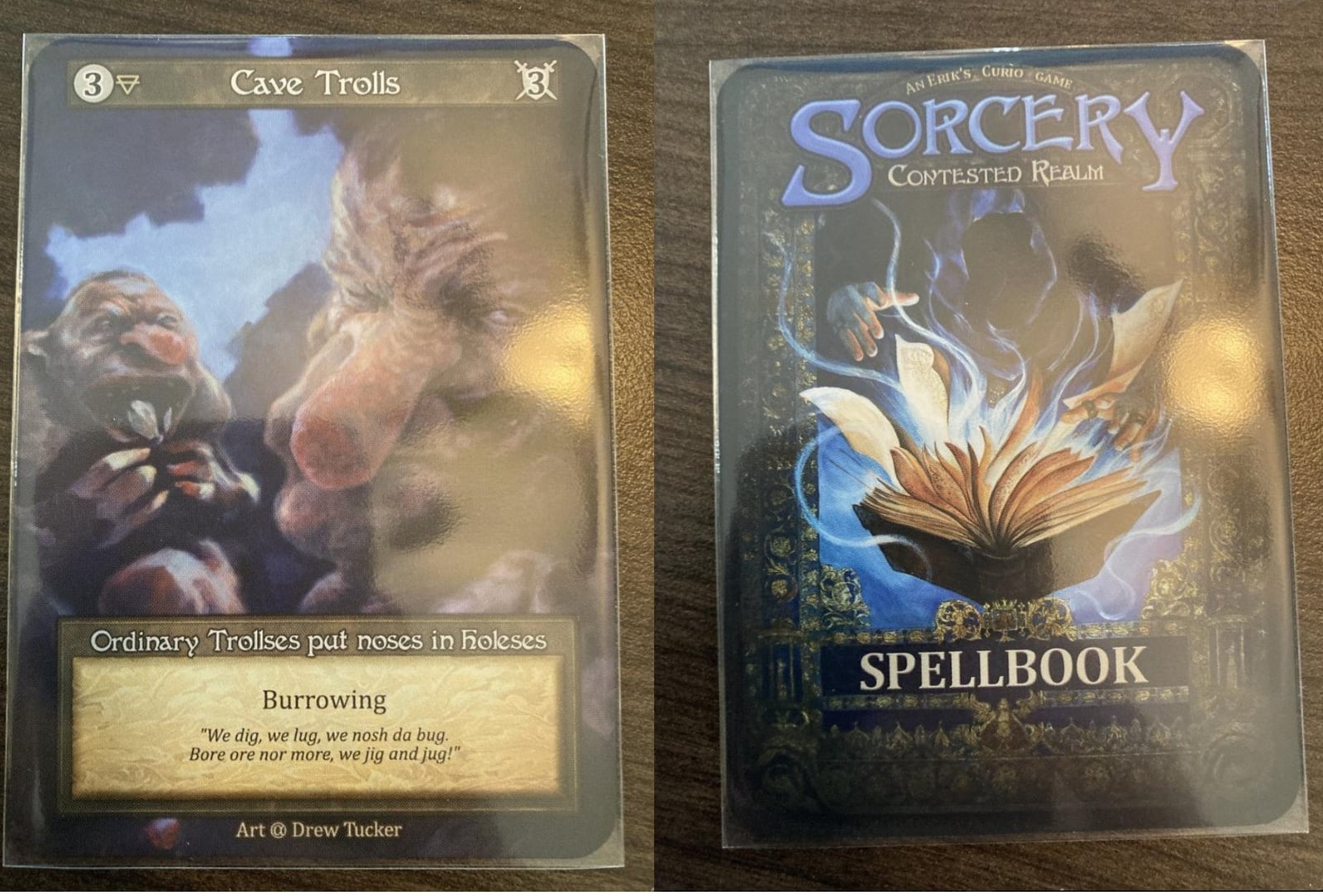
Cave Trolls by Drew Tucker — via Collector Arthouse
Ordinaries are the workhorses. The card pool at this tier is the largest in any given set (eleven Ordinary slots per pack means a large print run), and the cards are typically designed as efficient role-players — vanilla beaters, cheap removal, low-cost utility creatures, basic-resource sites.
Cave Trolls is a representative example. The descriptor on the card face — "An Ordinary Troll of gentle disposition" — names the rarity directly, which is one of Sorcery's better small design choices: every card's flavor text or descriptor tells you what tier you're holding, no symbol-reading required. Cave Trolls comes in at 3 mana, has the Burrowing keyword for off-surface mobility, and exists to fill the 2-drop curve slot in Earth-leaning decks. There are dozens of cards like it across the sets — none individually flashy, all collectively load-bearing.
You can run four of an Ordinary in a single deck. That's the maximum copy count in any rarity tier, and it exists because the deck-construction expectation is that you want four of your Ordinary engine pieces. Restricting them would cripple deckbuilding. Most competitive lists in Constructed run 30-40 Ordinaries in their 60+ Spellbook, with the Exceptional and Elite slots reserved for archetype glue and centerpieces.
This is also the tier the community-built Peasant format is built on — but that's a section unto itself further down.
Exceptional cards (3 copies allowed)
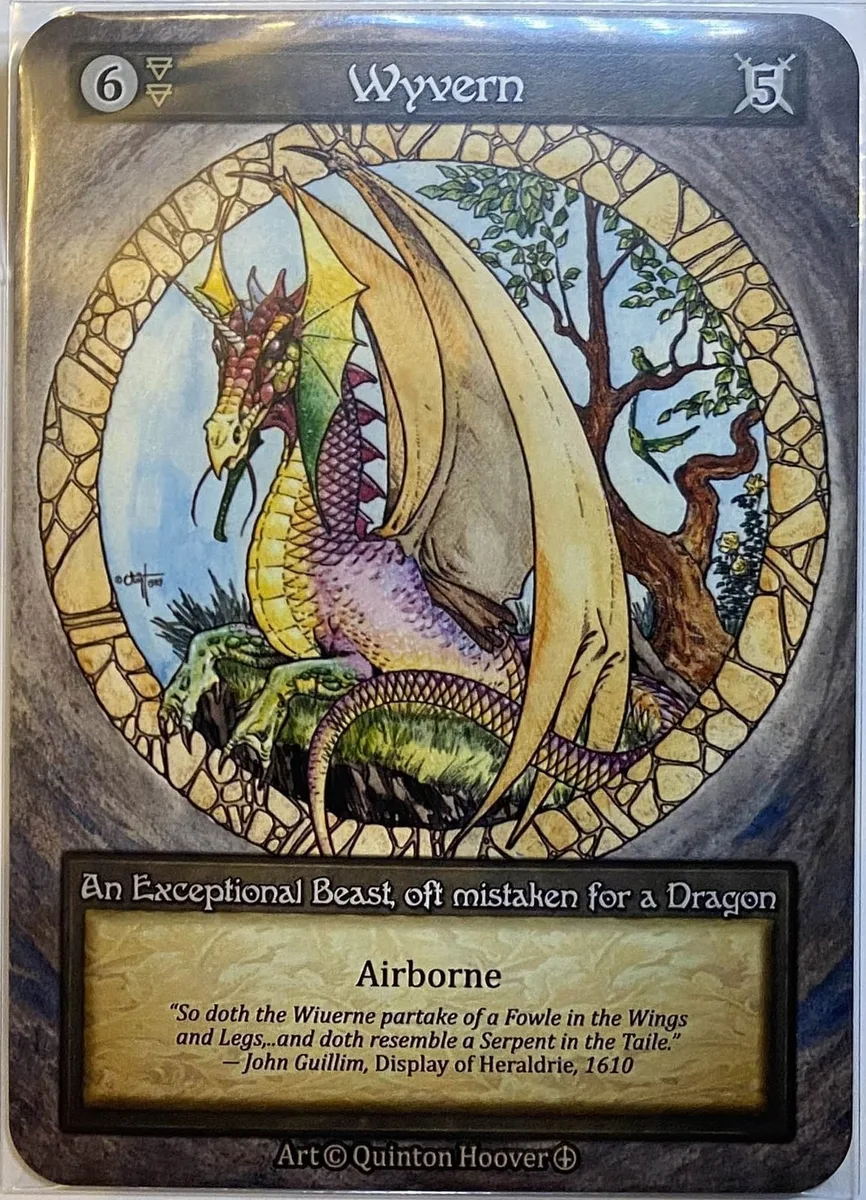
Wyvern by Quinton Hoover — via Collector Arthouse
Exceptionals occupy the design middle. Three copies allowed, three per pack, and a card pool that's smaller than Ordinary but still wide enough that most archetypes get their pick of role-defining tools at this tier.
Wyvern is a good example. The card descriptor names the tier — "An Exceptional Beast oft mistaken for a Dragon" — and the card itself does work that's worth a 3-of slot but isn't quite an Elite-tier splash. It comes in at 6 mana, has Airborne (the keyword that lets it fly across the board to dodge ground-based blockers), and slots into Earth/Water-leaning Beast tribal lists.
The 3-copy cap matters because it produces a different deckbuilding pressure than 4-of. Three-of cards are the slots where you're committing to an archetype without going all-in. You're saying: I want to see this card most games, but it's not the engine. Cutting from 3 to 2 changes the consistency math meaningfully, which is part of why Exceptional staples have a stable secondary-market value — they're cards every deck in their archetype wants, and they're capped just tightly enough that scarcity bites.
The other thing Exceptionals do is define the format's color identities. The Beta elemental precons each lean heavily on their element's Exceptional pool — Avatar of Fire's deck identity is closer to its Exceptional aggressive minions than to its Ordinary chip-damage spells, for example. (Every Sorcery Avatar Explained breaks the elemental lines down further.) Rarity tier also shapes secondary-market pricing — Exceptional staples hold value because every archetype wants them at near-max copies.
Elite cards (2 copies allowed)
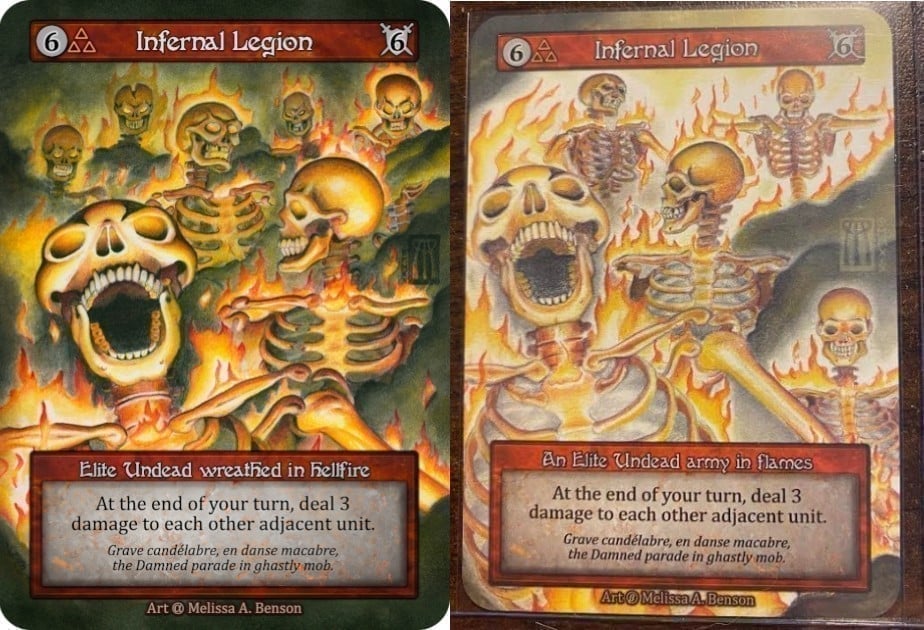
Infernal Legion by Melissa A. Benson — via Collector Arthouse
Elites are where the splashy effects live. Two-copy cap, one Elite-or-Unique slot per pack, and a card pool that tilts toward "deck centerpiece" candidates — board wipes, must-answer threats, finishers, lock pieces.
Infernal Legion is a clean Elite example. Descriptor: "An Elite Undead army in flames." At 6 mana the card deals 3 damage to every adjacent unit at end of turn — a board-shaping threat that punishes the opponent for clustering minions, and a finisher that closes games when their Avatar is below 6 life and within range. Most Fire-and-Earth decks that have a 2-of slot open spend it here.
The 2-copy cap is the tier where deckbuilding gets real. Three-of cards smooth out variance; two-of cards are choices. Every Elite slot in your deck is a deliberate "I want this in my opening hand often, but a singleton would be too risky and a 3-of would crowd out other Elites." A 60-card Spellbook can probably afford 8-12 Elites in total — six Elites at 2-of each, plus some 1-of Uniques. That math is part of what makes the format's deck-construction puzzle interesting.
Elites are also where Sorcery's secondary market gets serious. The Collector Arthouse "Best Cards" piece tracks current staples, and most of the four-figure Elite prices belong to Alpha printings — those exist in low numbers because the set never had a retail print run. Newer-set Elites trade in the tens, not hundreds.
Unique cards (1 copy allowed)
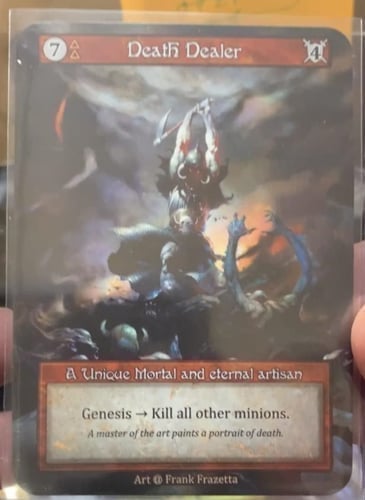
Death Dealer by Frank Frazetta — via Collector Arthouse
Uniques are the rarity-tier equivalent of Magic's legendary creatures — one copy per deck, by hard cap. The card pool at this tier is small. Each set ships a handful of Uniques, and they're the cards that anchor deck identities.
Death Dealer is the classic Alpha Unique. The descriptor — "A Unique Mortal and eternal artisan" — and the rules text — "Genesis → Kill all other minions" — make the card a pure board-clear effect, hard to answer once it lands. Seven mana with a Genesis trigger means you only get one shot at it per game; the singleton restriction makes Uniques a 0-or-1 design space that the publisher uses for the splashiest possible effects.
Mechanically the 1-copy cap is what enables Sorcery's design to push hard on Uniques. If you could run four Death Dealers, the card breaks the game. At one copy, it's a deliberate "I draw this once per match, maybe" splash that earns its slot through scarcity, not consistency. Most Constructed lists run 4-8 Uniques across their 60-card Spellbook, picked carefully — too many Uniques and you lose the redundancy that wins long games.
One important clarification: Uniques are not the same as Curio cards. Uniques are a rarity tier inside the standard pull system — every Sorcery set has a defined Unique pool, and any player can run any Unique they own at the 1-copy cap. Curios are alternate-art or pre-production variants slipped into the Ordinary slot of boosters at a community-estimated rate of roughly one per fifty boxes, sit outside the rarity-tier system entirely, and trade in collector circles for prices the rarity-tier Uniques generally don't approach. They're separate concepts that share a vibe and get conflated. The Art House & Collectors directory section is the right starting point if you're chasing Curios specifically.
Peasant format ≠ MTG Pauper
This is the section MTG players need most.
In Magic, Pauper is a community-built format that allows only cards printed at common rarity. The community sometimes builds Peasant as a slightly broader variant, allowing commons plus a small number of uncommons. Both formats exist on the budget end of the rarity ladder.
Sorcery's community Peasant format is structurally different. The community variant — also sometimes called "Poorcery" in playgroup conversations — restricts decks to Ordinary and Exceptional cards only. Elite and Unique are excluded. That's the opposite of MTG Pauper's "commons only" framing; it's much closer to "all the tiers except the rares and mythics."
Three notes on Peasant in Sorcery:
It's a community format, not officially sanctioned. The publisher doesn't list Peasant on the official formats page, doesn't print Peasant-specific products, and doesn't sanction Peasant events. It's a playgroup-driven variant, the way Cube Draft or kitchen-table multiplayer is. (Every Sorcery Format Explained walks through the publisher-sanctioned formats specifically.)
The card pool is larger than you'd expect. Because the Ordinary slot is eleven per pack, the Ordinary card pool is by far the largest tier in the game — probably 60-70% of the total card pool by raw card count, depending on the set. Combine that with Exceptionals (another 20%) and Peasant decks have access to roughly 80-85% of the printed cards. That's not pauper-style scarcity; it's "play most of the format, just leave the splashy chase rares at home."
Strategic implication: Peasant rewards consistency, not bombs. Without Elites and Uniques, no deck can lean on a splashy 2-of board wipe or a 1-of finisher. The format flattens variance: games are decided by sequencing, threshold curves, and trade math rather than by who topdecks their Elite first. That's why budget-leaning playgroups gravitate to Peasant — the format makes the financial floor close to the financial ceiling.
The MTG Pauper analogue exists in Sorcery, but it's a separate playgroup variant — sometimes called "Ordinary-only" — and is much less common than Peasant. Most Sorcery community references that say "Peasant" mean Ordinary + Exceptional, not Ordinary only.
Why this system makes budget decks competitive
The 4/3/2/1 cap math is the part of Sorcery's design most newcomers underestimate.
In an unrestricted format (no copy limits by rarity), competitive decks tend to converge on the strongest 8-12 cards in the format, run four of each, and pad the rest with the next-best 20 cards. That's the optimization-equilibrium pattern that drives MTG Standard prices — chase rares cost what they do because every competitive deck wants four copies.
Sorcery's rarity cap flips that equilibrium. The strongest Unique in the game cannot appear more than once in any deck. The two strongest Elites give you four total Elite copies across your deck. Your 8th-12th best Ordinaries fill the rest of the slots because the rarity ladder forces you to spread out.
Two consequences:
The marginal cost of a competitive deck stays bounded. You cannot brute-force a winning list by spending more on the same Elite four times — you can only own two of any given Elite, and one of any given Unique. The financial ceiling on building a tournament-viable deck is structurally lower than in unrestricted-rarity formats.
Ordinaries do real work. Because the Ordinary slot fills 30-40% of every deck, and because four-ofs are allowed at that tier, the quality of your Ordinary lineup determines the floor of how often your deck does what it's supposed to. Cheap, abundant, widely-available cards win games. The Eternal Durdles rarity-and-budget piece makes the structural argument in detail — budget builders aren't competitive despite the rarity caps; they're competitive because of them.
This is the editorial part: a small number of well-chosen Ordinaries plus a tight Exceptional core beats a deck that's tried to cram in too many singletons of every Elite in the format. The rarity ladder rewards focus, and focus is free.
Where rarity meets pack-buying decisions
If you're at the buy-in stage, the rarity distribution should shape how you spend. A booster box yields 396 Ordinaries, 108 Exceptionals, and 36 Elite-or-Unique cards (with a community-estimated 5-6 of those being Unique). The Ordinary and Exceptional pools fill out fast — a single box usually gets you 4-ofs of most Ordinaries and 2-3-ofs of most Exceptionals in the set.
The Elite-or-Unique slot is the chase. Buying boxes targets that slot — every 36 packs yields roughly 30 Elite copies and 6 Unique copies on average. Buying singles targets specific cards. The math leans heavily toward singles for anyone trying to build a specific deck, and toward sealed product for anyone collecting the set or drafting it.
The Is Sorcery Worth It in 2026 piece walks through the buy-in numbers and points at the Where to Buy stores section of the directory for vendors.
Bottom line
Four tiers. Four copy limits. One rarity-shaped distribution per pack. Peasant is a community format excluding Elite and Unique (not MTG Pauper — that confusion is the most common one for crossover players). The system rewards Ordinary mastery over Unique chasing, which is why the financial ceiling on a tournament-viable list stays close to the floor.
If you build with the rarity system in mind — anchor on Ordinaries, role-define with Exceptionals, splash with Elites, anchor with one or two Uniques — you'll build cleanly. If you try to brute-force a deck by running every Elite you can find, the copy-cap math will fight you.
Where to go from here
- Sorcery Threshold and Sites, Explained — how the Atlas works and why Sites aren't ranked by the same rarity ladder
- Every Sorcery Format, Explained — the publisher's sanctioned formats vs the community variants
- Curio Cards in Sorcery, Explained — the chase pulls that sit outside the rarity tier system
- Curiosa.io, the Official Deckbuilder, Explained — filter the card library by rarity to browse each tier
- Sorcery vs Magic: The Gathering, Explained — broader context for the rarity-and-format comparison
- Is Sorcery Worth It in 2026? — the buy-in math by rarity tier
Sources
- Sorcery TCG Constructed format — official copy limits: 4 Ordinary, 3 Exceptional, 2 Elite, 1 Unique
- Sorcery TCG Gothic set page — official booster composition: 11 Ordinary, 3 Exceptional, 1 Elite or Unique per 15-card pack
- Sorcery TCG Draft format — Limited formats waive copy limits (drafted card pools play as-drafted)
- Eternal Durdles — Anatomy of a Booster Pack — community pack-distribution analysis
- Eternal Durdles — Rarity System and Budget Decks — budget viability argument from community analysis
- Collector Arthouse — Best Cards Currently in Sorcery — current Elite and Unique staples by archetype
- Curiosa.io card library — filter by rarity to browse each tier's card pool