The honest version of this question gets asked the wrong way. People ask "is Sorcery worth it?" hoping for a yes-or-no — usually wanting a yes — and the answer that does anyone real good is "it depends, very specifically, on you."
There are players for whom Sorcery in 2026 is the best card game in print. There are players who'd hate it for entirely legitimate reasons. The mistake is buying a precon and a TTS subscription, finding out which side you land on three months in, and resenting either yourself or the game for the misdiagnosis.
This piece walks through what Sorcery actually is right now — what's strong, what's worrying, who should jump in this year, who should wait or pass — with sources for every factual claim because the answer matters and the cost of getting it wrong is real money and real time.
What Sorcery actually is in 2026
Three years past the original Kickstarter, the picture is concrete. Five sets are in print: Alpha (May 2023, Kickstarter-exclusive, 403 cards), Beta (October 2023, retail re-release of Alpha with a new frame, 402 cards), Arthurian Legends (October 2024, 220 cards, the first standalone expansion), Dragonlord (2025, a 13-card dragon mini-set), and Gothic (December 2025, 440 cards, the largest single release to date). Roughly 1,000 unique cards across the corpus. Nothing has ever rotated. Every card printed since Alpha is still legal in Constructed.
The 2026 organized play structure is also fully in place. The pipeline reads bottom-up as Store Kits → Cornerstone Championships → Grand Contests → Avatar of the Realm. Cornerstone is the local-store tier (first wave allocated May 2026). Grand Contests are the regional capstone tier — the 2026 rebrand of what ran as Crossroads in 2025; same regional-tier function, broader scope, refreshed prize structure. Confirmed 2026 Grand Contest stops include SCG CON Washington DC (May 29), SorceryFest Leeuwarden (July 3–5), Gen Con Indianapolis (July 30–August 2), and a Melbourne event at Plenty of Games. The whole 2026 season culminates in Avatar of the Realm, Sorcery's first world championship — November 13–15 at the Marriott Long Wharf Hotel in Boston.
That last fact is the biggest 2026 datapoint. Sorcery now has a worlds. Three years from Kickstarter to a globally-routed world championship with a fixed venue and dates is a pace most TCGs never match.
Avatar of the Realm announcement art — via sorcerytcg.com
The publisher is still Erik's Curiosa Limited, single founder Erik Olofsson, headquartered in New Zealand, independent — no acquisition, no IP licensing carve-out, no signs of a corporate parent on the horizon. The game it was on Kickstarter is the game it is now, with a roadmap that's mostly been hit on schedule.
What makes Sorcery genuinely different
Five things, and all five are unusual enough to matter when you're deciding whether to buy in.
The grid. Sorcery is played on a 5×4 board — twenty squares, both Avatars start in the bottom middle of their side. Cards aren't abstract permanents in a play zone; they're objects with position. A minion three squares away can't punch your Avatar without traveling. A flyer on the far edge has to land somewhere before it threatens anything. The board state has geometry, and that geometry decides games. No other major TCG works this way.
The two-deck resource model. Every player runs two decks — a 60-card Spellbook of minions, magics, auras, and artifacts, and a 30-card Atlas of sites. Each turn you choose: draw a spell or draw and play a site. The structural consequence is that the mana-screw / mana-flood problem MTG has carried since 1993 simply doesn't exist in Sorcery. There's depth to the choice — what to spend a turn on, how to time site drops — but the variance floor is dramatically higher. (Sorcery vs Magic explainer goes deeper.)
Threshold as a floor, not a cost. The single concept Magic players get wrong most often. Mana is spent each turn and refills from sites; threshold is the permanent elemental affinity floor your sites provide and is never spent. Three Water sites give you 3 Water threshold for the rest of the game, unless the sites are destroyed. Cards check that floor to be castable. (Threshold and Sites explainer.)
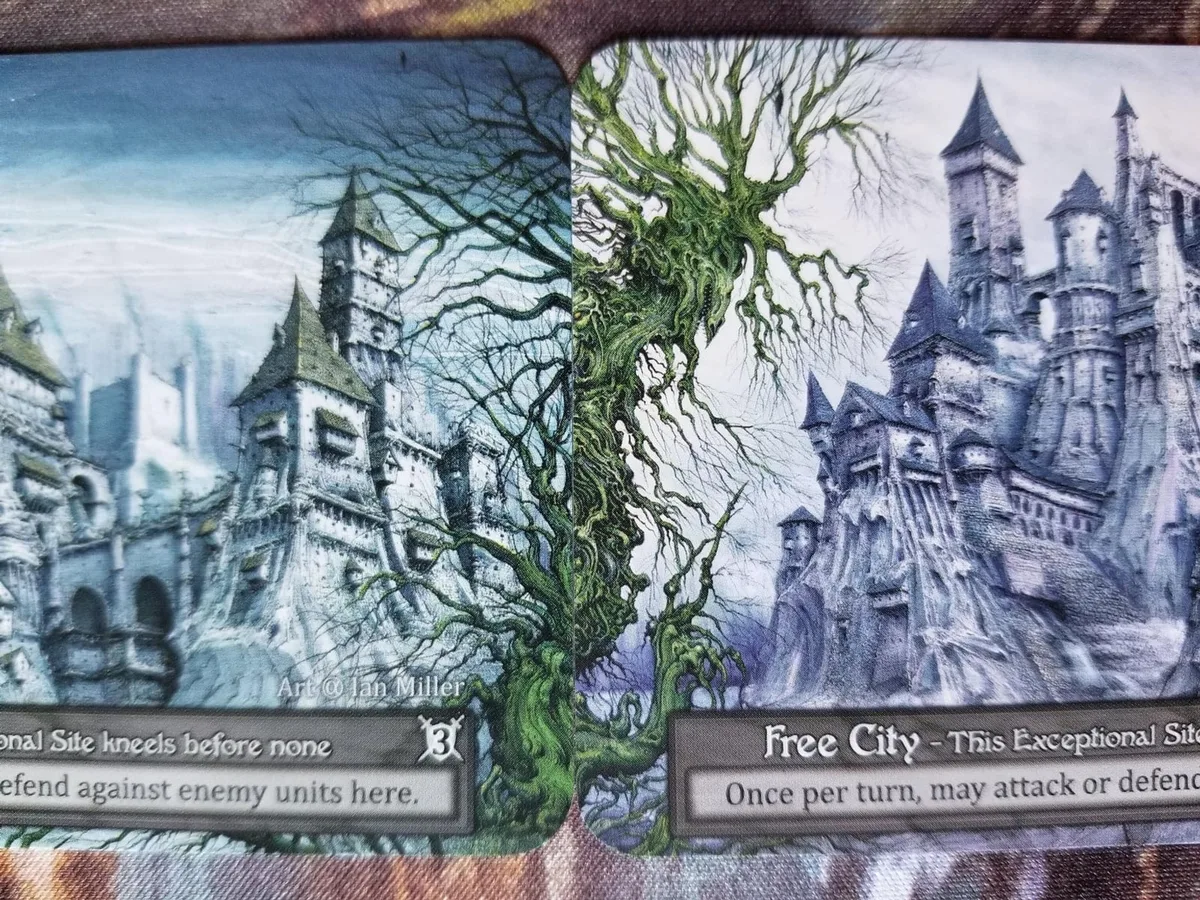
Free City by Ian Miller — via Collector Arthouse
Hand-painted art, no exceptions. Every illustration in the game is hand-painted in physical media — oils, acrylics, watercolours, ink. No digital illustration. No AI. No exceptions. The art roster includes Magic-era veterans (Liz Danforth, Quinton Hoover, Anson Maddocks, Drew Tucker, Melissa Benson, Jeff A. Menges) and contemporary fantasy painters of similar stature (Frank Frazetta foil promos, Rodney Matthews, Ian Miller, Dan Seagrave, Gerald Brom). The aesthetic isn't a marketing line — it's the explicit production constraint the publisher has held to across 1,000 cards and counting.
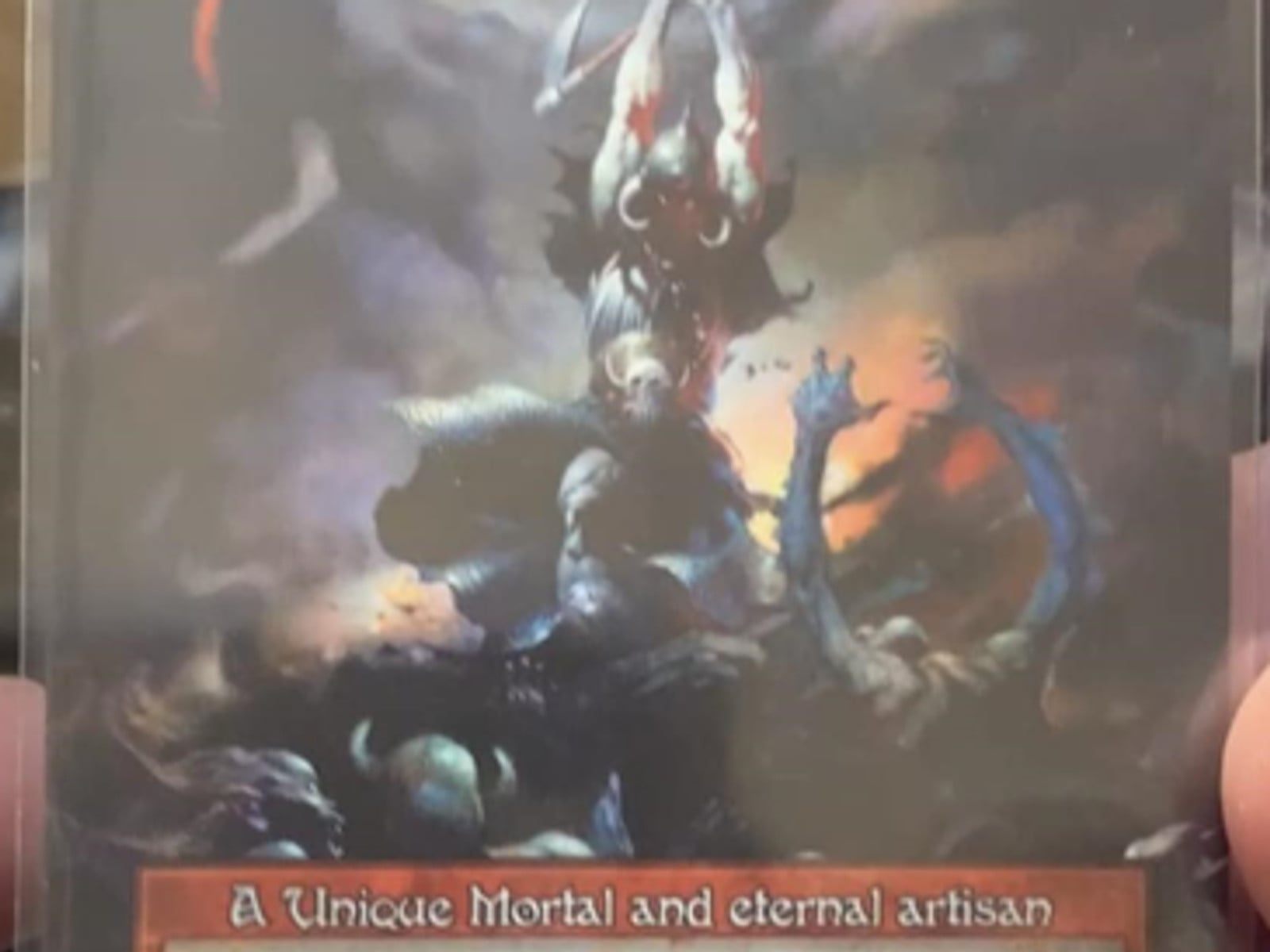
Death Dealer by Frank Frazetta — via Collector Arthouse
No rotation, no digital, no IP crossover. Every card printed since Alpha is legal forever. There is no MTG Arena equivalent — online play is the official Tabletop Simulator mod plus a community-run Sorcery League Discord. There are no Universes Beyond crossovers — no Lord of the Rings cards, no Final Fantasy cards, no Marvel. The IP is the IP.
That bundle is the actual differentiation. Each individual choice has tradeoffs, which the rest of this article walks through.
What's actually strong about the game
The art holds up. Three years and a thousand cards in, the painted-art commitment hasn't softened. TechRaptor's review calls the hand-painted artwork "legitimately gorgeous and distinctive, giving the game an old-school fantasy vibe that stands out among competitors." If you set a Sorcery card next to a contemporary MTG card on a table, the difference is the kind people notice before they know what they're looking at.
The design has depth. The 34 playable Avatars across the five sets cover an unusually wide design range — pure aggro, lockdown control, recursion, tribal, transforming flip-cards (the Arthurian-era Druid is the only one in the game), site-disruption, all-spells, and so on. The Bardsword "Month into Gothic" report covering SCG CON Atlanta noted 16 distinct Avatars in the Top 17 of one of the first major Gothic-era events — Interrogator was the only duplicate. The format is diverse, not solved. (Every Avatar Explained walks through the full roster.)
Sealed product is hitting on time and at scale. Gothic shipped on December 5, 2025 — 440 cards, 36-pack boxes (up from Arthurian's 24-pack format), four preconstructed Prophets of Doom decks with alternate-art Dan Seagrave Avatars. The set was the biggest single drop in the game's history and landed on schedule. Arthurian Legends previously ranked 7th on TCGplayer's October 2024 Top 25 Sealed TCG Products list, and was nominated for a 2025 GAMA Origins Award. The publisher is moving real product in real volume.
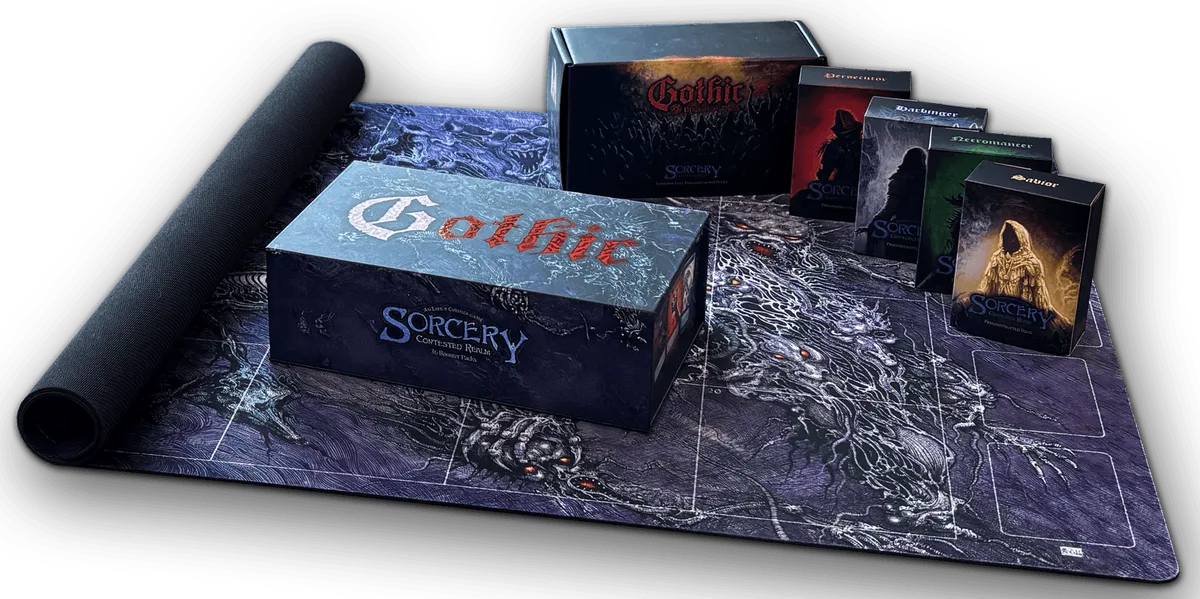
Gothic family product lineup — via sorcerytcg.com
The OP scene is mature for its age. Three years from Kickstarter to a worlds event with a routed regional qualifying pipeline is fast. The Star City Games partnership announced in July 2025 added the regional championship tier — Crossroads at the time, rebranded to Grand Contest for 2026 — at SCG CON Houston, Baltimore, and Las Vegas, with City of Glass alternate-art prize cards by Adam Burke. The community-run Sorcery League TTS Discord is on its 10th season, with global 24/7 matchmaking, a Discord-bot pairing system, and seven-week regular seasons plus playoffs. SorceryCon hit Indianapolis in February 2026 for four days; SorceryFest brings the European Grand Contest to Leeuwarden in July.
Secondary-market interest is real. This cuts both ways (covered next), but the surface-level signal is unambiguous: Alpha booster boxes have been nearing $1,000 on TCGPlayer and eBay, individual Alpha cards command premium prices, and the entire Curio Card community archive at Collector Arthouse — 67+ catalogued chase variants across the five sets — exists because there's enough collector demand to sustain serious documentation work. The community is large and serious enough that an unofficial chase-card catalogue is the de-facto authoritative reference. (Curio Cards explainer goes deep on this.)
What's worrying or where the game falls short
This is the section honest reviews skip. Here it is.
The player base is small compared to the big TCGs. Sorcery is not Magic. It's not Lorcana, it's not Pokémon, it's not Yu-Gi-Oh. The community is real and growing, but it's measured in tens of thousands of active players globally, not millions. The practical consequence shows up at local game stores: r/SorceryTCG threads in May 2026 include a player saying "the nearest store in the Sorcery locator is a 40 minute drive and it doesn't seem they have any" — and another asking "Is Sorcery a Players IP or Collectors? It's performing a lot like Pokemon as the latter — there are zero plays in my area." Neither thread is an outlier. The honest framing: outside major metros and a few enthusiast clusters, you may not have a local play group, and may have to commit to TTS or driving. (How to play online covers the TTS path.)
Secondary-market premiums on key cards are punishing. The collector-grade Alpha cards trade in the four figures. Erik's Curiosa (the Alpha-exclusive eponym card) is around $300 non-foil and nearly $7,000 in foil (current secondary-market pricing). Alpha Avatar foils are $100+. Sealed Alpha boxes have nudged $1,000. Beta — the retail version of the same cards — is much more reasonable, but if you're chasing playsets of specific cards or specific Avatars in foil, the math gets serious fast. You can play Sorcery cheaply. You cannot collect Sorcery cheaply.
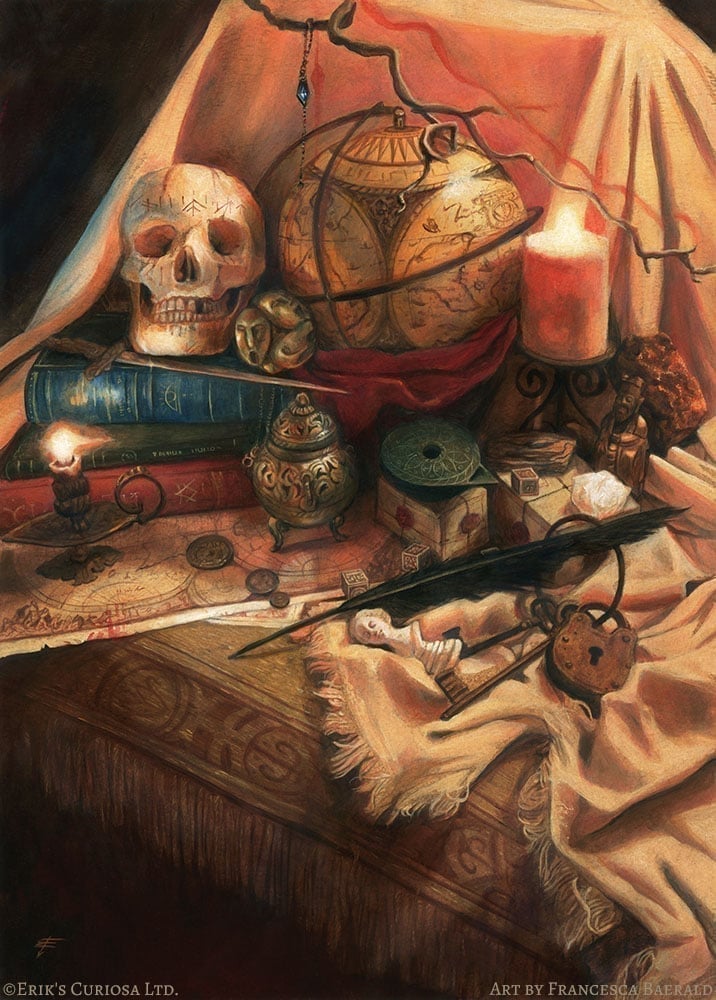
Erik's Curiosa by Francesca Baerald — via Collector Arthouse
Print runs are constrained, and regional availability is uneven. The Alpha Kickstarter shipped roughly 29,000 booster boxes and 7,000 precons — print-to-demand for backers, with no retail second pressing. Beta and later sets are open-print, but distribution is concentrated in North America, Europe, Oceania, and selected Asia-Pacific markets. If you're in a region without active distribution, importing is an option but freight and customs eat into the value proposition fast.
There is no native digital client. Online play happens through the official Tabletop Simulator mod (Steam Workshop ID 2884846136) — TTS itself is $19.99 one-time, frequently $9.99 in seasonal sales. The mod is well-maintained and the Sorcery League Discord matchmaking works, but the experience is closer to MTGO 2003 than to MTG Arena 2025: physical fidelity, no rules-engine automation, voice chat via Steam or Discord. You enforce your own threshold counts, your own mana, your own combat math. If you came from Arena hoping for a frictionless digital queue, this is the single biggest gap.
The learning curve is non-trivial. Reviewers consistently flag Sorcery as sitting in "medium-heavy" complexity territory — the grid, the two-deck resource model, the threshold-as-floor concept, and the sites-as-permanents-with-position interactions stack into a system that takes several full games to internalize. The 2024 rulebook is comprehensive but dense. The format is also actively being clarified — minor rules questions still get adjudicated by community FAQ and judge rulings, with Eternal Durdles and other community sources tracking edge cases (the Magician avatar's interaction with the no-Atlas rule was a recent example). The cadence is healthy but it means new players occasionally hit a "wait, what?" moment.
Sorcery is strictly two-player. No Commander equivalent, no multiplayer politics, no four-player free-for-all in the official rules. There is a community-modded 4-player TTS variant (Workshop ID 3166403381), but the base game is duels-only. If your primary card-game social ritual is a Commander pod, Sorcery doesn't replace it.
Who Sorcery is for
The specific player profiles that match the game's strengths most cleanly:
The lapsed MTG player burned out on the corporate cycle. Sorcery is the game for someone who loved 1990s/early-2000s MTG, hates rotation, hates Universes Beyond, hates the Standard-as-treadmill model, and wants a small, knowable, slow-growing card pool with hand-painted art. The Garfield-era talent on Sorcery's roster — Liz Danforth, Anson Maddocks, Quinton Hoover, Drew Tucker, Melissa Benson, Jeff A. Menges — exists for this exact audience. (Sorcery vs Magic explainer.)
The board gamer who wants TCG depth without the bloat. If positional games (Hearthstone Battlegrounds, BFG / Wesnoth-style spatial play, Summoner Wars) scratch an itch, the Sorcery grid is the highest-quality version of that itch in a TCG framing. The board state is a real second axis to think on.
The art collector. Sorcery is the only major TCG in 2026 with a zero-AI, zero-digital, hand-painted-only commitment across the entire card pool. If you'd own Frazetta originals if you could, owning the foil Sorcerer or Witch Frazetta promos is the closest a $300 card gets you to that.
The competitive player who likes diverse, unsolved metas. 16 distinct Avatars in a top 17 is the kind of format diversity that means deck-building skill and matchup-reading both still matter. You're not picking from a five-deck tier list.
The player with a play group already. The single biggest predictor of whether someone sticks with Sorcery is having one or two regular opponents in the first month. If you have a friend who'll play with you, this is the strongest possible "buy" signal. A Beta Preconstructed four-pack box runs $40 MSRP (often $150–200 from retailers given the limited print), TTS is $19.99, and you're playing legit games inside an hour.
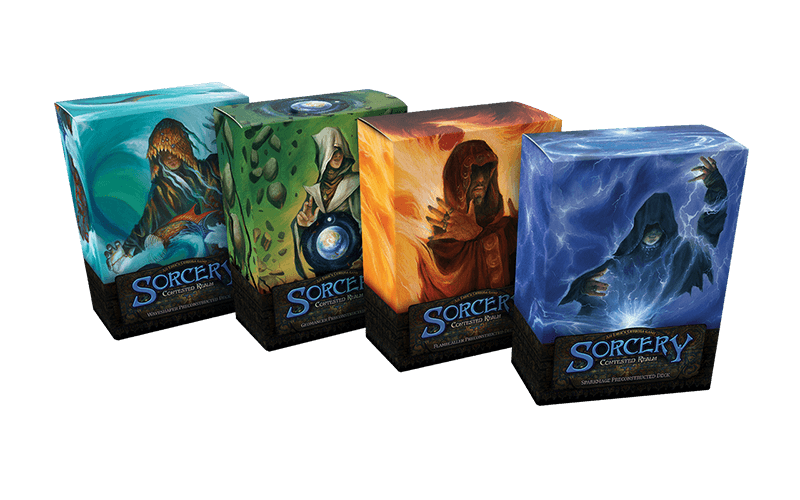
Sorcery Beta Preconstructed four-pack — via sorcerytcg.com
The collector with patience. Sorcery's secondary market is real but the chase-card scene is still maturing. If you enjoy the hunt — Curio cards, alternate-art promos, Frazetta foils, the Collector Arthouse catalogue work — there's a deep rabbit hole to fall into here that's nowhere near saturated.
Who should wait or pass
Equally specific:
You want a giant tournament scene like MTG's. Sorcery's competitive scene is real and the OP pipeline is mature, but events run in the hundreds, not thousands. If your model for "thriving TCG" is a 5,000-player Pro Tour, Sorcery isn't that yet and may never be that. Avatar of the Realm 2026 is the first world championship at any scale, and the venue choice (a hotel ballroom, not an arena) is honest about the expected size.
You don't have a local play group, and aren't willing to use TTS. This is the single hardest filter. If you don't have at least one regular opponent in physical reach, and you're not willing to learn Tabletop Simulator and use the community Discord matchmaking, you're going to bounce off the game within a month no matter how good it is. The cards alone won't keep you engaged.
You want a free, polished digital client. MTG Arena is free, beautiful, and runs on your phone. Sorcery has TTS, which is $19.99 and looks like 2014. Both are fine choices. They're answers to different questions.
You play Commander as your primary social ritual. Sorcery is two-player only. The 4-player community mod exists but isn't the supported product. If you want a four-person table with a chaotic political layer, Sorcery doesn't have that experience.
You're price-sensitive about secondary markets. Sorcery's collector chase is real and the prices are real. A Beta precon plays great, but the moment you start chasing playsets of specific Elites or Uniques, or you decide you want a foil Sorcerer Frazetta promo, the math diverges sharply from a casual MTG Standard collection.
You want a settled, finalized rules engine. Sorcery's rules are mostly clear but the format is young and edge cases still surface through community FAQ and judge adjudication. If you need every rules interaction to be Oracle-text canonical with a digital rules engine to enforce it, Sorcery's manual play model will frustrate you.
The bottom line
For the right player, Sorcery in 2026 is the strongest card game purchase available — a complete, growing, independently-published TCG with a hand-painted art commitment unmatched in the category, a mature design system, a routed competitive pipeline ending in a world championship in Boston this November, and a non-rotating card pool you'll still be playing in 2030.
For the wrong player, it'll feel small, expensive in unfamiliar ways, and frustrating to play online. Both takes are correct for the people they apply to.
The cleanest test: buy a Beta precon, install TTS, and play three full games inside two weeks. The Beta Preconstructed four-pack box is $40 MSRP (more like $150–200 from retailers given the limited print), TTS is $19.99 (or $9.99 on sale), and the Sorcery League Discord will pair you with opponents inside an hour. One Saturday afternoon decides it. If the grid clicks and the deck-building puzzle scratches the itch, you have your answer. If it doesn't, the Beta precon resells (the secondary-market floor on these has held), the TTS purchase keeps working for every other tabletop game in the catalogue, and you spent less than dinner-and-a-movie finding out.
The honest case against waiting is that the OP year is now. Cornerstone, Grand Contests, and Avatar of the Realm are all happening in 2026. If you want the world-championship-year experience — playing alongside the scene's first global capstone — this is the year to be in it, not next.
The honest case for waiting is that the next set hasn't been announced. If you're the kind of buyer who'd rather start with the freshest release, watching for the post-Gothic announcement and using the wait to learn the game on TTS is also reasonable.
Both answers are correct. The one that's not correct is "buy now without checking which kind of player you are." That's the version of this question that wastes money. Don't be that buyer.
Where to go from here
- Sorcery vs Magic: The Gathering, Explained — the long-form comparison if you're MTG-curious
- Every Sorcery Avatar, Explained — the full 34-Avatar roster, by skill and archetype
- Every Sorcery Set, Explained — Alpha through Gothic, what each added
- How to Play Sorcery Online, Explained — TTS setup, deck import, finding opponents
- Sorcery Threshold and Sites, Explained — the resource model walkthrough
- Curio Cards Explained — if the collector angle is what's pulling you in
Sources
- Organized Play overview — sorcerytcg.com — full 2026 pipeline: Cornerstone, Grand Contests, Avatar of the Realm
- 2026 Grand Contests — sorcerytcg.com — Grand Contest dates, prize structure, hero image source
- Sorcery: Contested Realm Coming To SCG CON Events — Star City Games — July 2025 SCG partnership, Crossroads at SCG CON Houston/Baltimore/Las Vegas
- Gothic set page — sorcerytcg.com — 440 cards, 36-pack boxes, December 5, 2025 release, Prophets of Doom precon details
- Sorcery League TTS Season 10 — sorcerytcg.com — Season 10, seven-week regular season, Discord-bot matchmaking, participation rewards
- Bardsword — A Month into Gothic — SCG Atlanta Top 17 with 16 distinct Avatars, Interrogator and Archimago meta context
- Sorcery: Contested Realm — Wikipedia — Kickstarter NZ$5.78 million from 6,456 backers, set release dates, GAMA Origins nomination
- Sorcery TCG: Alpha vs. Beta — Collector Arthouse — Alpha 29,000 boxes / 7,000 precons print run, Erik's Curiosa $300 / ~$7,000 foil, Alpha box near $1,000
- Sorcery: Contested Realm Review — TechRaptor — the "legitimately gorgeous and distinctive" art quote and "medium-heavy" complexity rating
- Collector Arthouse Curio Cards archive — 67+ catalogued chase variants across five sets
- Sorcery: Contested Realm Beta Booster Box — Prince Distribution — Beta MSRP $200, 36-pack contents
- Steam Workshop — Sorcery: Contested Realm — official TTS mod, Workshop ID 2884846136