If you're sorting through Sorcery's card pool for the first time, the type system is mercifully small. The rulebook splits the game's cards into three categories — Avatars, sites, and spells — and the spells split into exactly four types: minions, magics, auras, and artifacts. Those four Sorcery spell types are your whole Spellbook. Learn what each one does mechanically and the card pool stops being a wall of painted rectangles and starts being a set of tools.
The cleanest way to learn the four types isn't four abstract definitions — it's watching the same job done four different ways. After the definitions, one worked example runs throughout: fire damage as a minion, a magic, an aura, and an artifact, in four real cards. The differences do the teaching.
What counts as a spell (and what doesn't)
From the rulebook, verbatim:
"There are three main categories of cards: Avatars, sites, and spells. Spells further break down into four card types: minion, artifact, aura, and magic."
The boundary matters, because two of the most important cards on the table are not spells:
Your Avatar is not a spell. It starts the game already in play, never sits in a deck or a hand, and is never cast. It's you — and it's your default Spellcaster, the unit doing the casting.
Sites are not spells. Sites live in your Atlas — the second deck every Sorcery player runs — and they're played, not cast, using your Avatar's tap ability. In rules terms, playing a site is an ability activation, the same category of action as moving a minion. The turn structure article draws the line: casting a spell is the only action that counts as a spell being cast; the rest of your turn is abilities.
Which leaves a clean rule of thumb, straight from the rulebook: "Any card in your hand that is not a site is a spell." You cast spells to summon minions, conjure artifacts and auras, and invoke magics — three flavor verbs, one shared casting procedure.
The rules all four types share
Casting a spell works the same way regardless of type:
A Spellcaster must cast it. "To cast a spell from your hand, you need to identify a Spellcaster under your control to cast it. The Spellcaster and its location are by whom and where the spell is being cast." Your Avatar is always a Spellcaster; some minions are too. Position matters: range words like "nearby" and projectile paths measure from the caster's square.
It costs mana, and usually threshold. Spells "often have two requirements to play: a mana cost and an elemental threshold." Mana is spent and refills; threshold is a floor your sites establish and never spend — the threshold and Sites primer unpacks that split.
It happens on your turn. There is no instant speed in Sorcery and no casting on the opponent's turn. Whatever type you're playing, you cast it during your own Main Phase or not at all.
The rest — where the card ends up, how long it stays, what kills it — is the type system.
Minions: spells that become bodies
"Minions are your greatest allies, assisting you with myriad unique abilities in offense and defense."
A minion is a spell that turns into a unit. When the spell resolves, "it summons the minion under your control atop any of your sites, and they remain in the realm until something causes them to leave play." From that point it's a piece on the board: it moves, attacks, defends, intercepts, and activates abilities.
Three mechanical facts define the type:
One number does two jobs. A minion's power rating "reflects how hard they hit in combat. It also describes how much damage they can take before dying." Damage equal to or greater than power kills it — there is no separate toughness stat. A 6-power minion hits for 6 and survives 5. The full math lives in How Combat Works, including the detail that damage on minions clears at the end of every turn.
They arrive drowsy. A minion that entered the realm this turn suffers summoning sickness: it "cannot tap, or be tapped, to pay for costs associated with any ability" until end of turn. Plan a turn ahead.
They stack. "There is no limit to the number of minions that may occupy the same site" — though the rulebook dryly notes it's rarely a good idea.
Fire's version of the type: Ancient Dragon — 7 mana, triple Fire threshold, power 6, "An Elite Dragon of breathtaking majesty." It flies (Airborne), and it taps to "deal 4 damage to each other unit at target location nearby." That's a Fireball-sized burst every turn — stapled to a body the opponent can kill, tie up in combat, or force out of position. Repetition is the upside; vulnerability is the price.
Magics: spells that vanish
"Magics are transient spells that have immediate impact and then dissipate as soon as they resolve."
Magics are the one-shots, and they're structurally unique: "Magics are the only cards in the game that do not enter play when they are cast." A magic does what it says, then goes straight to its owner's cemetery. Nothing remains on the board to attack, dispel, or steal — and since Sorcery has no response window during casting, the only way to answer a magic is before it happens: kill the Spellcaster, or stay out of range.
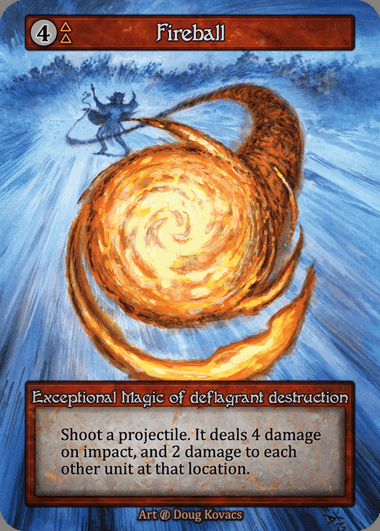
Fireball by Doug Kovacs — via Curiosa
Fire's version: Fireball — 4 mana, double Fire threshold, "Exceptional Magic of deflagrant destruction." The text: "Shoot a projectile. It deals 4 damage on impact, and 2 damage to each other unit at that location." The projectile travels in a straight cardinal line from your caster, and the first unit in its path takes 4 — friend or foe; the rulebook is explicit that projectiles hit whatever they meet first. Then the card is gone. The fastest damage of the four types, and the only one that leaves nothing behind.
Auras: spells that become terrain
"Auras are mostly incorporeal, but lasting, manifestations of elemental power. They usually impact a large area within the realm, conferring boons or conditions within their reach."
An aura is cast like any other spell, but it resolves onto the board itself — at the intersection of four squares, along the border between two, or onto a single square, depending on the card — and it keeps working turn after turn. It doesn't attach to a minion. Units standing in its footprint feel the effect; units that walk in three turns later feel it too. And because auras have no power rating, combat can't touch them — they leave play when a printed duration runs out or when something dispels them.
That's the deliberately short version: auras diverge from other games' enchantments sharply enough that they get a full article of their own — placement geometry, removal, stacking, archetypes. If auras are the type tripping you up, read that next.
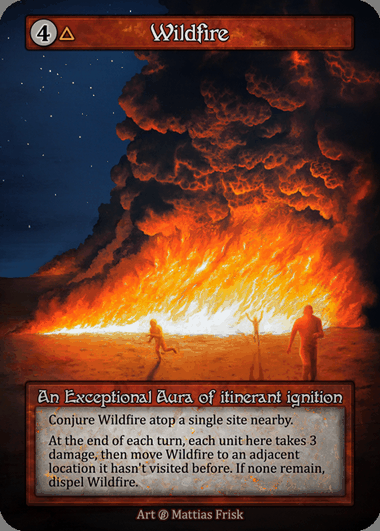
Wildfire by Mattias Frisk — via Curiosa
Fire's version: Wildfire — 4 mana, single Fire threshold, "An Exceptional Aura of itinerant ignition." It conjures atop one nearby site, and at the end of each turn "each unit here takes 3 damage," after which the fire moves to an adjacent location it hasn't visited before, dispelling itself when none remain. Same element as Fireball, a different shape entirely: less damage per hit, but it ticks every turn, hits every unit on its square, and no amount of fighting removes it.
Artifacts: spells that become objects
"Artifacts are various relics, edifices, tools, gear, gadgets, devices, and baubles, often charged with lasting enchantments by wizards of old."
An artifact resolves into a physical object in the realm: "it is conjured into the realm atop any site you control or directly into the waiting hands of one of your units." Objects get carried — "a unit can carry any number of artifacts" — picked up (a once-per-turn basic ability), dropped, and looted by whoever stands where they lie. An unguarded artifact is loose treasure.
Two things set the type apart:
Most artifacts skip the threshold system. The rulebook notes that "unlike other spells, artifacts do not typically require an elemental threshold to play." Mana alone usually pays for them — which makes artifacts the one spell type any deck can borrow from, regardless of element.
They're tools, not actors. The subtypes — "armor, weapons, relics, devices, documents, automatons, or monuments" — describe objects. Most do little or nothing alone; they make the unit carrying them, or the region around them, better at something.
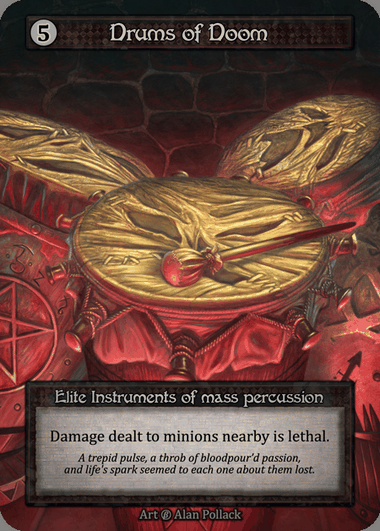
Drums of Doom by Alan Pollack — via Curiosa
Fire's version — and the most instructive of the four: Drums of Doom, 5 mana, no threshold at all, "Elite Instruments of mass percussion." The text: "Damage dealt to minions nearby is lethal." Lethal is a Codex keyword: any amount of damage, one point or more, is enough to kill. The Drums deal no damage themselves. They convert damage — every stray point of fire near the Drums becomes a kill shot. The artifact answer to "how do I burn things?" isn't more fire; it's making the fire you already have count double.
The same fire, four shapes
Side by side:
| Card | Type | Cost | The damage it represents |
|---|---|---|---|
| Fireball | Magic | 4 mana, 2 Fire | 4 damage once, plus 2 splash — then the card is gone |
| Ancient Dragon | Minion | 7 mana, 3 Fire | 4 damage every turn, on a 6-power body that can be attacked |
| Wildfire | Aura | 4 mana, 1 Fire | 3 damage per turn to a roaming location, untouchable by combat |
| Drums of Doom | Artifact | 5 mana, none | 0 damage itself — makes nearby damage to minions lethal |
All four ship together in the Alpha-era Fire preconstructed deck, per the community wiki's deck list, and the design intent is visible: one element, four deliveries. Read the table as a set of trade-offs, because that's what the type system is:
- Magic buys speed. Fireball's damage lands the moment you cast it, no setup, no warning. The cost is that the card works exactly once.
- Minion buys repetition, at risk. Two taps of Ancient Dragon out-throw a Fireball — if the Dragon lives that long. Minions are the only spell type the opponent can answer with ordinary combat.
- Aura buys inevitability. Wildfire is the slowest per turn, but no fight removes it and it doesn't care whose units stand in it. The opponent needs a specific answer or has to play around the footprint.
- Artifact buys leverage. Drums of Doom does nothing on an empty board and multiplies a developed one. Artifacts reward decks that already have a plan — and their threshold-free costs make them splashable into any element.
When you build a Spellbook, this is the practical reason the types matter. The question isn't "is this card good?" — it's "how many one-shots, how many bodies, how many lasting effects, and how many tools does my plan need?" Filtering the pool type by type on Curiosa and the other community deckbuilders is the fastest way to see each bucket; the type filter sits at the top of the card search. If the two-deck, four-type structure still feels like a lot, the curated Start Here resources — rulebook PDF, learn-to-play videos — walk the same ground at beginner pace.
Where to go from here
- The Sorcery Turn Structure — when in the turn you cast all of this, and why there's no instant speed
- Sorcery Threshold and Sites, Explained — the mana-and-threshold system every spell type pays into
- Auras in Sorcery, Explained — the full treatment of the board-as-terrain spell type
- How Combat Works in Sorcery — what happens once your minions are standing in the realm
- What Is Sorcery: Contested Realm? — the wide-angle introduction if you're still deciding whether to learn the game
Sources
- Sorcery TCG official "How to Play" page — rulebook home, accessed 2026-06-06
- Sorcery Companion — Rules — community-formatted full rulebook; verbatim card-type definitions ("three main categories," "Any card in your hand that is not a site is a spell"), casting requirements, summoning sickness, projectile and artifact-carrying rules
- Curiosa.io card data, verified individually: Fireball, Ancient Dragon, Wildfire, Drums of Doom
- Sorcery Companion — Codex: Lethal — keyword definition ("any damage a Lethal unit deals to a minion is enough to kill it")
- Fire Deck (Four Elements) — Sorcery: Contested Realm Wiki — Alpha Fire precon deck list, cross-reference for the four example cards' shared origin