Grand Contests are the regional championship tier of Sorcery: Contested Realm's 2026 organized-play season — weekend-scale gatherings that sit between the local-store Cornerstone Championships and November's Avatar of the Realm in Boston. The tier is new for 2026: it replaces Crossroads, the circuit that crowned Sorcery's regional champions through 2025, and it runs on a model the game hasn't used before — hosting by invitation, entry open to anyone who registers. The season is already underway. The first Grand Contest wrapped at SCG CON Washington, DC over the May 29 weekend, with a 75-player field and a Necromancer taking the title.
What follows is the shape of the tier: where it came from, who runs one and how you get in, the dated 2026 calendar, the Washington results, the prize support, and whether any of this qualifies you for Boston. For the tier below — the store-level championships that feed players into these rooms — the Cornerstone explainer is the companion piece.
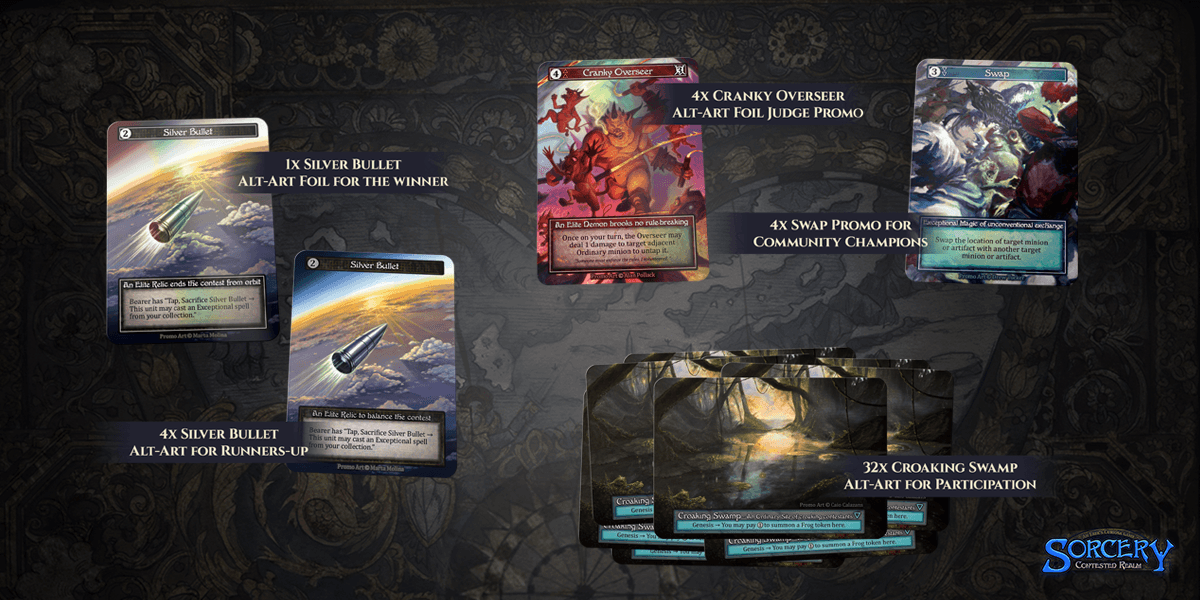
The 2026 Grand Contest kit promo lineup — via sorcerytcg.com
From Crossroads to Grand Contest
Crossroads was 2025's regional layer. The first-ever Crossroads ran at Gen Con 2025 — a sold-out, 128-player event won by Nate "Duo" Smith's Hot Springs Druid — and the circuit then traveled through Germany's Metropole Ruhr region, Australia, and a run of US SCG CON stops before closing in Las Vegas that November.
The April 3, 2026 announcement retired the name. The publisher's wording: Grand Contests are "a new tier in Sorcery Organized Play for 2026, replacing Crossroads," designed to span "several countries or states" per event. The regional function carried over intact; two things changed.
The first is the host model, covered in the next section. The second is the framing. Organized Play 2026 launched under an "expanding circle" philosophy — the publisher states outright that the goal "isn't to filter players through increasingly narrow levels of competition" but to widen who plays. That framing has a verifiable structural consequence: no tier in the published 2026 pipeline gates entry to the tier above it (more on Boston below). The circle's base is real, too: the publisher counts more than 1,800 players across 150 Cornerstone events in 2025.
Where the tier sits: Gothic Store Kit (regular weekly play) → Cornerstone Championship (your store's annual one) → Grand Contest (regional) → Avatar of the Realm (global). A Grand Contest is an organized-play tier, not a format — Constructed is layered on top of it, and Every Sorcery Format, Explained untangles that distinction if it's fuzzy.
Hosting is curated, playing is open
The tier's defining structure is the asymmetry in that heading: a venue can't apply to host one, and a player doesn't qualify into one.
On the organizer side, the publisher is explicit: "These are curated events. Grand Contest status is extended by invitation to select groups with a proven track record of community support." Three host families hold invitations so far. In the United States, Star City Games — every SCG CON in 2026 is a Grand Contest event, beginning with Washington, DC on May 29. In Europe, Trolls of the Realm, the organizers behind SorceryFest in Leeuwarden, which carries the first European Grand Contest; the announcement also name-checks White Rabbit, Aquila Games, and the Sorcerers at the Core, wording that reads like more European invitations are coming. In Asia-Pacific, Plenty of Games in Melbourne — a store that has hosted Sorcery events since the game's 2023 launch window.
On the player side, entry is open registration through whichever group hosts. The publisher's own recap language calls Grand Contests the "highest level of open competition" in Organized Play 2026 — no invite, no points season, no qualifier grind. The gating factors are practical: travel, and the host's registration costs (a convention badge plus event fee at SCG CON and Gen Con; weekend tickets direct from the organizer in Leeuwarden and Melbourne).
The main event is Constructed at every stop announced so far, run as Swiss feeding a Top 8 — Washington ran that structure, and Melbourne publishes the same shape (Swiss Saturday, Top 8 Sunday). Bring the post-Gothic Constructed profile: 60-card Spellbook minimum, 30-card Atlas minimum, and the optional 10-card Collection. The single published exception to the Constructed default: Gen Con hosts two Grand Contests, one Constructed and one Limited — the first non-Constructed Grand Contest main event on the books. Side events orbit the main one at every stop. SorceryFest wraps its contest in Sealed, Draft, an Alpha Draft, and learn-to-play sessions; Gen Con adds Escalation Sealed and Team Sealed.
The 2026 circuit, dated
As of June 6, 2026, every published Grand Contest, drawn from the publisher's announcements and the Sorcery Play Network feed:
- SCG CON Washington, DC — May 29–31. Ran. The season opener; results below.
- SCG CON Las Vegas — late June. The convention opens June 26; the Play Network lists the Grand Contest main event for Saturday, June 27.
- SorceryFest, Leeuwarden, Netherlands — July 3–5. The first European Grand Contest, at Boutique Hotel Catshuis, main event Saturday, July 4. Artists Elwira Pawlikowska and Pedro G. Ferreira are attending.
- Melbourne, Australia — July 25–26. Asia-Pacific's first, at Plenty of Games in the Melbourne CBD, drawing players from Australia, New Zealand, and South-East Asia.
- Gen Con, Indianapolis — July 30–August 2. Two Grand Contests — the Constructed and Limited championships — inside the convention's four-day Sorcery slate.
- SCG CON Dallas (Fort Worth, TX) — September 5.
- SCG CON Baltimore — September 12.
- SCG CON Los Angeles — October 10.
- SCG CON Hartford — October 24.
The four autumn SCG CON stops exist as Play Network listings so far, without dedicated announcement posts. More is expected — the publisher calls the Asia-Pacific program "just getting started" and promises further news — but nothing else is public as of June 6, 2026. The /events page mirrors the Play Network feed daily and is the fastest way to watch new stops appear, and the Play & Compete section of the directory indexes the rest of the organized-play stack around it.
What Washington showed
The publisher's June 1 recap puts hard numbers on the season opener: a 75-player field representing 24 different Avatars, played down through Swiss into a Top 8, with Gideon Miller's Necromancer defeating Brian Snyder's Persecutor in the final. All eight Top 8 decklists are public on Curiosa, linked from the recap.
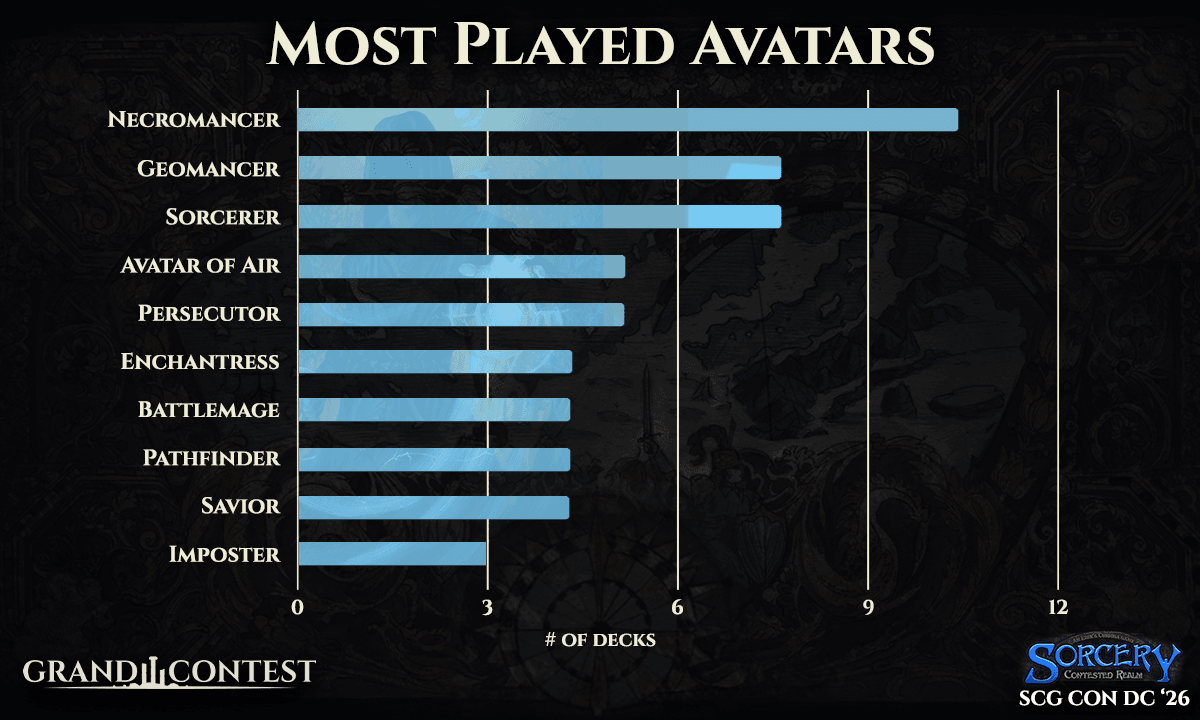
Most-played Avatars across the 75-player Washington, DC field — via sorcerytcg.com
The field data is the part worth studying. Necromancer was the most-played Avatar at ten pilots and converted three of the eight Top 8 slots — consistent with the trajectory the Necromancer survey traces from SCG CON Atlanta through SorceryCon. Geomancer and Sorcerer tied for second-most-played at seven pilots each and converted nothing. Druid appeared exactly twice in the whole field, and one of the two took third place. The lone Archimago in the room finished Top 8. Twenty-four distinct Avatars across 75 players is a genuinely wide field — the recap calls it one of the most diverse the circuit has seen — and it backs up the post-Gothic picture the 2026 meta survey describes: lots of viable Avatars, a clear front-runner, and popularity that doesn't reliably predict conversion.
Two non-results details say a lot about what the tier is for. The judge team awarded the event's discretionary uncut sheet to a community standout, Jeremy Murray, for sportsmanship rather than standings — that's the second print sheet in the prize structure doing exactly what it was designed to do. And artists Scott Kirschner, Bryon Wackwitz, and Margaret Organ-Kean worked the venue all weekend — signings, original paintings, prints. The finals video was slated for the publisher's YouTube channel in the week after the event.
What you play for
The publisher publishes the Grand Contest kit contents, and every promo in it is a hand-painted alternate art:
- Foil Silver Bullet for top finishers, art by Marta Molina, plus four non-foil copies for participants
- Four foil Cranky Overseer judge promos, art by Alan Pollack
- Four foil Swap promos for community champions, art by Drew Tucker
- Thirty-two alternate-art Croaking Swamp participant promos, art by Caio Calazans
Kits scale as the field grows, and hosts decide the exact distribution. Melbourne's published breakdown, for instance, gives foil Silver Bullets to first and second, non-foils to third through eighth, and Gothic boosters through the standings, plus an Alpha Pledge Pack the store had been holding for the occasion.
On top of the kit, every 2026 Grand Contest carries two Gothic print sheets: one for top placement, one awarded at the organizer's discretion for fair play or a standout community moment. That second sheet is prize support for behavior, not match record — and Washington already used it that way.
What the published structure does not include is cash. Nothing in the Grand Contest prizing announced to date is a cash payout — it's promos, print sheets, and product, with hosts free to add to the pool. If prize-pool EV is your deciding factor for a six-hour drive, that's worth knowing before you book anything.
The Boston question
The question every competitive player asks about a regional tier: does a Grand Contest finish qualify you for the world championship?
As of June 6, 2026, the answer is that no qualification requirement has been published at all. Avatar of the Realm — November 13–15 at the Marriott Long Wharf in Boston — opened registration to everyone on May 28, on a badge model with capped attendance. The publisher's framing is "every Sorcerer welcome," with the only gate being that once badges sell out, they're gone. That matches the expanding-circle philosophy the program runs on: the publisher's "road to the Avatar of the Realm" is a season arc, not a points ladder.
So what Grand Contests actually feed Boston is preparation and reputation rather than slots. The Boston main event is Constructed; the Grand Contest circuit is where its field gets tested in public, list by list. Boston's own prize structure: the Constructed Championship winner takes the Avatar of the Realm title; the top-performing pilot of each distinct Avatar with a winning record earns a "Champion of the Realm" title and a Rainbow Foil of that Avatar; the top three take home original hand-painted Tower paintings by Atlas Thorn. If a formal qualification layer ever arrives, it isn't public now — and the badge-sales model suggests 2026, at least, won't have one.
Showing up
Practical close, for anyone eyeing a stop on the list. Registration runs through the host, not the publisher — SCG CON and Gen Con events need the convention's own registration on top of the event fee, while SorceryFest and Melbourne sell weekend tickets directly. Tickets and travel are the whole barrier, so the useful prep is social: the regional Discord servers are where carpools, room splits, and testing pods form ahead of each stop. If you're buying into a list before an event, SCG CON vendor halls carry singles on site, but the stores in the directory are the saner option for anything you want sleeved and tested before the weekend.
For the testing itself: the Washington Top 8 lists are public, the meta survey covers the wider post-Gothic field, and ten Necromancers in a 75-player room is a matchup you should plan for, not a surprise. The circuit has seven published stops left this year. Pick one within reach and play it — open entry is the whole point of the tier.
Sources
- Sorcery TCG — 2026 Grand Contests: Where the Realm Gathers — published 2026-04-03; tier definition, Crossroads replacement, kit contents, curated-host model, SCG CON and SorceryFest designations
- Sorcery TCG — Where Tables Connect: Sorcery Organized Play 2026 — published 2026-03-13; four-tier pipeline, expanding-circle framing, 2025 participation figures
- Sorcery TCG — Where Tables Connected: SCG CON Washington DC Recap — published 2026-06-01; field size, Avatar breakdown, Top 8, winner, community prizing, Las Vegas date
- Sorcery TCG — SorceryFest 2026 – Grand Contest Event — published 2026-04-17; Leeuwarden dates, venue, organizers, prizes, attending artists
- Sorcery TCG — The Grand Contest comes to Melbourne — published 2026-05-01; July 25–26 dates, Swiss/Top 8 structure, host-added prizing
- Sorcery TCG — Gen Con Event Registration Opens This Sunday — published 2026-05-12; two Gen Con Grand Contests, side-event slate
- Sorcery TCG — Avatar of the Realm 2026: The Realm Converges in Boston — published 2026-05-22; badge model, May 28 ticket sales, championship prize structure
- Sorcery TCG — Avatar of the Realm event page — dates and venue, accessed 2026-06-06
- Sorcery TCG — Organized Play — program overview and Gen Con 2026 dates, accessed 2026-06-06
- Sorcery TCG — Gen Con 2025 Crossroads: Champion Deck Breakdown — published 2025-08-08; 128-player sold-out first Crossroads, 2025 circuit shape
- Sorcery Play Network — Events — published Grand Contest listings and dates, accessed 2026-06-06