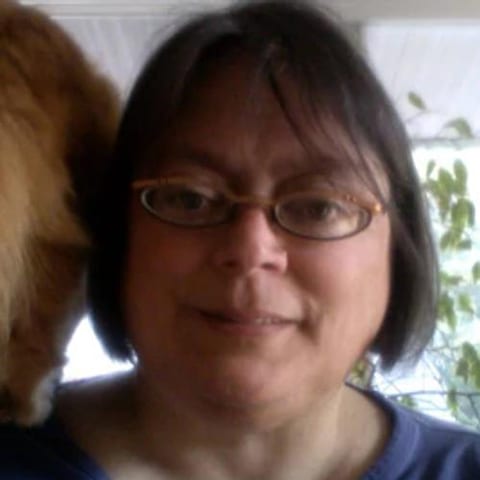
Margaret Organ-Kean is an American watercolorist based in West Seattle whose career in fantasy gaming reaches back to the first years of the trading-card-game industry. She started out at an insurance company, but the science-fiction convention and art-show circuit pulled her in another direction: she met Wizards of the Coast at the San Francisco WorldCon and landed a job as an early artist on Magic: The Gathering. She holds a B.A. in art history and trained across three universities, with every major tied to art. Alongside Magic she has worked on Vampire: The Eternal Struggle, Iron Crown's Middle-earth Collectible Card Game, the full deck of The Great Dalmuti, and illustration for periodicals including Cricket. Decades on, she is one of the 1990s Seattle game-art veterans now painting for Sorcery: Contested Realm.
Her Magic debut was Antiquities (March 1994), where she was assigned Ivory Tower, Amulet of Kroog, and Martyrs of Korlis — all three printed with her name misspelled "Organ-Keen." She is not an Alpha-era Magic artist in the strict sense; she came in with the first expansion, then became a fixture across many sets. Ivory Tower and Lion's Eye Diamond are the two pieces she's most associated with from that run.
Style
Organ-Kean works in watercolor, and the medium is the signature. Her illustrations carry a whimsical, fantastical, almost childlike quality — a world-blended, mosaic-laid look that reads very differently from the dense oil realism that dominates most TCG art. Collector Arthouse describes the work as "whimsical, fantastical illustrations with a childlike quality," and that lines up with how her cards sit on the table: lighter, brighter, more storybook than the painterly heavyweights around them.
Watercolor is an unusual choice for a game whose cards are high-fidelity reproductions of physical paintings. Where oil-on-board artists give Sorcery its thick-paint surface, Organ-Kean brings transparency and flow — washes and soft edges instead of impasto. Across a spread of her cards the throughline is tone over grit: fairy-tale subjects handled with warmth rather than menace, even on the darker Gothic material.
Cards on Sorcery
Collector Arthouse credits Organ-Kean on 12 Sorcery cards across Alpha, Beta, Arthurian Legends, and Gothic — a footprint that touches most of the game's run so far. The documented list, per the collector-side archives:
- Animist
- Blue Knight
- Boudicca
- Common Cottagers
- Cornerstone
- Dispel
- Finwife
- Observatory
- Sir Bors the Younger
- Sir Tom Thumb
- The Round Table
- Vril Revenant
The Arthurian Legends cluster is the clearest concentration — Blue Knight, Boudicca, Sir Bors the Younger, Sir Tom Thumb, and The Round Table all pull from the Arthurian and British-legend material the set is built on, which suits a watercolorist with a storybook sensibility. Dispel is the one with an extra wrinkle: an alternate-art version was produced as a participation promo for the Cornerstone organized-play events. (Note that "Cornerstone" is also one of her credited card names in Beta, separate from the event series of the same name — easy to conflate, worth keeping straight.)
Beyond the Sorcery work, her recent slate includes pieces for Magic's Lorwyn Eclipsed (2026), so she remains an active contributor on both games.
Where to see more Margaret
- organ-kean.com — her own site and the source of record, with originals, commission info, and a bio. Also on Facebook and Instagram.
- Her Sorcery cards — the 12 pieces above, spread across Alpha, Beta, Arthurian Legends, and Gothic; card data on curiosa.io.
- Her Magic catalog — from the Antiquities debut through Ivory Tower and Lion's Eye Diamond and on to Lorwyn Eclipsed, listed on Scryfall.
- Collector Arthouse — Margaret Organ-Kean — the full Sorcery card index this piece draws on.
Sources
- Margaret Organ-Kean — Collector Arthouse artist page — WorldCon/Wizards origin story, "whimsical, fantastical illustrations with a childlike quality," "Appears In: Alpha, Beta, Arthurian Legends, Gothic," and the 12-card Sorcery index
- Margaret Organ-Kean — official site, About page — West Seattle base; watercolor medium; B.A. in art history across three universities; Ivory Tower and Lion's Eye Diamond in Magic; The Great Dalmuti deck; Cricket magazine; and "Sorcery: Contested Realms," "Sorcery: Arthurian Legends," "Sorcery: Gothic," and "Magic: the Gathering: Lorwyn Eclipsed" named as recent work
- An Interview with 'Magic' artist Margaret Organ-Kean — Magic Untapped — Antiquities debut (March 1994); Ivory Tower, Amulet of Kroog, Martyrs of Korlis; the "Organ-Keen" name misspelling
- Sorcery: Contested Realm — Cornerstone events news — Cornerstone organized-play event series (distinct from her Cornerstone card), context for the Dispel participation promo