Sorcery: Contested Realm and Disney Lorcana arrived within three months of each other in 2023, and that's close to the last thing they have in common. One is published by Ravensburger under an official Disney licence and passed a billion cards sold inside a year and a half — the most successful product launch in the company's history. The other was funded by 6,456 Kickstarter backers, printed once in its original form, and never reprinted.
Magic players sizing up Sorcery are choosing between relatives. Sorcery and Lorcana are strangers — they sit at opposite ends of the current TCG market, the most accessible mass-IP game in the category against one of the smallest-print, most deliberately collector-shaped. A feature-by-feature scorecard would miss that. The useful question isn't which game is better; it's which one is built for you. What follows sorts that out by player, not by feature.
Two 2023 launches, opposite corners of the hobby
Lorcana launched in August 2023 with The First Chapter, a 216-card set reimagining Disney characters as "glimmers" you summon with magical ink. Demand outran print capacity for months. By the beginning of 2025 the game had sold over a billion cards, and Ravensburger now describes it as a "long-term pillar" of its portfolio. The pace matches the ambition: roughly a set per quarter, with set nine (Fabled) landing September 2025 and set thirteen (Attack of the Vine) already in event goodie bags for the August 2026 Championships. Ravensburger announced that set twelve, scheduled for May 2026, would bring the first Pixar characters into the game. Worth noting honestly: Ravensburger reported that Lorcana sales fell in 2025 as buyers "with a primary interest in investment" withdrew — while adding that late-2025 sets still sold out and the player base kept growing. The hype phase ended; the game didn't.
Sorcery launched in May 2023 off a Kickstarter that raised NZ$5.78 million from those 6,456 backers. The Alpha printing — roughly 29,000 booster boxes and 7,000 precon boxes — has never been rerun. Three years on, the game is five sets and about 1,000 unique cards deep, releasing once or twice a year, still published by Erik's Curiosa Limited: one founder, headquartered in New Zealand, no corporate parent. What Is Sorcery: Contested Realm? covers the full picture.
One game is engineered for reach. The other is engineered for permanence and scarcity. Neither bet is wrong — they're placed on different players.
The thirty-second sort
- You're buying for a household — kids, partners, Disney people. Lorcana, without hesitation. The section below explains why Sorcery doesn't compete for that table.
- You want a tactical system you can study for years. Sorcery's grid and two-deck engine are the deeper well, and nothing you learn gets rotated away.
- You're a collector first. Both games are serious here, in opposite ways — formal abundance versus unofficial scarcity. Read both collecting sections before spending.
- You want a big competitive ladder this year. Lorcana's circuit is orders of magnitude larger. Sorcery offers a young scene where the worlds stage is genuinely reachable.
"I want a game the whole household will play"
Lorcana, and it isn't close.
The on-ramp is engineered end to end. Single-player starter decks list at $16.99 on Ravensburger's own shop (checked June 2026), with a $29.99 Collection Starter Set pitched explicitly at Disney fans who want to collect before they compete. The official site splits its how-to-play guidance into three tracks — new players, collectors, and TCG players — which tells you exactly who Ravensburger expects to walk in the door. The rules support games of three or more players out of the box, there's a co-op Illumineer's Quest product line that pits up to four players against a villain, and at the 2026 Championships — held at the Disneyland Resort and Disneyland Paris — children 12 and under attend free with a ticketed adult. The game itself is a race to 20 lore: you quest with characters to score, and you can only attack characters that are already exerted, which keeps the default mode of play forward-moving rather than punishing. And the cast is Mickey, Elsa, Stitch, Maleficent — characters the whole table already knows.
Sorcery, measured against the same criteria: it's strictly a two-player duel, reviewers place it in medium-heavy complexity territory, and the $40-MSRP Beta precon box that anchors its entry point actually runs $150–200 at retail because of the constrained print run. Then there's the art.
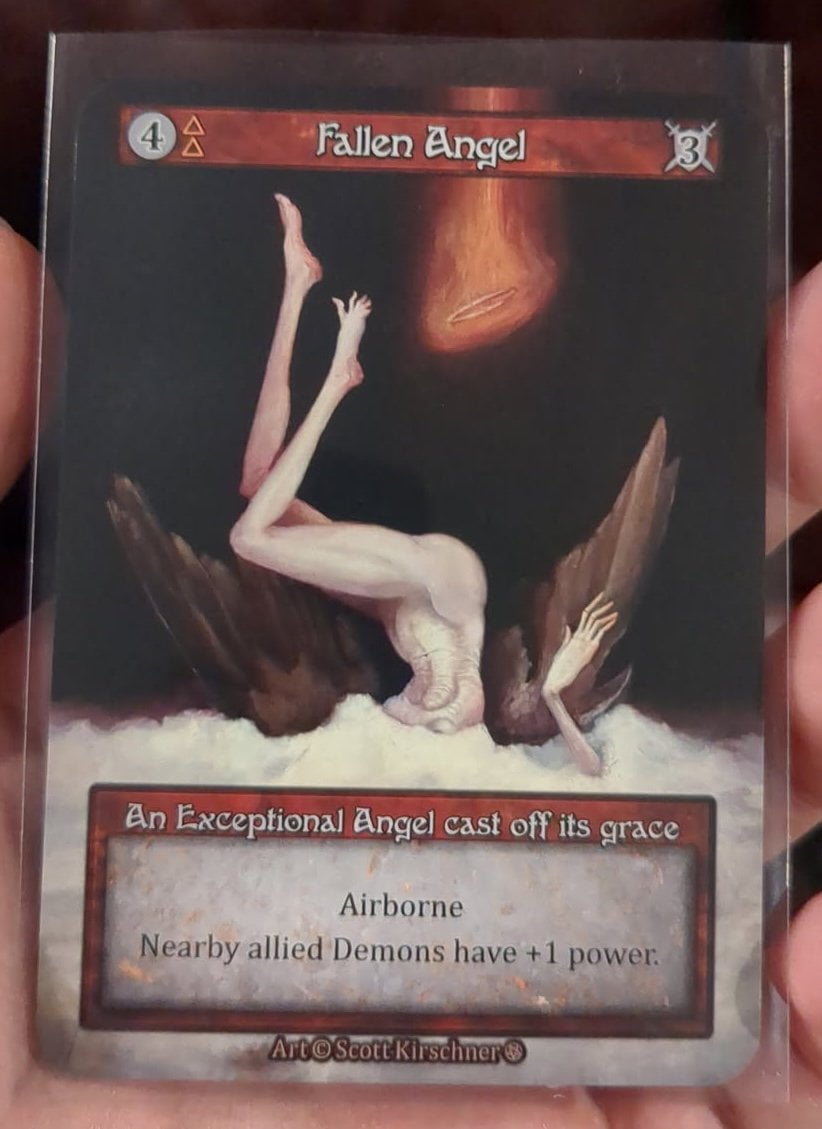
Fallen Angel by Scott Kirschner — via Collector Arthouse
That's a representative Sorcery card: a ragged angel cast out of grace, painted in physical media for a set themed on "dread, devotion, and despair." Sorcery's aesthetic is aimed at adults who grew up on 1980s D&D manuals and metal album covers. If your table includes a seven-year-old who loves Stitch, this isn't a contest, and pretending otherwise would be doing you a disservice.
"I want a game I can study for years"
This is Sorcery's strongest ground. The game is played on a 5×4 grid where every card has a position — minions step between squares, sites are laid as terrain, and your Avatar is a unit standing somewhere specific. Every player runs two decks, a Spellbook of spells and an Atlas of sites, choosing each turn which to draw from. Threshold, the elemental affinity your sites accumulate, gates what you can cast. The result is a card game with a board-game's spatial layer on top — 7 Things That Make Sorcery Different walks through the full stack. And because nothing has ever rotated, study compounds: the lines you learn this year stay legal indefinitely. The meta rewards it, too — one of the first major Gothic-era events put 16 distinct Avatars in its Top 17.
The fair version of Lorcana's side: it is a real competitive game, not a toy. Exerting a character to quest exposes them to challenges, so scoring is a timing decision; inking a card removes it from your game permanently, so resource choices have teeth; songs and Shift add layered play patterns. Locations even add a light positional wrinkle — characters move onto them for benefits. But there's no board, no adjacency, no terrain. And Core Constructed — the premier format — rotates annually by design. Ryan Miller, the game's co-designer, framed it plainly: rotating out older cards keeps "new strategies and fresh deck designs" coming. That's a defensible philosophy, and it means the format you master is rebuilt on a schedule. Deep study is possible in Lorcana; permanent study is the thing Sorcery sells.
"I'm collecting as much as playing"
Here's where the comparison gets genuinely interesting, because both games are collector games — built on opposite theories of what makes cardboard precious.
Lorcana collects through abundance and a formal ladder. The rarity system runs from Common up through Enchanted, and 2025 added Epic and Iconic tiers above that — Iconics appearing just twice per set. Ravensburger reprints early fan favourites (including Enchanted versions) when demand warrants, sells a starter product aimed squarely at collectors, and names "players and collectors" as the game's core target group. With a billion-plus cards in circulation, the market is huge and liquid: whatever you're chasing, someone is selling it, and whatever you're done with, someone is buying.
Sorcery collects through scarcity and the unofficial. Alpha was printed once for backers and never again. Erik's Curiosa, the Alpha-exclusive eponym card, sits around $300 non-foil and near $7,000 in foil; sealed Alpha boxes have approached $1,000. The chase tier — Curio cards — isn't on the rarity sheet at all: the publisher declines to acknowledge Curios exist, and the de facto registry is a community archive maintained at Collector Arthouse, alongside the broader art-collector resources the scene has built. The one partial exception proves the rule: for the Gilded knight subset, artist Elvira Shakirova received artist proofs — the only Curios to get even that much official recognition.
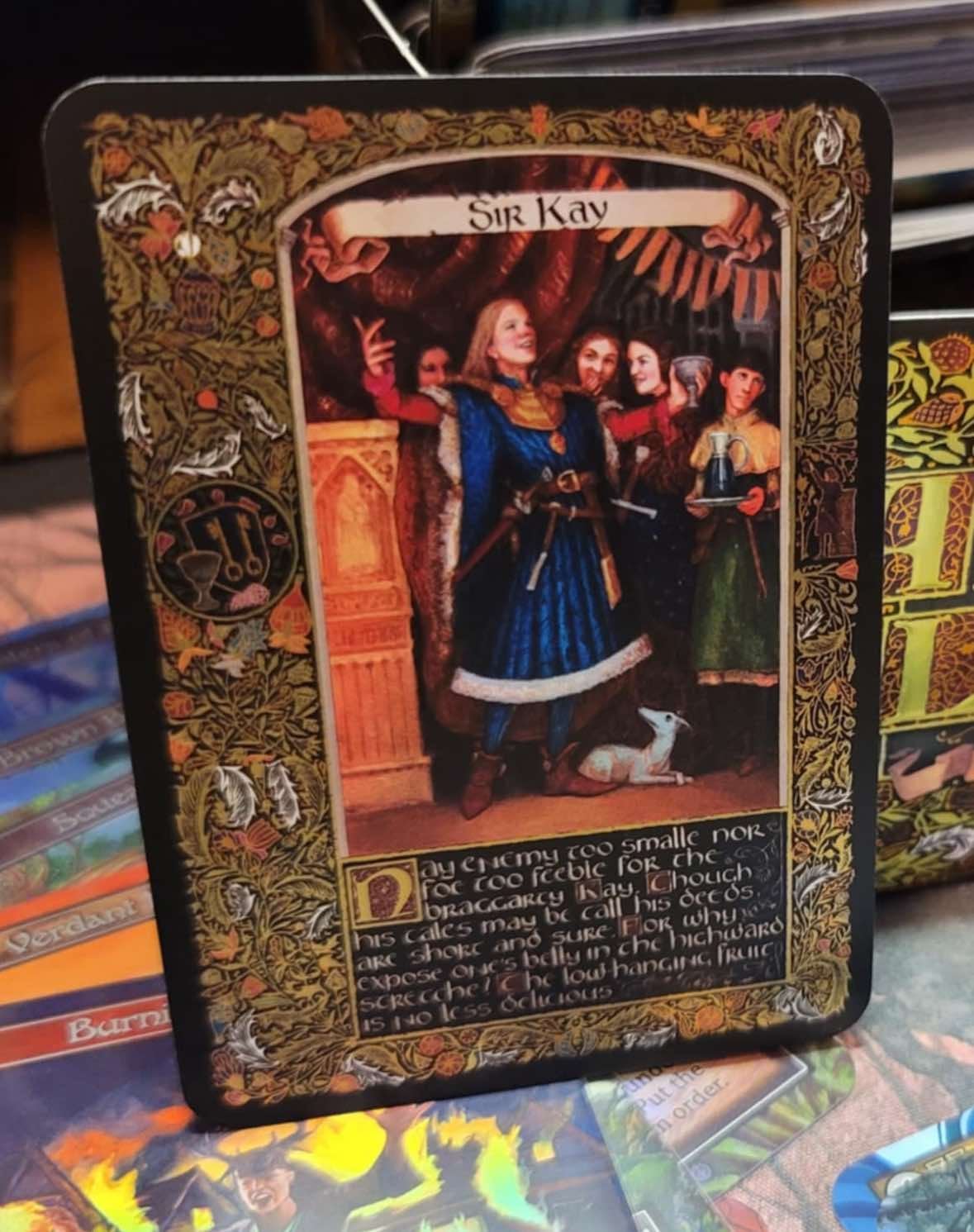
Gilded Sir Kay by Elvira Shakirova — via Collector Arthouse
Both honest caveats, plainly: Lorcana's speculative froth cooled in 2025 by Ravensburger's own account, so treat any investment pitch with suspicion. And Sorcery's collecting is punishing at the top — you can play the game cheaply, but you cannot collect it cheaply, and the market is far thinner if you ever need to sell.
"I care who painted the card"
Lorcana's art is licensed character art, executed to Disney's standards by many illustrators — polished, on-model, and at the Enchanted tier often gorgeous. The star of the card is the character. That's not a criticism; it's the product working as designed, and for a Disney-shaped collector it's exactly the appeal.
Sorcery's model is the inverse: every card is a hand-painted, single-artist commission in physical media, with the painter's name as part of the card's identity — Frank Frazetta, Gerald Brom, Rodney Matthews, Ian Miller, plus a roster of original-era Magic painters. The Fallen Angel above is a clean example of how it works: Erik Olofsson's art direction to Scott Kirschner was a single line — "a ragged angel curled up in a crater where it would have landed rather violently" — and the artist painted it, without even knowing the card was destined to be a chase variant. Somewhere, that painting physically exists. If the credit line on a card matters to you — if you'd rather own a painter's work than a character's likeness — that's the divide.
"I want a ladder to climb"
Lorcana's competitive scale is something Sorcery can't currently offer. The Challenge circuit runs on four continents — Milwaukee, Richmond, Bologna, Ghent, São Paulo, Melbourne and more in the current season — feeding Championships held on Disney resort property in August and September 2026. The numbers are arena-sized: European qualifying days cap at 2,048 players each, and the Last Chance Qualifier alone seats 1,024. The game crowned its first world champion in June 2025 in a 28-player event, and is building the pyramid underneath at speed.
Sorcery's 2026 pipeline — Cornerstone store championships, then regional Grand Contests, then Avatar of the Realm, the first world championship, in a Boston hotel this November — is real, routed, and small. Fields run in the hundreds. The flip side of small is proximity: the community Discord servers that organise most competitive play are intimate enough that regulars know each other, and a dedicated newcomer can plausibly play their way to the worlds stage within a season or two. Climbing a big ladder versus mattering on a small one is a genuine temperament question. Only you know which one you'd rather wake up early for.
"I don't want my deck to expire"
Worth isolating, because the two policies are mirror opposites and both publishers are explicit about them.
Lorcana rotates. Beginning with Fabled in September 2025, the first four sets left Core Constructed, and the 2026 Championship season is contested on sets nine through thirteen only — which works out to a competitive shelf life of roughly fifteen months to two years per set. Rotated cards stay playable in Infinity Constructed, an officially supported eternal format, so your collection isn't dead — but the deck you tuned for the premier format has a posted expiry date.
Sorcery doesn't rotate. Every card printed since Alpha in May 2023 remains Constructed-legal, the pool grows by one or two sets a year, and the publisher has given no signal that will change. The practical buyer math: a $100 Lorcana deck is a season pass; a $100 Sorcery deck is a permanent tool that will face more competition over time. Which one feels like the better deal says a lot about which game you should buy.
The price of admission — and of staying
Getting in: two Lorcana starter decks and a handful of boosters put a brand-new pair of players at the table for under $50, purchasable today at mass retail almost anywhere. Sorcery's equivalent — the Beta precon box with four ready-made elemental decks — lists at $40 but realistically costs $150–200 from the stores that still have it, and online play runs through a $19.99 Tabletop Simulator mod rather than a free app. Lorcana wins the entry math decisively. All prices as of June 2026.
Staying is where the curves cross. Lorcana ships roughly four sets a year, and Core rotation means staying competitive is a recurring subscription — manageable per set, relentless in aggregate. Sorcery ships one or two sets a year and invalidates nothing, so a playset purchase amortises indefinitely; the money trap is instead the collector's chase, which is strictly optional. Cheap to enter and costly to keep current, versus costly to enter and cheap to maintain. Decide which cost structure suits how you actually spend.
Where each game will let you down
Lorcana will frustrate you if you wanted spatial tactics (there's no board), permanence (Core rotates on schedule), scarcity collecting (a billion cards in circulation is the opposite of scarce), or a world built for the game — the fantasy is licensed, and you will always be playing someone else's characters. None of that is a flaw; all of it is the price of being what it is.
Sorcery will frustrate you if you need local opponents on demand (outside enthusiast metros, finding tables takes real effort), polished digital play (Tabletop Simulator is the only online option), a family-friendly table (two players, adult-aimed art), or low-cost collecting (the chase tier starts in the hundreds). Is Sorcery Worth It in 2026? walks the full ledger if you're on the fence.
Picking your lane
These two games aren't rivals for the same evening. Lorcana is the one you hand to a mixed table of kids, parents, and Disney people, and the one to pick if you want a thronged competitive circuit this year. Sorcery is the one for the player who wants a chessboard under their card game, a painter's name on every card, and a collection that doesn't expire — if that's pulling at you, the Start Here resources cover the onboarding path, and Which Sorcery Precon Should You Buy First? covers the first purchase.
And because they overlap so little, owning both is more coherent than it sounds — they don't compete for the same shelf, the same friends, or the same part of your brain. If your actual reference point is a different tactical game entirely, the Flesh and Blood comparison covers the indie-TCG sibling rivalry. But if the choice really is Lorcana or Sorcery, the honest tiebreaker is the table: picture who's sitting at yours, and the answer is usually already there.
Sources
- Disney Lorcana Turns the Page to the Next Chapter — disneylorcana.com — May 2025 announcement: August 2023 launch, 216-card First Chapter, Core Constructed rotation from Fabled, Infinity Constructed, Iconic/Epic rarities, Ryan Miller and Elaine Chase quotes, first World Championship (June 2025, 28 players)
- Lorcana Challenge — disneylorcana.com — accessed 2026-06-06: 2026 Championship venues and dates, sets 9–13 Core legality, 2,048-player qualifying days, 1,024-player LCQ, kids-12-and-under policy, Set 13 Attack of the Vine
- Disney Lorcana Quick Start Rules (PDF) — files.disneylorcana.com — 20-lore win condition, inkwell rules, 60-card/two-ink deckbuilding, exerted-character challenges, multiplayer support
- Disney Lorcana starter decks — ravensburger.us — accessed 2026-06-06: $16.99 starter decks, $29.99 Collection Starter Set
- Disney Lorcana sales fell in 2025 — BoardGameWire — published 2026-01-28: billion-plus cards sold by start of 2025, most successful launch in Ravensburger's history, 2025 normalisation, investment buyers withdrawing, Set 12 Pixar debut
- How to Play — disneylorcana.com — the three-track onboarding split (new players / collectors / TCG players)
- Fallen Angel — Collector Arthouse — Scott Kirschner commission story and Erik Olofsson's art direction
- Gilded Sir Kay — Collector Arthouse — Gilded subset, artist proofs, publisher non-acknowledgement of Curios
- Sorcery TCG: Alpha vs. Beta — Collector Arthouse — Alpha print run (~29,000 boxes / 7,000 precons), Erik's Curiosa pricing, Alpha box values
- Sorcery: Contested Realm — Wikipedia — Kickstarter NZ$5.78M from 6,456 backers, set release history
- Organized Play overview — sorcerytcg.com — Cornerstone, Grand Contests, Avatar of the Realm pipeline
- Avatar of the Realm — sorcerytcg.com — first Sorcery world championship, Boston, November 13–15, 2026
- Gothic set page — sorcerytcg.com — set theme and December 2025 release
- Sorcery Beta Booster Box — Prince Distribution — Beta product MSRP reference
- Sorcery: Contested Realm Review — TechRaptor — medium-heavy complexity assessment
- A Month into Gothic — Bardsword — 16 distinct Avatars in SCG CON Atlanta Top 17
- Steam Workshop — Sorcery: Contested Realm — official Tabletop Simulator mod