Sorcery: Contested Realm tournaments run at four scales: a weekly night at a local game store, that store's annual championship, a regional weekend that pulls players across state and national borders, and one global gathering in Boston each November. The publisher's 2026 organized-play program gives those tiers names — Gothic Store Kit, Cornerstone Championship, Grand Contest, Avatar of the Realm — and its event platform lists, as of early June 2026, roughly 2,500 upcoming in-person events across 29 countries. If you've only ever played Sorcery across a kitchen table or on Tabletop Simulator, the in-person scene is bigger and closer than the announcement posts make obvious.
What follows is the map and the finder. The map: what each tier is, who can enter (almost always: anyone who registers), and where each one runs. The finder: the four tools that locate the event nearest you, because the honest answer to "when's the next Sorcery tournament near me" is a live feed, not a calendar post. The Cornerstone explainer and the Grand Contest explainer go deep on those two tiers' kits, prizing, and results; what you need here is which room to aim for and where the door is.
The pyramid, in one pass
Sorcery Organized Play 2026, announced in March, structures sanctioned play in four levels:
- Gothic Store Kit — regular play at a local game store, weekly or monthly, supported by a publisher promo kit.
- Cornerstone Championship — a store's one annual championship, run from an allocated kit.
- Grand Contest — regional weekend events run by invited organizers, nine dated stops in 2026 so far.
- Avatar of the Realm — the global capstone, November 13–15 in Boston.
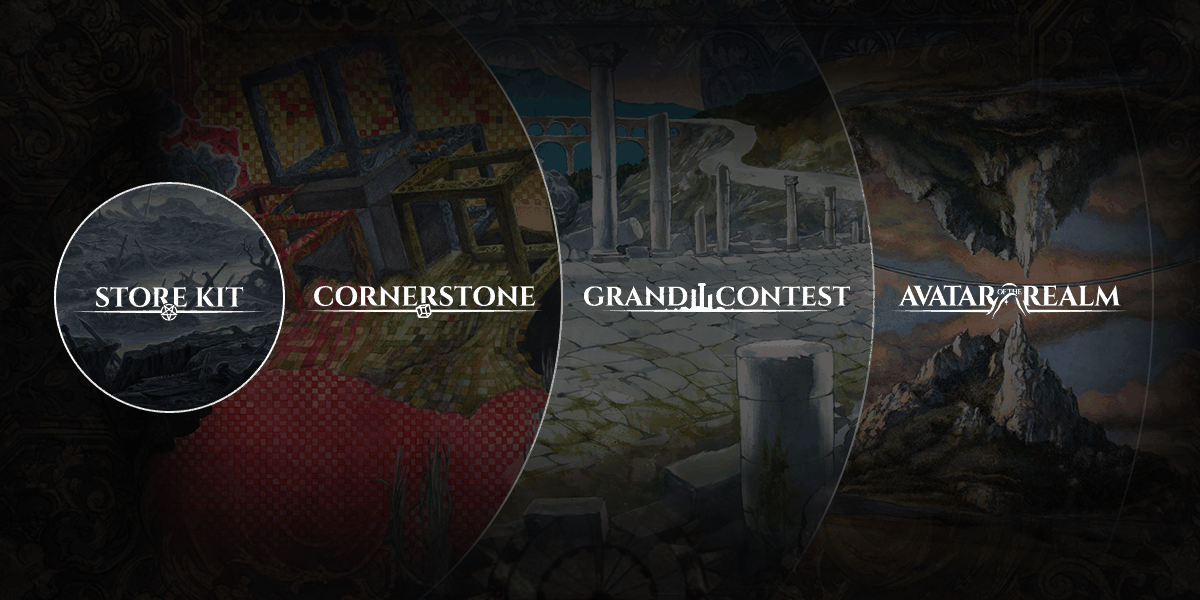
The four levels of Sorcery Organized Play 2026 — via sorcerytcg.com
The publisher frames the program as "an expanding circle" rather than a ladder — its stated goal "isn't to filter players through increasingly narrow levels of competition." That framing has one practical consequence worth internalizing before anything else: no tier requires a result from the tier below. You don't grind store nights to unlock a Cornerstone, a Cornerstone trophy buys nothing at a Grand Contest, and Boston sold badges to anyone with a browser (details below). The tiers sort by how far you'll travel and how big the room is, not by permission. For scale at the base: the 2025 season counted more than 1,800 players across 150 Cornerstone events, before this year's expansion.
One more event belongs on the map outside the official four: SorceryCon, the community-run convention, covered alongside Boston further down. The directory's Play & Compete section keeps a standing index of the whole stack — the event platform, leagues, and matchmaking included.
Tier one: the weekly store night
Nearly all in-person Sorcery happens here, and the numbers say so. Of the roughly 2,500 listings live on the event feed in early June 2026, constructed tournaments (about 1,150) and casual meetups (about 1,150) split the calendar almost evenly, with learn-to-play sessions (around 130) and sealed and draft events (just over 100) filling out the rest. What those listing labels imply — the deck a "Constructed Tournament" expects you to bring, what "Sealed" hands you at the door — is what Every Sorcery Format, Explained untangles. The practical version: a learn-to-play night needs nothing but your presence, a casual meetup takes a precon as-is, and a store-night tournament is the lowest-stakes place to build tournament habits.
The publisher's support product for this tier is the Gothic Store Kit: each kit covers eight players with alternate-art promos (Flaming Skull cards for participants and winners, a foil Swap for a community champion), playmats illustrated by Dan Seagrave and Brom, and two draft kits. There's no mandated schedule — stores run at whatever cadence their community sustains.
Store nights also decide where the next tier lands. Cornerstone kits are allocated on Play Network activity and community engagement, which means the stores whose weeknight tables stay busy are the ones that get a championship. If you want a Cornerstone in your town in the next allocation wave, the move is unglamorous: show up on Tuesdays.
Tier two: Cornerstone, your store's championship
One per store, per year. The publisher frames the Cornerstone Championship as a store's "annual celebration" of its community — a championship event run from a publisher-supplied kit (eight players per kit, with stores receiving kits scaled to expected turnout), carrying alternate-art promos for the champion, participants, the judge, and a community champion.
The 2026 tier runs on applications. Stores applied through the publisher's organized-play program; the first allocation wave was announced May 11, 2026, with kits arriving from late June, and allocation continues — the 2026 kit is offered until Q3. The player half is simpler: open registration, no qualification of any kind. Format is the store's choice, and the live listings show how literally stores take that — June and July Cornerstones on the feed run Constructed in Hong Kong, Maryland, and Dubbo, Australia; Sealed in Belgium and New Zealand; Draft in Washington State. The Cornerstone explainer covers kit contents, prizing, and how to prepare for your first one.
Tier three: Grand Contests, the regional weekends
The regional tier, new for 2026 — Grand Contests replaced the Crossroads circuit that ran through 2025. The structure is asymmetric: hosting is by publisher invitation to organizers "with a proven track record of community support," while playing is open registration through whichever organizer hosts. A curated venue, an uncurated field.
The 2026 circuit, as of June 6, from the publisher's announcements and the Play Network feed:
- SCG CON Washington, DC — ran May 29–31. The season opener: a 75-player field, 24 different Avatars, a Necromancer title.
- SCG CON Las Vegas — convention opens June 26, Grand Contest listed for Saturday, June 27.
- SorceryFest, Leeuwarden, Netherlands — July 3–5, main event July 4. The first European Grand Contest.
- Melbourne, Australia — July 25–26, hosted by Plenty of Games. The first in Asia-Pacific.
- Gen Con, Indianapolis — July 30–August 2, with two Grand Contests: a Constructed championship and a Limited one.
- SCG CON stops through autumn — Dallas (Fort Worth) September 5, Baltimore September 12, Los Angeles October 10, Hartford October 24.
The July pair is the part worth flagging if you live outside North America: 2026 is the first season the regional tier physically reaches three continents, and the publisher says more Asia-Pacific announcements are coming. For the tier's host model, prize kits, and what the Washington field looked like in detail, the Grand Contest explainer walks all of it; the 2026 meta survey is the read on what decks the field will bring.
The destination events: SorceryCon and Avatar of the Realm
Two events are worth a flight rather than a drive — one community-built, one official.
SorceryCon is, in the publisher's own words, "the entirely community-run celebration of all things Sorcery." The 2026 edition ran February 19–22 in Indianapolis: a Limited championship and a Constructed championship as headline events, side formats from Two-Headed Dragon to four-way free-for-alls, twelve attending artists, a cosplay tradition, and Erik Olofsson on the floor playing games. Learn-to-play participants each kept a Gothic preconstructed deck. It sits outside the official pyramid, which is precisely what it demonstrates: the scene fills a four-day convention without the publisher running it.
Avatar of the Realm is the official capstone — November 13–15, 2026, at the Marriott Long Wharf in Boston. Three main events across the weekend (a mystery Sealed event Friday, the Constructed Championship Saturday, finals plus Team Sealed Sunday), panels with Erik Olofsson and featured artists, and a single badge covering event entry, panels, and weekend lunches.
One detail deserves precision: Boston has no qualification gate. Badges went on open sale May 28, 2026 — the publisher's words are "every Sorcerer welcome" — and the only limit is capacity. Once badges sell out, they're gone. No Grand Contest finish, Cornerstone trophy, or points total is required to enter the Constructed Championship. The entry requirement for the year's global event is a badge and a deck.
How to actually find your event
Four tools, in the order worth trying them.
The Sorcery Play Network (play.sorcerytcg.com) is the canonical source. It's the publisher's official event platform, built on Carde.io, and it's where stores are directed to list sanctioned events — the Cornerstone announcement tells stores to list there explicitly "so that players nearby can search." The events page filters by location, event level (the dropdown that isolates Cornerstones or Grand Contests from the weeknight noise), and play format, and a free account lets you register for events and accrue Dust, the program's participation-reward currency. If an event is sanctioned, it's here; the gaps are the unsanctioned ones.
The events page on this site (/events) mirrors the Play Network feed daily and renders the nearest two hundred or so upcoming events in one scroll — about three weeks of the global calendar, store nights and marquee stops together, with dates, cities, formats, and registration counts. It's the fastest answer to "is anything happening near me this month." For planning past that window, go upstream to the Play Network itself.
The official store locator (sorcerytcg.com/locator) covers the gap event feeds miss. Not every store that stocks Sorcery lists events, and plenty run casual tables that never touch the Play Network. Find the stores around you on the locator map, then ask — a message or a phone call surfaces unlisted play nights more often than you'd expect. The Where to Buy section of the directory maps the wider store ecosystem, online retailers included, if the nearest shelf turns out to be far away.
Discord handles what listings can't: "anyone playing near me?", carpools and hotel splits for Grand Contest weekends, finding a testing pod before a Cornerstone. The servers indexed in the directory's Discord section are where that coordination happens — several are organized by region, which makes the near-me question answerable by humans instead of filters.
If nothing is near you
A real possibility — 29 countries on the feed still leaves plenty of map dark, and even inside covered countries the dots cluster around cities. Two honest moves.
Play online while the map fills in. Tabletop Simulator plus the Sorcery League Discord is the established online scene, and it costs a $20 mod platform rather than a flight — How to Play Sorcery Online is the setup walkthrough. The online community doubles as scouting: the people you play against know which paper events are worth traveling to, because they travel to them.
Or build the bottom tier yourself. The Gothic Store Kit application is open to any store, kits are limited but allocation is ongoing, and eight players is the threshold a kit is designed around. If your local store stocks the game but doesn't run events, pointing the owner at the publisher's Store Kit post is a five-minute conversation. As of June 2026 the path upward is stated outright: consistent Play Network hosting builds toward a Cornerstone allocation. Store nights aren't just the bottom of the pyramid — they're how the pyramid decides where to grow.
The base is wide by design. Find a table; the tiers above it find you.
Sources
- Sorcery TCG — Where Tables Connect: Sorcery Organized Play 2026 — published 2026-03-13; four-level program, expanding-circle framing, 2025 participation figures
- Sorcery TCG — Where Communities Take Root: The Gothic Store Kit — published 2026-03-20; kit contents, eight-player sizing, store applications, path to Cornerstone qualification
- Sorcery TCG — Where Communities Are Celebrated: 2026 Cornerstone Championships — published 2026-03-27; annual-championship framing, store's-choice format, Play Network listing guidance, Q3 kit window
- Sorcery TCG — Organized Play: Cornerstone Allocation May 2026 — published 2026-05-11; first allocation wave, late-June kit arrival, ongoing allocation criteria
- Sorcery TCG — 2026 Grand Contests: Where the Realm Gathers — published 2026-04-03; curated-host model, open play, SCG CON and SorceryFest designations
- Sorcery TCG — Where Tables Connected: SCG CON Washington DC Recap — published 2026-06-01; 75-player field, 24 Avatars, Necromancer win, Las Vegas dates
- Sorcery TCG — Gen Con Event Registration Opens This Sunday — published 2026-05-12; two Gen Con Grand Contests, side-event slate
- Sorcery TCG — Avatar of the Realm 2026: The Realm Converges in Boston — published 2026-05-22; November 13–15 dates, May 28 open badge sale, badge inclusions, capacity cap
- Sorcery TCG — SorceryCon 2026: The World's Largest Community Run Sorcery Event Returns — published 2025-12-12; February 19–22 dates, headline championships, attending artists
- Sorcery Play Network — event search, filters, Dust rewards; accessed 2026-06-06
- Sorcery TCG — Store Locator — accessed 2026-06-06
- Event counts, format split, country spread, and circuit dates: Sorcery Play Network feed (Carde.io), as mirrored by this site's /events data — snapshot 2026-06-05