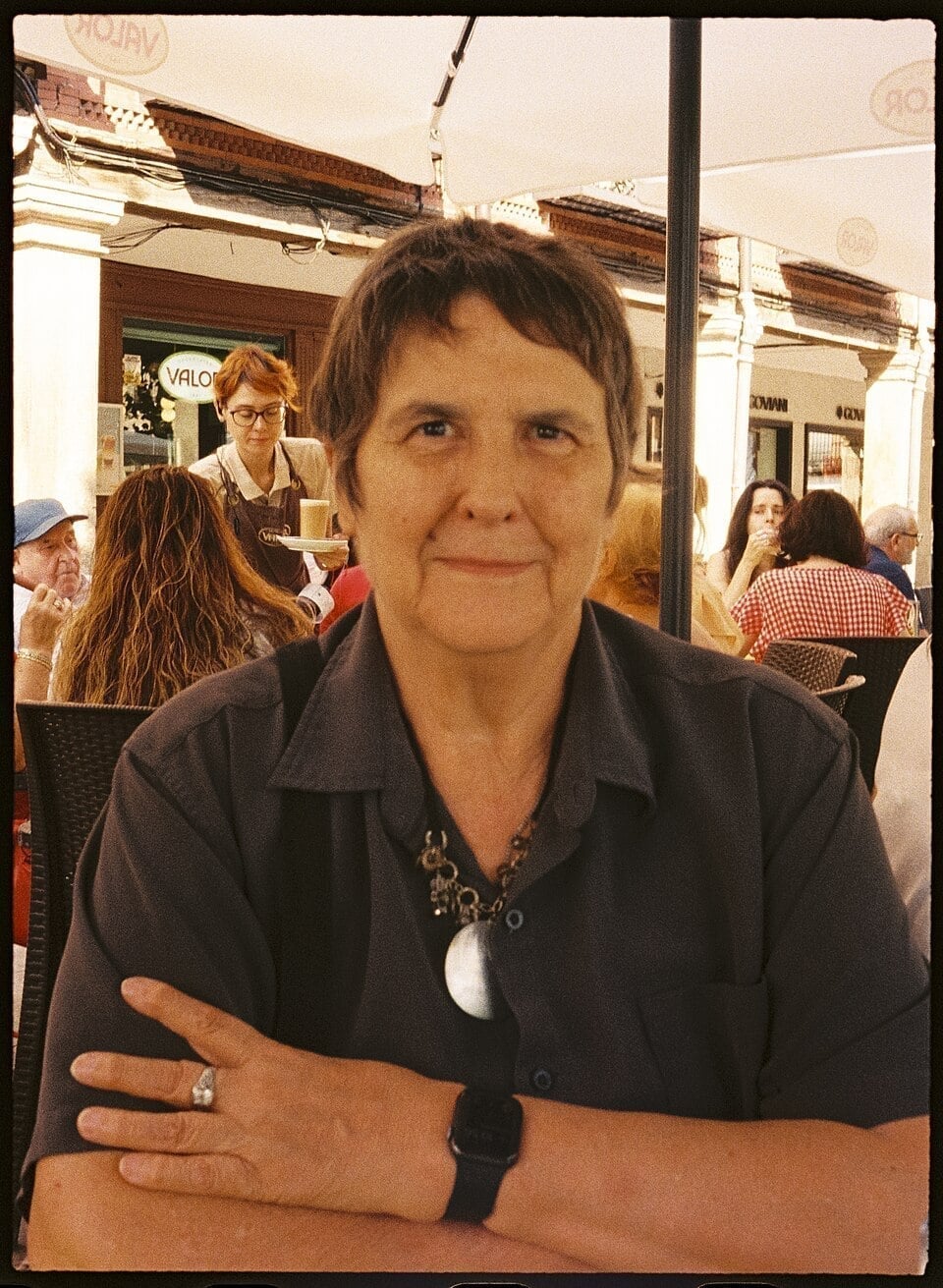
Liz Danforth (Elizabeth T. Danforth, born 1953) is an American fantasy illustrator, game developer, editor, and writer. She took a BA in anthropology from Arizona State University and a master's in library science from the University of Arizona — a credential that matters later, because the second half of her career turned partly toward writing about games and libraries. But the throughline is the game industry, where she has worked continuously since the mid-1970s.
Flying Buffalo hired her as a staff artist and production hand in 1978. Ken St. Andre's Tunnels & Trolls — first published in 1975, the second commercial tabletop RPG after Dungeons & Dragons — was the company's flagship, and Danforth became central to it. She developed, edited, and illustrated the fifth edition (1979), the version most longtime players think of as definitive, and returned decades later to write and illustrate Deluxe Tunnels & Trolls (2015). Alongside the game she edited Sorcerer's Apprentice, Flying Buffalo's house magazine, across its full run of seventeen issues (1978–1983).
From there the freelance résumé reads like a roll call of the formative game publishers. She illustrated for Steve Jackson Games' Melee and Wizard, Iron Crown Enterprises' Middle-earth Role-Playing (MERP) and Rolemaster, GDW's Traveller, FASA's BattleTech, Shadowrun, and Earthdawn, and TSR's Dragon magazine and AD&D modules. On the card-game side she contributed to Legend of the Five Rings, the Middle-earth Collectible Card Game, the BattleTech CCG, and 7th Sea. She was inducted into the Academy of Gaming Arts and Design's Hall of Fame in 1995, and wrote the "Games, Gamers and Gaming" column for Library Journal from 2009 to 2011.
She's also an original-era Magic artist — specifically, one whose debut was Legends (June 1994), not the 1993 Alpha and Beta core sets. Per Scryfall, her earliest Magic cards are the three she painted for Legends — Devouring Deep, Rust, and Tuknir Deathlock — followed by a steady run through Fallen Empires (including the much-played Hymn to Tourach), Ice Age, Homelands, Alliances, and Mirage. Her own site puts it plainly: "one of the original artists for Magic the Gathering, creating art for about three dozen of the early cards."
Style
She works in pen-and-ink and in paint, with a draftsman's discipline underneath — the linework is the foundation, and the colour goes on top of a drawing that already holds together. That two-stage process is exactly why one of her two Sorcery cards exists as a half-finished Curio (see below).
The career arc explains some of the look. Where most of the painters on the Sorcery roster came up through the paperback-cover and card-game pipeline that Frank Frazetta opened in the 1960s, Danforth came up through tabletop RPGs — staff artist at Flying Buffalo from 1978, developing, editing, and illustrating Tunnels & Trolls before Magic existed. The visual language of tabletop fantasy was still being written when she was writing it. The discipline of an early-era RPG illustrator — drawing for legibility on cheap paper at small reproduction sizes — is the same discipline a card-frame painter solves at smaller scale today.
Cards on Sorcery
Danforth has two documented cards on the Sorcery roster, and they sit at opposite ends of the chase market — one a high-value Alpha foil, one an off-grid design-history Curio.
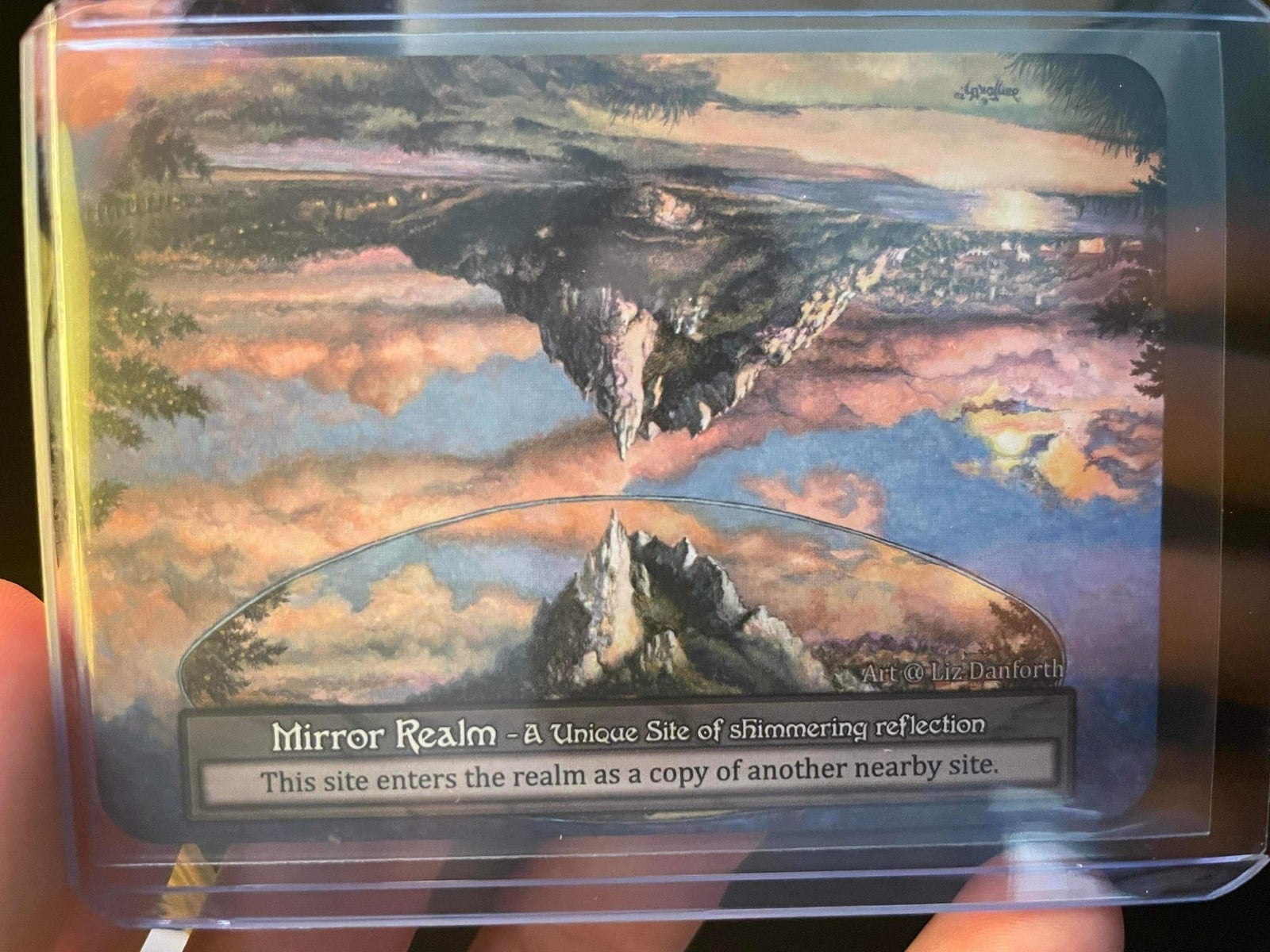
Mirror Realm by Liz Danforth — via Collector Arthouse
Mirror Realm (Alpha Site). A landscape Site from the original Alpha set — a floating landmass with a reflected counterpart, the composition built around the symmetry the card's name promises. There's also an Alpha Curio variant, and it's a characteristically playful one: per Collector Arthouse, the Curio is an inverted rendition of the original, the landmass flipped overhead with its reflection arching beneath and the title bar dropped to the bottom of the frame. Collector Arthouse notes it's "not true to the original painting, and thus does not have real historical development relevance" — a visual gag on the mirror mechanic rather than a design fossil. The Alpha foil printing trades around $900 NM, putting it just outside the public top ten alongside cards like the Dragonlord Avatar and Gothic's Lilith — documented in The Most Expensive Sorcery Cards Right Now.
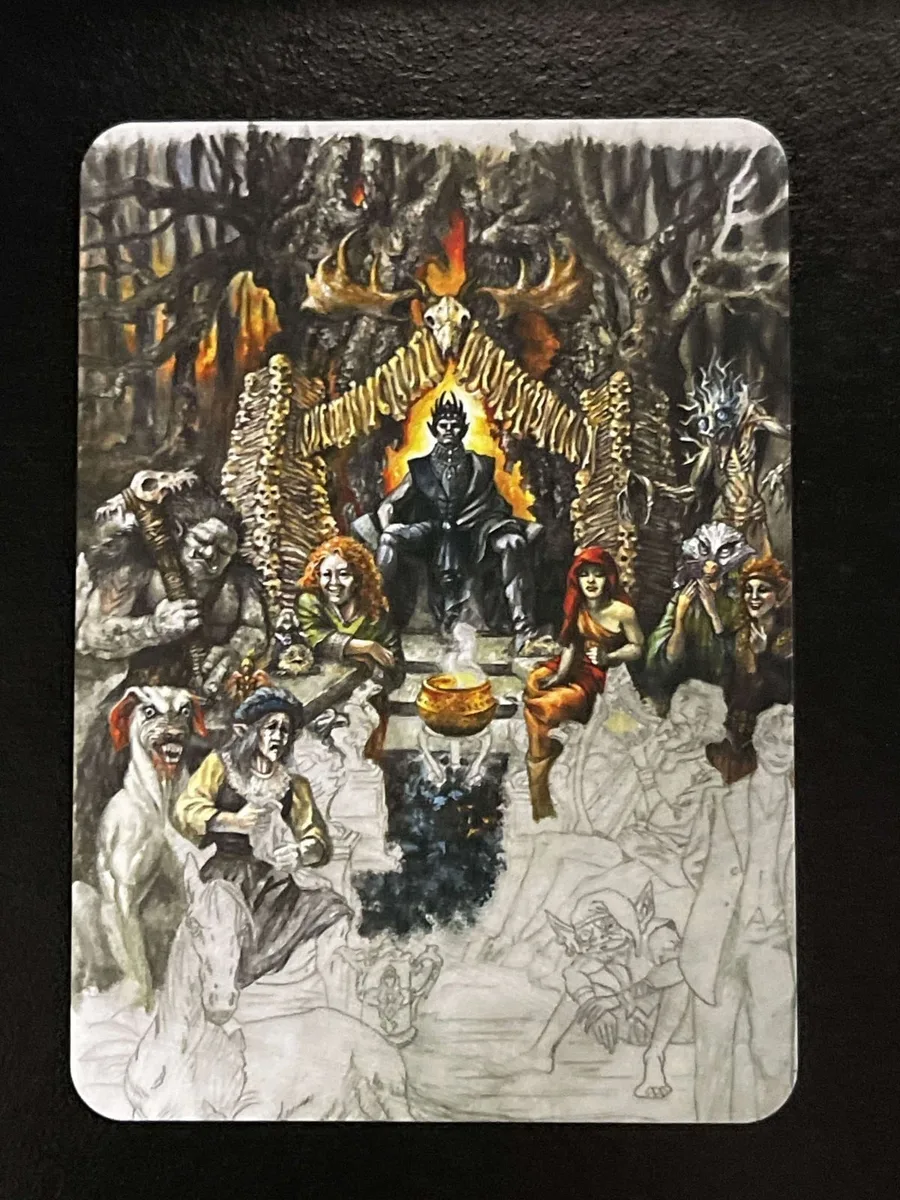
Unseelie Court (Sketch) by Liz Danforth — via Collector Arthouse
Unseelie Court (Arthurian Sketch Curio). The more historically interesting of the two. Arthurian Legends carries the largest Curio pool of any set, but it's overwhelmingly variant-prints and themed subseries — the Unseelie Court Sketch is the only documented design-history Curio in the entire set, a sketch variant in the Alpha-era tradition rather than a foil reprint. And it's a first: per Collector Arthouse, Sketch Curios had surfaced in Alpha and Beta before, but Danforth's Unseelie Court is "the first Curio to be a half-finished, half-painted version" rather than a pure pencil draft. The card catches her exact working method mid-stride — the linework laid down, the paint partway across it.
There's a footnote attached. When the community was scrambling to catalogue Arthurian Curios on release, a second half-finished sketch surfaced — a Witch, formatted to mimic Danforth's Unseelie Court and attributed to Séverine Pineaux. It turned out to be a fake Curio, a forgery built in the visual grammar Danforth's card had just established. Erik's Curiosa, whose standing policy is to never acknowledge Curios in any direction, broke that silence to publicly denounce the fake. The full episode is in Every Curio in Arthurian Legends.
Where to see more Danforth
- lizdanforth.com — her own site, the source of record. She still takes commissions, posts process work, and maintains a Patreon. She describes herself there as working "as an artist, writer, editor, and/or game developer on role-playing games, card games, and board games" since 1978.
- Tunnels & Trolls — the fifth edition (1979) and Deluxe Tunnels & Trolls (2015) are the work she's most identified with. Flying Buffalo still sells T&T material; the deluxe edition is the easiest modern way to see her developing and illustrating a game end-to-end.
- Her early-Magic cards — Hymn to Tourach (Fallen Empires) is the famous one, still played in older Magic formats. Full set-by-set list on Scryfall, which is also the cleanest way to verify exactly which sets she was in (Legends onward) versus which she wasn't (Alpha, Beta).
- Her writing on games — Danforth wrote the "Games, Gamers and Gaming" column for Library Journal from 2009 to 2011, advocating for games in libraries.
Sources
- Liz Danforth — Wikipedia — birth year (1953), full name (Elizabeth T. Danforth), Flying Buffalo hire (1978), Sorcerer's Apprentice run (1978–1983, 17 issues), Tunnels & Trolls fifth-edition (1979) and Deluxe (2015) roles, 1995 Academy of Gaming Arts and Design Hall of Fame induction, Library Journal column (2009–2011), video-game scenario work
- lizdanforth.com — official site — her self-description ("one of the original artists for Magic the Gathering, creating art for about three dozen of the early cards"; "artist, writer, editor, and/or game developer ... since 1978")
- Liz Danforth — Scryfall card search — verified Magic card list and set attributions: debut in Legends (June 1994) with Devouring Deep, Rust, Tuknir Deathlock; ~36 unique pieces across Legends, Fallen Empires, Ice Age, Homelands, Alliances, Mirage and later sets; no cards in Alpha (LEA) or Beta (LEB)
- Liz Danforth — Sorcery TCG artist profile — her Sorcery commissions and the game-art credit list (Tunnels & Trolls, Melee/Wizard, Iron Crown Middle-earth, Traveller, BattleTech, Shadowrun, Earthdawn, Legend of the Five Rings, 7th Sea)
- Mirror Realm — Collector Arthouse Alpha Curio archive — Danforth attribution, the inverted-landscape Curio variant, and the "not true to the original painting" framing
- Unseelie Court Sketch — Collector Arthouse Arthurian Legends Curio archive — Danforth attribution, "first Curio to be a half-finished, half-painted version," and the fake-Witch forgery that Erik's Curiosa publicly denounced