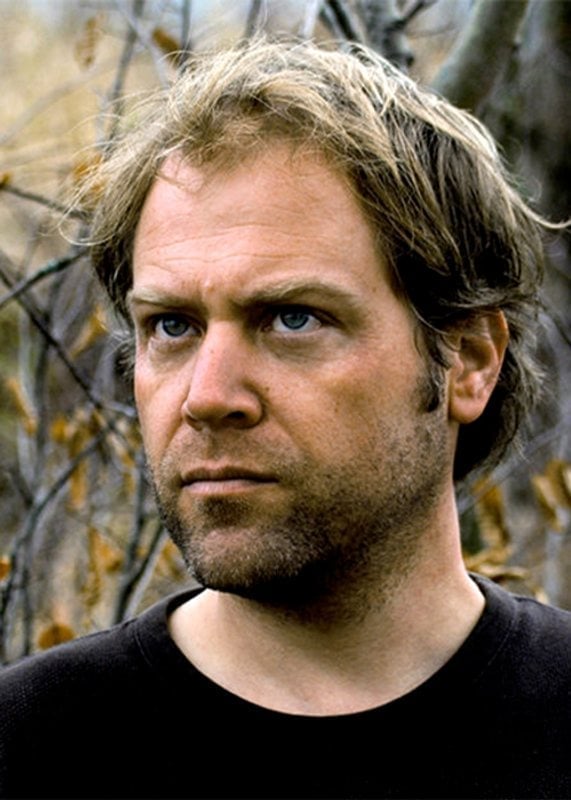
Dan Seagrave is a British painter, born in Worksop, in the English Midlands, in 1970, and raised in the village of Ravenshead near Nottingham — rural enough for the landscape to soak in, close enough to the city for the contrast to register. He is entirely self-taught. No art school, no formal training; he built the technique by doing the work.
The doing started early. At seventeen he painted an album cover for a local thrash band, Lawnmower Deth, who landed an indie deal off the back of it. Unpaid commissions for small labels followed, then paid work as the British extreme-metal scene exploded at the turn of the 1990s. From 1990 — age nineteen — he began spending time in Canada, eventually settling in Toronto, where he worked as a head painter and art director and received Canadian resident status in 2003. He has been based there since.
He still paints. The early covers were gouache; his recent work — including the Sorcery commissions — is acrylic, a medium that holds the fine detail he's known for. He works mostly from instinct rather than reference, and his personal pieces have been known to take up to a year apiece.
Style
The cover that started it was Morbid Angel's Altars of Madness (1989, Earache) — widely cited as the first true death metal album cover, not just art slapped on a sleeve but a fully realised otherworld that matched the music's ambition. It caught the attention of every other label in the scene, and the commissions stacked up fast. What followed is a near-complete survey of the genre's foundational records: Entombed's Left Hand Path (1990), Dismember's Like an Ever Flowing Stream (1991), Suffocation's Effigy of the Forgotten (1991), Gorguts' Considered Dead (1991), Pestilence's Consuming Impulse (1989) and Testimony of the Ancients (1991). For a stretch of roughly five years he was the house painter for an entire subculture.
The style is instantly recognisable: vast, decaying dreamscapes built from organic-architectural fusion — alien cathedrals collapsing into biological rot, biomechanical structures stretching into impossible deep-space perspectives. The eye falls into the painting rather than landing on a subject. There's no gore in the cheap sense; the horror is architectural and atmospheric, a sense of enormous dead systems still grinding on. He spawned countless imitators and, by broad agreement, was never matched at his own register.
Cards on Sorcery
Sorcery has built its roster around established fantasy and metal-album painters rather than the digital illustrators most modern card games use. Frank Frazetta, Gerald Brom, Ian Miller, Rodney Matthews — and Dan Seagrave, who shows up more often than most. His Sorcery work breaks into three groups.
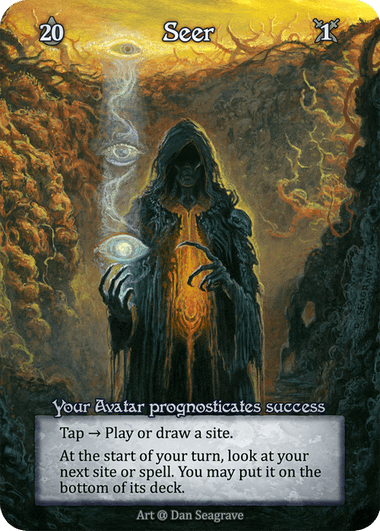
Seer by Dan Seagrave — via Curiosa
Two playable Avatars. Seagrave painted Seer and Duplicator, both colorless no-element Avatars. Seer is a quiet control toolbox — scry one at the start of every turn, sculpting your draws across a long game. Duplicator is a restricted-combo Avatar built around matched pairs of Uniques, beloved by combo pilots and near-unfaceable for everyone else. Both are covered in full in the Avatar guide.
A run of Alpha and Beta cards. This is the part most players miss. Beyond the Avatars, Seagrave painted a sizeable batch of early-set Sites and Magics. Blasted Oak, a portrait Atlas Site that yields spell power, is marked "Legendary" and is one of his most-cited Alpha pieces. The Collector Arthouse index — the deepest of the game's art-house and collector resources — credits him on Black Obelisk, Bottomless Pit, Boneyard, Acid Rain, Cone of Flame, Chains of Prometheus, City of Traitors, Cage of Sidrak, Battlefield, and more — a spread of Alpha and Beta cards deep enough that he's one of the foundational visual contributors to the original game, not just a guest credit.
Four Prophets of Doom precon alt-arts. For the December 2025 Gothic release, Seagrave painted alternate-art versions of all four Prophets of Doom Avatars — Harbinger, Necromancer, Savior, and Persecutor. Each ships inside its own dual-element preconstructed deck, still current product at the stores that carry the game. The element symbol isn't printed on the Avatar card itself; the precon deck supplies the threshold. These alt-arts are exclusive to the precon decks — you can't pull them from boosters — which makes the four-painting set a single coherent collector target. The buying side is covered in the precon comparison.
Across the three groups, Seagrave's footprint runs from the game's first set to its most recent — Alpha through Gothic.
Where to see more Seagrave
- danseagrave.com — the artist's official site, with a curated selection of album covers, personal work, and biography. The source of record for verifying a Seagrave attribution. The site notes its gallery is a selection, not a complete catalogue.
- The album covers themselves — Altars of Madness, Left Hand Path, Effigy of the Forgotten, and the rest are still in print on vinyl and CD and easy to find secondhand. The original sleeves are the cultural artifact.
- Gallery representation — Seagrave's fine-art work has shown through galleries including Beinart Gallery, which carries his available pieces and prints. This is the route for original or limited work rather than reproductions.
- Collector Arthouse — Dan Seagrave — the full Sorcery card index this piece draws on.
Sources
- Dan Seagrave — official site, About page — born Worksop 1970, grew up Ravenshead, first cover for Lawnmower Deth at 17, spending time in Canada from 1990 (age 19), Canadian resident status 2003
- Dan Seagrave — Wikipedia — born 1970; album discography including Morbid Angel Altars of Madness (1989), Suffocation Effigy of the Forgotten (1991), Dismember Like an Ever Flowing Stream (1991), Entombed Left Hand Path, Gorguts Considered Dead, Pestilence Testimony of the Ancients and Spheres
- Albums with cover art by Dan Seagrave — Wikipedia category — full cross-referenced list of cover credits
- Dan Seagrave — Collector Arthouse artist page — "British painter known for his death metal album covers," completely self-taught; Sorcery card index (Seer, Duplicator, Blasted Oak, Black Obelisk, Bottomless Pit, Boneyard, Acid Rain, Cone of Flame, Chains of Prometheus, City of Traitors, Cage of Sidrak, Battlefield, and the four Prophets of Doom alt-arts); "Appears In: Alpha, Beta, Gothic"
- Dan Seagrave — official Sorcery TCG artist page — publisher's artist profile, "British artist renowned for his intricate and highly detailed album covers, particularly within the death metal genre"
- No Echo — Dan Seagrave interview — Altars of Madness as the breakthrough death metal cover, year-long timelines on personal paintings
- Moshville Times — Dan Seagrave interview (Part 2), 2018 — gouache in the late 1980s, acrylic in recent work; works instinctively with minimal reference
- Curiosa.io — Seer and Duplicator — official card data for the two Seagrave Avatars
- Sorcery TCG — Gothic — Prophets of Doom preconstructed decks (Harbinger, Necromancer, Savior, Persecutor), December 5 2025 release