In most trading card games, money multiplies. The strongest card in a format is usually also a card every competitive deck wants as a playset, so whatever it costs, a legal deck pays it four times over. Sorcery: Contested Realm cut that multiplier off at the root: the rarer the card, the fewer copies a deck may run. Four Ordinaries, three Exceptionals, two Elites, one Unique — and in the June 2026 market data, the expensive cards are almost exclusively Uniques. The priciest playable card in the game's three retail sets, Ring of Morrigan at $222.63, can enter your deck exactly once.
That single structural choice is a stronger argument for entering this game cheaply than any starter discount could be. What follows is the case, made with numbers: what each rarity tier actually trades for, what a tournament-legal deck costs under the caps, what the tournament record shows, and — honestly — where money still buys real advantages.
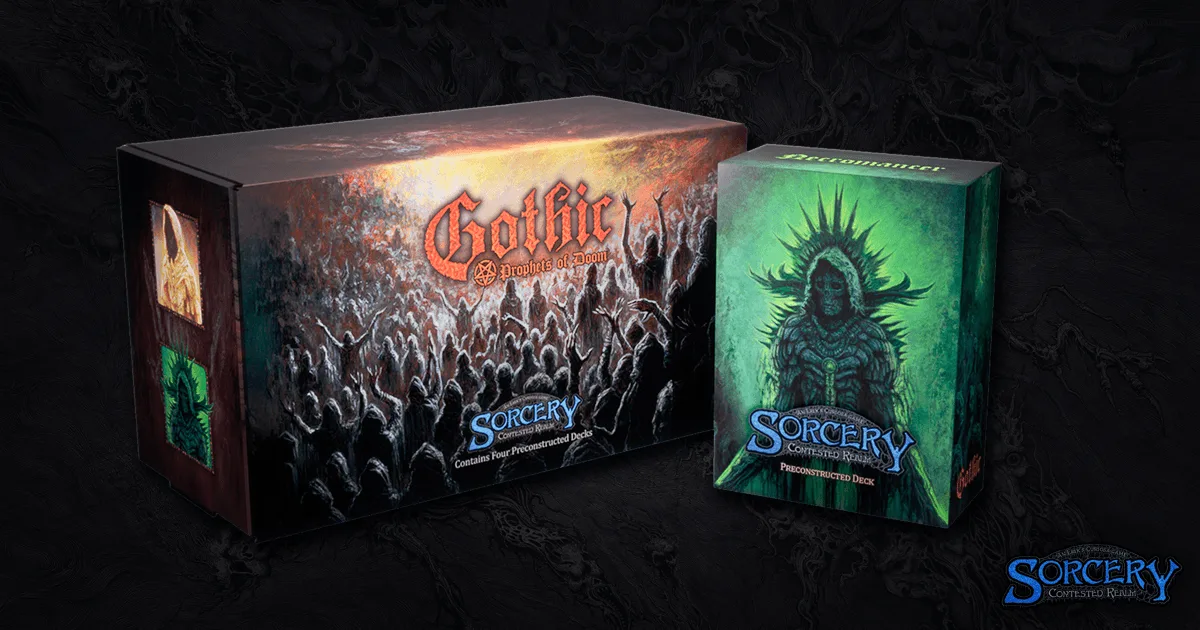
The Prophets of Doom preconstructed decks from Gothic — via sorcerytcg.com
A copy cap is a price cap in disguise
The caps are baked into the publisher's Constructed rules: "Up to 4 copies of each Ordinary card, 3 of each Exceptional, 2 Elite, and 1 copy of each Unique," on top of a 60-card-minimum Spellbook and a 30-card-minimum Atlas. How the four tiers work as a system — pack ratios, what each tier is designed to do, the community Peasant variant — is the territory of the rarity system explainer, including the point this argument builds on: in formats without rarity-scaled copy limits, competitive decks converge on the strongest eight-to-twelve cards and run the maximum copies of each. That convergence is what detonates chase-rare prices in other games — the market prices the card for playset demand, because playset demand is what every tuned list generates.
Sorcery makes that convergence illegal. The tier where the money lives is the tier capped at one copy, so a deck cannot concentrate its slots — or your spending — into the top of the price curve. However much Ring of Morrigan costs, no deck pays it twice. In a four-copy game, the same card would be an $890 commitment before sleeves; here the rule, not your budget, says once.
What the tiers trade for, June 2026
The figures below are TCGplayer market prices from this site's Market Data tracker, June 5, 2026 snapshot, covering the three retail sets — Beta, Arthurian Legends, and Gothic — with promo printings excluded. (Alpha trades on collector logic and gets its own paragraph further down.) Sorcery's market is small enough that the date is half the information — sanity-check against the price guides the directory catalogues before money moves.
| Tier | Copy cap | Median price | Share under $1 | Priciest card |
|---|---|---|---|---|
| Ordinary | 4 | $0.09 | 100% | $0.51 |
| Exceptional | 3 | $0.17 | 96% | $5.32 (Toolbox) |
| Elite | 2 | $0.50 | 81% | $10.77 |
| Unique | 1 | $6.34 | 7% | $222.63 (Ring of Morrigan) |
Three facts in that table do the heavy lifting.
The workhorse tier is functionally free. Every one of the 270 Ordinaries with a listed market price trades under 55 cents. A maxed four-of playset of the median Ordinary costs 36 cents. Four copies of every single Ordinary across all three retail sets — 1,080 cards, the full engine room of the format — comes to about $107. These are the cards that fill more than half of most Spellbooks, and they cost less per playset than a pack of sleeves.
The middle tiers stay in pocket-change territory. The most expensive Exceptional in the retail pool is $5.32, and you'd want at most three. Elites — the tier a Magic player would read as the rare slot — top out at $10.77, with four out of five trading under a dollar.
The money concentrates exactly where the cap is hardest. The fifteen most expensive playable cards across the three retail sets are Uniques, every one of them. Even there the median is $6.34 — half the Unique pool trades under seven dollars — but the $40-plus club is all 1-of cardboard: the Omphalos cycle at $44–67 apiece, Philosopher's Stone at $81.26, Morgana le Fay at $92.55, Archangel Michael at $100.83. The tier you're allowed the least of is the only tier that can hurt you.
Pricing the envelope of a legal deck
Tier prices become a deck price once you add the shape competitive lists actually take — and the rarity explainer describes that shape: a Spellbook anchored on mid-30s Ordinary counts, roughly a dozen Exceptionals, six-to-eight Elite copies, a handful of Uniques. Pricing that structure is a costing exercise, not a shopping list — modeled here as 34 Ordinaries, 12 Exceptionals, 8 Elite copies, and 6 Uniques in a 60-card Spellbook — and it prices out three ways at the June 5 snapshot:
- At median prices per tier: about $47 — and 81 percent of that total is the six Unique slots.
- At 75th-percentile prices (a list leaning toward the in-demand end of each tier): about $117.
- Same structure with all six Uniques at the 90th percentile: about $250.
The Atlas barely moves the math. Sites ride the same rarity ladder, and the ordinary ones trade at the same few-cents level as ordinary spells — Beta's basic rivers sit at fifteen cents each.
The composition matters more than the totals. In the median build, the fifty-plus cards that aren't Uniques cost around nine dollars combined. A Sorcery deck's price is its Uniques — and the Uniques are precisely what the rules forbid you to buy in quantity. Skip them, trim them, or run the cheap half of the Unique pool, and the envelope collapses toward the cost of a board game.
For calibration, the two in-print entry products undercut the envelope entirely: Gothic's Prophets of Doom precons trade at $35.73 against their $66.60 MSRP, and Beta's Four Elementals box — four ready-to-play decks in one product — at $52.83. (Which precon to buy first ranks all eight.) An entire entry product costs less than one copy of Archangel Michael.
What the tournament record shows
Case studies here are evidence that the structure holds at real tables — not lists to copy.
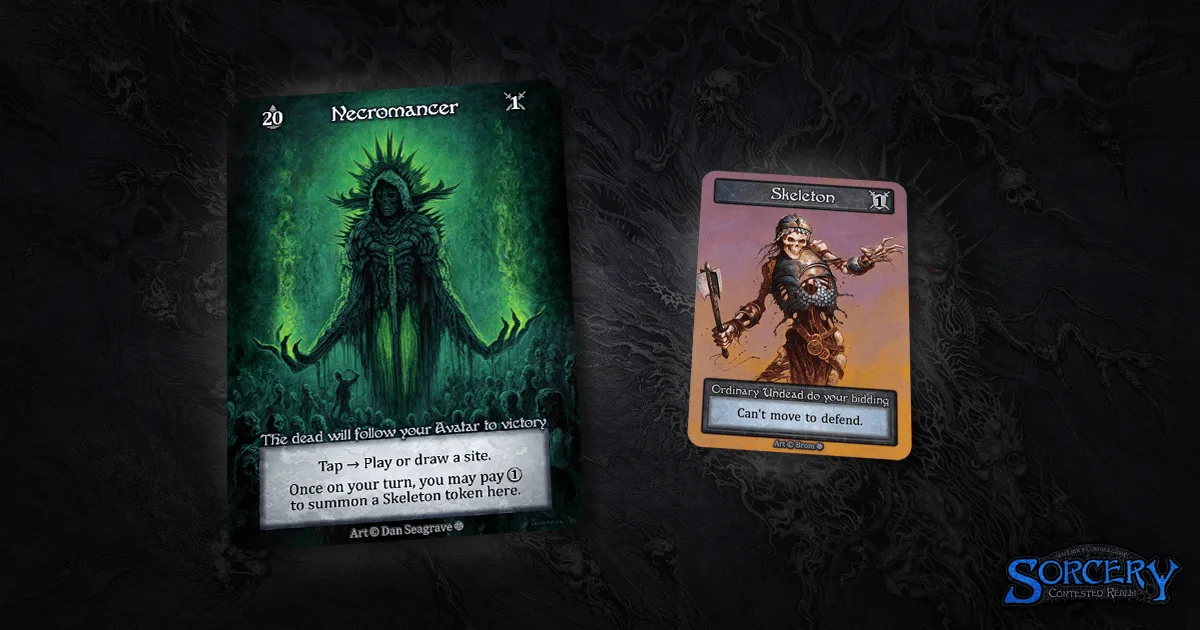
The Necromancer Avatar and its Skeleton token — via sorcerytcg.com
The season-opening Grand Contest at SCG CON Washington, DC — May 29–31, 2026, 75 players, 24 different Avatars — was won by Gideon Miller piloting Necromancer, the Avatar that ships in those $35.73 precons, with a list he named "TerriblePacticePrecon" (spelling his, joke intact). The winning list is a tuned build, not the stock deck, but the name is the tell: the archetype that took the title is the one whose on-ramp costs less than a night out. Necromancer was also the event's most-played Avatar at ten pilots and converted three of the eight Top 8 slots — the same trajectory the 2026 meta survey traces through SorceryCon and SCG CON Atlanta. The Grand Contests explainer has the full event picture.
The older receipt belongs to Geomancer, the Beta Earth precon Avatar. Jarrod Scriven won the 48-player Australia & New Zealand Championship in April 2024 on a mono-Earth Geomancer list, and framed his deckbuilding in the publisher's interview in exactly the terms this argument needs: "I value consistency over more powerful, inconsistent options." Consistency is the budget builder's native resource — four-of Ordinaries are simultaneously the cheapest cards in the game and the ones that make a deck do the same thing every game.
The record cuts both ways, and pretending otherwise would oversell it. At Washington, Geomancer tied for second-most-played at seven pilots and converted zero Top 8 finishes. Cheap access gets archetypes into the room; it doesn't win on schedule.
On the aggro side, the community analysis points the same direction. SorceryRec's February 2026 budget guide names Bladedancer the format's friendliest Avatar for low-budget builds: "You can build a competitive Bladedancer list without any Unique cards and lose to a fully-tuned deck only at the margins." That's analysis, not a trophy — no marquee Bladedancer finish sits on the public record as of this writing — but the reasoning is the rarity argument in miniature: aggressive decks run on cheap, efficient minions, and Sorcery prints its cheap, efficient minions at the two tiers that cost cents.
Where money still wins
The thesis is that the caps bound what money can do — not that money does nothing. Three places it still matters.
Archetype-defining Uniques are real costs. If the deck you fall in love with is anchored on Ring of Morrigan, wants two or three cards from the Omphalos cycle, or leans on Archangel Michael, the Unique suite alone runs $200–400 at the snapshot. The cap kills the multiplier, not the sticker. Decks built around several marquee Uniques carry envelopes well past the $250 mark, and no rarity rule discounts them.
Tuned lists buy their edges. SorceryRec's honest framing is that budget builds concede the power ceiling and the narrow answers — some matchups get harder when the specific high-rarity answer isn't anywhere in your ninety cards. The caps keep a cheap deck in the game; they don't hand it the mirror-breaker.
Collecting is a different game with different prices. Alpha's Death Dealer trades at $418.14; the Beta printing of the same card — identical rules text — is $10.13. The $408 gap buys provenance, not power, and none of it is required to sit down at a tournament. The same split runs through foils and Curio variants. The set-buying ranking prices that lane honestly: Alpha is a collector artifact, and chasing it has nothing to do with competing. Boosters, likewise, remain a lottery — the cheap route into the playable pool is singles, the case the singles-or-sealed piece makes in full.
None of those qualifications touch the core claim. In most card games, the answer to "can I compete without spending much?" is "define compete." In Sorcery, the structure gives a real answer: the tiers that fill nine-tenths of your deck trade for cents, the expensive tier is capped at one copy per card, and the products that teach the game cost less than a single chase Unique.
The buy-in path this implies
If the argument lands, the sequence writes itself. Start with an in-print precon — $36 at market from the stores the directory tracks. Expand toward the tournament minimums with low-tier singles, which is where the copy caps quietly subsidize you: the Prophets of Doom decks ship with a 36-card Spellbook and 16-card Atlas, and the gap to 60-and-30 is mostly Ordinary and Exceptional cardboard at cents apiece. Test the upgrades on the free deckbuilders — Curiosa hosts the published tournament lists, so you can see precisely which Uniques an archetype actually leans on before any of them costs you money — and buy those last, at price-guide-checked numbers, once you know the deck is yours. If you're a step earlier in the funnel — still deciding whether to play at all — the worth-it piece is the gut check.
The caps won't win you games, and they won't make a $35 deck beat a $400 one on card quality alone. What they do is keep the floor and the ceiling within shouting distance of each other — close enough that piloting, sequencing, and matchup knowledge decide more games than the receipt does. The rules, not your budget, cap how much power a deck can stack. The rest is skill.
Sources
- Sorcery TCG — Constructed format — official copy limits (4 Ordinary / 3 Exceptional / 2 Elite / 1 Unique) and the 60-card Spellbook / 30-card Atlas minimums — accessed 2026-06-06
- Sorcery market data — TCGplayer market prices via tcgcsv.com; all price figures, medians, percentiles, and sealed-product values from the 2026-06-05 snapshot
- Where Tables Connected: SCG CON Washington DC Recap — published 2026-06-01 — 75-player field, 24 Avatars, Gideon Miller's winning Necromancer and its decklist name, per-Avatar pilot counts
- Play Sorcery's Geomancer like an Australian/New Zealand Champion — published 2024-05-24 — 48-player ANZ Championship result and Jarrod Scriven's consistency quote
- Prophets of Doom: Meet the Necromancer — published 2025-10-01 — precon composition (36-card Spellbook, 16-card Atlas), product imagery
- Sorcery TCG — Gothic set page — Prophets of Doom product description — accessed 2026-06-06
- SorceryRec — Budget Deck Building: Getting Competitive Without Breaking the Bank — published 2026-02-20 — community analysis of budget-friendly Avatars; quoted Bladedancer assessment
- Which Sorcery Precon Should You Buy First? — internal reference for the $66.60 Prophets of Doom MSRP