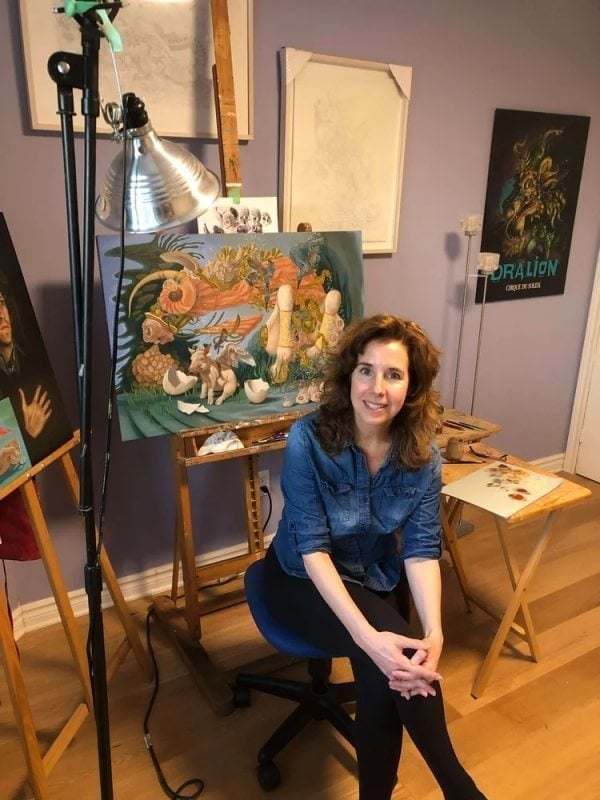
Heidi Taillefer is a Canadian contemporary surrealist painter, born in Montreal in 1970. As a child she took weekly art classes at the La Palette art school in Beaconsfield, Quebec — watercolour, mixed media, the standard suburban-Quebec creative upbringing — and pursued Humanistic studies at McGill University, where she studied the classics. The mythological vocabulary that runs through her later work was laid down then.
She frames herself as "self-taught despite the childhood art classes" — the classes gave her the technique, but the visual language is hers, built from her mother's art books and from the early-20th-century surrealists she names as influences: Max Ernst, Giorgio de Chirico, and especially Paul Delvaux. By the mid-1990s she was earning a living as a commercial illustrator. The career inflected in 1999 with the marketing poster for Dralion, Cirque du Soleil's then-new touring production. From there she worked extensively with the company and co-founder Guy Laliberté on additional projects, and a long client list built up around the commercial side: Infiniti (two art cars for the luxury automaker, 2009–2010), the NFL, Forbes, Coheed and Cambria.
In 2004 she gave up the commercial work entirely and went full-time on fine art. She has exhibited internationally since — her first museum show was at the McAllen International Museum in 1997, and the gallery and museum work has continued across Europe and North America. Honors include Best in Show at Surreal Salon in 2018 (juried by Ron English) and the 2020 Traditional Art Award at the international Beautiful Bizarre contest, with recurring features in Juxtapoz, Hi-Fructose, and Beautiful Bizarre. She still paints out of Montreal; the body of work the Sorcery commissions sit inside is a serious fine-art career, not a TCG side gig.
Style
The shorthand for the Taillefer look is "mechanical-organic." It's accurate as far as it goes, but the more honest description is surrealist symbolism rendered with classical figurative discipline — and the mechanical-organic motif is the language she uses inside that frame, not the frame itself. The technical line she draws between herself and most contemporary digital illustrators: oils, on canvas, worked with glazing techniques, in the tradition of the Northern Renaissance and the early-20th-century Surrealists who came before Dalí.
Her artist's thesis, in her own words: the work "reflects the ubiquity of technology in society and our increasing merger with it." She paints "subjects comprised of seemingly incongruous objects characterized as symbolic" — figures with mechanism showing through skin, automatons that breathe, organic forms wrapped in gear and tube. "I am a nature lover at heart, with an obsession for mechanisms and automatons of all kinds. My work grew out of a combined fascination with biology and science fiction."
That sensibility has one consequence for the Sorcery work worth flagging: she is careful, on the medieval-fantasy commissions, not to lean too hard on the mechanism. On her Sir Tristan piece for Arthurian Legends, she explained the balance: "I didn't want to create a robot, because that would come across as terminator-esque." The Sorcery cards keep the surrealism and the classical figure work; the explicit machinery dials back to fit the period.
Cards on Sorcery
Erik's Curiosa announced Taillefer in July 2022 via the official Discord, two-plus years before her work shipped on a retail card. The interim was the lead time the medium demands. Oil paintings worked with glazing don't ship on a six-week turnaround, and Taillefer has said the Sorcery commissions felt "uncharacteristically free" — closer in spirit to a fine art project than to a commercial illustration job. Per Collector Arthouse — the hub of the game's art-house and collector scene — she has appeared so far in Arthurian Legends and Gothic, with fifteen credited cards.
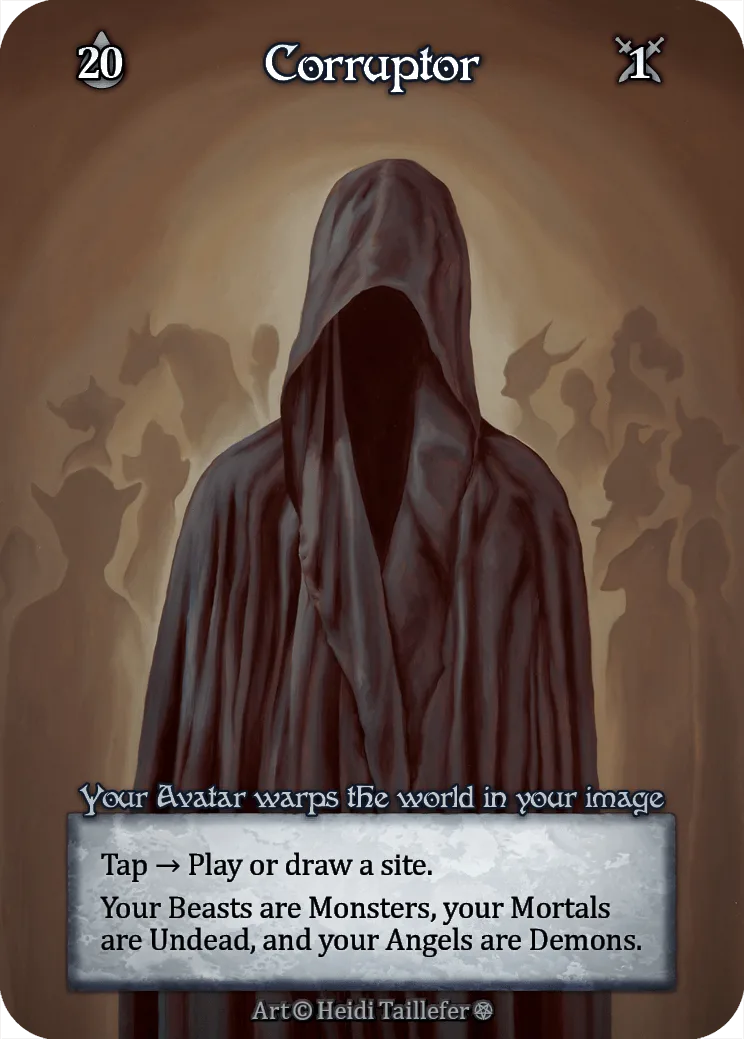
Corruptor by Heidi Taillefer — via Curiosa
Arthurian Legends — the medieval commissions. Her first four cards for the game shipped with Arthurian Legends in October 2024. She described the work as a return to a childhood obsession — she'd watched The Legend of King Arthur on her father's VCR repeatedly as a kid, fixating on medieval winged dragons. On the Sir Tristan piece she made the deliberate choice to depict him as a musician rather than a warrior, working a vielle into his hands instead of a sword. "Depicting Sir Tristan as a musician moves away from the more clichéd associations with him as a warrior." She used her own family members as models for the Arthurian work. The Arthurian credits include Guardian Angel, Grain Sparrow, Redbreast Robin, Ominous Owl, and Ribble Boggart — a bird-and-creature cluster that reads as natural ground for a painter whose career obsession is the boundary between organism and the not-quite-living.
Gothic — surrealism in its native register. The Gothic expansion in December 2025 brought the larger run. Where the Arthurian commissions asked her to soften the mechanism, the Gothic set's dread-and-decay register sits closer to her natural Surrealist vocabulary, and the credits accumulated accordingly: Corruptor, Sea Witch, Monstrous Lion, Jack the Ripper, Nadir Seed, Peace Offering, Return to Nature, Begone!, Accusation, Lure. Corruptor is one of the playable Gothic Avatars — a no-element colorless Avatar built around hijacking your opponent's monsters, the kind of card whose flavor ("reframes the world's monsters; then plays them") sits unusually well with a painter whose own work reframes the bodies it depicts. Full mechanical read in the Avatar guide.
That her name turns up on a playable Avatar in only her second set is a quick measure of how Erik's Curiosa scales an artist into the roster once the first commissions land.
Where to see more Taillefer
- heiditaillefer.com — the artist's official site. Galleries of fine-art paintings (including the Dralion poster, the Infiniti art cars, and the deep fine-art body of work), the artist's own statement, and gallery and exhibition listings.
- Gallery representation — Taillefer has shown internationally through galleries including Modern Eden in San Francisco and Galerie JANO. Her fine-art work, including originals and limited prints, moves through those channels rather than through the TCG secondary market.
- The publications — Juxtapoz, Hi-Fructose, and Beautiful Bizarre magazines have all run features and interviews with her over the past decade; the Beautiful Bizarre 2020 Traditional Art Award and the 2018 Surreal Salon coverage are the easiest entry points.
- Collector Arthouse — Heidi Taillefer — the per-artist gallery that catalogues the fifteen-card Sorcery footprint and links the 2022 Mike Servati interview where most of the biographical detail in this piece originates.
Sources
- Heidi Taillefer — Collector Arthouse artist page — the canonical fifteen-card credit list (Accusation, Begone!, Corruptor, Grain Sparrow, Guardian Angel, Jack the Ripper, Lure, Monstrous Lion, Nadir Seed, Ominous Owl, Peace Offering, Redbreast Robin, Return to Nature, Ribble Boggart, Sea Witch), "Appears In: Arthurian Legends, Gothic"
- Sorcery Artist Interview: Heidi Taillefer — Collector Arthouse — July 21, 2022 Discord announcement, interview by Mike Servati; primary source for "I never actually thought I would become an artist," the Yukon-at-21 pivot, the Paul Delvaux / Max Ernst / Giorgio de Chirico influence list, the "uncharacteristically free" framing of the Sorcery work, and the family-models-for-Arthurian detail
- Heidi Taillefer — Sorcery TCG official artist page — Montreal Quebec base, mid-1990s commercial-illustrator start, 1999 Cirque du Soleil Dralion poster, Infiniti art cars 2009–2010, McAllen International Museum 1997 first museum exhibition, 2018 Surreal Salon Best in Show juried by Ron English, 2020 Traditional Art Award at the international Beautiful Bizarre contest
- Welcome Heidi Taillefer! — Sorcery TCG news, 16 August 2024 — pre-Arthurian-Legends launch announcement, source for the Sir Tristan as musician brief and the "I didn't want to create a robot" quote
- Heidi Taillefer — About the Artist (official site) — Montreal 1970 birth, La Palette art school in Beaconsfield Quebec, full-time fine art from 2004, the "language of mechanism" artist's statement
- Heidi Taillefer — Wooarts profile — McGill Humanistic studies and Guy Laliberté collaboration via Cirque du Soleil
- Curiosa.io — Corruptor — official card data for the playable Gothic Avatar
- Sorcery: Contested Realm — Wikipedia — Arthurian Legends (October 2024) and Gothic (December 2025) release dates