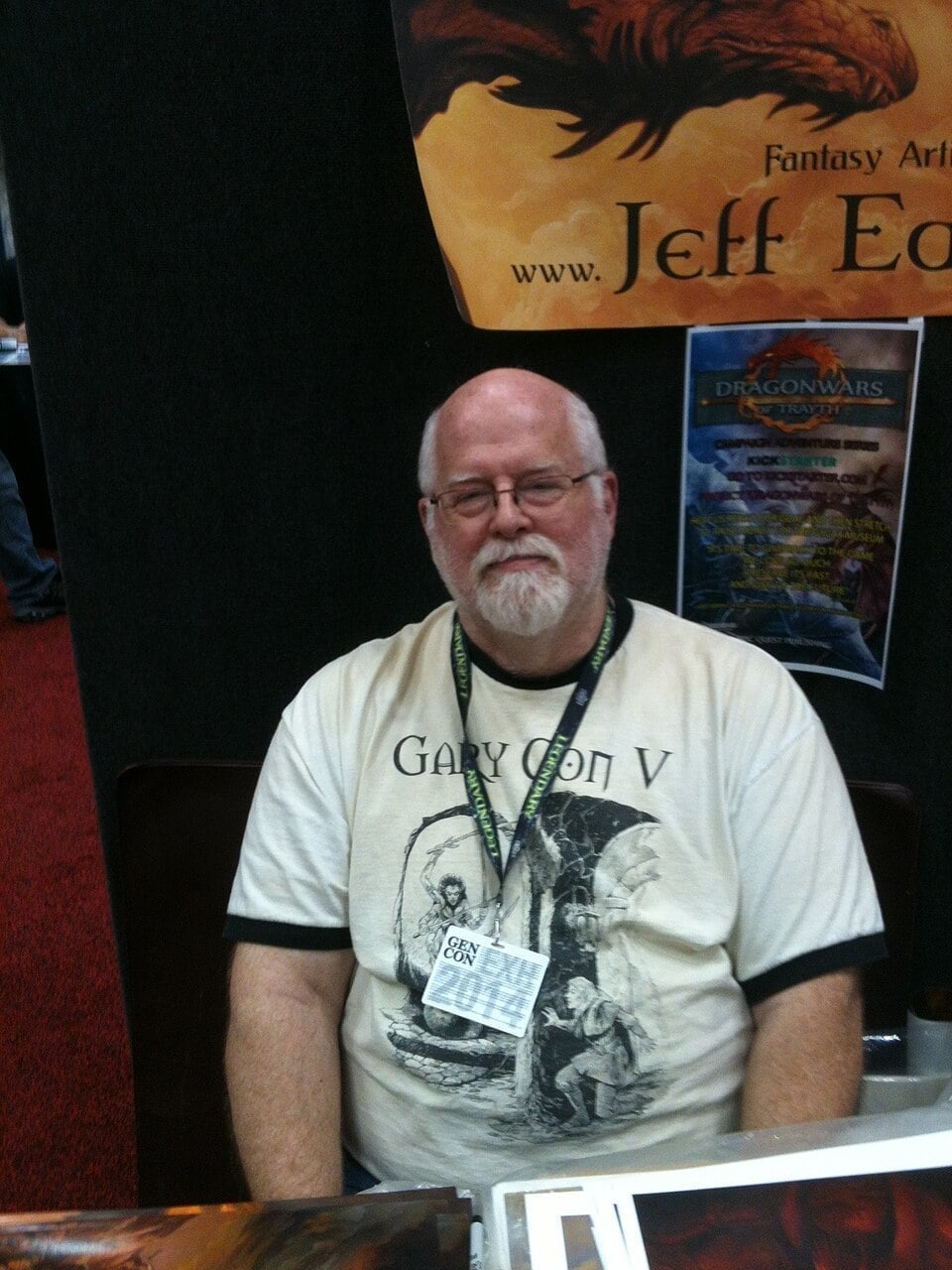
Jeff Easley is an American fantasy painter, born in 1954 in Nicholasville, Kentucky. He earned a BFA in painting from Murray State University in 1977. By his own account the formative influence was Frank Frazetta — which puts him one generation downstream of the painter whose Death Dealer Curio anchors the other end of Sorcery's marquee-artist roster.
He freelanced early, including work touching Marvel Comics and Warren Publishing, before joining TSR's art staff in March 1982. His first TSR job was painting the gemstones on the spines of the first four Endless Quest books. He worked up fast. His red dragon became the face of the AD&D Monster Manual from 1983 to 1989 — which means it sat on the shelf of nearly every game store and bedroom that touched the hobby in that decade. He was one of the four staff painters — with Larry Elmore, Clyde Caldwell, and Keith Parkinson — whose oils are the visual memory of TSR-era D&D. He painted the 2nd-edition Player's Handbook, the Dungeon Master's Guide, the Monstrous Manual, Dragonlance and Forgotten Realms covers, and a wall of modules and boxed sets. He stayed through TSR's absorption into Wizards of the Coast and left in 2003 — roughly twenty years on staff. He went back to freelance after that, and still sells prints and takes commissions today.
Style
The "big four" TSR painters didn't share a signature, but they shared a discipline, and Easley sits at the painterly end of it. His work is oil on board, built around a single dramatic creature or figure, lit theatrically — usually one hard light source with deep shadow behind. Backgrounds are atmospheric rather than fussy; the eye lands on the monster first and the world second. Compared to Elmore's cleaner, more illustrative finish or Caldwell's high-gloss pin-up polish, Easley's surfaces are darker and rougher, the brushwork left visible. His dragons in particular have a heaviness — real weight and menace — that reads even at the size of a paperback spine.
That look is what TSR sold. Through the 1980s the cover painting was the marketing: a kid in a game store didn't read the rules first, they saw the dragon. The four painters between them defined what fantasy was supposed to look like for a generation, and that visual vocabulary — muscled heroes, baroque monsters, oil-paint atmosphere — is the same one Sorcery deliberately reaches back to. The publisher's whole production constraint is hand-painted physical media, no digital, no AI.
A note on his Magic: The Gathering credits, since they come up. Easley did illustrate Magic cards — roughly forty-nine of them — but in the late era, from Mercadian Masques (1999) through Eventide (2008), not the original 1993 Garfield-era sets. His through-line to Sorcery runs through D&D, not through early Magic.
Cards on Sorcery
Unlike the Frazetta footprint, this isn't a posthumous license of an old painting. Easley is alive, working, and commissioned — twelve cards per Collector Arthouse (the cornerstone of the game's art-house and collector scene), new paintings made for the game, not catalogue reuse:
Adept Illusionist · Awakened Mummies · Colicky Dragonettes · East-West Dragon · Firebolts · Heat Ray · Mazuj Ifrit · Roaming Monster · Sneak Thief · Spectral Stalker · Telekinesis · Waypoint Portal
These are normal playable cards with Easley paintings on them — the dragon-and-monster end of his range fits Sorcery's bestiary cleanly. His own store dates Spectral Stalker's commission to "Erik's Curiosa, 2021," which means he was painting for the game two years before Alpha shipped.
On top of that base work sit two Beta Curio variants — the collector-grade printings the Beta Curio catalogue documents in full.
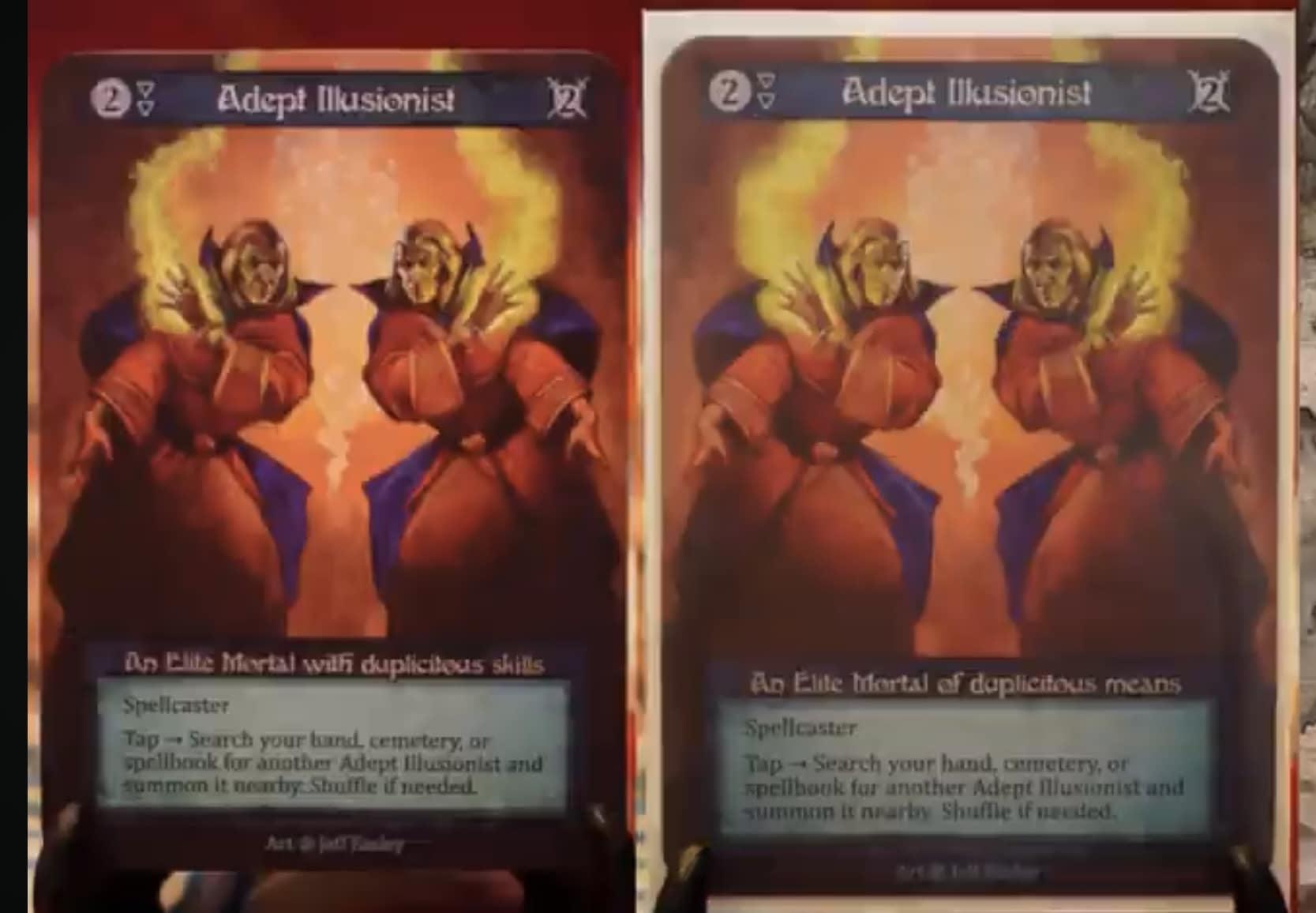
Adept Illusionist (mirrored Curio variant) by Jeff Easley — via Collector Arthouse
Adept Illusionist (Beta Curio). The Curio variant of Easley's Adept Illusionist is the art horizontally mirrored, plus a deliberate typo in the text box — "Duplicious means" instead of "Duplicitous means." Both tells are subtle enough that the card has been mistaken for a standard print in trades; authentication usually rests on the mirror reversal first, the typo second. A fitting variant for a card literally named Illusionist — the trick is in seeing which way round the image runs.
Critical Strike (Beta Curio). Easley's marquee Beta Curio. It's a Beta-symbol card carrying the Alpha-set artwork — originally an Alpha box-topper image — printed in foil. Per its Collector Arthouse page, the giveaway is that the foil treatment doesn't cover a full-bleed art image the way a "regular" foil would, which is the obvious tell that you're holding a Curio rather than a standard foil. It's the companion piece to the Sirian Templar foil hybrid (Gadu Duaso's art), built the same way, different card.
Where to see more Easley
- jeffeasleyart.com — his official site and store. High-resolution prints pulled from originals held by collectors, limited lithographs, commission inquiries, and the Sorcery card pages (he sells prints of the Sorcery commissions there too). The source of record for his attributions.
- The TSR rulebooks themselves — the 1st- and 2nd-edition AD&D core books, Dragonlance Adventures, the Forgotten Realms line. Used copies are cheap and abundant on AbeBooks and in any shop with an RPG shelf, and the covers are the cultural artifact in their original context.
- The Dragon Magazine and Dragonlance art collections — anthology books like The Art of Dragon Magazine and the Dragonlance art volumes gather the TSR painters side by side, which is the easiest way to see Easley against Elmore, Caldwell, and Parkinson.
Sources
- Jeff Easley — Wikipedia — born 1954 Nicholasville KY, BFA Murray State 1977, TSR start March 1982, "Red Dragon" on the AD&D Monster Manual cover 1983–1989, 2nd-edition core books, ~49 Magic cards from Mercadian Masques through Eventide, left WotC 2003
- Jeff Easley — official site and store — self-described Frazetta influence, current print/lithograph/commission activity, Sorcery card pages
- Spectral Stalker — Jeff Easley store page — "painted for use in Sorcery: Contested Realm … Image copyright Erik's Curiosa, 2021"
- Jeff Easley — Collector Arthouse artist page — twelve Sorcery cards across Alpha/Beta/Gothic; bio noting Marvel Comics freelance, TSR 1982, departure 2003, return with Sorcery's Alpha set
- Jeff Easley — Sorcery TCG official artist page — publisher bio (Warren Publishing and Marvel Comics freelance, TSR 1982, AD&D work, left WotC 2003)
- Adept Illusionist Beta Curio — Collector Arthouse — mirrored art + "Duplicious"/"Duplicitous" typo, Easley attribution
- Critical Strike Beta Curio — Collector Arthouse — Easley attribution, Alpha box-topper artwork, foil with non-full-bleed art as the Curio tell